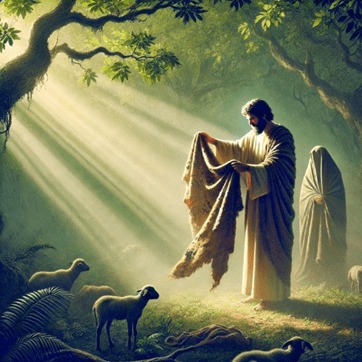
Genesis 3: 21Also for Adam and his wife the Lord God made tunics of skin, and clothed them.
Adam and Eve have sinned, eating forbidden fruit that gives them the knowledge of good and evil. Before this, there was only good; however, now after making this first disobedient choice, they can choose to continue to disobey, doing evil. Now that God is evicting Adam and Eve from Eden, they need protective clothing and God makes tunics of skin, presumably animal skin, indicating that some animals have had to die. Even if God simply has caused the animals to fall asleep and cease breathing, these deaths are still a form of sacrifice.
Genesis 4:1-2 Adam slept with Eve his wife. She conceived and had Cain. She said, “I’ve gotten a man, with God’s help!” Then she had another baby, Abel. Abel was a herdsman and Cain a farmer.
3-5 Time passed. Cain brought an offering to God from the produce of his farm. Abel also brought an offering, but from the firstborn animals of his herd, choice cuts of meat. God liked Abel and his offering, but Cain and his offering didn’t get his approval. Cain lost his temper and went into a sulk.
6-7 God spoke to Cain: “Why this tantrum? Why the sulking? If you do well, won’t you be accepted? And if you don’t do well, sin is lying in wait for you, ready to pounce; it’s out to get you, you’ve got to master it.”
I’ve always wondered what was wrong with Cain’s offering. Perhaps God has made it clear that He wants a blood offering; however, even though Cain could go to Abel and bargain for a perfect lamb, he chooses to haul in produce from his farm. Perhaps God would have been pleased had Cain brought in the best new produce he had; however, Cain might have collected whatever was left over after the harvest and offered that to God instead. God doesn’t want leftovers; He wants first fruits. Giving God the best of the first fruits of the harvest is an act of faith, indicating trust that God will give more. Withholding first fruits from God or giving Him rubbish demonstrates complete disregard for God, His righteousness, His holiness, and His majesty.
Perhaps Cain has gotten the idea that as the eldest, he is special and should not be forced to behave properly. Obviously, Cain is angry with God and is pouting. God tells Cain, “If you do well, won’t you be accepted? And if you don’t do well, sin is lying in wait for you, ready to pounce; it’s out to get you, you’ve got to master it.” These statements sound as if God has already instructed Cain on the ways Cain can please God. But Cain doesn’t WANT to do well! Cain thinks he’s fine and God should accept him just as he is. Cain’s first sin is assuming that he is fine and doesn’t need to repent of anything. Cain’s second sin is refusing to give God his best, and his third sin is refusing to accept correction, reproof, and God’s warning. At this point, Cain still has the opportunity to repent, but Cain is busy being offended and is nursing self-pity.
Millenia later, Oswald Chambers, a noted Christian writer, will state that “Self-pity is of the devil.” Here God is trying to warn Cain; however, Cain has his fingers stuffed in his ears and refuses to listen.
8 Cain had words with his brother. They were out in the field; Cain came at Abel his brother and killed him.
9 God said to Cain, “Where is Abel your brother?”
He said, “How should I know? Am I his babysitter?”

10-12 God said, “What have you done! The voice of your brother’s blood is calling to me from the ground. From now on you’ll get nothing but curses from this ground; you’ll be driven from this ground the hat has opened its arms to receive the blood of your murdered brother. You’ll farm this ground, but it will no longer give you its best. You’ll be a homeless wanderer on Earth.”
Blood means life. Sacrificing an animal indicates that a person realizes he/she should be giving his/her life to whatever god is being worshiped, but asking that god to accept the life of the animal instead. The shedding of innocent blood brings curses on a land; by murdering Abel, Cain has brought curses on any land he farms and on himself.
The saddest part of the Cain and Abel story is this: Not once does Cain ever express any remorse for having murdered Abel. Cain tries to cover up his horrible deed and never confesses. God is the One who confronts Cain. Cain never begs God’s forgiveness, nor does he ask what kind of sacrifice he might do to pay for murdering his brother. All Cain is concerned about is his own skin. There is also no indication that Cain confesses to his parents. Cain simply huffs off, leaving his parents-and God-grieving.
These are the first Biblical recordings regarding blood sacrifices. The pagan world contains myriads of different sacrifices, depending on the deity being worshiped. But look at the difference in the heart attitude between the two brothers: Abel is humble and offers the best lamb he can while Cain appears to think God is lucky Cain has made any offering at all. Centuries later, God will rebuke the Israelites for a similar attitude: “When you offer blind animals for sacrifice, is that not wrong? When you sacrifice lame or diseased animals, is that not wrong? Try offering them to your governor! Would he be pleased with you? Would he accept you?” says the LORD Almighty.” (Malachi 1:8)
Offerings of any kind without repentance are worthless. In Jesus’ day, the Pharisees would make an enormous production of contributing to the temple, even going so far as to have trumpeters preceding them so everybody would know what they were doing. But was there any sign of repentance? Jesus told a story of a Pharisee and a tax collector both going to the temple. The Pharisee stood in the middle of the temple, reciting his virtues to himself and then leaving. The tax collector stood in a corner, beating his chest and begging, “God, be merciful to me, a sinner!” The tax collector repented while the Pharisee did not. It was the tax collector who left justified before God rather than the Pharisee.
What good are offerings that don’t cost us anything? Jesus commended one humble widow for putting in two small coins, for she was giving everything she had while the Pharisees were giving out of their abundance and would have plenty left over.
Today, we don’t have to make blood sacrifices anymore because Jesus Christ has shed His blood for our sins on the cross at Calvary. But God’s warning to Cain remains for us today: “If you do well, won’t you be accepted? And if you don’t do well, sin is lying in wait for you, ready to pounce; it’s out to get you, you’ve got to master it.” How can we “do well?” We do well when we acknowledge that we are sinners and that nothing we do is good enough to make up for our sins. We do well when we confess our sins to God and repent of them, accepting the blood sacrifice Jesus has already made for us.
PRAYER: Father God, thank You for loving us and caring for us. Lord, we confess that we are sinners and that we cannot free ourselves from our sins. But You have loved us so much that You have sent Jesus to live as a sinless man and to die for our sins. We accept Jesus’ sacrifice on our behalf. Lord, help us to live completely and totally for You for the rest of our lives, knowing that one day You will take us to heaven to be with You. In the mighty and precious Name of King Jesus. Amen.
 Burunche's Blog
Leave a comment