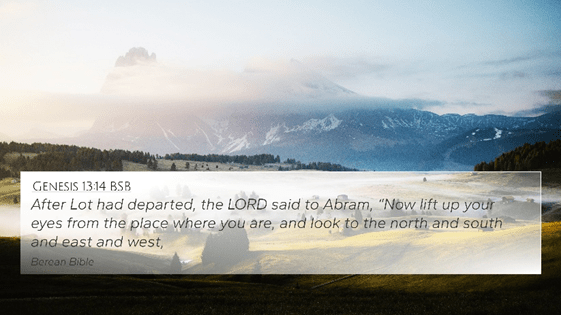
Genesis 13:14-17 “After Lot separated from him, God said to Abram, “Open your eyes, look around. Look north, south, east, and west. Everything you see, the whole land spread out before you, I will give to you and your children forever. I’ll make your descendants like dust—counting your descendants will be as impossible as counting the dust of the Earth. So—on your feet, get moving! Walk through the country, its length and breadth; I’m giving it all to you.”
18 Abram moved his tent. He went and settled by the Oaks of Mamre in Hebron. There he built an altar to God.”
Abraham and Lot have run into a problem; each of them has so much livestock that overgrazing and conflict among their workers has become rampant. As the elder, Abraham has the right to choose the best land for himself; however, to avoid conflict, Abraham allows Lot first choice. Looking eastward at the Jordan River valley, Lot naturally chooses that land for himself. Genesis 13:10-11 tells us, “Lot looked. He saw the whole plain of the Jordan spread out, well-watered (this was before God destroyed Sodom and Gomorrah), like God’s garden, like Egypt, and stretching all the way to Zoar. Lot took the whole plain of the Jordan. Lot set out to the east.”
Sadly, Lot fails to consider the wicked nature of the land’s inhabitants, particularly the citizens of Sodom and Gomorrah. The Dead Sea exists at this time, and nobody knows the ancient sites of Sodom and Gomorrah, although some experts believe they are thought to be located on the east side of the Dead Sea in Jordan. The Dead Sea is part of the Rift Valley and is an area where tectonic plates come together. There might be thermal activity below the earth’s surface in this area, but of course, Lot doesn’t know any of this. At any rate, in the beginning, Lot isn’t worried; he lives in tents and has no intention of moving into town…or does he?
There’s a sharp contrast between Lot and Abraham. Lot is more worried about grabbing everything he can than honoring his uncle. Lot’s choice demonstrates his poor spiritual and emotional condition, for in this culture, age demands respect. By Lot’s selfish choice, he has cursed himself and his family. And there is never any mention of Lot worshiping God in any fashion whatsoever. Having allowed Lot to choose the best grazing for himself, Abraham spends time with God, and God encourages him that God will give Abraham and his children the land forever and that Abraham’s descendants will be too numerous to even count.
What is Abraham’s response to all this? Abraham moves to the Oaks of Mamre near Hebron and immediately builds an altar. Although blood sacrifices are not mentioned specifically, Abraham would not build an altar unless he was planning to sacrifice animals to God. God’s promises prompt Abraham to move away from his nephew Lot and to worship by offering burnt offerings of animals.
Abraham is offering animals because that’s all he can do at this point. But in the fullness of time, God will send Jesus as the perfect Sacrifice, making animal sacrifices unnecessary. Hebrews 10:1-10 tells us “For the law is only a shadow of the good things to come, not the realities themselves. It can never, by the same sacrifices offered year after year, make perfect those who draw near to worship. If it could, would not the offerings have ceased? For the worshipers would have been cleansed once for all, and would no longer have felt the guilt of their sins.
Instead, those sacrifices are an annual reminder of sins, because it is impossible for the blood of bulls and goats to take away sins. Therefore, when Christ came into the world, He said: “Sacrifice and offering You did not desire, but a body You prepared for Me. In burnt offerings and sin offerings You took no delight. Then I said, ‘Here I am, it is written about Me in the scroll: I have come to do Your will, O God.’”
In the passage above He says, “Sacrifices and offerings, burnt offerings and sin offerings You did not desire, nor did You delight in them” (although they are offered according to the law). Then He adds, “Here I am, I have come to do Your will.” He takes away the first to establish the second. And by that will, we have been sanctified through the sacrifice of the body of Jesus Christ once for all.”
Although we don’t need to build stone altars anymore, we do need to create points in our lives where we stop to worship God and where we are willing to sacrifice, whether it be our ambitions or our cherished prejudices-whatever God is demanding we give up to Him. Currently, I am making a living sacrifice of an ankle injury. While riding my bicycle, I ran into a log on a public pathway, spraining my left ankle and cracking a small bone in the lower leg. But had I not gotten injured, careless motorcycle riders would have run into the log, possibly killing themselves. I thank God that my incidental injury that will heal within a few weeks has kept others from disaster.
Today, we need to ask ourselves if there are other living sacrifices God wants us to make. We don’t make sacrifices to earn our way into heaven; we sacrifice to glorify God and to demonstrate our gratitude to Him. May God help us, so that we will continue glorify Him with everything we do!
PRAYER: Father God, thank You for loving us and caring for us. Lord, we give You permission to help Yourself to every part of our lives. In the mighty and precious Name of King Jesus. Amen.
 Burunche's Blog
Leave a comment