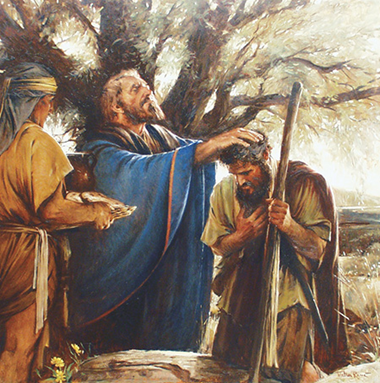
Genesis 14: 17-20 After Abram returned from defeating Kedorlaomer and his allied kings, the king of Sodom came out to greet him in the Valley of Shaveh, the King’s Valley. Melchizedek, king of Salem, brought out bread and wine—he was priest of The High God—and blessed him:
Blessed be Abram by The High God, Creator of Heaven and Earth. And blessed be The High God, who handed your enemies over to you.
Abram gave him a tenth of all the recovered plunder.
21 The king of Sodom said to Abram, “Give me back the people but keep all the plunder for yourself.”
22-24 But Abram told the king of Sodom, “I swear to God, The High God, Creator of Heaven and Earth, this solemn oath, that I’ll take nothing from you, not so much as a thread or a shoestring. I’m not going to have you go around saying, ‘I made Abram rich.’ Nothing for me other than what the young men ate and the share of the men who went with me, Aner, Eshcol, and Mamre; they’re to get their share of the plunder.”
Abraham has separated from Lot and is living near Hebron with his Amorite friends Aner, Eshcol, and Mamre. Meanwhile, the kings of Sodom and Gomorrah rebel against more powerful kings who have been dominating them. This rebellion proves disastrous, for the powerful forces capture Sodom and Gomorrah, along with all their inhabitants, including Lot and his family. When Abraham gets word, he and his three friends organize and attack the raiders, chasing them north beyond Dan and above Damascus, and recovering all the people and goods they have stolen. As Abraham is returning, he is met by two kings of totally different character. The king of Sodom offers to let Abraham keep all the plunder and just return the people to him. But there is another and far more righteous king who also meets Abraham-Melchizedek. Nobody knows where Melchizedek has come from; all we know is that he is king of Salem, king of peace, that he is a priest of the Most High God, and that he brings out bread and wine and blesses Abraham, praising God for Abraham’s victories.
Where is Salem? Although many scholars have argued that Jerusalem is Salem by an older term, others have identified a city called Salim in northern Israel. If Abraham and his friends chased the raiders north beyond Dan, the location of Salim would be quite logical.
The raiders Abraham has defeated have attacked several places so evidently there is a huge amount of plunder. Abraham responds to Melchizedek’s ministry by giving him a tenth of the plunder recovered from the raiders as an act of worship to God. When the king of Sodom tempts Abraham to keep all the plunder, Abraham refuses, vowing, “I swear to God, The High God, Creator of Heaven and Earth, this solemn oath, that I’ll take nothing from you, not so much as a thread or a shoestring. I’m not going to have you go around saying, ‘I made Abram rich.’ Nothing for me other than what the young men ate and the share of the men who went with me, Aner, Eshcol, and Mamre; they’re to get their share of the plunder.”
Abraham is already rich, and might become far richer were he to act on the suggestion of the king of Sodom. But Abraham wants nothing to do with the king of Sodom; in fact, had Lot and his family not been captured, Abraham would probably have remained in Hebron. Obviously, Abraham knows the true nature of the king of Sodom; on the other hand, Melchizedek is righteous and just and Abraham recognizes a fellow believer. When Abraham gives one tenth of the plunder to Melchizedek, he is worshiping God by this action. True worship costs.
Melchizedek is a mysterious figure who appears suddenly and then is never mentioned again until he is referred to in Psalm 110 and in Hebrews 5.
Speaking of the Messiah, Psalm 110:4-7 tells us, “God gave his word and he won’t take it back: you’re the permanent priest, the Melchizedek priest. The Lord stands true at your side, crushing kings in his terrible wrath, bringing judgment on the nations, handing out convictions wholesale, crushing opposition across the wide earth. The King-Maker put his King on the throne; the True King rules with head held high!
Hebrews 5:1-3 Every high priest selected to represent men and women before God and offer sacrifices for their sins should be able to deal gently with their failings, since he knows what it’s like from his own experience. But that also means that he has to offer sacrifices for his own sins as well as the peoples’.
4-6 No one elects himself to this honored position. He’s called to it by God, as Aaron was. Neither did Christ presume to set himself up as high priest, but was set apart by the One who said to him, “You’re my Son; today I celebrate you!” In another place God declares, “You’re a priest forever in the royal order of Melchizedek.”
Who was Melchizedek and where did he come from? Scholars have argued over these questions for centuries. Priests act as intermediaries between worshipers and God. Melchizedek is not a priest from the Tribe of Aaron but evidently someone whom God has chosen. Abraham recognizes a true believer ministering appropriately and responds accordingly. God describes Jesus as being a priest forever in the royal order of Melchizedek because Jesus by his life, death, and resurrection has become the high priest for all those who believe. Rather than offering animals, Jesus has sacrificed his own body and blood-the only perfect sacrifice ever offered. Jesus has therefore become both sacrifice and priest through the Will of his Heavenly Father.
Hebrews 5 goes on to tell us: 7-10 While he lived on earth, anticipating death, Jesus cried out in pain and wept in sorrow as he offered up priestly prayers to God. Because he honored God, God answered him. Though he was God’s Son, he learned trusting-obedience by what he suffered, just as we do. Then, having arrived at the full stature of his maturity and having been announced by God as high priest in the order of Melchizedek, he became the source of eternal salvation to all who believingly obey him.
When God was giving Moses the commands embodied in Exodus-Deuteronomy, He ordered the Israelites to sacrifice faultless animals at certain times of the year and to make additional sacrifices for particular sins. But since Jesus has come, he has become both sacrifice and high priest, eliminating the need for animal sacrifice.
Upon meeting Melchizedek, Abraham immediately gives him one tenth of the plunder as an offering to the Most High God. Abraham might argue that he DESERVES all the plunder; in fact, as the conquering leader, Abraham doesn’t even need to hand the people over to the king of Sodom. The king of Sodom is only alive because Abraham and his friends have rescued him.
Although blood sacrifices are not mentioned in this passage, it’s possible that Abraham and Melchizedek do sacrifice animals as part of their worship together. On the other hand, this plunder has already been gained at the expense of the blood of the fighting men, another form of blood sacrifice.
At one point, a Jebusite named Araunah offers King David his threshing floor and oxen to make a sacrifice to halt a plague. But David refuses. “But the king replied to Araunah, “No, I insist on paying you for it. I will not sacrifice to the LORD my God burnt offerings that cost me nothing.” So David bought the threshing floor and the oxen and paid fifty shekels of silver for them. (2 Samuel 24:24) Real sacrifices always cost in terms of time, effort, money, or laying down one’s own plans in submission to God. When we tell God, “Not my will, but Yours be done,” we are making living sacrifices of ourselves. Let us remember that God will never be anyone’s debtor, and the sacrifices we make pale by comparison with what Jesus has already done for us on the cross at Calvary.
PRAYER: Father God, thank You for loving us and caring for us. Lord, help us to make living sacrifices of everything we are or hope to be, knowing that You can take what we give you and do far above anything we can possibly imagine with our small offerings. In the mighty and precious Name of King Jesus. Amen.
 Burunche's Blog
Leave a comment