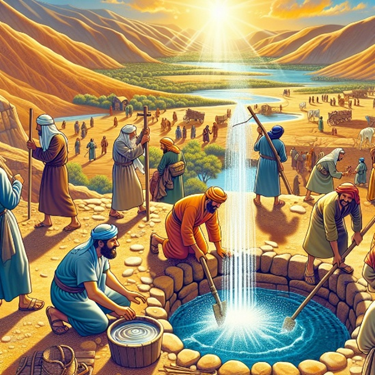
(Isaac has moved to the Philistine area of Gerar due to a famine in other areas; however, he has become so prosperous, that Abimelech, the Philistine commander, orders him to move away from him. Resentful, the Philistines have clogged up all the wells Abraham previously dug.)
Genesis 26:17-18 So Isaac left. He camped in the valley of Gerar and settled down there. Isaac dug again the wells which were dug in the days of his father Abraham but had been clogged up by the Philistines after Abraham’s death. And he renamed them, using the original names his father had given them.
19-24 One day, as Isaac’s servants were digging in the valley, they came on a well of spring water. The shepherds of Gerar quarreled with Isaac’s shepherds, claiming, “This water is ours.” So Isaac named the well Esek (Quarrel) because they quarreled over it. They dug another well and there was a difference over that one also, so he named it Sitnah (Accusation). He went on from there and dug yet another well. But there was no fighting over this one so he named it Rehoboth (Wide-Open Spaces), saying, “Now God has given us plenty of space to spread out in the land.” From there he went up to Beersheba. That very night God appeared to him and said,
“I am the God of Abraham your father; don’t fear a thing because I’m with you. I’ll bless you and make your children flourish because of Abraham my servant.”
25 Isaac built an altar there and prayed, calling on God by name. He pitched his tent and his servants started digging another well.
26-27 Then Abimelech came to him from Gerar with Ahuzzath his advisor and Phicol the head of his troops. Isaac asked them, “Why did you come to me? You hate me; you threw me out of your country.”
28-29 They said, “We’ve realized that God is on your side. We’d like to make a deal between us—a covenant that we maintain friendly relations. We haven’t bothered you in the past; we treated you kindly and let you leave us in peace. So—God’s blessing be with you!”
30-31 Isaac laid out a feast and they ate and drank together. Early in the morning they exchanged oaths. Then Isaac said good-bye and they parted as friends.
32-33 Later that same day, Isaac’s servants came to him with news about the well they had been digging, “We’ve struck water!” Isaac named the well Sheba (Oath), and that’s the name of the city, Beersheba (Oath-Well), to this day.
All Isaac has wanted is to escape the drought that has evidently taken over some parts of the land. Moving westward into Philistia, Isaac has prospered to the extent that the Philistines are both envious and anxious. When the Philistines order Isaac to leave, he settles in one area and begins opening wells that the Philistines have clogged up out of spite. It’s mind-boggling to think that in an area in which water is scarce anybody would do something so foolish, but jealous people don’t think rationally.

Isaac’s men keep opening up the old wells, and the Philistines keep trying to claim them. But Isaac persists and his men finally create a well without any controversy. Isaac names this well Rehoboth, “Wide open spaces.” From there, Isaac moves to Beersheba, where God meets him, reassuring him that God will continue to fulfill His promises of health, protection, and prosperity. In response to this divine visitation, Isaac builds an altar and undoubtedly sacrifices perfect animals on that altar. After all, the only reason for an altar to be built is as a place of animal sacrifice.
Isaac sacrifices, worships, and prays, and his men begin digging yet another well. Meanwhile, Abimelech and his chief men show up. After evicting Isaac from Philistia, Abimelech has evidently had second thoughts, realizing that Isaac is so powerful that offending him is a sad mistake. Isaac and Abimelech make a treaty and part as friends. Just as the dust from Abimelech’s retinue is clearing, Isaac’s men come to him fairly jumping with joy. After several days of hot fruitless toil, Isaac’s men have found another vein of water and have created yet another well. Isaac calls this well and the area around it Beersheba- “the well of the oath.”
What does blood have to do with this story? It is after Isaac speaks with God, building an altar and offering sacrifices, that Abimelech and his men come to make peace. Once more, God is responding to Isaac’s faithfulness.
Today, God does not demand blood sacrifices from us, for Jesus has made the ultimate blood sacrifice for the sins of the world. But we must believe in what Jesus has done, confess our sins, and turn away from our sins to follow God and His Holy Word. God asks that we make living sacrifices of ourselves. May God help us so that we will not postpone that decision, for none of us know the day our lives might end.
PRAYER: Father God, thank You for loving us and caring for us. Lord, help us to confess our sins to You and accept Your free gift of eternal life through Christ Jesus. It’s in the mighty and precious Name of Jesus that we pray. Amen.
 Burunche's Blog
Leave a comment