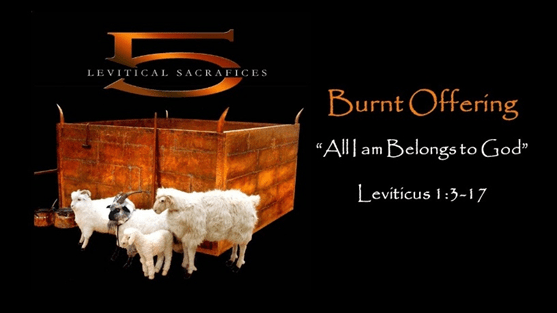
Leviticus 1: 1-2 “God called Moses and spoke to him from the Tent of Meeting: “Speak to the People of Israel. Tell them, when anyone presents an offering to God, present an animal from either the herd or the flock.
3-9 “If the offering is a Whole-Burnt-Offering from the herd, present a male without a defect at the entrance to the Tent of Meeting that it may be accepted by God. Lay your hand on the head of the Whole-Burnt-Offering so that it may be accepted on your behalf to make atonement for you. Slaughter the bull in God’s presence. Aaron’s sons, the priests, will make an offering of the blood by splashing it against all sides of the Altar that stands at the entrance to the Tent of Meeting. Next, skin the Whole-Burnt-Offering and cut it up. Aaron’s sons, the priests, will prepare a fire on the Altar, carefully laying out the wood, and then arrange the body parts, including the head and the suet, on the wood prepared for the fire on the Altar. Scrub the entrails and legs clean. The priest will burn it all on the Altar: a Whole-Burnt-Offering, a Fire-Gift, a pleasing fragrance to God.”
The Book of Leviticus is full of descriptions about blood sacrifices and the various times and fashions in which they are to be presented. I am only including this one description as an example. Why include this description? It’s great to speak generally about blood sacrifices as if they were some kind of sanitized ritual, but the truth is that they were anything but sanitized! When God decreed the regulations for the Aaronic priesthood, only men between 25-50 years of age could actively serve as priests because making those sacrifices demanded a great deal of strength. Hacking animals apart and splashing blood all over was not for weaklings. The priests had special clothes they were to wear to offer sacrifices, but it was understood that after they finished, they would bathe and change clothes.
If you continue to read in Leviticus, it describes other animal sacrifices for those too poor to afford a bull. Blood sacrifices are to be offered at several various times of the year as described in Matthew 27: But the principles are still the same: perfect animal or bird, handled respectfully and in a precise manner. Compare those sacrifices with the sacrifice of Jesus on the cross in Matthew 27:
35-40 After they had finished nailing him to the cross and were waiting for him to die, they killed time by throwing dice for his clothes. Above his head they had posted the criminal charge against him: this is Jesus, the king of the Jews. Along with him, they also crucified two criminals, one to his right, the other to his left. People passing along the road jeered, shaking their heads in mock lament: “You bragged that you could tear down the Temple and then rebuild it in three days—so show us your stuff! Save yourself! If you’re really God’s Son, come down from that cross!”
41-44 The high priests, along with the religion scholars and leaders, were right there mixing it up with the rest of them, having a great time poking fun at him: “He saved others—he can’t save himself! King of Israel, is he? Then let him get down from that cross. We’ll all become believers then! He was so sure of God—well, let him rescue his ‘Son’ now—if he wants him! He did claim to be God’s Son, didn’t he?” Even the two criminals crucified next to him joined in the mockery.
Jesus has already begun shedding blood, for the Roman soldiers have whipped him with a flagrum. We learn “the flagrum is a type of whip that typically has multiple thongs or lashes, usually with shards of pottery and pieces of bone tied in the ends to do the maximum amount of damage. The use of the flagrum was part of the Roman practice of scourging, which was a common method of punishment before crucifixion.” The Romans wanted tidy crucifixions in which victims would die within a few hours, so scourging helped shorten the survival time.
Note that although the priests are ordered to offer the blood sacrifices carefully and respectfully, Jesus endures satanic mocking, including scorn from the various religious leaders who should have been recognizing him as Messiah. The Romans drag Jesus to Calvary, “the place of the skull,” where they nail his harms and legs to a cross and set him between two thieves who are also being crucified.
45-46 From noon to three, the whole earth was dark. Around mid-afternoon Jesus groaned out of the depths, crying loudly, “Eli, Eli, lama sabachthani?” which means, “My God, my God, why have you abandoned me?”
47-49 Some bystanders who heard him said, “He’s calling for Elijah.” One of them ran and got a sponge soaked in sour wine and lifted it on a stick so he could drink. The others joked, “Don’t be in such a hurry. Let’s see if Elijah comes and saves him.” 50 But Jesus, again crying out loudly, breathed his last.
That “sponge soaked in sour wine?” Turns out, the Roman soldiers carried sponges with them to wipe their buttocks after defecating. That’s the kind of sponge the guy offered Jesus. Jesus died without tasting any wine on the cross, just as he had promised his disciples at the Last Supper.
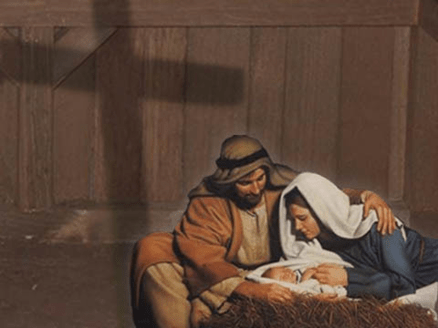
By now, you might be so revolted that you are ready to stop reading and scroll to something more uplifting. You might also be asking why God allowed His own Son to be put to death in such a shameful manner while for centuries, the priests had been treating their sacrificial animals with respect. But those animals were only a stop-gap measure to secure forgiveness from sin while Jesus’ death purchased forgiveness for all who would believe for eternity.
When Mary gave birth to Jesus, she already knew that he was going to be “Immanuel,” meaning “God with us.” The Jesus originates from the Hebrew Yeshua, a shortened form of Yehoshua (Joshua), which combines “Yah” (the shortened form of Yahweh) with “shua,” meaning “to save.” Thus, the name Jesus literally translates to “The Lord saves” or “Yahweh is salvation.” This meaning is significant as it encapsulates the mission and purpose of Jesus’ life and ministry. https://faithandformulas.com/the-amazing-biblical-meaning-of-the-name-jesus/
When John the Baptist saw Jesus for the first time, he cried out, “Here he is, God’s Passover Lamb! He forgives the sins of the world!” (John 1:29) Jesus suffered far more than any animal sacrifice ever suffered, for those animals were killed swiftly and mercifully while Jesus endured mocking and scourging before being crucified. There’s an old hymn that says,
“But the pains which He endured, alleluia! our salvation have procured; alleluia!
now above the sky He’s King, alleluia! where the angels ever sing: alleluia!“
As we are preparing our hearts for Christmas, let’s remember that Jesus wasn’t born just so that we could have celebrations and eat delicious food and exchange presents. Jesus came to give mankind the greatest gift of all: eternal life to all those who would believe in his Name.
PRAYER: Father God, thank You for loving us and caring for us. Lord, thank You for sending Jesus to die for our sins. We accept the sacrifice that Jesus has made, and we promise to follow hard after You all the days of our lives. In the mighty and precious Name of King Jesus. Amen.
 Burunche's Blog
Leave a comment