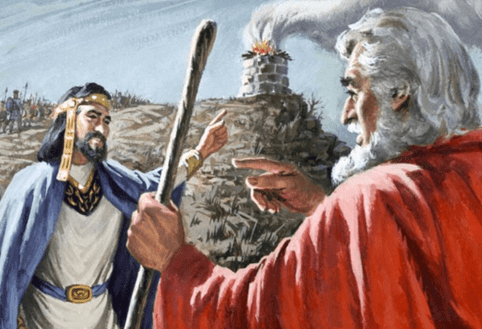
1 Samuel 13:13 Saul was a young man when he began as king. He was king over Israel for many years.
2 Saul conscripted enough men for three companies of soldiers. He kept two companies under his command at Micmash and in the Bethel hills. The other company was under Jonathan at Gibeah in Benjamin. He sent the rest of the men home.
3-4 Jonathan attacked and killed the Philistine governor stationed at Geba (Gibeah). When the Philistines heard the news, they raised the alarm: “The Hebrews are in revolt!” Saul ordered the reveille trumpets blown throughout the land. The word went out all over Israel, “Saul has killed the Philistine governor—drawn first blood! The Philistines are stirred up and mad as hornets!” Summoned, the army came to Saul at Gilgal.
5 The Philistines rallied their forces to fight Israel: three companies of chariots, six companies of cavalry, and so many infantry they looked like sand on the seashore. They went up into the hills and set up camp at Micmash, east of Beth Aven.
6-7 When the Israelites saw that they were way outnumbered and in deep trouble, they ran for cover, hiding in caves and pits, ravines and brambles and cisterns—wherever. They retreated across the Jordan River, refugees fleeing to the country of Gad and Gilead. But Saul held his ground in Gilgal, his soldiers still with him but scared to death.
8 He waited seven days, the time set by Samuel. Samuel failed to show up at Gilgal, and the soldiers were slipping away, right and left.
9-10 So Saul took charge: “Bring me the burnt offering and the peace offerings!” He went ahead and sacrificed the burnt offering. No sooner had he done it than Samuel showed up! Saul greeted him.
11-12 Samuel said, “What on earth are you doing?”
Saul answered, “When I saw I was losing my army from under me, and that you hadn’t come when you said you would, and that the Philistines were poised at Micmash, I said, ‘The Philistines are about to come down on me in Gilgal, and I haven’t yet come before God asking for his help.’ So I took things into my own hands, and sacrificed the burnt offering.”
13-14 “That was a fool thing to do,” Samuel said to Saul. “If you had kept the appointment that your God commanded, by now God would have set a firm and lasting foundation under your kingly rule over Israel. As it is, your kingly rule is already falling to pieces. God is out looking for your replacement right now. This time he’ll do the choosing. When he finds him, he’ll appoint him leader of his people. And all because you didn’t keep your appointment with God!”
King Saul is in trouble! The prophet Samuel has ordered Saul to wait at Gilgal for seven days so that Samuel will come and they will make sacrifices together. But Samuel is not appearing and Saul’s soldiers are slipping away as they look at the Philistine forces and become intimidated. Saul is frustrated and frightened. Besides, if Saul is king, why can’t he offer a sacrifice by himself? Why wait for Samuel? What makes Samuel so important? Why hasn’t Samuel come as he has promised?
Saul has never been noted for faith, restraint, or self-control, and today is no exception. In a panic, Saul proceeds to make the sacrifices himself. As soon as the last animal has been placed on the altar, Samuel walks up. Eugene Peterson’s Message translation likely describes the scene as it really takes place.
11-12 Samuel said, “What on earth are you doing?”
Saul answered, “When I saw I was losing my army from under me, and that you hadn’t come when you said you would, and that the Philistines were poised at Micmash, I said, ‘The Philistines are about to come down on me in Gilgal, and I haven’t yet come before God asking for his help.’ So I took things into my own hands, and sacrificed the burnt offering.”
13-14 “That was a fool thing to do,” Samuel said to Saul. “If you had kept the appointment that your God commanded, by now God would have set a firm and lasting foundation under your kingly rule over Israel. As it is, your kingly rule is already falling to pieces. God is out looking for your replacement right now. This time he’ll do the choosing. When he finds him, he’ll appoint him leader of his people. And all because you didn’t keep your appointment with God!”
Notice how Saul tries to guilt Samuel. “‘The Philistines are about to come down on me in Gilgal, and I haven’t yet come before God asking for his help.’ So I took things into my own hands, and sacrificed the burnt offering.” The unstated message here is simple: It’s all Samuel’s fault that Saul has had to make these sacrifices. Why hasn’t Samuel sent a messenger to indicate he’s coming?
What Saul fails to realize is that Samuel’s delay has been a test of Saul’s faith, and Saul has failed spectacularly. Had Saul waited until Samuel arrived, he would have proven himself suitable for remaining king, founding a dynasty, and leading the Israelites into a glorious future. But Saul has proven to be faithless and impulsive. Now God is already looking for Saul’s replacement.
Saul’s problem resembles that of Balak and Balaam: he views sacrifices as a form of sorcery, manipulating God to get desired results. Saul neither knows God nor respects Him. Samuel makes sacrifices to worship God because he loves, respects, and fears God. Until now, Samuel has had his doubts about Saul, and now those doubts are confirmed. Samuel must be grieving, for he can already see Saul’s eventual fall.
The tragedy of King Saul is simple: Saul’s heart is wrong, and no sacrifice will make up for that. As we continue through Advent, buying presents and possibly making donations to appeals such as the Salvation Army, we must examine our hearts. Are we doing these things as acts of worship or are we acting out of guilt or the desire to placate our consciences? May God help us so that we will worship Him no matter what we are doing.
PRAYER: Father God, thank You for loving us and caring for us. Lord, as Christmas approaches, let everything we do become an act of worship. In the mighty and precious Name of King Jesus. Amen.
 Burunche's Blog
Leave a comment