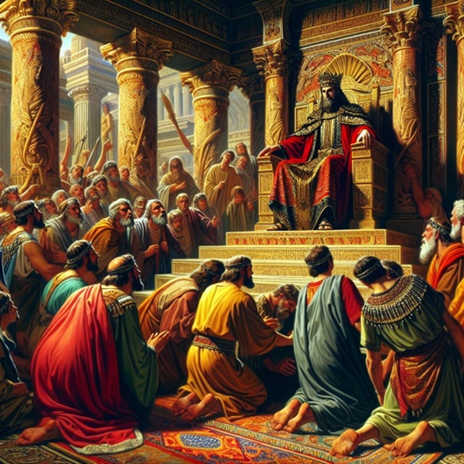
Matthew 2: Scholars from the East
2 1-2 After Jesus was born in Bethlehem village, Judah territory—this was during Herod’s kingship—a band of scholars arrived in Jerusalem from the East. They asked around, “Where can we find and pay homage to the newborn King of the Jews? We observed a star in the eastern sky that signaled his birth. We’re on pilgrimage to worship him.”
3-4 When word of their inquiry got to Herod, he was terrified—and not Herod alone, but most of Jerusalem as well. Herod lost no time. He gathered all the high priests and religion scholars in the city together and asked, “Where is the Messiah supposed to be born?”
5-6 They told him, “Bethlehem, Judah territory. The prophet Micah wrote it plainly:
It’s you, Bethlehem, in Judah’s land, no longer bringing up the rear. From you will come the leader who will shepherd-rule my people, my Israel.”
7-8 Herod then arranged a secret meeting with the scholars from the East. Pretending to be as devout as they were, he got them to tell him exactly when the birth-announcement star appeared. Then he told them the prophecy about Bethlehem, and said, “Go find this child. Leave no stone unturned. As soon as you find him, send word and I’ll join you at once in your worship.”
It’s 1956, and my third-grade class is performing at the Christmas program at my grade school in our small Midwestern town. Now the boys are singing/shouting, “We three kings of Orient are, bearing gifts, we travel afar. Field and fountain, moor and mountain, following yonder star.” It’s a wonderful Christmas carol, one that helps us remember those Persian scholars, the magi, who were searching for a Savior. We know these men found the infant Jesus. But who was King Herod the Great? How many wise men were there? Where did they come from? Why did God warn them not to return to Herod? For the next few days, we’re going to take a close look at this story, for it hold the key to much of Jesus’ future ministry. While it’s true that we celebrate the coming of the Magi on the Feast of Epiphany January 6th, we’re going to speed things up a little.
Pastor David Guzik in his Enduring Word Bible Commentary gives us some excellent information. For the complete discussion, see https://enduringword.com/bible-commentary/matthew-2/
We need to know King Herod’s nature. “This was the one known as Herod the Great. Herod was indeed great; in some ways great as a ruler, builder, and administrator; in other ways great in politics and cruelty.
i. “He was wealthy, politically gifted, intensely loyal, an excellent administrator, and clever enough to remain in the good graces of successive Roman emperors. His famine relief was superb and his building projects (including the temple, begun 20 B.C.) were admired even by his foes. But he loved power, inflicted incredibly heavy taxes on the people, and resented the fact that many Jews considered him a usurper. In his last years, suffering an illness that compounded his paranoia, he turned to cruelty and in fits of rage and jealousy killed close associates.” (Carson)
ii. “Augustus, the Roman Emperor, had said, bitterly, that it was safer to be Herod’s pig than Herod’s son. (The saying is even more epigrammatic in Greek, for in Greek hus is the word for a pig, and huios is the word for a son).” (Barclay)”
2. (3) Herod is troubled at the news brought by the wise men. When Herod the king heard this, he was troubled, and all Jerusalem with him.
a. When Herod the king heard this, he was troubled: Herod was constantly on guard against threats to his rule, especially from his own family. He assassinated many family members whom he suspected of disloyalty. His being troubled is completely in character.
i. Herod, who wanted to be accepted by the Jews whom he ruled, was not a Jew at all but an Edomite, and Rome recognized him as a vassal king over Judea. The Jews tempered their great hatred of him with admiration for his building projects, such as the magnificent improvements made to the second temple.
ii. Barclay reminds us of what a bloody, violent ruler Herod was: “He had no sooner come to the throne than he began by annihilating the Sanhedrin…he slaughtered three hundred court officers…he murdered his wife Mariamne, and her mother Alexandra, his eldest son Antipater, and two other sons, Alexander and Aristobulus.”
b. He was troubled, and all Jerusalem with him: The fact that all Jerusalem was troubled with Herod is significant. This was due either to the fact that the people of Jerusalem rightly feared what sort of paranoid outburst might come from Herod upon hearing of a rival king being born, or because of the size and dignity of this caravan from the East.
i. This trouble is again testimony to the greatness of Jesus, even as a young child. “Jesus of Nazareth is so potent a factor in the world of mind that, no sooner is he there in his utmost weakness, a new-born King, than he begins to reign. Before he mounts the throne, friends bring him presents, and his enemies compass his death.” (Spurgeon)
Reading how terrible Herod was, we might ask, “Why would God use someone like this in any fashion?” But we must remember Isaiah 55:9, which tells us that God’s ways are far higher than ours. God uses Herod’s paranoid query to his court scholars to help the magi learn where to look for baby Jesus.
Herod has already annihilated the Sanhedrin, has slaughtered 300 court officers, and has murdered several of his own family members. When Herod summons the remaining priests and Jewish religious scholars to his palace demanding to know the birthplace of the Messiah, these men rush to the court. These men quote Micah 5:1 “But you, Bethlehem-Ephrathah, least among the clans of Judah, from you shall come forth for me one who is to be ruler in Israel; whose origin is from of old, from ancient times.”
Bethlehem was known as the City of David, and the Messiah was to come from David’s royal lineage. In Herod’s day, Bethlehem was a tiny village about 6 miles from Jerusalem. Modern Bethlehem is practically a Jerusalem suburb. The wise men take off for Bethlehem while Herod rubs his hands in glee, thinking that he has duped these crazy astronomers into doing his investigation for him. At the same time, Herod is likely wondering, “Bethlehem? Why Bethlehem? Why not Jerusalem or some other major city. Bethlehem has nothing to recommend it-what a scraggly little place!
When we read the Christmas story, we frequently read only from Luke 2 and stop once the angels have returned to heaven and the shepherds have returned to their sheep. But if we unpack that story, there are many more miracles to discover. Here, God uses one of the most despicable rulers living to help the magi find Baby Jesus. Are the magi taken in by Herod’s oily pronouncements? Are you kidding? The magi are men of experience and Herod’s reputation has even reached Persia. So the magi take the advice of Herod’s scholars and try to distance themselves from Herod as they continue their quest.
We must always be prepared for God to do amazing things in our lives, using the most unlikely people. Here a tyrannical murderer plays a role he fails to understand. What is sad is that the religious scholars who advise the magi on the Messiah’s location refuse to heed their own advice, but remain in Jerusalem where they piously continue to await a Messiah who has already come just a short distance from their courts.
At Christmas and throughout the year, we have a choice: will we be like the magi, willing to risk everything to come to Jesus, or will we copy those religious scholars who could have come to Jesus but who failed to do so because they cherished other notions about what the Messiah would look like? As another Christmas carol urges, “O come, let us adore him!”
PRAYER: Father God, thank You for loving us and caring for us. Lord Jesus, we adore You for coming to earth as a helpless baby and enduring all the stresses of a human life. Thank You for Your great gift of salvation. In Your mighty and precious Name, Lord Jesus. Amen.
 Burunche's Blog
Leave a comment