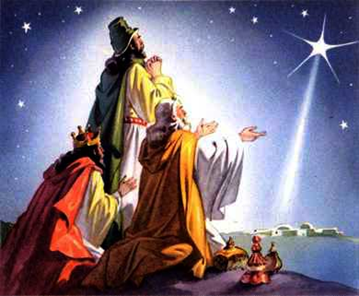
Matthew 2:Scholars from the East
2 1-2 After Jesus was born in Bethlehem village, Judah territory—this was during Herod’s kingship—a band of scholars arrived in Jerusalem from the East. They asked around, “Where can we find and pay homage to the newborn King of the Jews? We observed a star in the eastern sky that signaled his birth. We’re on pilgrimage to worship him.”
3-4 When word of their inquiry got to Herod, he was terrified—and not Herod alone, but most of Jerusalem as well. Herod lost no time. He gathered all the high priests and religion scholars in the city together and asked, “Where is the Messiah supposed to be born?”
5-6 They told him, “Bethlehem, Judah territory. The prophet Micah wrote it plainly:
It’s you, Bethlehem, in Judah’s land, no longer bringing up the rear. From you will come the leader who will shepherd-rule my people, my Israel.”
7-8 Herod then arranged a secret meeting with the scholars from the East. Pretending to be as devout as they were, he got them to tell him exactly when the birth-announcement star appeared. Then he told them the prophecy about Bethlehem, and said, “Go find this child. Leave no stone unturned. As soon as you find him, send word and I’ll join you at once in your worship.”
9-10 Instructed by the king, they set off. Then the star appeared again, the same star they had seen in the eastern skies. It led them on until it hovered over the place of the child. They could hardly contain themselves: They were in the right place! They had arrived at the right time!
Who were these scholars from the East? From Pastor David Guzik: “They were not kings but wise men, which means they were astronomers. There were not only three, but probably a great company. They seem to have come not on the birth night, but probably several months later… Being from the East, they would have been among Jews who were exiled from Judah and Israel centuries before. “That many Jews were mixed with this people there is little doubt; and that these eastern magi, or philosophers, astrologers, or whatever else they were, might have been originally of that class, there is room to believe. These, knowing the promise of the Messiah, were now, probably, like other believing Jews, waiting for the consolation of Israel.” (Clarke)
iii. There was a general expectation of a messiah or great man from Judea. Not very long after Jesus was born, the Roman historian Seutonius wrote: “There had spread over all the Orient an old and established belief, that it was fated at that time for men coming from Judea to rule the world.” Tacitus, another Roman historian of the general period, wrote: “There was a firm persuasion…that at this very time the East was to grow powerful, and rulers coming from Judea were to acquire universal empire.” (Cited in Barclay)
iv. “The tradition that the Magi were kings can be traced as far back as Tertullian (died c. 225). It probably developed under the influence of Old Testament passages that say kings will come and worship the Messiah (cf. Psalms 68:29, 31; 72:10-11; Isaiah 49:7; 60:1-6).” (Carson)
v. Church traditions even tell us their names – supposedly Melchior, Caspar, and Balthasar. You can see their supposed skulls in the great cathedral at Cologne, Germany.”
What about that star? Guzik continues:
f. For we have seen His star in the East: There are many different suggestions for the natural origin of this remarkable star. Some say it was a conjunction of Jupiter and Saturn; some, other planetary conjunctions; others suggest a supernova; and some think of comets or a specifically created unique star or sign.
i. Whatever it was, it is significant that God met them in their own medium: He guided the astronomers by a star. This was also in fulfillment of Numbers 24:17: A Star shall come out of Jacob; a Scepter shall rise out of Israel. This was widely regarded by ancient Jewish scholars as a Messianic prediction.
ii. Notice, it was His star: “The star was Christ’s star itself, but it also led others to Christ. It did this very much because it moved in that direction. It is a sad thing when a preacher is like a sign-post pointing the way but never following it, on his own account. Such were those chief priests at Jerusalem: they could tell where Christ was born, but they never went to worship him; they were indifferent altogether to him and to his birth.” (Spurgeon)
g. And have come to worship Him: The wise men came first to Jerusalem, assuming that the leaders of the Jews would be aware and excited about the birth of their Messiah. The wise men are about to find that this wasn’t the case at all.
This website https://www.biblestudytools.com/bible-study/topical-studies/6-things-to-know-about-the-star-the-magi-followed.html gives us fascinating information:
Here are six things to know about the star the magi followed:
1. Visibility
The star was visible from at least as far away as Persia, the former kingdom of Babylon, which was in the same region as modern-day Iran.
The magi came from afar, with many scholars believing at least some of them came from modern-day Iran. Some others hypothesize that they could have come from as far as India. While tradition depicts three magi, wise men, or even sometimes translated as kings, the Bible is unclear about how many came. The number three comes from the three gifts they brought: gold, frankincense, and myrrh.
2. Foretold by Daniel
The magi may have been looking for the star as a sign in the sky heralding the Messiah because they followed the teachings of Daniel.
One of the many questions that goes unanswered in the Bible is, how did these wise men from far away know to be looking for a sign in the sky for a Jewish king? How did they know this Jewish king would hold significance for them?
While there are a few theories, one of the stronger ones is that the magi were men who served in the city of Babylon, followers of the teachings of the Prophet Daniel. During the time of the exile, 597 BC to 538 BC, several young Jewish men rose to prominent positions at the Babylonian court, serving God in a pagan land. This included Daniel. It is possible that people influenced by Daniel during his lifetime continued to follow his teachings, his religion, and looked forward to the same promise of redemption. Astrology was a practice at the time, so they may have been looking to the heavens for signs of the promises of Daniel’s God.
Other theories suggest that just like Jewish religion made its way into Africa, such as with the Queen of Sheba (1 Kings 10) and the Ethiopian Eunuch (Acts 8:26-40) it may have made its way deeper into parts of central Asia. In recent years, people groups further into Asia have claimed to be followers of Judaism, and are theorized to be one of the lost tribes of Israel. If true, their existence could support the idea that worship of the one true God was more global than often believed at the time of Jesus’ birth.
3. Astrological Phenomenon
Some astronomers believe the “star” may have been a comet, a supernova, the planet Jupiter, or the constellation we call Aries. Others believe it was an alignment of Jupiter, Saturn, the moon, and the sun in the constellation of Aries.
While it can be easy to assume the star over Bethlehem was a bright, universally visible spot in the sky, the Bible is actually silent on how many people were able to see it, and – if it was visible to the multitudes – what people thought of it. The magi knew what it meant, and they followed it, but if it was noticeable to others is unclear.
Part of why the magi may have been aware of it was because they may have studied astrology, the reading of the location of the stars and the planets. When looking for a scientific explanation, there are only a handful of things that can create that bright of a light in the sky. If it was not just a star miraculously placed there by God for that purpose, which is entirely possible, then God could have used other natural wonders to create such a bright light, including supernovas and planets.
4. It Disappeared for a Time
The star disappeared for a time when the magi were in Jerusalem, which is why they asked Herod where the child was.
The Magi followed the star to Jerusalem, and stopped at Herod’s palace for clarity. Then the Bible records, “After hearing the king, they went on their way. And there it was — the star they had seen at its rising. It led them until it came and stopped above the place where the child was” (Matthew 2:9). The star rose again after they left the palace in Jerusalem to go to nearby Bethlehem.
God used this star, whether a natural or unnatural phenomenon, to guide the magi so they could provide the appropriate gifts for the young Messiah, and so they could testify to His arrival.
5. Herod’s Ignorance
King Herod did not seem concerned about the appearance of the star, but only at the birth of a king who could be a rival to his throne, meaning he may not have understood Scripture well.
The Bible records, “After Jesus was born in Bethlehem of Judea in the days of King Herod, wise men from the east arrived in Jerusalem, saying, ‘Where is he who has been born king of the Jews? For we saw his star at its rising and have come to worship him.’ When King Herod heard this, he was deeply disturbed, and all Jerusalem with him. So he assembled all the chief priests and scribes of the people and asked them where the Messiah would be born” (Matthew 2:1-4).
Herod did not seem to recognize the significance of the star, nor why the birth of this king of the Jews would be a blessing for all mankind. Even though many people at this time did not understand the true purpose of the Messiah’s mission, Herod only saw a threat to his power.
6. It Was Long-Awaited
The star was prophesied as far back as the Pentateuch, by Moses. In the Book of Numbers, the Prophet Balaam was given a prophecy about a coming ruler who would strike down Israel’s enemies. The details included some about his birth, as recorded in the Book of Numbers:
“I see him, but not now;
I perceive him, but not near.
A star will come from Jacob,
and a scepter will arise from Israel.
He will smash the forehead of Moab
and strike down all the Shethites”
The star referred to Jesus, but also to the star that signaled his birth as a sign for the people who were looking for it. These Scriptures may have been what the Magi used to look for a Savior.
The bright star in the dark sky has become one of the symbols of Christmas and new hope for believers around the world. Even non-believers will often put a star at the top of their tree in celebration. Christians should use this symbol as a way to share the gospel, the good news about the reason that Christmas is celebrated.
“Today in the city of David a Savior was born for you, who is the Messiah, the Lord” (Luke 2:11).
Jesus came to pay the price for the sins of all people, and if they put their faith in him, repenting of their sins, then anyone can be saved from hell and into eternal life.”
This star appeared at a time when people scanned the skies for signs of God’s will. There were plenty of Jewish astrologers in Jerusalem as well as astrologers in other places. Why didn’t the Jewish astrologers recognize this star? One possibility is that God did not reveal the star to everyone. Prior to the arrival of the magi in Jerusalem, nobody seemed to be agonizing over the appearance of a super-bright star and its meaning. This suggests that God selectively allowed the magi to see the star. Yet a second possibility is that the magi were actively searching for the Messiah while many others were only giving pious lip service to the idea. For those in comfortable socio-religious positions, the idea of a Messiah might have posed a threat to their status and well-being. What if the Messiah failed to agree with them?
In the end, the magi followed the star, worshiped Jesus, and then discretely returned home by a route different from the one they had followed to reach Jerusalem. Herod was left fuming in his palace. Tomorrow we will discuss what happened next.
There’s a popular Christmas meme that reads “Wise men still seek Him.” Are we seeking Jesus, or are we copying the Jewish scholars who refused to pay attention and who lost out on the greatest news of all time as a result? May God help us to continue to listen to Him!
PRAYER: Father God, thank You for loving us and caring for us. Lord, You have promised that all who seek You will find You. Please help us to find You and to obey You completely. In the mighty and precious Name of King Jesus. Amen.

 Burunche's Blog
Leave a comment