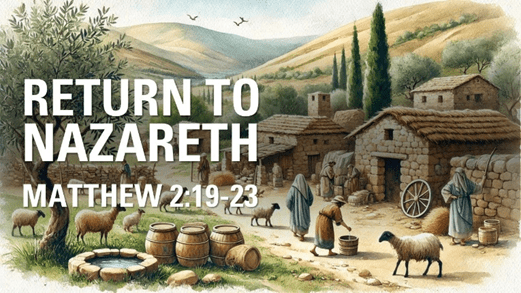
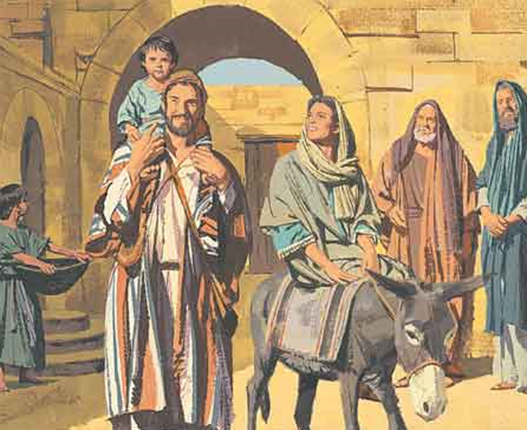
Matthew 2:19-20 Later, when Herod died, God’s angel appeared in a dream to Joseph in Egypt: “Up, take the child and his mother and return to Israel. All those out to murder the child are dead.”
21-23 Joseph obeyed. He got up, took the child and his mother, and reentered Israel. When he heard, though, that Archelaus had succeeded his father, Herod, as king in Judea, he was afraid to go there. But then Joseph was directed in a dream to go to the hills of Galilee. On arrival, he settled in the village of Nazareth. This move was a fulfillment of the prophetic words, “He shall be called a Nazarene.”
Twice God has spoken to Joseph in dreams, and now God speaks one final time. An angel appears in a dream ordering Joseph to return to Israel because “all those out to murder the child are dead.” Wicked King Herod dies, but there’s still danger. King Herod the Great has been succeeded by his son Archelaus, a weak, vicious man who has no problems slaughtering those who oppose him. Archelaus rules half the territory his father ruled, so God warns Joseph once more to settle in Nazareth in the Galilee. Joseph is a carpenter; however, he may also be a stone mason, skills that would be very welcome in a village.
Nazareth proves to be an excellent location for the Holy Family. Not only can Joseph provide necessary services for Nazareth, but the Romans are also building Sepphoris, a model village about 4 miles from Nazareth. The ruins of Sepphoris are open to tourists today, and the magnificent mosaics are well worth viewing. It’s possible that Joseph might have worked on some of the construction projects at Sepphoris.
One pastor’s wife used to tell us, “Blessed be nothing!” Why does God want His Son to grow up in a small village? Even though Jesus is the Son of God, he needs to fully experience what it means to be the “son of man,” and village life can teach that better than any other location.
- Jesus needs to understand poverty. Throughout the world, the poor are far more numerous than the rich. Jesus needs to know down to the marrow of his bones the work it takes to provide for a family. Evidence suggests that Joseph likely farmed in addition to doing carpentry or stone masonry. How else will Jesus understand farmers scattering seed, or a village lady desperately searching for the one silver coin she has lost or a shepherd seeking out the one foolish sheep stranded in the mountains? And how else will Jesus be able to crack jokes about a man so unobservant that he runs his face into a beam of wood carried by a carpenter because he’s searching out specks of dust in his neighbor’s eyes?
- The relative poverty of Nazareth prepares Jesus for the poverty he will face during his ministry. Once Jesus leaves the family home in Nazareth, he will never be able to claim anyplace as home again until he reaches heaven. Jesus will walk everywhere he goes and will depend on others to feed him. When Jesus calls out a Pharisee for failing to order his servants to wash Jesus’ feet, it’s because those feet have walked long distances over dirty rocky paths that day. There is no evidence to suggest that Jesus owns more than one set of clothing, automatically giving him sympathy with the poorest of the poor. Even more telling, when Jesus and Peter need to pay the temple tax, Jesus tells Peter to go fishing and to reach into a fish’s mouth for the coin that will cover both of them.
- Jesus must fully understand the temptations common to the poor. Proverbs 30:7-9 tells us, “Two things I ask of You—do not refuse me before I die: Keep falsehood and deceitful words far from me. Give me neither poverty nor riches; feed me with the bread that is my portion. Otherwise, I may have too much and deny You, saying, ‘Who is the LORD?’ Or I may become poor and steal, profaning the name of my God.…” Even though Jesus is the Son of God and has passed through severe temptations, he continues to be tempted for the remainder of his life. It can get bitterly cold in Israel. Think of Jesus and the disciples, passing through a village on a chill evening as others are withdrawing into small cozy homes perfumed with the fragrant odor of spicey soup. As the little group proceed up the street, local citizens enter their courtyards, baring them against night dangers. Will someone invite Jesus and the disciples in or must they struggle to find food and shelter? Without exception, Jesus must resist the temptation to become his own providence, to miraculously provide for his followers and himself. The moment Jesus fails to rely on his Heavenly Father, Satan has already gained a victory.
- Jesus must fully understand what it means to be a social outcast.Face it, nobody is going to beg a poor person to come to their home without an ulterior motive. Even the relatives of poor people are likely to view them in terms of the work they might get from them while handing out a meager reward. Jesus must live this reality so that he can teach about it. In addition, Nazareth is in the Galilee, a region noted for a mixture of Greco-Roman culture plus an overlay of Jewish piety. Jews in other places sneer at the Galileans, feeling they are semi-heretics, poorly educated, and certainly second-class Jews.
- Jesus needs poverty for credibility. Poor people won’t accept Jesus’ messages if he finishes teaching and runs back to a gated compound where he can enjoy a luxurious lifestyle being catered to by lots of servants.
Matthew 20:28 “For the Son of Man came not to be served, but to serve, and to give His life a ransom for many.” Jesus doesn’t need wealth, for ultimately he will own the riches of heaven. But Jesus does need poverty, for the poverty of Nazareth, its socially unfavorable location, and the struggles that ensue will combine to shape Jesus and to fit him for ministry. As our friend was fond of saying, “Blessed be nothing!”
PRAYER: Father God, thank You for loving us and caring for us. Lord, we bless You and praise You for sending Jesus to Nazareth, where he would learn the lessons and gain the experience necessary for his ministry. Thank You that no experience, no suffering, is ever wasted in Your Economy. In the mighty and precious Name of King Jesus. Amen.
 Burunche's Blog
Leave a comment