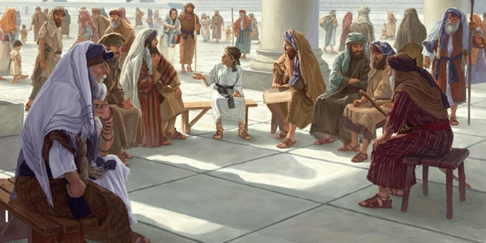
Luke 2:39-40 When they finished everything required by God in the Law, they returned to Galilee and their own town, Nazareth. There the child grew strong in body and wise in spirit. And the grace of God was on him.
41-45 Every year Jesus’ parents traveled to Jerusalem for the Feast of Passover. When he was twelve years old, they went up as they always did for the Feast. When it was over and they left for home, the child Jesus stayed behind in Jerusalem, but his parents didn’t know it. Thinking he was somewhere in the company of pilgrims, they journeyed for a whole day and then began looking for him among relatives and neighbors. When they didn’t find him, they went back to Jerusalem looking for him.
46-48 The next day they found him in the Temple seated among the teachers, listening to them and asking questions. The teachers were all quite taken with him, impressed with the sharpness of his answers. But his parents were not impressed; they were upset and hurt.
His mother said, “Young man, why have you done this to us? Your father and I have been half out of our minds looking for you.”
49-50 He said, “Why were you looking for me? Didn’t you know that I had to be here, dealing with the things of my Father?” But they had no idea what he was talking about.
51-52 So he went back to Nazareth with them, and lived obediently with them. His mother held these things dearly, deep within herself. And Jesus matured, growing up in both body and spirit, blessed by both God and people.
It all started out so well. Joseph, Mary, and Jesus went up to Jerusalem for Passover. While Luke doesn’t mention it, by this point, Jesus probably had several younger siblings who went along as well. If Joseph and Mary were struggling to control a bunch of little kids in the midst of a chaotic crowd, that would explain why they lost sight of Jesus. After all, Jesus was now twelve and about to go through his bar mitzvah, at which point he would be considered as a man who could help make up a minyan, a group of ten men for prayers. Jesus was close to several of the other families from Nazareth; he probably had attached himself to one of those. But once free from Jerusalem and its craziness, Joseph and Mary realized that they hadn’t seen Jesus in more than twenty-four hours and that he wasn’t with the other travelers from Nazareth.
Fearing the worst, Joseph and Mary returned to Jerusalem. After checking the place where the family had lodged, Jesus’ parents went to the temple. As they entered the temple, they could see a large group of scholars clustered together around a much smaller figure. Quietly approaching the group, they realized Jesus was at its center, and the scholars were taking turns asking him questions. What shocked Joseph and Mary was the attitude of the scholars, for they were listening to Jesus seriously, treating him as if he were one of them.
“Jesus!” Mary gasped. “What are you doing?”
“Oh hi, Mother,” Jesus replied.
Perplexed and angry, Mary continued, “Young man, why have you done this to us? Your father and I have been half out of our minds looking for you.”
“But Father, Mother,” Jesus replied,” why were you looking for me? Didn’t you know that I had to be here, dealing with the things of my Father?”
Mary and Joseph were confused and upset. What did Jesus mean by this statement? What other Father was Jesus referring to, if not to Joseph? Joseph looked at Mary, and Mary looked back at Joseph, shrugging her shoulders.
Finally, Joseph asserted himself, “Well, son, while we are glad that you have such hunger for the things of God, we must return to Nazareth.”
“Certainly, Abba,” Jesus replied. Jesus went around the circle, courteously taking leave of each of them individually.
“Young man, when your parents give permission, you really must return. You show unusual promise,” the eldest scholar stated.
“Oh, thank you, sir. You are too kind. I will certainly return,” replied Jesus, smiling to himself. Little did those scholars realize that Jesus was already thinking years ahead, anticipating that return. By then, many of those men would already have died. Jesus hoped they had heard enough that they would truly know God in His glory and power.
Bowing to all the august group once more, Jesus followed his parents out of the temple and down the steps to the road that led back to Nazareth. Rejoining the group, Jesus returned to Nazareth, to his father’s shop, and to village life. But Mary remembered Simeon’s prophecies and Hannah’s songs. In the stillness of night, Mary wondered what Jesus would eventually do.
“Had they done the right thing by retrieving Jesus from the temple, or should they have allowed him to find his own way home? Were Joseph and she interfering with Jesus’ ministry? How would they know when it was time for Jesus to begin that ministry? It certainly wasn’t easy knowing that Jesus was divine and that at some point, he would leave Nazareth for the larger world.”
If we ignore these few verses, we fail to learn from an important portion of Jesus’ life. After exhibiting his mental and spiritual brilliance, Jesus returned to Nazareth, where we hear virtually nothing about him until he presents himself to John the Baptist at the River Jordan at age 30. For eighteen years, Jesus lived quietly and obediently with his parents, working with his father as a carpenter and perhaps as a stone mason and a part-time farmer. What kind of pressure did Jesus encounter to become married? Ancient rabbis advised age eighteen as the ideal age for young men to marry, although girls might marry as soon as they began menstruating. But there were also some people who remained celibate, with John the Baptist being a prime example.
What kind of pressure did Mary and Joseph suffer because Jesus did not marry? Remember, this family is living in a small village where everybody knows everyone else’s business-or at least thinks they do! Each time Mary fetched water from the village well, she could expect a barrage of questions from the local gossips. “So, Mary, this son of yours, Jesus? Is he actually going to remain single? He’s making a good living, so why doesn’t he pick one of our girls to marry? I can suggest at least three different young ladies, any one of whom would be thrilled to marry him.”
Meanwhile, Joseph would be enduring similar queries. “Joseph, what’s wrong with your eldest son? He seems normal, so why hasn’t he married already? Or has he taken some kind of religious vow? Why don’t you simply meet with one of the local families and select a wife for him?”
Gotquestions.org has this to say about Jesus and celibacy:
Since Jesus was the ideal and model man, it is easy to wonder why He did not marry and father children during His earthly life. As a hard-working and skilled carpenter, a man with a magnetically good character and winsome personality, and with His years of fame and miracle-working, it is likely that more than one woman gave Him opportunity to marry.
No Scripture directly answers the question of why Jesus never married. Several possibilities have been suggested to explain Jesus’ singleness:
1. Jesus did not marry because He had limited time on earth. His strenuous travel and demanding work load would have prevented Him from rightly fulfilling the roles of husband and father. And a wife would have been a distraction to Jesus’ primary mission. A married Jesus would have had to place His wife’s needs above those of the world He came to rescue (see 1 Corinthians 7:32–35).
2. For three years, Jesus lived as a homeless healer-teacher (Luke 9:58). He would not have asked any woman to share such a life. While He now waits for His marriage to His betrothed Bride, the Church, He is preparing for her a heavenly home (John 14:2–3), readying for her a perfect and eternal place of protection.
3. Jesus knew that He had come to die (Isaiah 52:13–53:12; 1 Peter 1:19–20; Luke 18:31–33). If He married, He certainly would leave a widow, probably with small children to rear alone. He was incapable of deliberately causing such unnecessary pain.
4. If Jesus had married, His widow most likely would have been glamorized, idolized, deified, and likely physically endangered because of her relationship with Jesus.
5. Another reason that Jesus didn’t marry is likely that He did not wish to produce a blood successor or generate debate over who that successor would be or whether or not His successor should also be considered the “Son of God.” Jesus’ purpose was not to establish an earthly kingdom or a dynasty (see John 18:36).
6. Jesus did not marry because of His uniqueness. In his History of the Christian Church, Philip Schaff writes, “Jesus’ poverty and celibacy have nothing to do with asceticism, but represent, on the one hand the condescension of His redeeming love, and on the other His ideal uniqueness and His absolutely peculiar relation to the whole church, which alone is fit or worthy to be His bride. No single daughter of Eve could have been an equal partner of the Savior of mankind, or the representative head of the new creation” (Vol. III, p. 68). Schaff goes on to explain, “While Jesus was fully human, and therefore fully capable of perfectly fulfilling all aspects of marriage, He also was fully divine. Therefore, no one with only a human nature could be a suitable mate for Him.”
7. Jesus did not marry because He was not on earth to choose one woman above all others. He came to rescue and restore all who would receive Him. For Jesus to form a marital relationship with one woman would inevitably have confused generations to come about the meaning of His relationship with His spiritual Bride, the Church, to whom He was already betrothed (Ephesians 5:25–27; Revelation 19:7–10; 21:9; 22:17; 2 Corinthians 11:2). Jesus reserved Himself for His true, eternal Bride. If He had picked one woman to elevate above all others, He would have contradicted and undermined His ministry to all.
8. In human marriage, husband and wife become “one flesh” (Genesis 2:24). If the divine Jesus, who knew no sin, married a sinful woman (“for all have sinned,” Romans 3:23), His relationship to His wife would have raised some confusing uncertainties. If Jesus had become “one flesh” with a sinner, would that connection have tainted Him with sin? If they had had children, what kind of nature would these children have had? As physical children of the Son of God, what kind of relationships would they have had to God the Father?
These ideas reinforce the New Testament’s descriptions of Jesus as the ideal Man, the only purely righteous and good One who clearly and consistently pointed to eternity. Jesus did not marry because human marriage was not necessary to His mission of saving the world. Although marriage is a picture of Christ’s relationship with the church (Ephesians 5:31–32), it is only a temporary state in light of eternity. Those who by God’s grace through faith are included in that Bride of Christ have every reason to anticipate with eagerness Jesus’ coming to receive them into greater glory and joy than they ever have known on earth.
For eighteen years, Jesus absorbed everything there was to learn about village life, using those illustrations in later sermons. Jesus also remained obedient and prayerful. But never ignore the sacrifices made by Joseph and Mary. Instead of celebrating Jesus’ marriage and baby namings, Jesus’ earthly parents had to remain patient, tolerating vicious criticism and embarrassing questions from their friends and neighbors. Blood sacrifices are over swiftly, but this sacrifice lasted nearly two decades. Jesus was called to be the Savior of the world. Mary and Joseph were called to raise, protect, and defend Jesus until he left for ministry, leaving an example for all of us. May God help us to remain faithful, even when we must wait decades for God to act!
PRAYER: Father God, thank You for loving us and caring for us. Lord, help us to remain faithful, even when the fulfillment of Your will takes a long time. In the mighty and precious Name of King Jesus. Amen.
 Burunche's Blog
Leave a comment