
Genesis 23:1-2 When Sarah was 127 W old, she died in Hebron in the land of Canaan; there Abraham mourned and wept for her.
Abraham knew that Sarah’s body was failing. Each morning, it took Sarah longer to bathe, to dress, and to present herself for the day. Sarah’s maids were already coming to Abraham, “Father, Mama Sarah worries us. Not only is she becoming weaker, but now she almost refuses to eat. We struggle to find something she will take, and she scarcely drinks enough water to keep herself from fainting.” But Abraham didn’t want to face the possibility of life without Sarah. Abraham remembered Sarah with her dove’s eyes, her glistening jet-black hair, her fresh complexion, and her smile that could light up a room. Surely God would not take Sarah; after all, Abraham was ten years older and he felt fine.
That final morning, Sarah’s maids came to Abraham. “Papa, you need to come see Mama Sarah right now!” Ducking into Sarah’s tent, Abraham found Sarah propped up on pillows supported by Amina, one of the maids. “Sarah, my love,” Abraham began, but Sarah stopped him. “Abraham, I have always loved you and I have followed you and your dreams. I don’t want to leave you, but I must. Pray to your God, that He will be gentle with me.” Abraham broke into sobs, clinging to Sarah’s shoulders. When did Sarah become so thin, so frail? Wasn’t this the same woman whose beauty had entranced foreign rulers? Wasn’t this the mother of his miracle son Isaac? How could Abraham possibly say good-bye to his love? As Abraham embraced Sarah for the last time, her breathing slowed and then she gave one long breath and collapsed in his arms, leaving Abraham with nothing but memories. Where was God’s comfort in all of this?
Getting older is not for cowards! One of the most daunting parts of getting older is watching your spouse and yourself age and wondering how much longer you will have with them. My constant prayer for my husband and me is that we will be a blessing all our lives, that we will remain spiritually, physically, mentally, and emotionally strong, and that we will be able to cherish each other and those around us. If aging teaches little else, it should teach us to rely on God for our comfort and strength.
Isaiah 46:3-4 tells us, “Listen to Me, O house of Jacob, and all the remnant of the house of Israel, who have been upheld by Me from birth, who have been carried from the womb:
Even to your old age, I am He, and even to gray hairs I will carry you! I have made, and I will bear; even I will carry, and will deliver you.” Surely, in the middle of the night when all was quiet, God must have come to Abraham to comfort him.
But now Abraham had a new problem: In this land of rocks and caves, digging a grave would be impossible. Where could Abraham safely bury Sarah’s body so that no enemies would steal her body to violate it and attempt witchcraft against Abraham? Where could Abraham hide his beloved’s body so wild animals could not devour it?
Nearby princes learned of Sarah’s death and were now visiting him in condolence as custom demanded. After showing his friends Sarah’s body wrapped in the finest material possible, Abraham began negotiations.
Genesis 23:3- 9 Then, standing beside her body, he said to the men of Heth: “Here I am, a visitor in a foreign land, with no place to bury my wife. Please sell me a piece of ground for this purpose.”
“Certainly,” the men replied, “for you are an honored prince of God among us; it will be a privilege to have you choose the finest of our sepulchres, so that you can bury her there.”
Then Abraham bowed low before them and said, “Since this is your feeling in the matter, be so kind as to ask Ephron, Zohar’s son, to sell me the cave of Mach-pelah, down at the end of his field. I will of course pay the full price for it, whatever is publicly agreed upon, and it will become a permanent cemetery for my family.”
The conversations between Abraham and his neighbors were so precisely recorded that millenia later, we can still imagine these discussions. Even though Abraham’s herds had been grazing in the area for years, Abraham described himself as a visitor in a foreign land, indicating that he was not in a position of power and throwing himself on the mercy of his neighbors. Abraham’s neighbors were equally polite, describing Abraham as an honored prince of God and stating that it would be a privilege for Abraham to choose the finest of their burial places. This conversation is the first sign of God’s comfort, for these men could have been rude or unkind to this grieving old man; however, they were the epitome of courtesy.
Why were Abraham’s neighbors so kind to him? Wherever Abraham traveled, he did as much as he could to maintain good relationships with those around him. While Abraham’s neighbors were now calling to comfort him, it’s quite possible that Abraham had previously been the one to call on them in their bereavements. And Abraham, although an elderly stranger, was still quite powerful, not to mention the fact that Isaac, Abraham’s heir, was in his prime.
10-15 Ephron was sitting there among the others, and now he spoke up, answering Abraham as the others listened, speaking publicly before all the citizens of the town: “Sir,” he said to Abraham, “please listen to me. I will give you the cave and the field without any charge. Here in the presence of my people, I give it to you free. Go and bury your dead.”
Abraham bowed again to the men of Heth, and replied to Ephron, as all listened: “No, let me buy it from you. Let me pay the full price of the field, and then I will bury my dead.”
Well, the land is worth 400 pieces of silver,” Ephron said, “but what is that between friends? Go ahead and bury your dead.”
Several accounts of this discussion record Ephron as stating, “I give it to you” three times. Why is that number significant? Traditionally, the number three was used to mark completeness. By stating “I give it to you” three times, Ephron was indicating the seriousness of his offer. Once Ephron had made that statement, bargaining could now commence. But Abraham refused to haggle over the price of the cave, even though Ephron undoubtedly started by asking far more than the cave’s true worth. But Abraham refused to argue, despite his reputation as a canny man of business. This was one deal Abraham wanted to seal completely so that nobody could come later to try to collect the cave, stating that Abraham had cheated Ephron. And by paying the “first price,” Abraham was also honoring the men of Heth, indicating that he trusted them not to cheat him. By so doing, Abraham was paying tribute to the magnanimity of the men of Heth, leaving them feeling good about Abraham and themselves.
(Cultural insight: we live in Ghana, where the “first price” is generally at least twice as much as the seller’s “last price,” the actual price hoped for. Had Abraham wanted to haggle, he might have gotten the price reduced to 300 or even 250 pieces of silver. But sometimes, good will is more important than skinning someone by beating the price down. Once this deal was done, Abraham would still have to get along with the men of Heth.)
16-20 So Abraham paid Ephron the price he had suggested—400 pieces of silver, as publicly agreed. This is the land he bought: Ephron’s field at Mach-pelah, near Mamre, and the cave at the end of the field, and all the trees in the field. They became his permanent possession, by agreement in the presence of the men of Heth at the city gate. So Abraham buried Sarah there, in the field and cave deeded to him by the men of Heth as a burial plot.
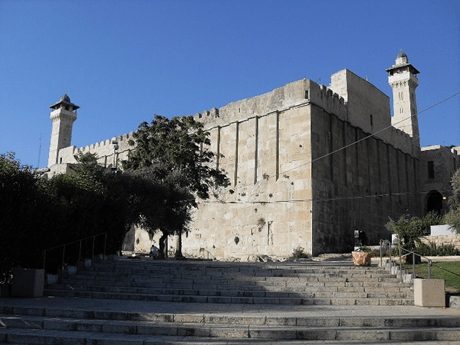
If you go to Hebron to find that cave, you will be confronted by a huge stone enclosure first erected by King Herod over the cave. This structure encloses the cave and is known as the Tomb of the Patriarchs, a site revered by Jews, Christians, and Muslims. Many Jews consider this a very holy site, second only to Jerusalem.
How did God comfort Abraham in his bereavement? First, there were the servants who had worked for Abraham for years, perhaps even for generations. At one point before Isaac’s birth, Abraham had even considered having to make his chief servant his heir, indicating the level of trust Abraham had with his servants. Although there was friction between Sarah and Hagar, much of that was Hagar’s fault. It’s likely that Sarah was quite kind to her other servants.
There was nothing forcing neighboring rulers to call on Abraham. Had Abraham not enjoyed cordial relationships with these men, they could have left him to grieve alone. And the quality of the language these men used when consoling Abraham and releasing a prime burial site demonstrates the kind of concern these men had. These men were not merely neighbors, but also close friends. In a harsh land where tragedies could occur suddenly, friendship was to be prized and comfort given whenever possible.
What about us? How are we caring for those around us? Abraham received comfort because he had been the comforter on several occasions. When tragedies strike, do we involve ourselves personally, or do we hide behind phone and tablet screens, making impersonal donations? In a devotional entitled “God with Skin On,” the author quotes Greg Laurie as having written “Our God put on skin and lived with us. God did this because he is passionate about us and wants to be in a relationship with us. The Word became flesh. The Word lived among us.” (Walking With Jesus: Daily Inspiration From The Gospel Of John by Greg Laurie)
While text messages and emojis might make the senders feel good, for those who are grieving, there’s nothing to substitute for human touch. Hugs without words out-do any number of crying or praying emojis or even messages!
May God help us so that we will be able to console those around us with the same consolation God gives us!
PRAYER: Father God, thank You for loving us and caring for us. Lord, help us to cherish those around us as You do. Help us to comfort the grieving, being Your hands and feet. In the mighty and precious Name of King Jesus. Amen.
 Burunche's Blog
January 14, 2026 at 7:13 pm
Wonderful Devotional!!!