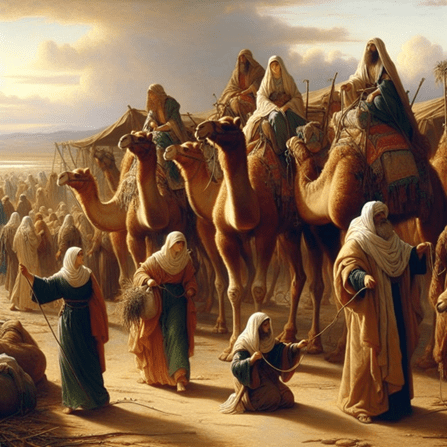
When we read the story of a wife for Isaac in Genesis, Isaac never gets very much attention. We focus on Eliezer the servant and his successful trip to Haran. We marvel at Rebekah’s willingness to travel hundreds of miles into an unknown land to marry a man whom she has never met. But Isaac and his grief are the reasons for that story, so let’s look at Isaac.
Genesis 24:61-67 So Rebekah and her servant girls mounted the camels and went with him.
Meanwhile, Isaac, whose home was in the Negeb, had returned to Beer-lahai-roi. One evening as he was taking a walk out in the fields, meditating, he looked up and saw the camels coming. Rebekah noticed him and quickly dismounted.
“Who is that man walking through the fields to meet us?” she asked the servant.
And he replied, “It is my master’s son!” So she covered her face with her veil. Then the servant told Isaac the whole story.
And Isaac brought Rebekah into his mother’s tent, and she became his wife. He loved her very much, and she was a special comfort to him after the loss of his mother.
Sarah was 90 when she gave birth to Isaac, so by the time Sarah died at age 127, Isaac was 37. Isaac thought his mother was a hoot! Right up until the last day or two of Sarah’s life, she was always the one with wry comments, spicy opinions on every subject imaginable, and the heart of Abraham’s camp. While Abraham presided over the major questions such as moving for better grazing and relationships with local chiefs, Sarah was the one who kept everything moving. It was Sarah who assigned tasks to the serving girls, Sarah who arranged marriages among the servants, Sarah who was always there to give pithy advice and encouragement.
Sarah had a wicked sense of humor, one she carefully disguised whenever it was necessary for her to play the grande dame. One day a visiting merchant vainly schemed to get the better of Abraham in a major deal. Abraham sententiously announced to the man that he needed to pray about it and the man should return on the morrow. But as soon as the man and his camels had disappeared over the nearest hill, Abraham called Sarah to him. Sarah had been sitting quietly in a corner during the negotiations, playing the part of a perfectly submissive wife with no business acumen.
“Well, Sarah, my love,” Abraham said, “what do you think of our friend Abdul?”
“Hmm,” Sarah mused, “as for that man, he talks out of both sides of his mouth. And Abraham, if you shake hands with him, be sure to count your fingers before and afterwards!”
“I see,” said Abraham. “So tomorrow, what should my answer be?”
“Oh, my love,” replied Sarah, “I suggest that you inform him that you have prayed and that you feel tomorrow is not an auspicious day for such a major endeavor. Tell him that you must continue to pray and that you will send a messenger, should the signs become more auspicious in the future.”
“And when do you anticipate the signs becoming more auspicious?” questioned Abraham, thoroughly enjoying the joke.
“Well,” mused Sarah, “perhaps if the Negeb desert suddenly begins blossoming with all kinds of crops and fruit trees. Or perhaps if our camels, who are notoriously ill-tempered, suddenly choose to become completely docile and come to our tents and sing to us.”
“Or perhaps,” Abraham added, “if you become pregnant at the age of 120?”
“Well, yes,” Sarah chuckled. “I praise Jehovah for allowing me to become a mother at age 90, but I don’t think Isaac needs another miracle sibling.”
Throughout Sarah’s entire life, she was the one who kept things humming in Abraham’s camp. Everyone realized that Sarah was dying when she stopped giving orders and simply lay in her bed, weakly requesting for Abraham and Isaac to come to her. For both men, it was unthinkable that this indomitable woman on whom they had both depended for so many years might leave them. Isaac particularly had no idea how he would go on. Seeing Isaac’s despair, Abraham realized that he had done everything for Isaac he could; now only a wife could console Isaac. Calling Eliezer to him, Abraham gave Eliezer detailed instructions and then personally selected the treasures Eliezer should carry to Haran to entice a young woman to return with him. But as Eliezer set off to the northeast on the road toward Haran, both Abraham and Isaac wondered if he would be successful, or indeed, if he would even return.
Three months had passed without any word from Eliezer or any of the relatives in Haran. Each evening, Isaac would walk out into the fields around his camp, searching for any sign of a caravan on the horizon. As Isaac walked, he continued to remember his mother, her wisdom, her sense of humor, her encouragement, and her love. Frankly, Isaac never knew it was possible to miss anyone as much as he missed his mother; the longing for her was a physical ache that refused to dissipate.
Finally, that last evening, Isaac walked out once more. Honestly, Isaac nearly remained in his tent that night; however, the evening breeze was fresh, the sunset was painting the evening sky with glowing colors, and Isaac figured, “Why not?” Looking northward, Isaac thought he saw something cresting a distant hill. On closer inspection, Isaac realized it was a caravan with Eliezer riding the lead camel. Forgetting tiredness and despair, Isaac began walking swiftly, but the walk increased to a jog and then the jog to a headlong run. It WAS Eliezer, and there were two ladies riding the spare camels! Now Isaac was pelting full-tilt. Meanwhile, Rebecca saw this handsome man running toward the caravan.
“Who is that man?” asked Rebecca.
“Oh, that is Isaac, my master Abraham’s son, your future husband,” replied Eliezer.
Rebekah and her nurse had been enjoying the evening breeze; however, now both ladies swiftly veiled themselves as custom demanded.
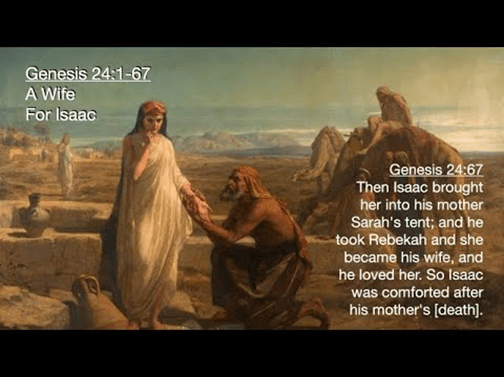
“Eliezer, welcome! A thousand welcomes!” cried Isaac.
“Thank you, thank you, thank you!” replied Eliezer. “We are thrilled to be here, and I think some introductions are in order. Isaac Ben Abraham, meet Rebekah, daughter of Bethuel, your father’s nephew, and granddaughter of Nahor, your father’s brother. Accompanying Rebekah is Amina, her faithful nurse, and a delightful lady in her own right.”
“Welcome, Rebekah! Welcome, Amina!” Isaac said. Isaac closely inspected Rebekah. While Rebecca was wrapped in traveling robes, her dark eyes were sparkling; in fact, her eyes reminded Isaac of his mother’s eyes. And Rebecca’s movements were lithe and graceful, hinting of the beauty hidden under those robes.
As Isaac was greeting Eliezer, Abraham was watching at a distance as he sat at the camp. Abraham had stood up when he heard Isaac’s cries of greeting and had seen the caravan approaching. Heaving an enormous sigh of relief, Abraham returned to the place where he had been resting and looked heavenward.
“Jehovah,” Abraham murmured, “no amount of thanks or praise or blessing is sufficient for what You have done. Not only have You given me Isaac as an heir, but You have also preserved Eliezer during his travels and have provided the perfect bride for Isaac. I am happy and relieved. Great is Your faithfulness!”
As I write these words, I am remembering all the bereavements we have endured during our lifetimes. We have lost parents, step-parents, siblings, close friends, and beloved pets. Grief can ambush us at any moment. Losses we have suffered decades ago may suddenly seem fresh if we see or hear something reminding us of the lost loved one.
I was seven years out from the loss of my mother when grief savagely attacked me. In the age before television became common, people in rural communities took entertainment where they could find it, including PTA meetings at grade schools. My mother was an excellent singer and actress; at one PTA meeting in our small Illinois town in the 1950’s she performed a comic song from the musical Guys and Dolls entitled “Adelaide’s Lament.” Seven years after my mother’s death and at least thirty years after that performance, I was in the audience for a community production of that musical in a town in Oklahoma. I was thoroughly enjoying things when “Adelaide’s Lament” started, and suddenly I was sobbing.
For my husband, one trigger for his grief is the final scene of the movie A River Runs Through It, based on a semi-autobiographical story by Norman Maclean. The movie depicts the true lives of a Montana family headed by a strict Presbyterian minister who was also a fly-fishing afficionado, and the tragedy of his brilliant younger son who was addicted to gambling and alcohol. The story is narrated by Norman, the older son, also a fly fisherman, who becomes a professor of Literature at the University of Chicago. In the final scene, the author, now an old man, is seen flyfishing on a river in Montana as the sinking sun gleams on the water. That scene always reminds my husband of his late father, who loved fishing. The movie is one of our favorites, but that last scene always leaves my husband in tears.
Can God comfort us in our grief? Yes! We can bear witness that God has repeatedly comforted us and has given us the strength to go forward. We returned to Ghana in November 2021, leaving one of my beloved brothers dying from COVID pneumonia. But we did so with my brother’s blessing because our hospital desperately needed my services and we knew we would see my brother in heaven. it’s tempting to get stuck in the grief; however, grief is an energy-suck that can pull us into a bottomless whirlpool of regret. Some of the best advice I ever heard about grief came from one of my father’s friends as they were burying my mother. A local farmer whose wife had died the year before advised Dad to grieve for awhile, then to put his grief away and open it at intervals. This practice would allow Dad to continue to function while still honoring my mother’s memory.
May God help those of us who are grieving so that we find our rest and comfort in Him. ‘
PRAYER: Father God, thank You for loving us and caring for us. Lord, for many of us, 2025 was a horrible year full of grief and loss. Lord, please comfort all those who mourn and give them the hope that only You can give. In the mighty and precious Name of King Jesus. Amen.
 Burunche's Blog
Leave a comment