
1 Samuel 8:1-5 In his old age, Samuel retired and appointed his sons as judges in his place. Joel and Abijah, his oldest sons, held court in Beersheba; but they were not like their father, for they were greedy for money. They accepted bribes and were very corrupt in the administration of justice. Finally the leaders of Israel met in Ramah to discuss the matter with Samuel. They told him that since his retirement things hadn’t been the same, for his sons were not good men.
For centuries, the Israelites have been governed by a succession of judges, of whom Samuel is the most recent. As long as Samuel continues to judge Israel, all is well; however, Samuel’s sons are a different matter. Not only are Samuel’s sons corrupt, but they are so corrupt that if one party to a dispute has already bribed them, they will side with the other party, assuming that side can pay them even more. This problem gives the Israelites the opportunity to push for a king, something they have wanted for a long time. Even though God has been king of Israel, these men want a tall strong brave inspiring man to lead them. Samuel is horrified; however, God orders Samuel to anoint Saul, the son of Kish, an important man from the tribe of Benjamin.
Saul LOOKS like the perfect king-tall, strong, and forceful. But morally, Saul proves weak and faithless, bowing to public pressure and failing the tests God sets for him. Samuel grieves, for he has assumed his work is done. But God has already chosen Saul’s successor, and before He’s through, everybody is going to be shocked.
1 Samuel 16:1-4 Finally the Lord said to Samuel, “You have mourned long enough for Saul, for I have rejected him as king of Israel. Now take a vial of olive oil and go to Bethlehem and find a man named Jesse, for I have selected one of his sons to be the new king.”
But Samuel asked, “How can I do that? If Saul hears about it, he will kill me.”
“Take a heifer with you,” the Lord replied, “and say that you have come to make a sacrifice to the Lord. Then call Jesse to the sacrifice, and I will show you which of his sons to anoint.”
So Samuel did as the Lord had told him to. When he arrived at Bethlehem, the elders of the city came trembling to meet him.
“What is wrong?” they asked. “Why have you come?”
5-9 But he replied, “All is well. I have come to sacrifice to the Lord. Purify yourselves and come with me to the sacrifice.”
And he performed the purification rite on Jesse and his sons, and invited them too. When they arrived, Samuel took one look at Eliab and thought, “Surely this is the man the Lord has chosen!”
But the Lord said to Samuel, “Don’t judge by a man’s face or height, for this is not the one. I don’t make decisions the way you do! Men judge by outward appearance, but I look at a man’s thoughts and intentions.”
Then Jesse told his son Abinadab to step forward and walk in front of Samuel. But the Lord said, “This is not the right man either.”
Next Jesse summoned Shammah, but the Lord said, “No, this is not the one.” In the same way all seven of his sons presented themselves to Samuel and were rejected.
10-13 “The Lord has not chosen any of them,” Samuel told Jesse. “Are these all there are?”
“Well, there is the youngest,” Jesse replied. “But he’s out in the fields watching the sheep.”
“Send for him at once,” Samuel said, “for we will not sit down to eat until he arrives.”
So Jesse sent for him. He was a fine looking boy, ruddy-faced, and with pleasant eyes. And the Lord said, “This is the one; anoint him.”
So as David stood there among his brothers, Samuel took the olive oil he had brought and poured it upon David’s head; and the Spirit of Jehovah came upon him and gave him great power from that day onward. Then Samuel returned to Ramah.
When Samuel anointed Saul as king, he really hoped that Saul would prove to be everything Israel needed. But Saul’s character does not match his physique. Given direct orders to wipe out the Amalekites and everything belonging to them, Saul tries to compromise-after all, some of that livestock is really prime, and perhaps the enemy king will be willing to buy his life with hidden wealth. Both God and Samuel grieve over Saul; however, Saul is obviously not fit. Now Israel needs a king who will truly obey God, and God sends Samuel to Bethlehem to anoint the next king from the house of Jesse.
Samuel calls Jesse and his sons to a sacrifice and then begins examining Jesse’s boys. All seven of the boys are tall, strong, and good-looking; surely one of these men will be the next king. But God keeps rejecting these men. By now, Samuel is really confused! What’s going on here?
“Jesse, do you have any more sons?” Samuel asks in confusion.
“Well, yes, there’s the youngest one, David. But you probably don’t want him. Besides, he’s out in the fields watching sheep.”
Meanwhile, David has gotten wind of Samuel’s coming, but he isn’t concerned. As the youngest and smallest, David has become used to being ignored and taken for granted. As far as the rest of the family thinks, sheep herding is all David is good for anyway. But God has a different idea. All the time that David has been herding sheep, he has been praying, playing his harp, writing music, and practicing his marksmanship with a sling. Many people in countries with modern high-powered rifles fail to appreciate that in Samuel’s time, soldiers with slings were the snipers of their day. Those slings were not simply children’s toys! At one point, the Bible describes soldiers who were experts with slings, either right-handed or left-handed, and who could hit a hair with their missiles. And all those encounters with lions and bears, all those nights spent living rough and watching the sheep, have made David one tough teen-ager. By contrast, David’s older brothers have remained in the house with Jesse, where things are easy and undemanding.
David has spent long hard years with God as his only source of comfort. Obviously, Jesse doesn’t care much about David, for when Samuel announces that he wants Jesse and all his sons to come for a sacrifice, Jesse doesn’t even consider calling David. After all, someone has to watch those sheep, and Jesse has seven big strong sons. Surely, this youngest one is expendable.
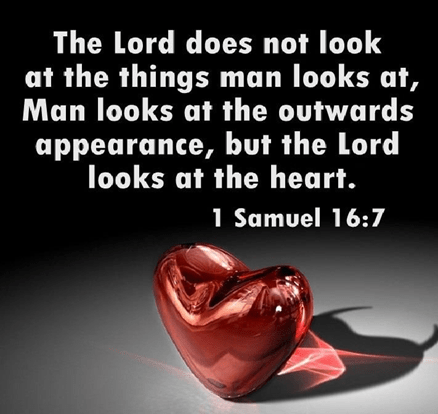
It’s God who has comforted David all these years, and that same God chooses David to rule over Israel. One of the key points in this chapter comes in verse 7 when God says,“Don’t judge by a man’s face or height, for this is not the one. I don’t make decisions the way you do! Men judge by outward appearance, but I look at a man’s thoughts and intentions.”
We don’t know which of David’s psalms is the earliest; however, many scholars feel that Psalm 23 might qualify. “Because the Lord is my Shepherd, I have everything I need! He lets me rest in the meadow grass and leads me beside the quiet streams. He gives me new strength. He helps me do what honors him the most. Even when walking through the dark valley of death I will not be afraid, for you are close beside me, guarding, guiding all the way.
You provide delicious food for me in the presence of my enemies. You have welcomed me as your guest; blessings overflow! Your goodness and unfailing kindness shall be with me all of my life, and afterwards I will live with you forever in your home.” (The Living Bible)
Although this psalm is perhaps the best-known and best-loved of all the psalms, many of us fail to realize it was written by a man whose own father thought so little of him that when the major prophet of Israel invited the family to worship with him, that same father initially left him out in the sheep pasture, essentially rejecting him from being his son.
Family dynamics can be scary and difficult. Sometimes, one or more children will be designated as “hero children,” who are given tasks far above their age level. Many times, those same children may be taken for granted, as if they don’t have the same emotional needs as their siblings. That’s what has happened to David. You might be that hero child, denied some of the emotional support from your family. But consider David; when God is selecting the next king, He ignores all seven of Jesse’s older sons, choosing David instead. The very challenges David has faced and his responses to them have developed the qualities needed for the next king of Israel.
In a book entitled Don’t Waste Your Sorrows, Paul E. Bilheimer graphically describes how suffering shapes us to fulfill God’s plans for our lives. David’s father has neglected him, sending him to the sheep pasture. But God has met David in that sheep pasture, comforting him and teaching him lessons he will need to govern wisely, for leading people is not dissimilar from herding wayward sheep.
God does not play favorites! The same God who plucked David from the sheep pasture to ultimately become king is watching over you today. God is all-knowing and all-powerful, and He can redeem every horrible experience you have ever had and use it for His glory. Drug addiction, PTSD, sexual abuse, emotional neglect, physical abuse-God is greater than all of these problems. My first marriage ended in divorce and I was thoroughly ashamed and devastated by this failure. But I learned God could redeem those years when I found myself counseling another woman whose life had been shattered by marital problems. When this lady told me that I couldn’t possibly understand her situation, I found myself saying, “Well, let me try.” In the next few moments, I perfectly described her emotional struggles and her feelings of worthlessness. When I finished, there was stunned silence at the other end of the phone, and then this lady asked in a shaking voice, “How do you KNOW these things?” And I answered, “BECAUSE I HAVE BEEN THERE!”
God is the Ultimate Comforter, who comforts us so that we might comfort others. But first, we must open ourselves to allow God to comfort us. This means we must let go of our hatreds, our resentments, our disgust, and our despair. Some people feed on emotional negativity, but that only leads to hellish despair. We must release all those things so that God can clean us up and give us His Holy Spirit. Let’s pray.
PRAYER:Father God, thank You for loving us and caring for us. Lord, You chose David, even when his family had rejected him. Jesus, You were “despised and rejected,” so you know how many of us have felt. Lord, please help all who read these words to let go of the negative things that are dragging them down, give those things to You, and let You replace them with Your love, joy, peace, patience, kindness, goodness, faithfulness, gentleness, and self-control. In the mighty and precious Name of King Jesus. Amen.
 Burunche's Blog
Leave a comment