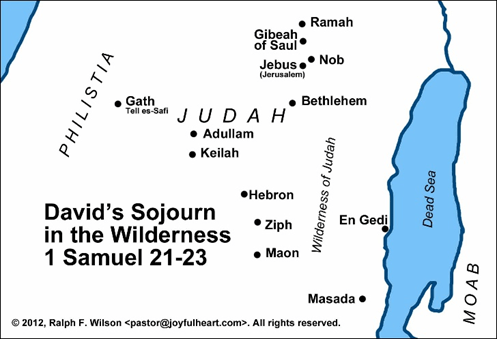
1 Samuel 23:1-6 One day news came to David that the Philistines were at Keilah robbing the threshing floors.
David asked the Lord, “Shall I go and attack them?”
“Yes, go and save Keilah,” the Lord told him.
But David’s men said, “We’re afraid even here in Judah; we certainly don’t want to go to Keilah to fight the whole Philistine army!”
David asked the Lord again, and the Lord again replied, “Go down to Keilah, for I will help you conquer the Philistines.”
They went to Keilah and slaughtered the Philistines and confiscated their cattle, and so the people of Keilah were saved. (Abiathar the priest went to Keilah with David, taking his ephod with him to get answers for David from the Lord.)
7 -13 Saul soon learned that David was at Keilah.
“Good!” he exclaimed. “We’ve got him now! God has delivered him to me, for he has trapped himself in a walled city!”
So Saul mobilized his entire army to march to Keilah and besiege David and his men. But David learned of Saul’s plan and told Abiathar the priest to bring the ephod and to ask the Lord what he should do.
“O Lord God of Israel,” David said, “I have heard that Saul is planning to come and destroy Keilah because I am here. Will the men of Keilah surrender me to him? And will Saul actually come, as I have heard? O Lord God of Israel, please tell me.”
And the Lord said, “He will come.”
“And will these men of Keilah betray me to Saul?” David persisted.
And the Lord replied, “Yes, they will betray you.”
So David and his men—about six hundred of them now—left Keilah and began roaming the countryside. Word soon reached Saul that David had escaped, so he didn’t go there after all.
David’s army now numbers 600 men, and they are running from Saul, hiding in caves in the southern part of Israel south of Hebron. The men of Keilah are opportunists who welcome David as long as he is delivering them from the Philistines but who then message Saul that he should come arrest David. Of course, there is the small fact that Saul has already threatened to destroy Keilah if its citizens refuse to hand David over to him. These people are caught in a dilemma: save the guy who has delivered them but possibly face total destruction of the city by Saul, or placate their crazy ruler. The Ghanaians have a saying that “When two elephants fight, it’s the grass that gets trampled.” The Keilah people fear that they will wind up as trampled grass, so they take the expedient way out, messaging Saul.
14-20 David now lived in the wilderness caves in the hill country of Ziph. One day near Horesh he received the news that Saul was on the way to Ziph to search for him and kill him. Saul hunted him day after day, but the Lord didn’t let him find him.
(Prince Jonathan now went to find David; he met him at Horesh and encouraged him in his faith in God.
“Don’t be afraid,” Jonathan reassured him. “My father will never find you! You are going to be the king of Israel and I will be next to you, as my father is well aware.” So the two of them renewed their pact of friendship; and David stayed at Horesh while Jonathan returned home.)
But now the men of Ziph went to Saul in Gibeah and betrayed David to him.
“We know where he is hiding,” they said. “He is in the caves of Horesh on Hachilah Hill, down in the southern part of the wilderness. Come on down, sir, and we will catch him for you and your fondest wish will be fulfilled!”
Next, it’s the men of Ziph who try to betray David to Saul. Why is everybody so afraid? Despite isolation, word has gotten around concerning the complete destruction of the town of Nob, including eighty-five priests, their families, and animals. Now people are terrified to help David for fear that their town will be the next one to be destroyed. The men of Ziph are willing to lead Saul to David; however, once more, David and his men escape.
24-29 So the men of Ziph returned home. But when David heard that Saul was on his way to Ziph, he and his men went even further into the wilderness of Maon in the south of the desert. But Saul followed them there. He and David were now on opposite sides of a mountain. As Saul and his men began to close in, David tried his best to escape, but it was no use. But just then a message reached Saul that the Philistines were raiding Israel again, so Saul quit the chase and returned to fight the Philistines. Ever since that time the place where David was camped has been called, “The Rock of Escape.” David then went to live in the caves of Engedi.
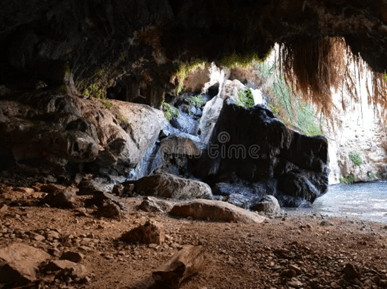
Talk about a thriller situation! David and his men are trapped with Saul and his army closing in on them. Suddenly, a panting messenger runs up to Saul. “King Saul,” the messenger gasps, “come quickly! The Philistines are raiding and we desperately need your help!” Muttering curses under his breath, Saul breaks off the hunt for David and heads north to meet the Philistines. Meanwhile, David and his men travel eastward to Engedi (now known as Ein-gedi) near the Dead Sea.
David’s wilderness adventures would make an excellent adventure movie, but what can we learn from his experiences?
- Helping people does not guarantee that they won’t betray you. When David and his men show up at Keilah, the Philistines are raiding the threshing floors. Not only do David and his men thoroughly trounce the Philistines, but they even confiscate the cattle the Philistines have already captured as they have raided their way across the countryside. Presumably, David leaves those cattle for the people of Keilah, meaning that they have their harvest plus more cattle than they possessed before. Do the citizens of Keilah remain loyal to David? Are you kidding? The second word reaches Keilah that they either hand David over or be wiped out, they are more than ready to hand David over. Loyalty only goes so far, and everybody has heard of the tragedy at Nob. You should always help people and do the right thing; however, remember that those same people have other pressures on them. Your help does not guarantee their loyalty.
- When God is on your side, He delivers you, even if it’s at the last second. The Bible indicates that Saul had David trapped on a mountain when he had to break off chasing David to go fight the Philistines. Notice though, that David was doing everything he could to help himself. God won’t deliver you as long as you are sitting still, refusing to lift a finger to extricate yourself from your problems.
- We can still gain comfort from God, even when friends prove false and we are in danger. God is the One who knows all the details of our lives. J. Hudson Taylor, founder of the China Inland Mission, was fond of saying that “Man is immortal until his work is done.” God has far more for David to do and is not about to allow Saul to slaughter him.
Throughout David’s life, he continued to write psalms. Psalm 142 is supposedly the one David wrote while hiding in that cave in Engedi.
142 1-2 How I plead with God, how I implore his mercy, pouring out my troubles before him. 3 For I am overwhelmed and desperate, and you alone know which way I ought to turn to miss the traps my enemies have set for me. 4 (There’s one—just over there to the right!) No one gives me a passing thought. No one will help me; no one cares a bit what happens to me. 5 Then I prayed to Jehovah. “Lord,” I pled, “you are my only place of refuge. Only you can keep me safe.
6 “Hear my cry, for I am very low. Rescue me from my persecutors, for they are too strong for me. 7 Bring me out of prison so that I can thank you. The godly will rejoice with me for all your help.”
You might identify with David. Perhaps people you have helped have failed you when you needed help. Remember that only God knows the whole story. Forgive those people but remember that God is the One who never fails, who never changes. Trust Him!
PRAYER: Father God, thank You for loving us and caring for us. Lord, help us to rely on You, no matter the circumstances and to forgive those who disappoint us, realizing they may be suffering in ways we cannot see. In the mighty and precious Name of King Jesus. Amen.
 Burunche's Blog
Leave a comment