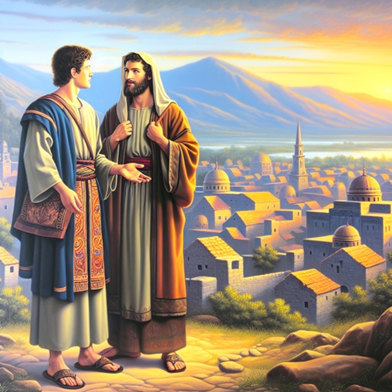
2 Samuel 2:1-4 After this, David asked the Lord, “Should I move back to one of the towns of Judah?”
“Yes,” the Lord replied.
Then David asked, “Which town should I go to?”
“To Hebron,” the Lord answered.
David’s two wives were Ahinoam from Jezreel and Abigail, the widow of Nabal from Carmel. So David and his wives and his men and their families all moved to Judah, and they settled in the villages near Hebron. Then the men of Judah came to David and anointed him king over the people of Judah.
Saul is dead, and the kingdom is dividing. At the word of the Lord, David moves to villages around Hebron. While Hebron is in Judah, it is a distance from Jerusalem and even further from most of the land of Benjamin. Abner, Saul’s former military commander and uncle, is about to anoint one of Saul’s remaining sons as king; however, the men of Judah remember Samuel’s anointing of David and spontaneously come to anoint David as king over Judah.
Hebron has a long and honorable spiritual history. Originally, Hebron was the town Caleb requested as part of his inheritance when Joshua was dividing the land. When Moses sent twelve spies out to spy out the Promised Land, Joshua and Caleb were the only two men who avowed that God would defeat all the Canaanites, including the giants. For his faith, Caleb was allowed to enter Canaan and was promised to receive the city of Hebron. The story is told in Joshua 14:6-15
A delegation from the tribe of Judah, led by Caleb son of Jephunneh the Kenizzite, came to Joshua at Gilgal. Caleb said to Joshua, “Remember what the Lord said to Moses, the man of God, about you and me when we were at Kadesh-barnea. I was forty years old when Moses, the servant of the Lord, sent me from Kadesh-barnea to explore the land of Canaan. I returned and gave an honest report, but my brothers who went with me frightened the people from entering the Promised Land. For my part, I wholeheartedly followed the Lord my God. So that day Moses solemnly promised me, ‘The land of Canaan on which you were just walking will be your grant of land and that of your descendants forever, because you wholeheartedly followed the Lord my God.’
“Now, as you can see, the Lord has kept me alive and well as he promised for all these forty-five years since Moses made this promise—even while Israel wandered in the wilderness. Today I am eighty-five years old. I am as strong now as I was when Moses sent me on that journey, and I can still travel and fight as well as I could then. So give me the hill country that the Lord promised me. You will remember that as scouts we found the descendants of Anak living there in great, walled towns. But if the Lord is with me, I will drive them out of the land, just as the Lord said.”
So Joshua blessed Caleb son of Jephunneh and gave Hebron to him as his portion of land. Hebron still belongs to the descendants of Caleb son of Jephunneh the Kenizzite because he wholeheartedly followed the Lord, the God of Israel. (Previously Hebron had been called Kiriath-arba. It had been named after Arba, a great hero of the descendants of Anak.)
Judges 1: 20 The town of Hebron was given to Caleb as Moses had promised. And Caleb drove out the people living there, who were descendants of the three sons of Anak.
Every Israelite knows the story of Caleb and how God gave him the city of Hebron, if he would drive out the giants. Caleb and his relatives completely eliminated the giants, taking over the town and renaming it. Now upon God’s advice, David is beginning to establish his kingdom, starting with his tribe of Judah, using Hebron as a temporary capital.
What’s so important about these few verses is the way David begins his kingship. David doesn’t struggle to gain control over all of Israel but begins by consulting God and then moving to the Hebron area. It is the men of Judah who come together to anoint David as king. Whoever recorded 2 Samuel was very careful about details; had David sent messengers all over Judah or Israel seeking support, we would know it.
The men of Judah anoint David as king because they recognize the validity of Samuel’s earlier anointing. These days, we know very little about anointing; however, the Bible speaks about it a great deal. God sent Samuel to Bethlehem to Jesse’s house to anoint one of his sons. When Samuel saw all those tall strapping men, he was certain that one of them would be the next king; however, it was only when Jesse called David in from the sheep pasture that God allowed Samuel to proceed to anoint David. Centuries later, Saint Paul will write to Christians in Rome, saying, “For God’s gifts and his call can never be withdrawn.” (Romans 11:29)
God is comforting David by moving the men of Judah to anoint him as king. This spontaneous act on the part of these people is the first affirmation that David will eventually become king over all Israel. What can we learn from this story?
Perhaps God has called you to a work. The work has been long and difficult and you have found yourself surrounded by nay-sayers. Take heart! The same God who called David from the sheep fold to become a king will confirm you in your calling just as He did for David. Do not give up! Do not despair! God is still on the throne and He is still Melech Ha’ Olam, King of the Universe. God’s gifts and His calling remain with you and He will never leave you or forsake you!
PRAYER: Father God, thank You for loving us and caring for us. Lord, help us to follow hard after You all the days of our lives, knowing that You are the Source of our comfort, our joy, our strength, and our hope. You are the Source of our provision. In the mighty and precious Name of King Jesus. Amen.
 Burunche's Blog
Leave a comment