Archive for January, 2026

JANUARY 21, 2026 WE ALL NEED COMFORT, BUT HOW DO WE GET IT? #21 GOD CAN COMFORT YOU WHEN YOUR BOSS DECIDES TO ENVY AND HATE YOU

January 21, 2026

1 Samuel 16:14-23 But the Spirit of the Lord had left Saul, and instead, the Lord had sent a tormenting spirit that filled him with depression and fear. Some of Saul’s aides suggested a cure.

“We’ll find a good harpist to play for you whenever the tormenting spirit is bothering you,” they said. “The harp music will quiet you and you’ll soon be well again.”

“All right,” Saul said. “Find me a harpist.”

One of them said he knew a young fellow in Bethlehem, the son of a man named Jesse, who was not only a talented harp player, but was handsome, brave, and strong, and had good, solid judgment. “What’s more,” he added, “the Lord is with him.”

So Saul sent messengers to Jesse, asking that he send his son David the shepherd. 20 Jesse responded by sending not only David but a young goat and a donkey carrying a load of food and wine. From the instant he saw David, Saul admired and loved him; and David became his bodyguard.

Then Saul wrote to Jesse, “Please let David join my staff, for I am very fond of him.”

And whenever the tormenting spirit from God troubled Saul, David would play the harp and Saul would feel better, and the evil spirit would go away.

Saul had it all, and he blew it! God chose Saul to be the first king over Israel and even put His Holy Spirit on Saul so that Saul prophesied at one point. Had Saul faithfully followed all God’s orders, God would have established Saul’s family as the ruling dynasty for Israel. But Saul never truly believed; instead, Saul tried to use God, and that never works. The Sovereign Lord of the Universe is not a fetish to be used and manipulated. After Saul’s final act of disobedience in refusing to follow God’s specific instructions on wiping out the Amalekites, God finally rejected Saul. Had Saul truly repented, God might have relented in his judgment; however, repentance never entered Saul’s mind. Nature abhors a vacuum, including a spiritual one. Once the Holy Spirit left Saul, demons entered. Only praise music played by a true believer could drive away the demons, so David became Saul’s harp player and his bodyguard. But now David was working for a man who had rejected God’s guidance.

1 Samuel 18:4-6 King Saul now kept David with him and wouldn’t let him return home anymore. He was Saul’s special assistant, and he always carried out his assignments successfully. So Saul made him commander of his troops, an appointment that was applauded by the army and general public alike. But something had happened when the victorious Israeli army was returning home after David had killed Goliath. Women came out from all the towns along the way to celebrate and to cheer for King Saul, and were singing and dancing for joy with tambourines and cymbals.

So far, so good. David has defeated Goliath and Saul has promoted him to commander of the Israelite troops. But now there’s a new problem: David is becoming more popular than Saul. To make things worse, the prophet Samuel has already informed Saul that God has rejected him as king and is choosing someone else to succeed him. Saul is furious and resentful, on the watch for any upstart. And more trouble is on the way.

7-16 However, this was their song: “Saul has slain his thousands, and David his ten thousands!”

Of course, Saul was very angry. “What’s this?” he said to himself. “They credit David with ten thousands and me with only thousands. Next they’ll be making him their king!”

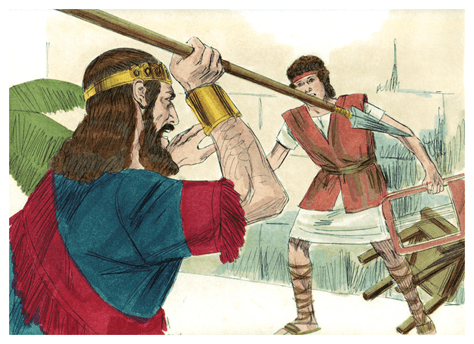
So from that time on King Saul kept a jealous watch on David. The very next day, in fact, a tormenting spirit from God overwhelmed Saul, and he began to rave like a madman. David began to soothe him by playing the harp, as he did whenever this happened. But Saul, who was fiddling with his spear, suddenly hurled it at David, intending to pin him to the wall. But David jumped aside and escaped. This happened another time, too, for Saul was afraid of him and jealous because the Lord had left him and was now with David. Finally, Saul banned him from his presence and demoted him to the rank of captain. But the controversy put David more than ever in the public eye.

David continued to succeed in everything he undertook, for the Lord was with him. When King Saul saw this, he became even more afraid of him; but all Israel and Judah loved him, for he was as one of them.

Saul is angry, anxious, and suspicious. While Saul has rejected God and His ways, David continues to serve God and God is with him. Saul is becoming increasingly paranoid, with demons crowding into his heart and mind. Eventually, Saul makes two different attempts to pin David to the wall with his spear, hoping to kill him. But each time Saul attempts something, David escapes. Saul even demotes David to the rank of captain in hopes of removing him from the public eye, but David becomes increasingly popular anyway. And the stories about Saul trying to spear David are circulating throughout Israel while its citizens wonder why Saul is trying to kill the hero who has delivered them from Goliath and the Philistines.

Paranoid schizophrenia and demon possession share many traits in common. I served my rotation in Psychiatry at a VA hospital shortly after the end of the Vietnam War. We had many young veterans who had gotten into drugs, particularly LSD, while they were in Nam, only to develop paranoid schizophrenia. At the time, I knew nothing about spiritual warfare or the demonic; however, looking back, I wonder how many of these poor souls had opened themselves to demons under the influence of drugs. Please do not misunderstand! I am not trying to over-simplify a highly complicated diagnosis, nor am I suggesting that if someone prays for you, you should throw away your drugs. But spiritual conditions are inevitably tied to physical and emotional ones; we cannot separate people’s natures into neat little boxes. And demons will take advantage of any weakness available.

David’s dilemma is also complicated. David has joined Saul’s staff at Saul’s written request and has become extremely popular. Now the very man who invited David to come in the first place has tried to kill him twice. What should David do? God has obviously opened this opportunity, but should David return to herding sheep? Lions and bears might be safer to deal with than a demon-possessed ruler. Where is God’s comfort in all of this?

One or two generations ago in America, a worker might join a company and work there his or her entire career, moving steadily up the ranks. These days, most companies have no loyalty to their workers, and the workers reflect that attitude. But what if you are a worker who has been specifically recruited for a position, only to have the boss who recruited you suddenly change? This is David’s dilemma.

In such a situation, there are two questions you must ask yourself:

  1. Has God brought you to this place?
  2. If God has brought you to this place, has He changed your assignment or should you remain?

If you firmly believe that God has brought you and that He has not changed your assignment, HOLD ON! God wants to do something wonderful and Satan is trying to oppose Him. You are simply caught in the middle.

Later, when David is fleeing from Saul, he expresses his fears and hopes in Psalm 34:1-9 I will praise the Lord no matter what happens. I will constantly speak of his glories and grace. I will boast of all his kindness to me. Let all who are discouraged take heart. Let us praise the Lord together and exalt his name. For I cried to him and he answered me! He freed me from all my fears. Others too were radiant at what he did for them. Theirs was no downcast look of rejection! This poor man cried to the Lord—and the Lord heard him and saved him out of his troubles. For the Angel of the Lord guards and rescues all who reverence him.

Oh, put God to the test and see how kind he is! See for yourself the way his mercies shower down on all who trust in him. If you belong to the Lord, reverence him; for everyone who does this has everything he needs.

Ultimately, God delivers David, making him king instead of Saul. But God is the One who does that; David refuses to kill Saul, even when he might. You too can take comfort in the knowledge that “The Angel of the Lord guards and rescues all who reverence him.”

PRAYER: Father God, thank You for loving us and caring for us. Lord, help us to trust in You, even when things appear bleak. You are the One who calls us, who saves us, and who leads us into the bright future You have for us. In the mighty and precious Name of King Jesus. Amen.
JANUARY 20, 2026 WE ALL NEED COMFORT, BUT HOW DO WE GET IT? #20 GOD CAN COMFORT YOU WHEN PEOPLE DON’T BELIEVE IN YOU

January 20, 2026

1 Samuel 17:1-3 The Philistines now mustered their army for battle and camped between Socoh in Judah and Azekah in Ephes-dammim. Saul countered with a buildup of forces at Elah Valley. So the Philistines and Israelis faced each other on opposite hills, with the valley between them.

4-7 Then Goliath, a Philistine champion from Gath, came out of the Philistine ranks to face the forces of Israel. He was a giant of a man, measuring over nine feet tall! He wore a bronze helmet, a two-hundred-pound coat of mail, bronze leggings, and carried a bronze javelin several inches thick, tipped with a twenty-five-pound iron spearhead, and his armor bearer walked ahead of him with a huge shield.

8-10 He stood and shouted across to the Israelis, “Do you need a whole army to settle this? I will represent the Philistines, and you choose someone to represent you, and we will settle this in single combat! If your man is able to kill me, then we will be your slaves. But if I kill him, then you must be our slaves! I defy the armies of Israel! Send me a man who will fight with me!”

King Saul has faced opposing forces before, but he’s never encountered anything like this! The Philistines have one of the giants on their side, and he’s challenging the Israelites to send forth a champion for a mano-a-mano duel. But this guy is ginormous, and nobody wants to face him.

David has joined Saul’s staff on a part-time basis because Saul has learned David’s songs of praise can drive away the demons that have been attacking him. Now David has returned from home and is asking about this giant. Everybody takes one look at this teen-ager and figures this kid is just satisfying his morbid curiosity. But David knows better and claims he can handle this giant.

1 Samuel 17:32-37 “Don’t worry about a thing,” David told him. “I’ll take care of this Philistine!”

“Don’t be ridiculous!” Saul replied. “How can a kid like you fight with a man like him? You are only a boy, and he has been in the army since he was a boy!”

But David persisted. “When I am taking care of my father’s sheep,” he said, “and a lion or a bear comes and grabs a lamb from the flock, I go after it with a club and take the lamb from its mouth. If it turns on me, I catch it by the jaw and club it to death. I have done this to both lions and bears, and I’ll do it to this heathen Philistine too, for he has defied the armies of the living God! The Lord who saved me from the claws and teeth of the lion and the bear will save me from this Philistine!”

Saul finally consented, “All right, go ahead,” he said, “and may the Lord be with you!”

As a small boy, David has had to learn to fight smarter, not wasting force. Repeatedly, God has delivered David from vicious animals several times his size. David’s confidence is not in himself, but in the God who has preserved his life all these years. And David has a secret weapon, one Goliath has never previously encountered.

38-42 Then Saul gave David his own armor—a bronze helmet and a coat of mail. David put it on, strapped the sword over it, and took a step or two to see what it was like, for he had never worn such things before. “I can hardly move!” he exclaimed, and took them off again. Then he picked up five smooth stones from a stream and put them in his shepherd’s bag and, armed only with his shepherd’s staff and sling, started across to Goliath. Goliath walked out toward David with his shield-bearer ahead of him, sneering in contempt at this nice little red-cheeked boy!

As a conventional soldier, Saul can’t imagine facing this giant without armor; however, David rapidly realizes that Saul’s armor is only a hindrance. All the years that David has been facing huge powerful wild animals, he has never used armor and he doesn’t need it today either.

43-47“Am I a dog,” he roared at David, “that you come at me with a stick?” And he cursed David by the names of his gods. “Come over here and I’ll give your flesh to the birds and wild animals,” Goliath yelled.

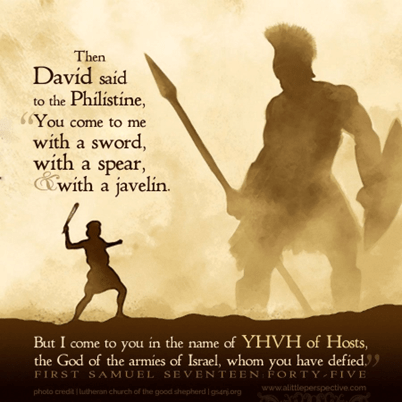
David shouted in reply, “You come to me with a sword and a spear, but I come to you in the name of the Lord of the armies of heaven and of Israel—the very God whom you have defied. Today the Lord will conquer you, and I will kill you and cut off your head; and then I will give the dead bodies of your men to the birds and wild animals, and the whole world will know that there is a God in Israel! And Israel will learn that the Lord does not depend on weapons to fulfill his plans—he works without regard to human means! He will give you to us!”

If all David has going for him is force, he would have died a long time ago. But David trusts in the One True Living God, and David has a secret weapon: his sling and five smooth stones. Remember that those operating slings are the snipers of this day. Why Saul hasn’t already deployed sling operators against Goliath is a mystery. It’s likely nobody has considered anything of the sort, cowed as they have been by Goliath’s size and his noise.

48-51 As Goliath approached, David ran out to meet him and, reaching into his shepherd’s bag, took out a stone, hurled it from his sling, and hit the Philistine in the forehead. The stone sank in, and the man fell on his face to the ground. So David conquered the Philistine giant with a sling and a stone. Since he had no sword, he ran over and pulled Goliath’s from its sheath and killed him with it, and then cut off his head. When the Philistines saw that their champion was dead, they turned and ran.

David fully realizes that Goliath might just be stunned. Far safer for David to behead Goliath, removing all doubt, as well as conclusively demonstrating that Goliath has been defeated. But that first rock might actually have done the trick. How lethal is David’s rock to Goliath’s forehead? What does medical evidence suggest? An internet search provides the following information:

Based on the account in 1 Samuel 17, one blow to the head with a stone was sufficient to disable, stun, and cause a fatal injury to Goliath, but David followed up with a second action to ensure death. 

Here are the details regarding the death of Goliath:

  • The Initial Blow: David used a sling and a stone, which struck Goliath in the forehead, sinking into his skull. This caused immediate collapse, with the giant falling face-down to the ground.
  • Medical Perspective: The blow likely caused a penetrating craniocerebral injury (traumatic brain injury), rendering Goliath unconscious and likely causing immediate or rapid fatal brain injury.
  • The Final Act: Although the blow rendered Goliath unable to defend himself, David ran to the fallen giant, took Goliath’s own sword, and cut off his head to ensure he was completely dead.
  • Biblical Interpretation: While verse 50 says David killed him with the stone and sling, verse 51 clarifies that David finished him off and cut off his head. Scholars often interpret this as the stone causing the fatal trauma, while the decapitation served as the ultimate proof of death and a display of total victory. 

Therefore, the blow to the head was mortal, but the decapitation was the final action that confirmed his demise. 

Frequently, we focus on David’s faith and God’s provision, and those are certainly great teaching points. But look at David’s situation. For the sake of time, I have omitted large parts of 1 Samuel 17, for when David appears in Saul’s camp, three of his big strong older brothers who are already in Saul’s army mock him, accusing him of mere sensationalism. And when David vows that he will kill Goliath, the mocking simply intensifies.

David’ older brothers have never paid much attention; after all, David was simply the little guy watching the sheep. These men have no inkling of the dangers David has faced or the wild animals David has killed. It’s likely that the first time David came back to the house claiming to have killed a lion, these guys treated it as an enormous joke, accusing David of spinning tall tales. There’s also another major difference between David and his brothers: David is a man of faith and his brothers trust in their own prowess. Each time David’s family has ignored or mocked his efforts, God has comforted him.

Perhaps you have grown up in a family where your best efforts have been derided by your siblings. Perhaps even your parents have refused to believe you are competent and capable. But God knows the human heart, and God sees your efforts. God knows your talents and your potential far better than anyone else does. The same God who empowered David to kill giants can empower you to deal with the problems you are facing. Just give God the glory and trust Him; He will see you through.

PRAYER: Father God, thank You for loving us and caring for us. Lord, You are the One who empowers us and inspires us. You are the One who can give us the strength to face all our challenges, even if that means taking out giants with a slingshot. Help us to find our comfort in You and our rest in You. In the mighty and precious Name of King Jesus. Amen.

JANUARY 19, 2026 WE ALL NEED COMFORT, BUT HOW DO WE GET IT? #19 HOW CAN GOD COMFORT YOU WHEN YOUR OWN FAMILY DOESN’T CARE ABOUT YOU?

January 19, 2026

1 Samuel 8:1-5 In his old age, Samuel retired and appointed his sons as judges in his place. Joel and Abijah, his oldest sons, held court in Beersheba; but they were not like their father, for they were greedy for money. They accepted bribes and were very corrupt in the administration of justice. Finally the leaders of Israel met in Ramah to discuss the matter with Samuel. They told him that since his retirement things hadn’t been the same, for his sons were not good men.

For centuries, the Israelites have been governed by a succession of judges, of whom Samuel is the most recent. As long as Samuel continues to judge Israel, all is well; however, Samuel’s sons are a different matter. Not only are Samuel’s sons corrupt, but they are so corrupt that if one party to a dispute has already bribed them, they will side with the other party, assuming that side can pay them even more. This problem gives the Israelites the opportunity to push for a king, something they have wanted for a long time. Even though God has been king of Israel, these men want a tall strong brave inspiring man to lead them. Samuel is horrified; however, God orders Samuel to anoint Saul, the son of Kish, an important man from the tribe of Benjamin.

Saul LOOKS like the perfect king-tall, strong, and forceful. But morally, Saul proves weak and faithless, bowing to public pressure and failing the tests God sets for him. Samuel grieves, for he has assumed his work is done. But God has already chosen Saul’s successor, and before He’s through, everybody is going to be shocked.

1 Samuel 16:1-4 Finally the Lord said to Samuel, “You have mourned long enough for Saul, for I have rejected him as king of Israel. Now take a vial of olive oil and go to Bethlehem and find a man named Jesse, for I have selected one of his sons to be the new king.”

But Samuel asked, “How can I do that? If Saul hears about it, he will kill me.”

“Take a heifer with you,” the Lord replied, “and say that you have come to make a sacrifice to the Lord. Then call Jesse to the sacrifice, and I will show you which of his sons to anoint.”

So Samuel did as the Lord had told him to. When he arrived at Bethlehem, the elders of the city came trembling to meet him.

“What is wrong?” they asked. “Why have you come?”

5-9 But he replied, “All is well. I have come to sacrifice to the Lord. Purify yourselves and come with me to the sacrifice.”

And he performed the purification rite on Jesse and his sons, and invited them too. When they arrived, Samuel took one look at Eliab and thought, “Surely this is the man the Lord has chosen!”

But the Lord said to Samuel, “Don’t judge by a man’s face or height, for this is not the one. I don’t make decisions the way you do! Men judge by outward appearance, but I look at a man’s thoughts and intentions.”

Then Jesse told his son Abinadab to step forward and walk in front of Samuel. But the Lord said, “This is not the right man either.”

Next Jesse summoned Shammah, but the Lord said, “No, this is not the one.” In the same way all seven of his sons presented themselves to Samuel and were rejected.

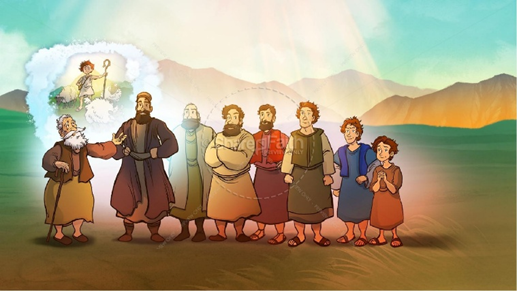
10-13 “The Lord has not chosen any of them,” Samuel told Jesse. “Are these all there are?”

“Well, there is the youngest,” Jesse replied. “But he’s out in the fields watching the sheep.”

“Send for him at once,” Samuel said, “for we will not sit down to eat until he arrives.”

So Jesse sent for him. He was a fine looking boy, ruddy-faced, and with pleasant eyes. And the Lord said, “This is the one; anoint him.”

So as David stood there among his brothers, Samuel took the olive oil he had brought and poured it upon David’s head; and the Spirit of Jehovah came upon him and gave him great power from that day onward. Then Samuel returned to Ramah.

 When Samuel anointed Saul as king, he really hoped that Saul would prove to be everything Israel needed. But Saul’s character does not match his physique. Given direct orders to wipe out the Amalekites and everything belonging to them, Saul tries to compromise-after all, some of that livestock is really prime, and perhaps the enemy king will be willing to buy his life with hidden wealth. Both God and Samuel grieve over Saul; however, Saul is obviously not fit. Now Israel needs a king who will truly obey God, and God sends Samuel to Bethlehem to anoint the next king from the house of Jesse.

Samuel calls Jesse and his sons to a sacrifice and then begins examining Jesse’s boys. All seven of the boys are tall, strong, and good-looking; surely one of these men will be the next king. But God keeps rejecting these men. By now, Samuel is really confused! What’s going on here?

“Jesse, do you have any more sons?” Samuel asks in confusion.

“Well, yes, there’s the youngest one, David. But you probably don’t want him. Besides, he’s out in the fields watching sheep.”

Meanwhile, David has gotten wind of Samuel’s coming, but he isn’t concerned. As the youngest and smallest, David has become used to being ignored and taken for granted. As far as the rest of the family thinks, sheep herding is all David is good for anyway. But God has a different idea. All the time that David has been herding sheep, he has been praying, playing his harp, writing music, and practicing his marksmanship with a sling. Many people in countries with modern high-powered rifles fail to appreciate that in Samuel’s time, soldiers with slings were the snipers of their day. Those slings were not simply children’s toys! At one point, the Bible describes soldiers who were experts with slings, either right-handed or left-handed, and who could hit a hair with their missiles. And all those encounters with lions and bears, all those nights spent living rough and watching the sheep, have made David one tough teen-ager. By contrast, David’s older brothers have remained in the house with Jesse, where things are easy and undemanding.

David has spent long hard years with God as his only source of comfort. Obviously, Jesse doesn’t care much about David, for when Samuel announces that he wants Jesse and all his sons to come for a sacrifice, Jesse doesn’t even consider calling David. After all, someone has to watch those sheep, and Jesse has seven big strong sons. Surely, this youngest one is expendable.

It’s God who has comforted David all these years, and that same God chooses David to rule over Israel. One of the key points in this chapter comes in verse 7 when God says,“Don’t judge by a man’s face or height, for this is not the one. I don’t make decisions the way you do! Men judge by outward appearance, but I look at a man’s thoughts and intentions.”

We don’t know which of David’s psalms is the earliest; however, many scholars feel that Psalm 23 might qualify. “Because the Lord is my Shepherd, I have everything I need! He lets me rest in the meadow grass and leads me beside the quiet streams. He gives me new strength. He helps me do what honors him the most. Even when walking through the dark valley of death I will not be afraid, for you are close beside me, guarding, guiding all the way.

You provide delicious food for me in the presence of my enemies. You have welcomed me as your guest; blessings overflow!  Your goodness and unfailing kindness shall be with me all of my life, and afterwards I will live with you forever in your home.”  (The Living Bible)

Although this psalm is perhaps the best-known and best-loved of all the psalms, many of us fail to realize it was written by a man whose own father thought so little of him that when the major prophet of Israel invited the family to worship with him, that same father initially left him out in the sheep pasture, essentially rejecting him from being his son.

Family dynamics can be scary and difficult. Sometimes, one or more children will be designated as “hero children,” who are given tasks far above their age level. Many times, those same children may be taken for granted, as if they don’t have the same emotional needs as their siblings. That’s what has happened to David. You might be that hero child, denied some of the emotional support from your family. But consider David; when God is selecting the next king, He ignores all seven of Jesse’s older sons, choosing David instead. The very challenges David has faced and his responses to them have developed the qualities needed for the next king of Israel.

In a book entitled Don’t Waste Your Sorrows, Paul E. Bilheimer graphically describes how suffering shapes us to fulfill God’s plans for our lives. David’s father has neglected him, sending him to the sheep pasture. But God has met David in that sheep pasture, comforting him and teaching him lessons he will need to govern wisely, for leading people is not dissimilar from herding wayward sheep.

God does not play favorites! The same God who plucked David from the sheep pasture to ultimately become king is watching over you today. God is all-knowing and all-powerful, and He can redeem every horrible experience you have ever had and use it for His glory. Drug addiction, PTSD, sexual abuse, emotional neglect, physical abuse-God is greater than all of these problems. My first marriage ended in divorce and I was thoroughly ashamed and devastated by this failure. But I learned God could redeem those years when I found myself counseling another woman whose life had been shattered by marital problems. When this lady told me that I couldn’t possibly understand her situation, I found myself saying, “Well, let me try.” In the next few moments, I perfectly described her emotional struggles and her feelings of worthlessness. When I finished, there was stunned silence at the other end of the phone, and then this lady asked in a shaking voice, “How do you KNOW these things?” And I answered, “BECAUSE I HAVE BEEN THERE!”

God is the Ultimate Comforter, who comforts us so that we might comfort others. But first, we must open ourselves to allow God to comfort us. This means we must let go of our hatreds, our resentments, our disgust, and our despair. Some people feed on emotional negativity, but that only leads to hellish despair. We must release all those things so that God can clean us up and give us His Holy Spirit. Let’s pray.

PRAYER:Father God, thank You for loving us and caring for us. Lord, You chose David, even when his family had rejected him. Jesus, You were “despised and rejected,” so you know how many of us have felt. Lord, please help all who read these words to let go of the negative things that are dragging them down, give those things to You, and let You replace them with Your love, joy, peace, patience, kindness, goodness, faithfulness, gentleness, and self-control. In the mighty and precious Name of King Jesus. Amen.  
JANUARY 18, 2026 WE ALL NEED COMFORT, BUT HOW DO WE GET IT? #18 GOD CAN EVEN RECONCILE FIGHTING SIBLINGS

January 18, 2026

Genesis 25:1-10 Now Abraham married again. Keturah was his new wife, and she bore him several children: Zimran, Jokshan, Medan, Midian, Ishbak, Shuah. Jokshan’s two sons were Sheba and Dedan. Dedan’s sons were Asshurim, Letushim, and Leummim. Midian’s sons were Ephah, Epher, Hanoch, Abida, and Eldaah.

Abraham deeded everything he owned to Isaac; however, he gave gifts to the sons of his concubines and sent them off into the east, away from Isaac.

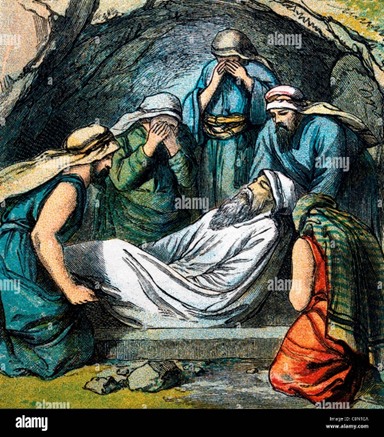
Then Abraham died, at the ripe old age of 175, and his sons Isaac and Ishmael buried him in the cave of Mach-pelah near Mamre, in the field Abraham had purchased from Ephron the son of Zohar, the Hethite, where Sarah, Abraham’s wife, was buried.

If you do the math, by the time Sarah dies, Abraham is already 137 years old; however, God blesses him so that he is able to marry again, a lady named Keturah, and father six more sons. After deeding everything to Isaac, Abraham makes generous gifts to these men and sends them eastward so they won’t be tempted to compete with Isaac.

When Abraham dies at age 175, Ishmael is at least 88 and Isaac is 75. Setting any old differences aside, the two men come together to bury Abraham in the cave of Mach-pelah where Sarah is buried. Isaac is the son of promise, inheriting Abraham’s spiritual legacy and much of his wealth. In the past, Abraham has prayed over Ishmael, and God has promised to make Ishmael great. (Genesis 17:20 “I shall cause him to multiply and become a great nation.” And God repeats this promise to Hagar in Genesis 21:18) God does grant Ishmael twelve sons, each of whom becomes the chief of his own tribe. But the most important thing about these few verses is that Abraham’s boys cooperate on his funeral. As carefully as the Bible scribes have been to record every small detail, if Ishmael and Isaac had fought over their father’s funeral, that fight would have been recorded down to the last syllable.

Think about it: Ishmael is the first-born, and under the customs of many tribes, Ishmael should inherit, no matter whether his mother is a concubine or a wife. But God has decreed that Isaac, the son of promise, must inherit from Abraham. In modern parlance, Isaac is the “chosen child.” And Ishmael is a difficult character, far more comfortable hunting in the wilderness than remaining in tents. God blesses Ishmael according to Ishmael’s nature, just as He blesses Isaac.

There are some families where siblings get along well, and then there are other families where sibling rivalries can be vicious. One set of twins spent decades distancing themselves from each other because each thought the other was their father’s favorite. In fact, their father was a good man; however, he had been raised by older siblings when his mother died, and he had never learned how to express affection. When one twin was doing something outstanding, the father would praise that twin to the other. “Look at your brother! Isn’t that great?” Blessedly, God brought timely reconciliation, but years of fellowship were lost because of that wrong belief. And there are parents who truly favor one child over all the others, frequently with disastrous results.

Some families have done well until a parent dies, and it’s time for the estate to be settled. Siblings fighting over stuff may refuse to speak to one another for years. But it’s hard to say “I’m sorry” to a grave. Promising to reconcile “tomorrow” is worthless, for that tomorrow may never come.  

How does God want us to relate to our siblings? How can He bring comfort? Ephesians 4 has a lot to say about getting along with difficult people. Ephesians 4:2-3 tells us, “Be humble and gentle. Be patient with each other, making allowance for each other’s faults because of your love. Try always to be led along together by the Holy Spirit and so be at peace with one another.” Most of us want to give ourselves a “free pass” to behave badly, stating all kinds of excuses; meanwhile, we rush to judge others severely. When I was a child, my parents used to warn me that when I pointed one finger at someone else, I had three fingers and a thumb pointing back at me, indicating that I was just as at fault as the person whom I was criticizing.

Ephesians 4:26-27 warns us, “If you are angry, don’t sin by nursing your grudge. Don’t let the sun go down with you still angry—get over it quickly; for when you are angry, you give a mighty foothold to the devil.”

It’s true that “unforgiveness is like drinking poison and expecting the other person to die.” Ephesians 4:31-32 advises, “Stop being mean, bad-tempered, and angry. Quarreling, harsh words, and dislike of others should have no place in your lives. Instead, be kind to each other, tenderhearted, forgiving one another, just as God has forgiven you because you belong to Christ.”

But what if someone has really hurt you badly, so badly you can scarcely even think about that person? The father of the famous Christian author and teacher, C.S. Lewis, was a selfish and difficult man, insensitive to the needs of both his sons. Once Lewis became a Christian, he had to continue to forgive his father as an act of will, until one day he realized that he had succeeded. Incidentally, this process of forgiveness took years.

Notice something else: Forgiving someone who has hurt you, even loving them, does not mean you have to trust them if they have proven themselves untrustworthy. Unless God specifically orders you to make yourself vulnerable, you are not obligated to expose yourself to further abuse. But there are exceptions. Saint Paul was stoned in Lystra; however, God preserved him, and he later returned to the city to teach new converts. God used Paul to demonstrate His mighty power to the unbelievers at Lystra.

As we consider the miracle of Ishmael and Isaac cooperating to perform their father’s funeral, we should examine ourselves. Have we been harboring grudges against anyone, particularly against any of our siblings? If God brings anyone to mind, ask God to help you and then forgive! Why carry a load of anger around so it can eat into your soul? And there is this about forgiveness: the more you forgive others, the easier it becomes. Remember that God forgives us when we confess our sins. If the Judge of the whole earth can forgive that readily, how can we lesser beings continue to hold grudges?

PRAYER: Father God, thank You for loving us and caring for us. Lord, many of us are walking wounded, hemorrhaging spiritually from hurts inflicted by family and acquaintances. We confess that we are sinners and that we cannot free ourselves from our own sins, let alone forgive others. Please, Lord, forgive us our sins and grant us the courage and the grace to forgive all those who have hurt us, whether intentionally or unintentionally. In the mighty and precious Name of King Jesus. Amen.

JANUARY 17, 2026 WE ALL NEED COMFORT, BUT HOW DO WE GET IT? #17 WHAT ABOUT ISAAC? CAN GOD COMFORT US IN OUR GRIEF?

January 17, 2026

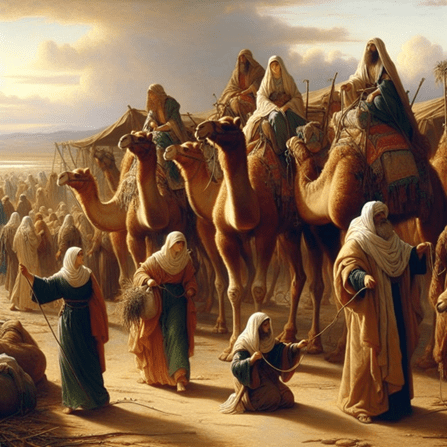
When we read the story of a wife for Isaac in Genesis, Isaac never gets very much attention. We focus on Eliezer the servant and his successful trip to Haran. We marvel at Rebekah’s willingness to travel hundreds of miles into an unknown land to marry a man whom she has never met. But Isaac and his grief are the reasons for that story, so let’s look at Isaac.

Genesis 24:61-67 So Rebekah and her servant girls mounted the camels and went with him.

Meanwhile, Isaac, whose home was in the Negeb, had returned to Beer-lahai-roi. One evening as he was taking a walk out in the fields, meditating, he looked up and saw the camels coming. Rebekah noticed him and quickly dismounted.

“Who is that man walking through the fields to meet us?” she asked the servant.

And he replied, “It is my master’s son!” So she covered her face with her veil. Then the servant told Isaac the whole story.

And Isaac brought Rebekah into his mother’s tent, and she became his wife. He loved her very much, and she was a special comfort to him after the loss of his mother.

Sarah was 90 when she gave birth to Isaac, so by the time Sarah died at age 127, Isaac was 37. Isaac thought his mother was a hoot! Right up until the last day or two of Sarah’s life, she was always the one with wry comments, spicy opinions on every subject imaginable, and the heart of Abraham’s camp. While Abraham presided over the major questions such as moving for better grazing and relationships with local chiefs, Sarah was the one who kept everything moving. It was Sarah who assigned tasks to the serving girls, Sarah who arranged marriages among the servants, Sarah who was always there to give pithy advice and encouragement.

Sarah had a wicked sense of humor, one she carefully disguised whenever it was necessary for her to play the grande dame. One day a visiting merchant vainly schemed to get the better of Abraham in a major deal. Abraham sententiously announced to the man that he needed to pray about it and the man should return on the morrow. But as soon as the man and his camels had disappeared over the nearest hill, Abraham called Sarah to him. Sarah had been sitting quietly in a corner during the negotiations, playing the part of a perfectly submissive wife with no business acumen.

“Well, Sarah, my love,” Abraham said, “what do you think of our friend Abdul?”

“Hmm,” Sarah mused, “as for that man, he talks out of both sides of his mouth. And Abraham, if you shake hands with him, be sure to count your fingers before and afterwards!”

“I see,” said Abraham. “So tomorrow, what should my answer be?”

“Oh, my love,” replied Sarah, “I suggest that you inform him that you have prayed and that you feel tomorrow is not an auspicious day for such a major endeavor. Tell him that you must continue to pray and that you will send a messenger, should the signs become more auspicious in the future.”

“And when do you anticipate the signs becoming more auspicious?” questioned Abraham, thoroughly enjoying the joke.

“Well,” mused Sarah, “perhaps if the Negeb desert suddenly begins blossoming with all kinds of crops and fruit trees. Or perhaps if our camels, who are notoriously ill-tempered, suddenly choose to become completely docile and come to our tents and sing to us.”

“Or perhaps,” Abraham added, “if you become pregnant at the age of 120?”

“Well, yes,” Sarah chuckled. “I praise Jehovah for allowing me to become a mother at age 90, but I don’t think Isaac needs another miracle sibling.”

Throughout Sarah’s entire life, she was the one who kept things humming in Abraham’s camp. Everyone realized that Sarah was dying when she stopped giving orders and simply lay in her bed, weakly requesting for Abraham and Isaac to come to her. For both men, it was unthinkable that this indomitable woman on whom they had both depended for so many years might leave them. Isaac particularly had no idea how he would go on. Seeing Isaac’s despair, Abraham realized that he had done everything for Isaac he could; now only a wife could console Isaac. Calling Eliezer to him, Abraham gave Eliezer detailed instructions and then personally selected the treasures Eliezer should carry to Haran to entice a young woman to return with him. But as Eliezer set off to the northeast on the road toward Haran, both Abraham and Isaac wondered if he would be successful, or indeed, if he would even return.

Three months had passed without any word from Eliezer or any of the relatives in Haran. Each evening, Isaac would walk out into the fields around his camp, searching for any sign of a caravan on the horizon. As Isaac walked, he continued to remember his mother, her wisdom, her sense of humor, her encouragement, and her love. Frankly, Isaac never knew it was possible to miss anyone as much as he missed his mother; the longing for her was a physical ache that refused to dissipate.

Finally, that last evening, Isaac walked out once more. Honestly, Isaac nearly remained in his tent that night; however, the evening breeze was fresh, the sunset was painting the evening sky with glowing colors, and Isaac figured, “Why not?” Looking northward, Isaac thought he saw something cresting a distant hill. On closer inspection, Isaac realized it was a caravan with Eliezer riding the lead camel. Forgetting tiredness and despair, Isaac began walking swiftly, but the walk increased to a jog and then the jog to a headlong run. It WAS Eliezer, and there were two ladies riding the spare camels! Now Isaac was pelting full-tilt. Meanwhile, Rebecca saw this handsome man running toward the caravan.

“Who is that man?” asked Rebecca.

“Oh, that is Isaac, my master Abraham’s son, your future husband,” replied Eliezer.

Rebekah and her nurse had been enjoying the evening breeze; however, now both ladies swiftly veiled themselves as custom demanded.

“Eliezer, welcome! A thousand welcomes!” cried Isaac.

“Thank you, thank you, thank you!” replied Eliezer. “We are thrilled to be here, and I think some introductions are in order. Isaac Ben Abraham, meet Rebekah, daughter of Bethuel, your father’s nephew, and granddaughter of Nahor, your father’s brother. Accompanying Rebekah is Amina, her faithful nurse, and a delightful lady in her own right.”

“Welcome, Rebekah! Welcome, Amina!” Isaac said. Isaac closely inspected Rebekah. While Rebecca was wrapped in traveling robes, her dark eyes were sparkling; in fact, her eyes reminded Isaac of his mother’s eyes. And Rebecca’s movements were lithe and graceful, hinting of the beauty hidden under those robes.

As Isaac was greeting Eliezer, Abraham was watching at a distance as he sat at the camp. Abraham had stood up when he heard Isaac’s cries of greeting and had seen the caravan approaching. Heaving an enormous sigh of relief, Abraham returned to the place where he had been resting and looked heavenward.

“Jehovah,” Abraham murmured, “no amount of thanks or praise or blessing is sufficient for what You have done. Not only have You given me Isaac as an heir, but You have also preserved Eliezer during his travels and have provided the perfect bride for Isaac. I am happy and relieved. Great is Your faithfulness!”

As I write these words, I am remembering all the bereavements we have endured during our lifetimes. We have lost parents, step-parents, siblings, close friends, and beloved pets. Grief can ambush us at any moment. Losses we have suffered decades ago may suddenly seem fresh if we see or hear something reminding us of the lost loved one.

I was seven years out from the loss of my mother when grief savagely attacked me. In the age before television became common, people in rural communities took entertainment where they could find it, including PTA meetings at grade schools. My mother was an excellent singer and actress; at one PTA meeting in our small Illinois town in the 1950’s she performed a comic song from the musical Guys and Dolls entitled “Adelaide’s Lament.” Seven years after my mother’s death and at least thirty years after that performance, I was in the audience for a community production of that musical in a town in Oklahoma. I was thoroughly enjoying things when “Adelaide’s Lament” started, and suddenly I was sobbing.

For my husband, one trigger for his grief is the final scene of the movie A River Runs Through It, based on a semi-autobiographical story by Norman Maclean. The movie depicts the true lives of a Montana family headed by a strict Presbyterian minister who was also a fly-fishing afficionado, and the tragedy of his brilliant younger son who was addicted to gambling and alcohol. The story is narrated by Norman, the older son, also a fly fisherman, who becomes a professor of Literature at the University of Chicago. In the final scene, the author, now an old man, is seen flyfishing on a river in Montana as the sinking sun gleams on the water. That scene always reminds my husband of his late father, who loved fishing. The movie is one of our favorites, but that last scene always leaves my husband in tears.

Can God comfort us in our grief? Yes! We can bear witness that God has repeatedly comforted us and has given us the strength to go forward. We returned to Ghana in November 2021, leaving one of my beloved brothers dying from COVID pneumonia. But we did so with my brother’s blessing because our hospital desperately needed my services and we knew we would see my brother in heaven. it’s tempting to get stuck in the grief; however, grief is an energy-suck that can pull us into a bottomless whirlpool of regret. Some of the best advice I ever heard about grief came from one of my father’s friends as they were burying my mother. A local farmer whose wife had died the year before advised Dad to grieve for awhile, then to put his grief away and open it at intervals. This practice would allow Dad to continue to function while still honoring my mother’s memory.

May God help those of us who are grieving so that we find our rest and comfort in Him. ‘

PRAYER:  Father God, thank You for loving us and caring for us. Lord, for many of us, 2025 was a horrible year full of grief and loss. Lord, please comfort all those who mourn and give them the hope that only You can give. In the mighty and precious Name of King Jesus. Amen.
JANUARY 16, 2026 WE ALL NEED COMFORT, BUT HOW DO WE GET IT? #16 GOD CAN COMFORT YOU EVEN WHEN YOUR BOSS SETS YOU A NEARLY IMPOSSIBLE TASK “BUT GOD” PART 2

January 16, 2026

Genesis 24:28-33 The girl ran home to tell her folks, and when her brother Laban saw the ring, and the bracelets on his sister’s wrists, and heard her story, he rushed out to the spring where the man was still standing beside his camels, and said to him, “Come and stay with us, friend; why stand here outside the city when we have a room all ready for you, and a place prepared for the camels!”

So the man went home with Laban, and Laban gave him straw to bed down the camels, and feed for them, and water for the camel drivers to wash their feet. Then supper was served. But the old man said, “I don’t want to eat until I have told you why I am here.”

“All right,” Laban said, “tell us your errand.”

Well! Of all the things that have happened recently, having Rebecca come running home from the spring wearing a gold nose ring and heavy bracelets is the last thing Bethuel, Nahor, Milcah, and Laban are expecting. And when Rebecca begins her story about a stranger who has traveled all the way from their relative Abraham in Canaan, they are shocked. Frankly, Abraham’s relatives in Haran haven’t heard from him in so long that they have assumed he was dead. Now suddenly here’s this distinguished-looking gentleman claiming to be Abraham’s steward, leading a caravan with several camels obviously loaded with precious gifts.

34-35 “I am Abraham’s servant,” he explained. “And Jehovah has overwhelmed my master with blessings so that he is a great man among the people of his land. God has given him flocks of sheep and herds of cattle, and a fortune in silver and gold, and many slaves and camels and donkeys.

36-41 “Now when Sarah, my master’s wife, was very old, she gave birth to my master’s son, and my master has given him everything he owns. And my master made me promise not to let Isaac marry one of the local girls, but to come to his relatives here in this far-off land, to his brother’s family, and to bring back a girl from here to marry his son. ‘But suppose I can’t find a girl who will come?’ I asked him. ‘She will,’ he told me—‘for my Lord, in whose presence I have walked, will send his angel with you and make your mission successful. Yes, find a girl from among my relatives, from my brother’s family. You are under oath to go and ask. If they won’t send anyone, then you are freed from your promise.’

By now, Rebekah’s family is looking at this stranger skeptically. They think this man is telling the truth, but how will Rebekah react? Rebekah has never traveled outside the fields belonging to Haran. Now Abraham’s representative is putting forth a proposition: Abraham desires a wife for his son. If Rebekah agrees, it’s likely that her family will never see her again. After all, the trip took Abraham’s steward nearly three weeks of hard travel.

42-49 “Well, this afternoon when I came to the spring I prayed this prayer: ‘O Jehovah, the God of my master Abraham, if you are planning to make my mission a success, please guide me in this way: Here I am, standing beside this spring. I will say to some girl who comes out to draw water, “Please give me a drink of water!” And she will reply, “Certainly! And I’ll water your camels too!” Let that girl be the one you have selected to be the wife of my master’s son.’

“Well, while I was still speaking these words, Rebekah was coming along with her water jug upon her shoulder; and she went down to the spring and drew water and filled the jug. I said to her, ‘Please give me a drink.’ She quickly lifted the jug down from her shoulder so that I could drink, and told me, ‘Certainly, sir, and I will water your camels too!’ So she did! Then I asked her, ‘Whose family are you from?’ And she told me, ‘Nahor’s. My father is Bethuel, the son of Nahor and his wife Milcah.’ So I gave her the ring and the bracelets. Then I bowed my head and worshiped and blessed Jehovah, the God of my master Abraham, because he had led me along just the right path to find a girl from the family of my master’s brother. So tell me, yes or no. Will you or won’t you be kind to my master and do what is right? When you tell me, then I’ll know what my next step should be, whether to move this way or that.”

For some of us, this story might seem incredible; however, this family lives in an era when people put a great deal of weight on dreams and prayers. As far as these people are concerned, God has been speaking to Abraham and his servant has obeyed all Abraham’s orders. Now the whole matter comes down to Rebekah and her choices.

50-51 Then Laban and Bethuel replied, “The Lord has obviously brought you here, so what can we say? Take her and go! Yes, let her be the wife of your master’s son, as Jehovah has directed.”

At this reply, Abraham’s servant fell to his knees before Jehovah. Then he brought out jewels set in solid gold and silver for Rebekah, and lovely clothing; and he gave many valuable presents to her mother and brother. Then they had supper, and the servant and the men with him stayed there overnight. But early the next morning he said, “Send me back to my master!”

55-60 “But we want Rebekah here at least another ten days or so!” her mother and brother exclaimed. “Then she can go.”

But he pleaded, “Don’t hinder my return; the Lord has made my mission successful, and I want to report back to my master.”

“Well,” they said, “we’ll call the girl and ask her what she thinks.”

So they called Rebekah. “Are you willing to go with this man?” they asked her.

And she replied, “Yes, I will go.”

So they told her good-bye, sending along the woman who had been her childhood nurse, and blessed her with this blessing as they parted: “Our sister, may you become the mother of many millions! May your descendants overcome all your enemies.”

WOW! How much can one woman’s life change in 24 hours? Yesterday, Rebekah was simply going to the spring to fetch water. Today, Rebekah is climbing onto a camel, leaving for a new home and a new husband 500 miles and 3 weeks away. Rebekah will probably never see her family again. What if the man she is to marry turns out to be abusive or domineering? While Abraham’s servant might be trusting Jehovah, Rebekah has never heard of Him. Why is Rebekah willing to take such a bold step? Abraham’s servant, Eliezer, has spoken with conviction and God has moved in Rebekah’s heart. God is comforting Rebekah, even as she mounts that camel.

61-67 So Rebekah and her servant girls mounted the camels and went with him.

Meanwhile, Isaac, whose home was in the Negeb, had returned to Beer-lahai-roi. One evening as he was taking a walk out in the fields, meditating, he looked up and saw the camels coming. Rebekah noticed him and quickly dismounted.

“Who is that man walking through the fields to meet us?” she asked the servant.

And he replied, “It is my master’s son!” So she covered her face with her veil. Then the servant told Isaac the whole story.

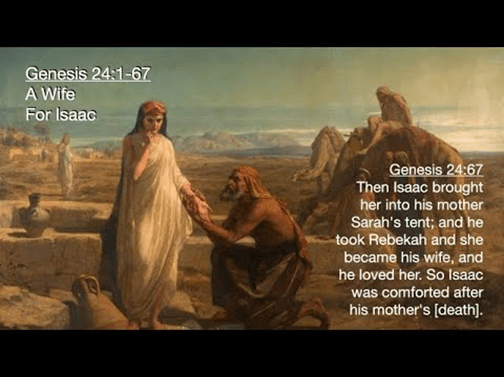
And Isaac brought Rebekah into his mother’s tent, and she became his wife. He loved her very much, and she was a special comfort to him after the loss of his mother.

It’s been months since Eliezer left for Haran, and frankly, Isaac has nearly given up hope. But Isaac finds walking in the fields at dusk particularly calming. As Isaac climbs a hill near his home camp, he sees a small caravan approaching. Isaac recognizes Eliezer; but how many more people are riding those camels? Suddenly, Isaac realizes that there are two women in the party and begins running. Eliezer has returned, bringing Rebekah and her nurse with him. It’s tough to know who is more thrilled, Isaac, Rebekah, or Eliezer. As Rebekah meets Isaac, she realizes that she has made the best decision of her life. And both Rebekah and Isaac are comforted.

The story of Eliezer, Isaac, and Rebekah demonstrates what a Comforter God really is. Isaac has lost his mother at the age of 37 and is grieving. Rebekah has left her home, her family, her friends, and everything familiar. Only Rebekah’s nurse has accompanied her. Now Rebekah has to find her way into a new relationship as a married woman. And what about Eliezer, the faithful steward who has now traveled at least 1000 miles to satisfy his master’s orders? Eliezer can rest, comforted that he has pleased Abraham and fulfilled everything Jehovah has called him to do.

Do you believe God is calling you to do something radical, something you have never done before? Take heart, for the same God who guided Eliezer safely to and from Haran, the same God who selected Rebekah as Isaac’s wife and comforted Rebekah and Isaac-that same God will guide you and comfort you.

PRAYER: Father God, thank You for loving us and caring for us. Lord, help us to trust You in all things, even when You are calling us to go in new directions. In the mighty and precious Name of King Jesus. Amen.
JANUARY 15, 2026 WE ALL NEED COMFORT, BUT HOW DO WE GET IT? #15 GOD CAN COMFORT YOU EVEN WHEN YOUR BOSS SETS YOU A NEARLY IMPOSSIBLE TASK PART 1 “BUT GOD!”

January 15, 2026

Genesis 24:1 -2Abraham was now a very old man, and God blessed him in every way. One day Abraham said to his household administrator, who was his oldest servant,

3-4 “Swear by Jehovah, the God of heaven and earth, that you will not let my son marry one of these local girls, these Canaanites. Go instead to my homeland, to my relatives, and find a wife for him there.”

5-9 “But suppose I can’t find a girl who will come so far from home?” the servant asked. “Then shall I take Isaac there, to live among your relatives?”

“No!” Abraham warned. “Be careful that you don’t do that under any circumstance. For the Lord God of heaven told me to leave that land and my people, and promised to give me and my children this land. He will send his angel on ahead of you, and he will see to it that you find a girl from there to be my son’s wife. But if you don’t succeed, then you are free from this oath; but under no circumstances are you to take my son there.” So the servant vowed to follow Abraham’s instructions.

Talk about impossible assignments! Eliezer of Damascus has been Abraham’s chief deputy ever since reaching adulthood. At one point prior to Isaac’s birth, Eliezer would have inherited everything from Abraham; however, Isaac has taken his rightful place as chief heir. Still, Abraham has always looked on Eliezer as a second son, one whom he loves as much as Ishmael, if not more. In the past, Abraham has relied on Eliezer to make sure things have run smoothly in the camp, but today Abraham is giving him a different assignment, one Eliezer would just as soon dodge. Abraham wants Eliezer to travel all the way back to Haran to Abraham’s nephew Nahor, to find a wife for Isaac.

The journey is a daunting one, 500-600 miles, lasting between 9-20 days, depending on road conditions, weather, bandits, etc. Eliezer must carry all the feed for the camels with him, for he cannot depend on finding grazing along the route. The caravan must also carry plenty of water, for who knows where the streams and wells are? And Abraham insists that Eliezer carry rich gifts with him to entice the girl to come and to placate her family. While Abraham is busy issuing orders, Eliezer is quaking inside! What if he fails to find Haran? What if he reaches Haran, only to find there are no eligible young ladies? And what if he reaches Haran, only to find that no eligible young lady wants to follow him off into an unknown future with a strange man? All through the journey, Eliezer continues to worry. Finding Haran is not so difficult because it is right on a major caravan route. But finding Abraham’s relatives? Who knows what will happen? Abraham has been gracious and generous to Eliezer for years; the last thing Eliezer wants to do is to disappoint Abraham, but the fears of failure remain.

Perhaps you can identify with Eliezer. Perhaps you have found yourself burdened with tasks that look impossible to complete. What comfort can you find? God promises that He will be with us, no matter what. Isaiah 43:1-3 tells us, “But now, thus says the Lord, who created you, O Jacob, and He who formed you, O Israel: “Fear not, for I have redeemed you; I have called you by your name; you are Mine. When you pass through the waters, I will be with you;
And through the rivers, they shall not overflow you. When you walk through the fire, you shall not be burned, nor shall the flame scorch you. For I am the Lord your God, the Holy One of Israel, your Savior…”
  Now let’s return to Eliezer, for his story holds even more encouragement.

10-11 He took with him ten of Abraham’s camels loaded with samples of the best of everything his master owned and journeyed to Iraq, to Nahor’s village. There he made the camels kneel down outside the town, beside a spring. It was evening, and the women of the village were coming to draw water.

12-14 “O Jehovah, the God of my master,” he prayed, “show kindness to my master Abraham and help me to accomplish the purpose of my journey. See, here I am, standing beside this spring, and the girls of the village are coming out to draw water. This is my request: When I ask one of them for a drink and she says, ‘Yes, certainly, and I will water your camels too!’—let her be the one you have appointed as Isaac’s wife. That is how I will know.”

Throughout the Bible, there are examples of people praying for God to give them signs that they are doing His will. Eliezer’s prayer is one of the earliest examples of such prayers, and he must be shaking in his sandals as he prays. There is every chance that no young lady will come to the spring until later. There is every chance that the young ladies will all look at Eliezer and rush back into the village to call their male relatives to deal with him. Eliezer is praying to a God whom he really doesn’t know but whom his master has trusted for years. If ever someone needs comfort, Eliezer needs it right now!

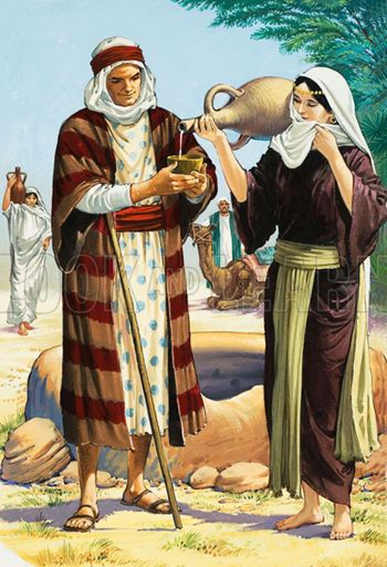
15-19 As he was still speaking to the Lord about this, a beautiful young girl named Rebekah arrived with a water jug on her shoulder and filled it at the spring. (Her father was Bethuel the son of Nahor and his wife Milcah.) Running over to her, the servant asked her for a drink.

“Certainly, sir,” she said, and quickly lowered the jug for him to drink. Then she said, “I’ll draw water for your camels, too, until they have enough!”

20-23 So she emptied the jug into the watering trough and ran down to the spring again and kept carrying water to the camels until they had enough. The servant said no more, but watched her carefully to see if she would finish the job, so that he would know whether she was the one. Then at last, when the camels had finished drinking, he produced a quarter-ounce gold nose ring and two five-ounce gold bracelets for her wrists.

“Whose daughter are you, miss?” he asked. “Would your father have any room to put us up for the night?”

24-27 “My father is Bethuel,” she replied. “My grandparents are Milcah and Nahor. Yes, we have plenty of straw and food for the camels, and a guest room.”

The man stood there a moment with head bowed, worshiping Jehovah. “Thank you, Lord God of my master Abraham,” he prayed; “thank you for being so kind and true to him, and for leading me straight to the family of my master’s relatives.”

Talk about getting prayers answered! Now God shows up! Scarcely has Eliezer finished his prayer, then God begins answering it right down to the smallest detail. Eliezer is ready to collapse in relief. Not only has God brought the right girl at the right time, but He has brought a young woman from the very family Eliezer is seeking. Little wonder that Eliezer immediately bows his head and worships Jehovah.

There’s a song from Fiddler on the Roof that speaks of L’chaim, Life. “Life has a way of abusing us, blessing and bruising us.” Work in medicine long enough, and you will learn medicine can do the same thing. Through the years, I have lost patients who should have lived; on the other hand, patients I was certain would die have recovered miraculously. At the end, all I can say is that it’s all up to God. That’s the same thing Eliezer is thinking.

Eliezer is not a young man, nor yet a foolish one. As the chief manager for Abraham’s teeming household, Eliezer has repeatedly made judgment calls that have brought great success. But when it counts most, Eliezer has depended on God, not his own judgment or his own calculations. Eliezer receives comfort from God because he is depending on God and not on himself. So many things could have gone wrong with Eliezer’s mission: Camels could have fallen sick or died. Water sources could have dried up. Sandstorms could have come up, hiding the road and causing Eliezer’s party to wander aimlessly until they died. Bandits could have attacked, murdering everyone and seizing the rich presents Eliezer was carrying for Abraham’s relatives. And even when Eliezer succeeds in reaching Haran, the wrong maiden might have approached him first. But God! But God has intervened, bringing the right girl from the right family at the right time to say the right things.

Today, do you feel like Eliezer? God has called you to step out in faith and you are terrified that everything is going to go wrong. Hang on. Remember that desperate prayer Eliezer prayed. God doesn’t play favorites. The same God who guided Eliezer, the same God who brought Rebekah to the spring at the right time, that same God is still on the throne and still answers prayers. Remember Isaiah 43 and be comforted.

PRAYER:  Father God, thank You for loving us and caring for us. Lord, many of us are stepping out in new directions this year, terrified that something will go wrong. Please comfort and strengthen all of those following Your leading, so they will continue to trust and go forward. In the mighty and precious Name of King Jesus. Amen.
JANUARY 14, 2026 WE ALL NEED COMFORT, BUT HOW DO WE GET IT? #14 WHAT COMFORT DOES GOD GIVE WHEN WE ARE BEREAVED?  

January 14, 2026

Genesis 23:1-2 When Sarah was 127 W old, she died in Hebron in the land of Canaan; there Abraham mourned and wept for her. 

Abraham knew that Sarah’s body was failing. Each morning, it took Sarah longer to bathe, to dress, and to present herself for the day. Sarah’s maids were already coming to Abraham, “Father, Mama Sarah worries us. Not only is she becoming weaker, but now she almost refuses to eat. We struggle to find something she will take, and she scarcely drinks enough water to keep herself from fainting.” But Abraham didn’t want to face the possibility of life without Sarah. Abraham remembered Sarah with her dove’s eyes, her glistening jet-black hair, her fresh complexion, and her smile that could light up a room. Surely God would not take Sarah; after all, Abraham was ten years older and he felt fine.

That final morning, Sarah’s maids came to Abraham. “Papa, you need to come see Mama Sarah right now!” Ducking into Sarah’s tent, Abraham found Sarah propped up on pillows supported by Amina, one of the maids. “Sarah, my love,” Abraham began, but Sarah stopped him. “Abraham, I have always loved you and I have followed you and your dreams. I don’t want to leave you, but I must. Pray to your God, that He will be gentle with me.” Abraham broke into sobs, clinging to Sarah’s shoulders. When did Sarah become so thin, so frail? Wasn’t this the same woman whose beauty had entranced foreign rulers? Wasn’t this the mother of his miracle son Isaac? How could Abraham possibly say good-bye to his love? As Abraham embraced Sarah for the last time, her breathing slowed and then she gave one long breath and collapsed in his arms, leaving Abraham with nothing but memories. Where was God’s comfort in all of this?

Getting older is not for cowards! One of the most daunting parts of getting older is watching your spouse and yourself age and wondering how much longer you will have with them. My constant prayer for my husband and me is that we will be a blessing all our lives, that we will remain spiritually, physically, mentally, and emotionally strong, and that we will be able to cherish each other and those around us. If aging teaches little else, it should teach us to rely on God for our comfort and strength.

Isaiah 46:3-4 tells us, “Listen to Me, O house of Jacob, and all the remnant of the house of Israel, who have been upheld by Me from birth, who have been carried from the womb:
Even to your old age, I am He, and even to gray hairs I will carry you! I have made, and I will bear; even I will carry, and will deliver you.”
Surely, in the middle of the night when all was quiet, God must have come to Abraham to comfort him.

But now Abraham had a new problem: In this land of rocks and caves, digging a grave would be impossible. Where could Abraham safely bury Sarah’s body so that no enemies would steal her body to violate it and attempt witchcraft against Abraham? Where could Abraham hide his beloved’s body so wild animals could not devour it?

Nearby princes learned of Sarah’s death and were now visiting him in condolence as custom demanded. After showing his friends Sarah’s body wrapped in the finest material possible, Abraham began negotiations.

Genesis 23:3- 9 Then, standing beside her body, he said to the men of Heth: “Here I am, a visitor in a foreign land, with no place to bury my wife. Please sell me a piece of ground for this purpose.”

“Certainly,” the men replied, “for you are an honored prince of God among us; it will be a privilege to have you choose the finest of our sepulchres, so that you can bury her there.”

Then Abraham bowed low before them and said, “Since this is your feeling in the matter, be so kind as to ask Ephron, Zohar’s son, to sell me the cave of Mach-pelah, down at the end of his field. I will of course pay the full price for it, whatever is publicly agreed upon, and it will become a permanent cemetery for my family.”

The conversations between Abraham and his neighbors were so precisely recorded that millenia later, we can still imagine these discussions. Even though Abraham’s herds had been grazing in the area for years, Abraham described himself as a visitor in a foreign land, indicating that he was not in a position of power and throwing himself on the mercy of his neighbors. Abraham’s neighbors were equally polite, describing Abraham as an honored prince of God and stating that it would be a privilege for Abraham to choose the finest of their burial places. This conversation is the first sign of God’s comfort, for these men could have been rude or unkind to this grieving old man; however, they were the epitome of courtesy.

Why were Abraham’s neighbors so kind to him? Wherever Abraham traveled, he did as much as he could to maintain good relationships with those around him. While Abraham’s neighbors were now calling to comfort him, it’s quite possible that Abraham had previously been the one to call on them in their bereavements. And Abraham, although an elderly stranger, was still quite powerful, not to mention the fact that Isaac, Abraham’s heir, was in his prime.

10-15 Ephron was sitting there among the others, and now he spoke up, answering Abraham as the others listened, speaking publicly before all the citizens of the town: “Sir,” he said to Abraham, “please listen to me. I will give you the cave and the field without any charge. Here in the presence of my people, I give it to you free. Go and bury your dead.”

Abraham bowed again to the men of Heth, and replied to Ephron, as all listened: “No, let me buy it from you. Let me pay the full price of the field, and then I will bury my dead.”

Well, the land is worth 400 pieces of silver,” Ephron said, “but what is that between friends? Go ahead and bury your dead.”

Several accounts of this discussion record Ephron as stating, “I give it to you” three times. Why is that number significant? Traditionally, the number three was used to mark completeness. By stating “I give it to you” three times, Ephron was indicating the seriousness of his offer. Once Ephron had made that statement, bargaining could now commence. But Abraham refused to haggle over the price of the cave, even though Ephron undoubtedly started by asking far more than the cave’s true worth. But Abraham refused to argue, despite his reputation as a canny man of business. This was one deal Abraham wanted to seal completely so that nobody could come later to try to collect the cave, stating that Abraham had cheated Ephron. And by paying the “first price,” Abraham was also honoring the men of Heth, indicating that he trusted them not to cheat him. By so doing, Abraham was paying tribute to the magnanimity of the men of Heth, leaving them feeling good about Abraham and themselves.

(Cultural insight: we live in Ghana, where the “first price” is generally at least twice as much as the seller’s “last price,” the actual price hoped for. Had Abraham wanted to haggle, he might have gotten the price reduced to 300 or even 250 pieces of silver. But sometimes, good will is more important than skinning someone by beating the price down. Once this deal was done, Abraham would still have to get along with the men of Heth.)

16-20 So Abraham paid Ephron the price he had suggested—400 pieces of silver, as publicly agreed. This is the land he bought: Ephron’s field at Mach-pelah, near Mamre, and the cave at the end of the field, and all the trees in the field. They became his permanent possession, by agreement in the presence of the men of Heth at the city gate. So Abraham buried Sarah there, in the field and cave deeded to him by the men of Heth as a burial plot.

If you go to Hebron to find that cave, you will be confronted by a huge stone enclosure first erected by King Herod over the cave. This structure encloses the cave and is known as the Tomb of the Patriarchs, a site revered by Jews, Christians, and Muslims. Many Jews consider this a very holy site, second only to Jerusalem.

How did God comfort Abraham in his bereavement? First, there were the servants who had worked for Abraham for years, perhaps even for generations. At one point before Isaac’s birth, Abraham had even considered having to make his chief servant his heir, indicating the level of trust Abraham had with his servants. Although there was friction between Sarah and Hagar, much of that was Hagar’s fault. It’s likely that Sarah was quite kind to her other servants.

There was nothing forcing neighboring rulers to call on Abraham. Had Abraham not enjoyed cordial relationships with these men, they could have left him to grieve alone. And the quality of the language these men used when consoling Abraham and releasing a prime burial site demonstrates the kind of concern these men had. These men were not merely neighbors, but also close friends. In a harsh land where tragedies could occur suddenly, friendship was to be prized and comfort given whenever possible.

What about us? How are we caring for those around us? Abraham received comfort because he had been the comforter on several occasions. When tragedies strike, do we involve ourselves personally, or do we hide behind phone and tablet screens, making impersonal donations? In a devotional entitled “God with Skin On,” the author quotes Greg Laurie as having written “Our God put on skin and lived with us. God did this because he is passionate about us and wants to be in a relationship with us. The Word became flesh. The Word lived among us.” (Walking With Jesus: Daily Inspiration From The Gospel Of John by Greg Laurie)

While text messages and emojis might make the senders feel good, for those who are grieving, there’s nothing to substitute for human touch. Hugs without words out-do any number of crying or praying emojis or even messages!

May God help us so that we will be able to console those around us with the same consolation God gives us!

PRAYER: Father God, thank You for loving us and caring for us. Lord, help us to cherish those around us as You do. Help us to comfort the grieving, being Your hands and feet. In the mighty and precious Name of King Jesus. Amen.

JANUARY 13, 2026 WE ALL NEED COMFORT, BUT HOW DO WE GET IT? #13 GOD, YOU’RE DEMANDING I SACRIFICE MY DEAREST TREASURE! WHAT COMFORT IS THERE IN THAT?

January 13, 2026

Genesis 22:1-4Later on, God tested Abraham’s faith and obedience.

“Abraham!” God called.

“Yes, Lord?” he replied.

“Take with you your only son—yes, Isaac whom you love so much—and go to the land of Moriah and sacrifice him there as a burnt offering upon one of the mountains which I’ll point out to you!”

The next morning Abraham got up early, chopped wood for a fire upon the altar, saddled his donkey, and took with him his son Isaac and two young men who were his servants, and started off to the place where God had told him to go. On the third day of the journey Abraham saw the place in the distance.

Talk about testing somebody’s faith! God has repeatedly told Abraham that Isaac will inherit through him and that all the nations of the earth will be blessed because of Isaac. But now God is ordering Abraham to offer up Isaac as a burnt offering, and Abraham doesn’t argue or question, but makes preparations and begins heading for the mountains as God has directed. Does Abraham inform Sarah before Isaac and he leave with two servants? Doubtful! If Abraham were to inform Sarah, Sarah would probably have pitched a fit, wailing and crying, accusing Abraham of being crazy. Frankly, Abraham feels horrible, watching Isaac, his beautiful boy stride ahead of the donkey. As Isaac drops back to walk along side Abraham and the donkey, Abraham can’t help noticing how Isaac’s skin glows with a light tan, how tightly his jet-black hair curls, and how handsome his arms and legs are. Abraham cherishes every bit of Isaac, and the thought of having to slaughter him and burn his beautiful body is almost more than Abraham can bear.

5-8 “Stay here with the donkey,” Abraham told the young men, “and the lad and I will travel yonder and worship, and then come right back.”

Abraham placed the wood for the burnt offering upon Isaac’s shoulders, while he himself carried the knife and the flint for striking a fire. So the two of them went on together.

“Father,” Isaac asked, “we have the wood and the flint to make the fire, but where is the lamb for the sacrifice?”

“God will see to it, my son,” Abraham replied. And they went on.

By now, Abraham is groaning inside! God has demanded obedience from Abraham in the past, but this test is so severe that Abraham doesn’t know how he can go through with it. The higher Abraham and Isaac climb, the more Abraham’s steps drag. Isaac, meanwhile, doesn’t notice anything apart from observing that his elderly father seems to tire more easily than normal. When Isaac asks about the lamb for the sacrifice, it’s all Abraham can do to choke out his reply. Abraham looks heavenward, questioning the Lord, but God isn’t saying anything.

9-14 When they arrived at the place where God had told Abraham to go, he built an altar and placed the wood in order, ready for the fire, and then tied Isaac and laid him on the altar over the wood. And Abraham took the knife and lifted it up to plunge it into his son, to slay him.

At that moment the Angel of God shouted to him from heaven, “Abraham! Abraham!”

“Yes, Lord!” he answered.

“Lay down the knife; don’t hurt the lad in any way,” the Angel said, “for I know that God is first in your life—you have not withheld even your beloved son from me.”

Then Abraham noticed a ram caught by its horns in a bush. So he took the ram and sacrificed it, instead of his son, as a burnt offering on the altar. Abraham named the place “Jehovah provides”—and it still goes by that name to this day.

Abraham and Isaac are about to collapse in relief! Abraham has dragged himself to the top of the mountain, building an altar with stones that seem to have tripled in weight. With trembling hands, Abraham has picked up the knife, looking once more into the face of the son whom he loves so much. How can Abraham possibly harm this young man, let alone kill him? Just as Abraham is raising the knife in both hands, the Angel of God suddenly shouts to him from heaven, “Abraham! Abraham!”

“Yes, Lord!” he answered.

“Lay down the knife; don’t hurt the lad in any way,” the Angel said, “for I know that God is first in your life—you have not withheld even your beloved son from me.”

That’s when Abraham suddenly notices the ram caught by its horns in a nearby bush. Trembling with relief, Abraham unties Isaac, helping him off the altar, and cuts the ram’s throat, sacrificing it instead.

Abraham has waited until the age of 100 for Isaac to be born. Now Jewish traditions tell us that Abraham is likely 125 years old, with Isaac being 25 years old. Isaac is old enough to marry, and Abraham and Sarah have likely been discussing the question of a wife for Isaac. Now, just as Isaac’s parents’ plans are about to go forward, God demands that Abraham sacrifice Isaac as a burnt offering, dashing all those plans. What kind of comfort is this? Why is God being so cruel to Abraham and Sarah? Haven’t they already suffered enough? And what about Isaac? If Isaac is 25 years old, he’s certainly old enough to question his father’s judgment.

If you’re identifying with Abraham and Sarah here, you’re not alone. Many of us have gone forward in faith, believing that we are fulfilling God’s will for our lives, only to find things falling apart. People and organizations whom we have trusted have disappointed us, perhaps even betraying us, leaving us in despair. Where is God’s comfort in the middle of such chaos? And why, when we are doing what God wants us to do, is God asking us to give up those things most dear to us? What are Gods’ promises of comfort worth in the midst of such chaos?  

 2 Corinthians 1:3-5 tells us, “What a wonderful God we have—he is the Father of our Lord Jesus Christ, the source of every mercy, and the one who so wonderfully comforts and strengthens us in our hardships and trials. And why does he do this? So that when others are troubled, needing our sympathy and encouragement, we can pass on to them this same help and comfort God has given us.You can be sure that the more we undergo sufferings for Christ, the more he will shower us with his comfort and encouragement.

Few things are worse than nearly having to slaughter your only son and then burn his body. And this is after Abraham has suffered all kinds of other trials over 125 years. If anybody needs comfort, it’s Abraham. But now that Abraham has come through this test, for the rest of his life, he will be qualified to comfort others, no matter their problems. Abraham can honestly testify that God is a Comforter who works miracles of provision.   

Genesis 22:15-18 Then the Angel of God called again to Abraham from heaven. “I, the Lord, have sworn by myself that because you have obeyed me and have not withheld even your beloved son from me, I will bless you with incredible blessings and multiply your descendants into countless thousands and millions, like the stars above you in the sky, and like the sands along the seashore. They will conquer their enemies, and your offspring will be a blessing to all the nations of the earth—all because you have obeyed me.” So they returned to his young men and traveled home again to Beer-sheba.

Once more, God reaffirms His promises to Abraham. Not only is God promising Abraham offspring but He’s also promising that Abraham’s offspring will conquer their enemies and will be a blessing to all the nations of the earth, all because of Abraham’s obedience. Considering the fact that God has just provided a ram for an offering, Abraham is not about to question God’s sincerity.

Centuries later, the prophet Samuel will confront King Saul, telling Saul that obedience is better than sacrifice and that rebellion is the same thing as witchcraft. (1 Samuel 15:22-23) Abraham’s obedience in the face of the threat to his son’s life leads to God’s assurance of comfort. God doesn’t play favorites; when we obey, God sends comfort.

By now, you might be thinking about recent attacks on Christians in Nigeria and Sudan. “But what about those people who were slaughtered while they worshiped? Revelation 6:9-11 And when he broke open the fifth seal, I saw an altar, and underneath it all the souls of those who had been martyred for preaching the Word of God and for being faithful in their witnessing. They called loudly to the Lord and said, “O Sovereign Lord, holy and true, how long will it be before you judge the people of the earth for what they’ve done to us? When will you avenge our blood against those living on the earth?” White robes were given to each of them, and they were told to rest a little longer until their other brothers, fellow servants of Jesus, had been martyred on the earth and joined them.

Those Christians martyred for their faith immediately go to heaven, where God brings comfort of a kind not available on earth. In heaven, God truly proves Himself to be the God of all Comfort. So no matter where we are, no matter our circumstances, God remains our supreme Comforter. You can bring your worries to Him, confident that He will hear and that He will act.

PRAYER: Father God, thank You for loving us and caring for us. Lord, many of us are burdened and feel as if we are collapsing. Please help all who come to You to KNOW that You are truly the God of all Comfort. In the mighty and precious Name of King Jesus. Amen.

JANUARY 12, 2026 WE ALL NEED COMFORT, BUT HOW DO WE GET IT? #12 MIRACLES ARE ALWAYS WORTH THE WAIT!

January 12, 2026

Genesis 21:1-7 | God is Worth the Wait | Matthew DoddGenesis 21:1-7 Then God did as he had promised, and Sarah became pregnant and gave Abraham a baby son in his old age, at the time God had said; and Abraham named him Isaac (meaning “Laughter!”). Eight days after he was born, Abraham circumcised him, as God required. (Abraham was 100 years old at that time.)

And Sarah declared, “God has brought me laughter! All who hear about this shall rejoice with me. For who would have dreamed that I would ever have a baby? Yet I have given Abraham a child in his old age!”

If there had been a Guiness Book of World Records in Abraham and Sarah’s day, she would have set the all-time record. Currently, the oldest recorded woman to give birth is Erramatti Mangamma from India, who had twin girls via IVF at the age of 74 in 2019, though some reports state 73, setting a world record for motherhood at an advanced age through assisted reproductive technology. Prior to that, a Spanish lady gave birth in her 60’s, also through IVF.

Newborns need to be fed every two hours, a fact that always leaves young mothers sleep-deprived. Sarah likely had lots of servant girls to help her and might also have found someone to serve as a wet nurse, since formulas weren’t available. But if God could allow Sarah to deliver a baby at the age of ninety, He could certainly provide breast milk to feed that baby and strength for Sarah to care for that baby, two more miracles that the Bible fails to mention. (The Bible was written by men who had never struggled with newborn feeding schedules, so we have no information about these important questions!)

For Sarah, Isaac’s birth fulfilled a life-long dream at the same time it erased decades of shame for being childless. After years of fantasizing about holding a baby and playing with a baby, now Sarah could do both those things. When the baby was sleeping, Sarah would steal in to admire him and marvel once more at the miracle of this baby’s life. Sarah spent every waking moment adoring this miracle son who had redeemed her standing as a woman by his birth. Now nobody could mock Sarah’s barrenness ever again.

Abraham, of course, was strutting around, puffing out his chest. How many other men had fathered sons at the age of 100?  Now Abraham had a son who could succeed him, for God had already promised that Isaac would be born and that Isaac would carry on Abraham’s line. But Abraham couldn’t help looking at Ishmael from time to time. After all, Ishmael was his first-born son, even if Ishmael’s mother was an Egyptian servant girl. What would happen to Ishmael, for God had made promises about him as well?

Genesis 21:8-10 Time went by and the child grew and was weaned; and Abraham gave a party to celebrate the happy occasion. But when Sarah noticed Ishmael—the son of Abraham and the Egyptian girl Hagar—teasing Isaac, she turned upon Abraham and demanded, “Get rid of that slave girl and her son. He is not going to share your property with my son. I won’t have it.”

11-13 This upset Abraham very much, for after all, Ishmael too was his son.

But God told Abraham, “Don’t be upset over the boy or your slave-girl wife; do as Sarah says, for Isaac is the son through whom my promise will be fulfilled. And I will make a nation of the descendants of the slave girl’s son, too, because he also is yours.”

14-16 So Abraham got up early the next morning, prepared food for the journey, and strapped a canteen of water to Hagar’s shoulders and sent her away with their son. She walked out into the wilderness of Beersheba, wandering aimlessly.

When the water was gone she left the youth in the shade of a bush and went off and sat down a hundred yards or so away. “I don’t want to watch him die,” she said, and burst into tears, sobbing wildly.

17-21 Then God heard the boy crying, and the Angel of God called to Hagar from the sky, “Hagar, what’s wrong? Don’t be afraid! For God has heard the lad’s cries as he is lying there. Go and get him and comfort him, for I will make a great nation from his descendants.”

Then God opened her eyes and she saw a well; so she refilled the canteen and gave the lad a drink. And God blessed the boy and he grew up in the wilderness of Paran, and became an expert archer. And his mother arranged a marriage for him with a girl from Egypt.

The whole thing with Ishmael started because Sarah refused to believe God could give her a son in her old age. Desperate for offspring, Sarah offered Hagar, her Egyptian servant, to Abraham as a concubine. Hagar gave birth to Ishmael, becoming arrogant and mocking Sarah. Sarah demanded that Hagar leave the camp. Only God’s admonition plus a miracle spring of water saved Hagar, convincing her to return. But evidently even though Hagar returned, her attitude toward Sarah failed to improve, and Ishmael picked up on it. Now Ishmael was tormenting Isaac, realizing that Isaac had become the favorite while he was second-best.

This time, both Hagar and Ishmael were forced to leave Abraham’s camp permanently, wandering in the wilderness around Beersheba in southern Canaan. But even in such dire straits, God still sent comfort to Hagar and her son. First, God spoke to Hagar, reassuring her, and then God opened Hagar’s eyes to see a well nearby. Finally, God blessed Ishmael, just as He had promised Abraham, keeping him safe as he grew up in the wilderness of Paran, becoming an expert archer and marrying an Egyptian girl. It’s always tempting to focus solely on Isaac the miracle baby and the comfort he brings to Abraham and Sarah without realizing that the comfort God brings to Hagar and Ishmael in their exile is just as miraculous. When the Bible speaks of the wilderness of Paran, we might think of semi-desert with some grass, some grazing, and certainly some trees. WRONG!

This is a modern photo of the wilderness of Paran. The wilderness of Paran is entirely in Transjordan, east of the Arabah Valley. Finding any water is miraculous!

  1. The wilderness of Paran is adjacent to the land of Midian: 1 Kings 11:18 The land of Midian is located at modern Al Bad in North Saudi Arabia. We may not be sure of where Paran is located, but we are sure where Midian is.
  2. The wilderness of Paran is usually misplaced in the modern Sinai desert northwest of Elat.
    1. This is no where near Midian and for this reason is wrong and must be rejected.
    1. This means that most modern Bible maps wrongly located the wilderness of Paran.
  3. Scripture says that God “dawned from Seir and Paran” then descended on Mt. Sinai. This is a most fascinating detail clearly revealed in scripture but missed by most Bible students. As Israel sat waiting for God to come to Mt. Sinai, they saw Him come in glory from the north, like a small distant storm cloud that got closer and bigger until God hovered over Mt. Sinai and the “fireworks began”.
  4. Paran is a large wilderness area that extends from Petra (Kadesh Barnea) down to Midian, east of the Arabah valley.
  5. Paran is three stops due north of Sinai (Mt. Lawz): Numbers 10:11-12, 33
  6. The beginning of Paran is between Hazeroth and Rithmah. Paran begins south of Rithmah, includes Rithmah and continues to Petra. and is two stops after Mt. Sinai. Num 12:16; 33:17
  7. The wilderness of Paran includes Kadesh Barnea: Numbers 13:26
  8. Both the wilderness of Paran and the Wilderness of Zin included Kadesh Barnea
  9. The wilderness of Paran is located south and east of Kadesh Barnea, whereas the Wilderness of Zin is located north and east of Kadesh Barnea.
  10. The wilderness of Paran is where Ishmael settled: Genesis 21:21 and of course we know that Ishmael settled in modern north Saudi Arabia on the east side of the Arabah valley. https://www.bible.ca/archeology/bible-archeology-exodus-route-wilderness-of-paran.htm

PRAYER: Father God, thank You for loving us and caring for us. Lord, help us to emember that You are still in the miracle business, even when we have created our own messes. Thank You for rescuing us from our stupidity. In the mighty and precious Name of King Jesus. Amen.