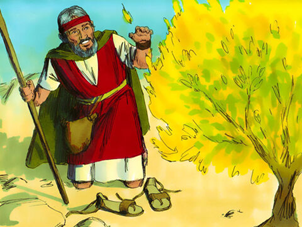
But wait! What was that in the distance? Some rare desert flower appeared to have suddenly blossomed in flaming colors.” Surely,” the shepherd mused, “I thought I knew all the common desert blossoms, but this is a new one.” As the shepherd moved closer, he realized that the bush was not bearing flowers but flames reaching to the heavens, and the bush was not consumed by the flames. Little did the shepherd realize that his life was about to change forever. Later, that same shepherd would record his experience in what we now know as Exodus 3:1-22, describing the morning that his life changed forever.
One day Moses was tending the flock of his father-in-law, Jethro, the priest of Midian. He led the flock far into the wilderness and came to Sinai, the mountain of God. There the angel of the Lord appeared to him in a blazing fire from the middle of a bush. Moses stared in amazement. Though the bush was engulfed in flames, it didn’t burn up. “This is amazing,” Moses said to himself. “Why isn’t that bush burning up? I must go see it.”
When the Lord saw Moses coming to take a closer look, God called to him from the middle of the bush, “Moses! Moses!”
“Do not come any closer,” the Lord warned. “Take off your sandals, for you are standing on holy ground. I am the God of your father—the God of Abraham, the God of Isaac, and the God of Jacob.” When Moses heard this, he covered his face because he was afraid to look at God.
Then the Lord told him, “I have certainly seen the oppression of my people in Egypt. I have heard their cries of distress because of their harsh slave drivers. Yes, I am aware of their suffering. So I have come down to rescue them from the power of the Egyptians and lead them out of Egypt into their own fertile and spacious land. It is a land flowing with milk and honey—the land where the Canaanites, Hittites, Amorites, Perizzites, Hivites, and Jebusites now live. Look! The cry of the people of Israel has reached me, and I have seen how harshly the Egyptians abuse them. Now go, for I am sending you to Pharaoh. You must lead my people Israel out of Egypt.”
But Moses protested to God, “Who am I to appear before Pharaoh? Who am I to lead the people of Israel out of Egypt?”
God answered, “I will be with you. And this is your sign that I am the one who has sent you: When you have brought the people out of Egypt, you will worship God at this very mountain.”
But Moses protested, “If I go to the people of Israel and tell them, ‘The God of your ancestors has sent me to you,’ they will ask me, ‘What is his name?’ Then what should I tell them?”
God replied to Moses, “I am who I am. Say this to the people of Israel: I am has sent me to you.” God also said to Moses, “Say this to the people of Israel: Yahweh, the God of your ancestors—the God of Abraham, the God of Isaac, and the God of Jacob—has sent me to you.
This is my eternal name, my name to remember for all generations.
“Now go and call together all the elders of Israel. Tell them, ‘Yahweh, the God of your ancestors—the God of Abraham, Isaac, and Jacob—has appeared to me. He told me, “I have been watching closely, and I see how the Egyptians are treating you. I have promised to rescue you from your oppression in Egypt. I will lead you to a land flowing with milk and honey—the land where the Canaanites, Hittites, Amorites, Perizzites, Hivites, and Jebusites now live.”’
“The elders of Israel will accept your message. Then you and the elders must go to the king of Egypt and tell him, ‘The Lord, the God of the Hebrews, has met with us. So please let us take a three-day journey into the wilderness to offer sacrifices to the Lord, our God.’
“But I know that the king of Egypt will not let you go unless a mighty hand forces him. So I will raise my hand and strike the Egyptians, performing all kinds of miracles among them. Then at last he will let you go. And I will cause the Egyptians to look favorably on you. They will give you gifts when you go so you will not leave empty-handed. Every Israelite woman will ask for articles of silver and gold and fine clothing from her Egyptian neighbors and from the foreign women in their houses. You will dress your sons and daughters with these, stripping the Egyptians of their wealth.”

While Moses had been raised in a palace as Pharoah’s daughter’s adopted son, he was forty years out from Egypt. After killing an Egyptian overseer who was beating a Hebrew slave, Moses had had to flee for his life, eventually finding his way to the camp of Jethro, a priest of Midian. Moses had found love and happiness with one of Jethro’s daughters, who had borne him two sons. Now Moses was a senior citizen, herding sheep and rejoicing in the peace of the desert. Life wasn’t easy but it was good, and Moses wanted nothing more than to herd the flocks and watch his sons marry and give him grandchildren. But God had other ideas.
Suddenly, Moses found himself in a confrontation with God, the same God about whom his parents had taught him when he was quite young, the same God whose presence he had sensed in the desert. And God was calling Moses to do something totally radical: he was to confront the most powerful ruler in the world and lead the Hebrews out of Egypt. Not only would Moses lead the Hebrews out of Egypt, but as they were leaving, the Hebrews would strip the Egyptians of their wealth.
Moses’ first reaction to God’s call was probably, “Huh? Who, me?” But as for separating the Egyptians from their wealth, Moses couldn’t believe it. Moses had grown up with the current Pharaoh and had been educated along with him. Moses knew just how class-conscious and materialistic the Egyptians were, particularly the upper classes. “Lord,” Moses thought to himself, “If You can strip the Egyptians of their wealth, You are truly a miracle worker!” God only smiled. He heard Moses thinking that thought, and He knew what He would do to convince the Egyptians. By the time God was through with the Egyptians, they would be thoroughly glad to be rid of the Hebrews and would give them everything just to get them out of their country.
Few callings from God are more dramatic than that of Moses. But consider the situation. Moses has been out of Egypt forty years and has established himself as a local leader with Jethro’s band. Moses is content to remain as a senior citizen, a chief of some kind, and an honored elder. Now God is calling Moses to do something so magnificent, so radical, that it boggles the imagination. God has to get Moses’ attention somehow, and He uses a burning bush.
God is calling Moses to do something that would challenge a much younger man. But all the time Moses has been herding sheep and goats in harsh places, God has been preparing him to lead the Israelites out of Egypt. God knows that herding Israelites is going to be far more challenging and stressful than herding sheep and goats. After forty years in this harsh environment, Moses is familiar with its demands and limitations. Such local knowledge is invaluable and cannot be gained overnight. Moses also has local connections in the wilderness, and these too will prove invaluable.
One mistake we might make as we age is assuming that God only calls young people to His work. If you believe, that, let me tell you about Nana Roberta Hampton. Nana Roberta taught school until she was 58, at which point, she joined Wycliffe Bible Translators and began teaching missionary children and progressed to training literacy teachers to teach their native tongues. One of Nana Roberta’s favorite phrases was “Rejoicing in Jesus!” In November 1994, we attended a retirement party for Nana Roberta in Ghana, and she was telling me she felt a little tired. Why? Well, it seems that two weeks previously, she had gone to a remote village. She began the journey in a pickup truck, then transferred to a motorcycle as far as a stream, then crossed the stream in a canoe, and then was picked on the back of a bicycle to the village. After fulfilling her purpose at that village, she repeated her journey in reverse and was now admitting she felt a little tired. Nana was 80 at the time. Even when Nana Roberta no longer lived in Ghana full-time, she still returned several times for various literacy conferences, last returning at age 85. Nana lived to be 93 and continued to praise God; in fact, she probably praised God and rejoiced in Him with her very last breath. Nana Roberta always promised that she would pray for us forever.
God knows that Moses will not only lead the Israelites out of Egypt but also shepherd them through the wilderness for forty years. God knows that He will give Moses all the laws necessary for the Israelites to live godly lives, even though they won’t want to obey. And God knows all the things Moses is going to suffer. But God also knows that He will give Moses the strength and the power to endure and that Moses will not only lead the Israelites but will also join Jesus and Elijah on the Mount of Transfiguration. While Moses is eyeing retirement, God is calling him into new employment.
Perhaps you are at mid-life and think you are too old for a radical change in your life. I was forty and my husband was forty-six when we first came to Ghana. Perhaps you are older and think all life has to offer you is retirement. My husband will soon be eighty-four and I will soon be seventy-eight. We are still ministering to the people God has placed in our hearts. What can we learn from the story of Moses’ call?
- Sometimes God uses dramatic events to call us. On the other hand, sometimes, God simply gives us strong feelings that we must step out and serve in a certain area.
- Age is no barrier. In many parts of the world, the elderly are respected for their wisdom. Age can be an advantage, for you might be weaker but also craftier!
- If God calls you, He has already been preparing you and will continue to do so.
- God can equip you even when you don’t realize it. Think about Moses spending forty years herding sheep and goats in the same wilderness through which he will later lead two million Israelites.
There’s a lot more to Moses’ call, and we will continue to examine it tomorrow. But remember that God loves you, God knows you, and God will never leave you or turn His back on you!
PRAYER: Father God, thank You for loving us and caring for us. Lord, speak to the hearts of all who read these words. Let them know that You have a purpose for their lives and that Your plans are far greater than theirs. In the mighty and precious Name of King Jesus. Amen.
 Burunche's Blog
Leave a comment