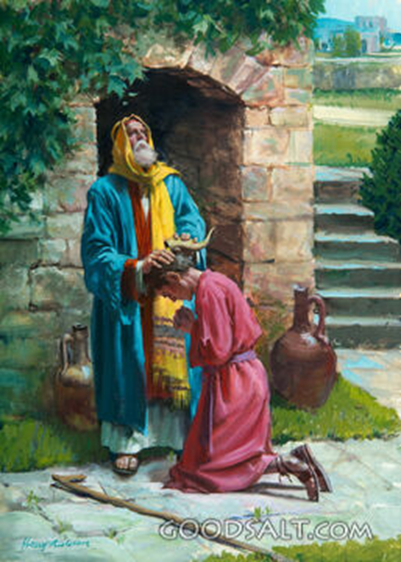
1 Samuel 16:1-13Now the Lord said to Samuel, “You have mourned long enough for Saul. I have rejected him as king of Israel, so fill your flask with olive oil and go to Bethlehem. Find a man named Jesse who lives there, for I have selected one of his sons to be my king.”
But Samuel asked, “How can I do that? If Saul hears about it, he will kill me.”
“Take a heifer with you,” the Lord replied, “and say that you have come to make a sacrifice to the Lord. Invite Jesse to the sacrifice, and I will show you which of his sons to anoint for me.”
So Samuel did as the Lord instructed. When he arrived at Bethlehem, the elders of the town came trembling to meet him. “What’s wrong?” they asked. “Do you come in peace?”
“Yes,” Samuel replied. “I have come to sacrifice to the Lord. Purify yourselves and come with me to the sacrifice.” Then Samuel performed the purification rite for Jesse and his sons and invited them to the sacrifice, too.
When they arrived, Samuel took one look at Eliab and thought, “Surely this is the Lord’s anointed!”
But the Lord said to Samuel, “Don’t judge by his appearance or height, for I have rejected him. The Lord doesn’t see things the way you see them. People judge by outward appearance, but the Lord looks at the heart.”
Then Jesse told his son Abinadab to step forward and walk in front of Samuel. But Samuel said, “This is not the one the Lord has chosen.” Next Jesse summoned Shimea, but Samuel said, “Neither is this the one the Lord has chosen.” In the same way all seven of Jesse’s sons were presented to Samuel. But Samuel said to Jesse, “The Lord has not chosen any of these.” Then Samuel asked, “Are these all the sons you have?”
“There is still the youngest,” Jesse replied. “But he’s out in the fields watching the sheep and goats.”
“Send for him at once,” Samuel said. “We will not sit down to eat until he arrives.”
So Jesse sent for him. He was dark and handsome, with beautiful eyes.
And the Lord said, “This is the one; anoint him.”
So as David stood there among his brothers, Samuel took the flask of olive oil he had brought and anointed David with the oil. And the Spirit of the Lord came powerfully upon David from that day on. Then Samuel returned to Ramah.
The elders of Bethlehem are terrified! Samuel the prophet has suddenly appeared, leading a heifer and announcing that he will sacrifice to the Lord in their town. While acts of worship are always welcome, you never know what a prophet might do, and Samuel is a very powerful prophet. God has already instructed Samuel to invite Jesse and all his sons to the sacrifices. Jesse is proud of his seven tall handsome older sons, but somebody has to watch the sheep, and David is the youngest. Besides, Dvid doesn’t really matter, for he’s only a teen-ager.
But God knows something Samuel doesn’t. Through David’s work with the sheep, he has been communing with God and trusting God to help him kill the wild animals attacking the sheep. David’s seven older brothers have remained back at the house, going through the motions of being religious, but never developing an active relationship with God. Frankly, none of these young men know God at all, and each of them has the potential to become just as big a disappointment as Saul if he were to become king.
God also knows another secret about David: David is a dead shot with a sling as well as being a gifted musician. After all, David has plenty of time to practice while he’s out there in the wilderness with the sheep, and there are lots of small stones of the right size. David probably prays and practices his harp playing and his marksmanship several hours a day. Anybody watching David would assume that he’s just killing time; however, God knows the skills David has developed while his brothers have been sitting in the house. Not only is David skilled but he’s also brave, diligent, and resourceful. The very trials that David has endured are the things that are preparing him to become a warrior and later a king.
When J. Hudson Taylor first went to China as a missionary, he felt he was a failure. There were major restrictions on where British subjects could travel, the group sponsoring Taylor sent inadequate funds and expected him to find housing for another missionary family that was coming later. But Taylor had developed his faith during days as a poverty-stricken medical student, and God put him in touch with a more experienced missionary who had adapted Chinese dress and who had become fluent in one of the major Chinese dialects. This new friendship was to shape the course of Taylor’s future ministry as he first began on his own and then founded the China Inland Mission.
What can we learn from David’s call? God is the One who chooses, and He is the One who must empower us. Our job is to remain in contact with God while His job is to equip us, to guide us, and to create opportunities for His work. David’s own father saw him as a nothing, a nobody, someone only fit to herd sheep. But God saw David as a king in apprenticeship. Don’t look at your shortcomings. Don’t look at your failures. Remember that God is the One who calls and He is responsible for equipping you and sustaining you. And God can redeem every difficult experience you have endured. Little did David realize that when he was killing lions and bears, he was preparing for the day he would face a giant.
PRAYER: Father God, thank You for loving us and caring for us. Lord, help us to follow hard after You all the days of our lives. Help us to remember that our hopes are in You, our strength comes from You, and that You are the Source of our provision. In the mighty and precious Name of King Jesus. Amen.
 Burunche's Blog
Leave a comment