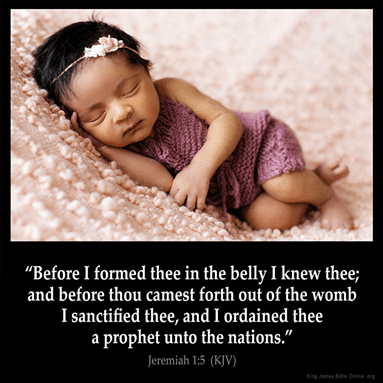
Jeremiah 1:1-3 These are the words of Jeremiah son of Hilkiah, one of the priests from the town of Anathoth in the land of Benjamin. The Lord first gave messages to Jeremiah during the thirteenth year of the reign of Josiah son of Amon, king of Judah.[627 B.C.] The Lord’s messages continued throughout the reign of King Jehoiakim, Josiah’s son, until the eleventh year of the reign of King Zedekiah, another of Josiah’s sons. In August of that eleventh year the people of Jerusalem were taken away as captives.
Jeremiah’s Call and First Visions
4-10 The Lord gave me this message:
“I knew you before I formed you in your mother’s womb. Before you were born, I set you apart
and appointed you as my prophet to the nations.”
“O Sovereign Lord,” I said, “I can’t speak for you! I’m too young!”
The Lord replied, “Don’t say, ‘I’m too young,’ for you must go wherever I send you and say whatever I tell you. And don’t be afraid of the people, for I will be with you and will protect you. I, the Lord, have spoken!” Then the Lord reached out and touched my mouth and said,
“Look, I have put my words in your mouth!
Imagine that you are seventeen. You love God, but you really don’t have a clue what you want to do with your life. You assume that you will soon marry and have a nice quiet life in your hometown of Anathoth. WRONG!!!WRONG!!!WRONG!!! While you, Jeremiah, are hoping for something calm and ordinary, God is planning something far different. Jeremiah has no idea what God is about to do with his life. God is calling Jeremiah to be one of the last prophets to the Southern Kingdom before the Babylonians overrun it, carrying some people off to Babylon while others remain in Jerusalem. The clock is ticking for the Israelites, for despite all God’s warnings, they have persisted in worshiping every pagan deity they can find, including demons demanding they burn their children as live offerings. God has selected Jeremiah to sound one of the desperate final warnings.
Why does God choose Jeremiah? Evidently, Jeremiah whole-heartedly follows God and is one of the few true believers left in Judah. God knows that Jeremiah will have a career spanning more than forty years, during which time he will be beaten, thrown in prison, dumped in a well full of muck where he nearly drowns until one of the court eunuchs saves him. Eventually, Jeremiah will even reluctantly accompany those from Judah when they insist on fleeing to Egypt, despite Jeremiah’s predictions that Nebuchadnezzar will conquer Egypt as well. And God knows that He has put more into Jeremiah than Jeremiah believes, for Jeremiah will endure through all this suffering, continuing to faithfully proclaim God’s word.
11-16 Today I appoint you to stand up against nations and kingdoms. Some you must uproot and tear down, destroy and overthrow. Others you must build up and plant.”
Then the Lord said to me, “Look, Jeremiah! What do you see?”
And I replied, “I see a branch from an almond tree.”
And the Lord said, “That’s right, and it means that I am watching,[the term in Hebrew for almond and watching sound similar] and I will certainly carry out all my plans.”
Then the Lord spoke to me again and asked, “What do you see now?”
And I replied, “I see a pot of boiling water, spilling from the north.”
“Yes,” the Lord said, “for terror from the north will boil out on the people of this land. Listen! I am calling the armies of the kingdoms of the north to come to Jerusalem. I, the Lord, have spoken!
“They will set their thrones at the gates of the city. They will attack its walls and all the other towns of Judah. I will pronounce judgment on my people for all their evil—for deserting me and burning incense to other gods. Yes, they worship idols made with their own hands!
17-19 “Get up and prepare for action. Go out and tell them everything I tell you to say.
Do not be afraid of them, or I will make you look foolish in front of them.
For see, today I have made you strong like a fortified city that cannot be captured, like an iron pillar or a bronze wall. You will stand against the whole land—the kings, officials, priests, and people of Judah. They will fight you, but they will fail. For I am with you, and I will take care of you. I, the Lord, have spoken!”
And if you think the professional religious people will accept Jeremiah gladly, think again! Jeremiah 20 tells the story of Pashhur, the high priest’s son, and a self-styled prophet who’s been busily telling people what they want to hear. As the Northern Kingdom falls to Assyria and the Babylonians approach, the citizens of Jerusalem are desperate for someone, anyone, to reassure them that despite all their disobedience, despite their gross blasphemies, despite their egregious neglect of God, God will give them a free pass and withhold His anger. Never mind all the warnings in the Book of Deuteronomy.
20:1-6 Now Pashhur son of Immer, the priest in charge of the Temple of the Lord, heard what Jeremiah was prophesying. So he arrested Jeremiah the prophet and had him whipped and put in stocks at the Benjamin Gate of the Lord’s Temple.
The next day, when Pashhur finally released him, Jeremiah said, “Pashhur, the Lord has changed your name. From now on you are to be called ‘The Man Who Lives in Terror.’ For this is what the Lord says: ‘I will send terror upon you and all your friends, and you will watch as they are slaughtered by the swords of the enemy. I will hand the people of Judah over to the king of Babylon. He will take them captive to Babylon or run them through with the sword. And I will let your enemies plunder Jerusalem. All the famed treasures of the city—the precious jewels and gold and silver of your kings—will be carried off to Babylon. As for you, Pashhur, you and all your household will go as captives to Babylon. There you will die and be buried, you and all your friends to whom you prophesied that everything would be all right.’”
OOF! Well! Guess that indicates what God thinks of Passhur and all other false prophets. Then Jeremiah goes on to complain about the force of his call. Jeremah 20:9 But if I say I’ll never mention the Lord or speak in his name, his word burns in my heart like a fire. It’s like a fire in my bones! I am worn out trying to hold it in! I can’t do it!
Finally, Jeremiah is so terrified, exhausted, and fed up that he concludes, “Why was I ever born? My entire life has been filled with trouble, sorrow, and shame.” (Jeremiah 20:18)
Reading the story of Jeremiah, we might wonder why anybody would answer that call and follow the Lord faithfully for more than forty years. The answer is simple: Jeremiah committed his life to the Lord and never turned back, even while he was lamenting bitterly. Abused, misunderstood, denigrated, stripped of everything, Jeremiah persisted in obeying God. When Gedaliah, the governor appointed by the Babylonians, was murdered, the remaining Israelites insisted on going to Egypt, despite Jeremiah’s admonitions to the contrary. Did Jeremiah die in Egypt? Did Jeremiah quietly find his way back to Anathoth? We don’t know. We only know that Jeremiah lived to see all his predictions come true, those predictions so loathed by the Israelites.
What can we gain from Jeremiah’s story? God designs our callings before we are ever born. God does not change His mind when we complain. As long as we will be faithful to God, He will continue to guide us. God does not change; we are the ones whose opinions shift with the wind. May God help us so that we will remain as faithful as Jeremiah did, even in the face of extreme opposition.
PRAYER: Father God, thank You for loving us and caring for us. Lord, help us to trust that if You call us, You will keep us, even in the face of adversity. Help us to remain true to Your calling, no matter what. In the mighty and precious Name of King Jesus. Amen.
 Burunche's Blog
Leave a comment