Amos 1: 1 The words of Amos, who was among the sheep breeders of Tekoa, which he saw concerning Israel in the days of Uzziah king of Judah, and in the days of Jeroboam the son of Joash, king of Israel, two years before the earthquake.
It’s the period between 760-755 B.C. Uzziah is king of Judah and Jeroboam II is king of Israel. Both nations are reveling in prosperity. Amos is quietly caring for sheep and sycamore trees in Tekoa, south of Jerusalem, when God suddenly calls him to prophesy. But God is calling Amos to prophesy to the Northern Kingdom, not to his own people. Why doesn’t God let Amos stay home? Centuries later, Jesus will give this insight: A prophet is not without honor, save in his own country. (Matthew 13:57, Mark 6:4) And God wants to use this sheep herder/sycamore tree farmer to shame and scandalize the religious professionals of the Northern Kingdom. Forget professional advertisers! God is the original Publicist, grabbing people’s attention by any means necessary. Making matters even worse, God has Amos prophesying against Bethel. Why?
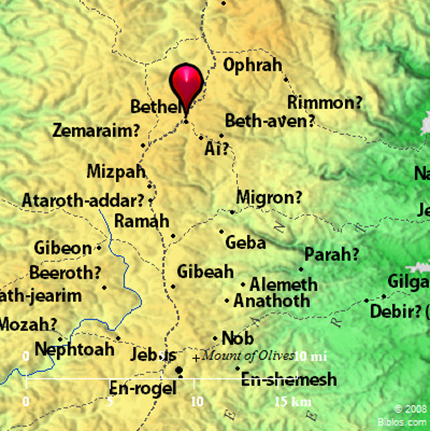
When the ten tribes split off from Rehoboam, leaving only Judah and Benjamin, Jeroboam, the first ruler of the Northern Kingdom was terrified to have his people returning to Jerusalem regularly for worship as God had ordered. So Jeroboam erected two enormous altars with golden calves, one at Bethel and the other at Dan in the far northeast. Then Jeroboam convinced his people that there was no need for them to suffer that LOOOOOONG journey to Jerusalem when they could SIMPLY travel to Bethel or Dan and practice his pseudo religion. Now Jeroboam II is ruling the Northern Kingdom, and idolatry is rife. Most priests claiming to serve Yahweh are faking it, and Amaziah, the priest of Bethel, is one of the biggest fakers.
Amos 7:10-17 Then Amaziah the priest of Bethel sent to Jeroboam king of Israel, saying, “Amos has conspired against you in the midst of the house of Israel. The land is not able to bear all his words. For thus Amos has said: ‘Jeroboam shall die by the sword, and Israel shall surely be led away captive from their own land.’”
Then Amaziah said to Amos: “Go, you seer! Flee to the land of Judah. There eat bread, and there prophesy. But never again prophesy at Bethel, for it is the king’s sanctuary, and it is the royal residence.”
Then Amos answered, and said to Amaziah: “I was no prophet, nor was I a son of a prophet,
but I was a sheepbreeder and a tender of sycamore fruit. Then the Lord took me as I followed the flock, and the Lord said to me, ‘Go, prophesy to My people Israel.’
Now therefore, hear the word of the Lord: You say, ‘Do not prophesy against Israel, and do not spout against the house of Isaac.’
“Therefore, thus says the Lord: ‘Your wife shall be a harlot in the city; your sons and daughters shall fall by the sword; your land shall be divided by survey line; you shall die in a defiled land;
and Israel shall surely be led away captive from his own land.’”
OUCH! Amaziah, are you listening at all? Amaziah recognizes that Amos is a seer; however, he hopes that if he sends Amos packing, Amos will take all his gloomy prophecies with him. Sorry, Amaziah! It doesn’t work that way. Once more, we have the example of someone who was quietly working when God suddenly picked him, pulling him out of his comfortable rut and dropping him into a hostile environment.
Amos pronounces God’s judgement on numerous nations, including Judah. But why has God sent Amos to Israel? How bad have things gotten? Amos 2:6-16 gives us the answer:
Thus says the Lord: “For three transgressions of Israel, and for four, I will not turn away its punishment, because they sell the righteous for silver, and the poor for a pair of sandals.
They pant after the dust of the earth which is on the head of the poor, and pervert the way of the humble. A man and his father go in to the same girl, to defile My holy name.
They lie down by every altar on clothes taken in pledge and drink the wine of the condemned in the house of their god.
According to the Law of Moses, Israelites were not to sell other Israelites as slaves, nor were they to oppress the poor. In addition, clothes taken in pledge were to be returned to the owner each night so that he would not suffer from the cold by sleeping naked. Idol worship was expressly and repeatedly forbidden.
“Yet it was I who destroyed the Amorite before them, whose height was like the height of the cedars, and he was as strong as the oaks; yet I destroyed his fruit above and his roots beneath. Also, it was I who brought you up from the land of Egypt, and led you forty years through the wilderness, to possess the land of the Amorite.
I raised up some of your sons as prophets, and some of your young men as Nazirites. Is it not so, O you children of Israel?” Says the Lord.
“But you gave the Nazirites wine to drink, and commanded the prophets saying, ‘Do not prophesy!’
“Behold, I am weighed down by you, as a cart full of sheaves is weighed down. Therefore, flight shall perish from the swift, the strong shall not strengthen his power, nor shall the mighty deliver himself; he shall not stand who handles the bow, the swift of foot shall not escape, nor shall he who rides a horse deliver himself. The most courageous men of might shall flee naked in that day,” says the Lord.
Amaziah doesn’t know it, but eventually, the citizens of the Northern Kingdom will curse his name because he has interfered with God’s warnings to them. Galatians 6:7 tells us, “Don’t be misled—you cannot mock the justice of God. You will always harvest what you plant.”
What can we learn from Amos’ call? First, God is not impressed with our social standing or our education, or lack thereof. Further investigation indicates that Amos is likely a businessman owning a large number of sheep, some of which might have been bred for temple sacrifices in Jerusalem. Amos obviously is a true believer and a worshiper of the One True Living God and has a sound grasp of the fundamentals of the Mosaic Law.
Compare Amos’ story with that of Prophet William Wade Harris of Liberia in 1910 and Babalola of Nigeria in the 1930’s. A Methodist missionary taught William Wade Harris to read and write English and his Grebo language. After working on ships cruising along the West Coast of Africa, Harris returned home, becoming a brick mason and raising a family. But Harris later became an evangelist, preaching against fetish huts and other abuses, converting more than 100,000 people, and urging his converts to burn all their fetishes.
And then there’s Joseph Ayodele Bablola, the African Christian who sparked a massive, Pentecostal-style revival in West Africa—specifically Nigeria—in the 1930’s.
Known as a Prophet and Apostle, Babalola was a key figure in the Aladura Movement (meaning “praying people”), and his 1930 revival at Oke-Oye in Ilesa, Nigeria, is considered a landmark event in African Christianity.
Key Details of the 1930s Revival:
- The Catalyst (1928-1930): Babalola, formerly a steam roller driver for the Public Works Department, claimed a direct call from God in 1928 to abandon his job and preach.
- Miracles and Healing: In September 1930, the revival began in earnest after Babalola was credited with raising a dead child. He became known for healing sicknesses, destroying idols, and using “life-giving water”.
- Impact: The revival caused thousands to convert, drawing people from across Nigeria and neighboring countries, and resulted in the founding of the Christ Apostolic Church (CAC).
- Spread: The revival movement spread from Ilesa to Ibadan, Lagos, and other regions, with some gatherings reportedly reaching 40,000 people.
- Influence in Ghana: In 1936, Babalola carried this revival to the Gold Coast (now Ghana), following earlier, related movements. (This information comes from an internet search.)
God isn’t worried about our ability; He is more interested in our availability. Amos said “Yes” to God and wound up prophesying in the Northern Kingdom. Prophet Harris and Prophet Babalola said “Yes” to God and sparked revivals that changed the face of much of West Africa. What might God do with you if you say “Yes?”
PRAYER: Father God, thank You for loving us and caring for us. Lord, help us to say “Yes” to your call, no matter how difficult that might be. In the mighty and precious Name of King Jesus. Amen.
 Burunche's Blog
Leave a comment