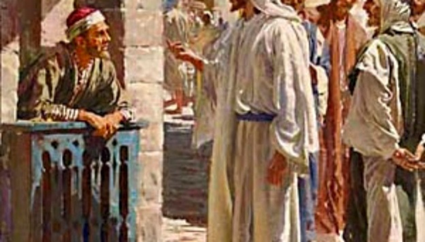
Luke 5:27-32 Later, as Jesus left the town, he saw a tax collector named Levi sitting at his tax collector’s booth. “Follow me and be my disciple,” Jesus said to him. So Levi got up, left everything, and followed him.
Later, Levi held a banquet in his home with Jesus as the guest of honor. Many of Levi’s fellow tax collectors and other guests also ate with them. But the Pharisees and their teachers of religious law complained bitterly to Jesus’ disciples, “Why do you eat and drink with such scum?”
Jesus answered them, “Healthy people don’t need a doctor—sick people do. I have come to call not those who think they are righteous, but those who know they are sinners and need to repent.”
It’s early morning in the town of Capernaum by the Sea of Galilee. Jesus is ambling down the main street, ostensibly entertaining himself by observing the bustle of roadside merchants, Roman soldiers, women hurrying to do their marketing, tradesmen plying their crafts. As far as those surrounding Jesus can tell, Jesus is simply amused by everything he sees, smiling and greeting people, waving at those at a distance. But Jesus has a purpose this morning; actually, he always has a purpose, something his followers are yet to realize. And this morning, the Holy Spirit is directing Jesus to a strange place, the tax collector’s office.
Nobody likes tax collectors! Tax collectors work for the hated Roman government but enrich themselves by padding people’s bills, inflating them to the advantage of the bill collector. The Pharisees, the professional religious people, scorn the tax collectors, even though some of these same men engage in sharp business practices every bit as heartless as the men whom they are mocking. Levi, son of Alphaeus is one of the tax collectors for Capernaum and has already opened his kiosk to take advantage of early morning business. Levi is well-educated; however, he comes from an impoverished family and has made up his mind that he will never be poor again. That resolve lasts right up until the moment that a shadow falls on Levi’s desk, and he looks up into the face of Jesus.
What does Levi see as he looks into that smiling face with those flashing dark eyes? Sure, Levi has heard about Jesus, who hasn’t? Being in the marketplace, Levi gets all the latest gossip and everybody is marveling over this former carpenter from Galilee who speaks about Yahweh as if he knows Him personally. But now there’s something compelling in those eyes, as if Jesus knows everything about Levi, the shame of poverty, the years of struggling, the scorn from Roman soldiers, the sting of continual rejection by religious leaders. Yes, Jesus sees everything about Levi and knows everything, and yet Jesus is gazing upon Levi as if Levi is a delightful close friend, a brother, and the very person Jesus has most wanted to meet on this bright sunny morning.
Levi is struck speechless, something that almost never happens. Normally, Levi is the one who can talk to anybody, convincing them to pay heavy taxes without clouting him. Now Levi feels as if his tongue is stuck to the roof of his mouth. And then Jesus speaks, “Follow me and be my disciple.” Without consciously thinking about it, Levi stands up, shutting the front of the kiosk. Levi gathers up his records and the money he’s collected, handing them to another one of the tax collectors, and then leaves to speak to Jesus.
“Lord,” Levi says hesitantly, “Would you be pleased to honor me with your presence at a noon meal at my home today?”
Jesus grins at Levi as if he’s simply been waiting for this invitation. “Absolutely, Levi! And be sure to invite your friends as well.”
Well! Levi has thrown dinner parties before, but today’s celebration will be the most important one of his life, as well as the last one he will ever put on. Luke tells the story, and you can imagine that he must have thoroughly interviewed Levi to gain this information.
Later, Levi held a banquet in his home with Jesus as the guest of honor. Many of Levi’s fellow tax collectors and other guests also ate with them. But the Pharisees and their teachers of religious law complained bitterly to Jesus’ disciples, “Why do you eat and drink with such scum?”
Jesus answered them, “Healthy people don’t need a doctor—sick people do. I have come to call not those who think they are righteous, but those who know they are sinners and need to repent.”
That bright morning in Capernaum marked a watershed in Levi’s life. Not only did Levi turn his back on his profession as a tax collector, but he even changed his name to Matthew. The name Levi means “joined, attached, or “united in harmony.” The name Matthew is derived from the Hebrew name Matityahu, and means “Gift of Yahweh” or “Gift of God.” Matthew truly became a gift of God, for not only did he become one of the original twelve disciples, but he wrote the Gospel aimed most clearly at Jews interested in Jesus. Following Jesus’ crucifixion and resurrection, Matthew preached in Judea for fifteen years before preaching in Macedonia, Persia, Syria, and Ethiopia. In Ethiopia, Matthew converted and protected a woman named Ephigenia, who had consecrated herself to God. When King Hirtacus succeeded the previous king, he sought to marry her and, enraged by Matthew’s refusal, ordered his death. Matthew died from a stab wound in the back while leading a church service.
What could possibly cause a flint-hearted tax collector willing to crush poor people for money to abandon a luxurious home, a steady income, and a comfortable way of life to follow an itinerant preacher? Love! When Jesus looked at Matthew, the unconditional love of God poured from his eyes. Matthew suddenly felt he was in the presence of someone who knew everything about him, including murderous thoughts about his competitors and the Romans, and loved him anyway. That love was so compelling that nothing else mattered.
Later, Matthew might have compared experiences with Peter, Andrew, James, and John. And each one of them would say the same thing: that the love of God as embodied in Jesus Christ was worth any amount of suffering. Later Saint Paul would describe the love of God this way: “For the love of Christ compels us )2 Corinthians 5:14) That love would compel Matthew to write, describing the life of Jesus. That love would drive Matthew to walk all over Judea, preaching. And eventually, that love would compel Matthew to travel to other countries, eventually dying in Ethiopia.
What can we learn from the story of Matthew’s call? Once Jesus calls you, nothing is as important as following him. There’s an old Gospel song that Matthew would have approved of.
In fancy I stood by the shore, one day,
Of the beautiful murm’ring sea;
I saw the great crowds as they thronged the way
Of the Stranger of Galilee;
I saw how the man who was blind from birth,
In a moment was made to see;
The lame was made whole by the matchless skill
Of the Stranger of Galilee.
I heard Him speak peace to the angry waves,
Of that turbulent, raging sea;
And lo! at His word are the waters stilled,
This Stranger of Galilee;
A peaceful, a quiet, and holy calm,
Now and ever abides with me;
He holdeth my life in His mighty hands,
This Stranger of Galilee.
And I felt I could love Him forever,
So gracious and tender was He!
I claimed Him that day as my Savior,
This Stranger,
He’s no Stranger,
But the Savior of Galilee.
PRAYER: Father God, thank You for loving us and caring for us. Lord, please let everyone who reads these words experience Your compelling love. Let them realize that You see them as they are, but You love them anyway. In the mighty and precious Name of King Jesus. Amen.
 Burunche's Blog
Leave a comment