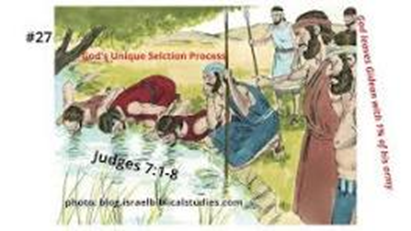
So Jerub-baal (that is, Gideon) and his army got up early and went as far as the spring of Harod. The armies of Midian were camped north of them in the valley near the hill of Moreh. The Lord said to Gideon, “You have too many warriors with you. If I let all of you fight the Midianites, the Israelites will boast to me that they saved themselves by their own strength. Therefore, tell the people, ‘Whoever is timid or afraid may leave this mountain and go home.’” So 22,000 of them went home, leaving only 10,000 who were willing to fight.
But the Lord told Gideon, “There are still too many! Bring them down to the spring, and I will test them to determine who will go with you and who will not.” When Gideon took his warriors down to the water, the Lord told him, “Divide the men into two groups. In one group put all those who cup water in their hands and lap it up with their tongues like dogs. In the other group put all those who kneel down and drink with their mouths in the stream.” Only 300 of the men drank from their hands. All the others got down on their knees and drank with their mouths in the stream.
The Lord told Gideon, “With these 300 men I will rescue you and give you victory over the Midianites. Send all the others home.” So Gideon collected the provisions and rams’ horns of the other warriors and sent them home. But he kept the 300 men with him.
When Gideon surveys the Valley of Jezreel, the valley is full of enemy troops. Even the 32,000 men Gideon has seems like a small number by comparison. But God isn’t pleased, for if He gives victory to those 32,000 men, they will take all the credit. So God proposes a series of tests. First, God advises Gideon to tell the men, “Whoever is timid or afraid may leave this mountain and go home.” You can practically hear the sighs of relief as 22,000 men immediately take to their heels, heading for home. But 10,000 men are left, and that’s still too many. Next, God orders Gideon to send the men to the spring and observe the manner in which they drink. 300 men scoop water in their hands and stand up to drink while watching for attack while the remaining 9700 kneel by the spring and scoop water. God knows that the 300 men who watch as they drink are seasoned warriors while the rest are careless and therefore liabilities in battle.
Now Gideon is really afraid! 300 men to defeat thousands of enemy soldiers with fancy weapons? How can this possibly work? Tomorrow we will see what a complete victory God gives Gideon, but today our focus is on the difference between our view of a situation and God’s. God has called Gideon. Gideon KNOWS God has called him. But Gideon is still looking at his own resources to save the situation; meanwhile, God is planning another miracle. Too many soldiers might convince the Israelites that they have gotten victory rather than realizing that God is simply using them as His tools. God wants to do something so audacious that NOBODY else can possibly get the credit for success.
This story resonates with me because we have lived it several times over. In February 1992 we came to a small village in northeastern Ghana to look at a clinic where a national church wanted us to work. There were eleven workers, no electricity, a poor water supply, no laboratory, no possibility of doing blood transfusions, and no operating room. I am a surgeon and an OR (Operating theatre) plus blood transfusions are necessary for surgery. But when we got out of the vehicle in the old mission house yard, the Holy Spirit descended like a big warm blanket wrapping around us, and suddenly we KNEW God wanted us to come to that uninviting place.
We returned in January 1993, and when we had been there a year, a small tribal war broke out. Suddenly, we became the only source of medical care for more than 100,000 people. I started the theatre and the laboratory, training several nurses and one physician’s assistant to group and cross match walk-in blood donors. We began doing hospital level work in a small health center building. That first year we performed 192 major operations, sterilizing everything in a large pressure cooker over a coal pot on the verandah. Eventually, God sent us a few more workers, raising our staff count to 22. But it was God who worked through those 22 workers, for nobody else could take the credit.
Today that small clinic has become a district hospital serving more than 120,000 people and attracting patients from great distances. But God is the only One who can really take credit. The rest of us have just happened to be in the near vicinity.
Perhaps you feel like Gideon. God has set you a daunting task and has then removed much of your help. Don’t worry! Remember that if God calls you, God is responsible for the results, and God can work just as effectively through a few people as He can through many. Trust God and then expect great things!
PRAYER: Father God, thank You for loving us and caring for us. Lord, help us to trust You no matter what, realizing that all success must come from You in the first place. In the mighty and precious Name of King Jesus. Amen.
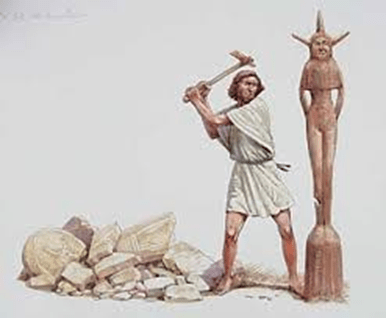
Judges 7:25-32 That night the Lord said to Gideon, “Take the second bull from your father’s herd, the one that is seven years old. Pull down your father’s altar to Baal, and cut down the Asherah pole standing beside it. Then build an altar to the Lord your God here on this hilltop sanctuary, laying the stones carefully. Sacrifice the bull as a burnt offering on the altar, using as fuel the wood of the Asherah pole you cut down.”
So Gideon took ten of his servants and did as the Lord had commanded. But he did it at night because he was afraid of the other members of his father’s household and the people of the town.
Early the next morning, as the people of the town began to stir, someone discovered that the altar of Baal had been broken down and that the Asherah pole beside it had been cut down. In their place a new altar had been built, and on it were the remains of the bull that had been sacrificed. The people said to each other, “Who did this?” And after asking around and making a careful search, they learned that it was Gideon, the son of Joash.
“Bring out your son,” the men of the town demanded of Joash. “He must die for destroying the altar of Baal and for cutting down the Asherah pole.”
But Joash shouted to the mob that confronted him, “Why are you defending Baal? Will you argue his case? Whoever pleads his case will be put to death by morning! If Baal truly is a god, let him defend himself and destroy the one who broke down his altar!” From then on Gideon was called Jerub-baal, which means “Let Baal defend himself,” because he broke down Baal’s altar.
Well! Now we learn that Gideon’s father owns the local Asherah pole and the altar of Baal. No wonder God isn’t helping Israel! Sounds as if Gideon’s father is the local fetish priest. And now God is testing Gideon, ordering Gideon to tear down the Asherah pole, destroy the altar of Baal, and use the stones from the altar to build an altar to the Lord, sacrificing the bull on it and using the wood from the Asherah pole as fuel. Shaking in his sandals, Gideon waits until the middle of the night and takes ten of the household servants to help him carry out God’s commands.
When morning comes, Gideon finds an angry mob is screaming for his blood because of his actions. But amazingly, Gideon’s father, the owner of the Asherah pole and the altar of Baal, defends Gideon. Gideon’s father Joash threatens that anyone defending Baal will die by morning. Besides, if Baal is really a god, he should be able to defend himself and destroy Gideon. Somehow, nobody in the mob wants to die quickly, so they leave. But Gideon is still worried and wants more assurance. A panting messenger has just delivered the word that enemy armies have crossed the Jordan and are camping in the valley of Jezreel.
33-40 Soon afterward the armies of Midian, Amalek, and the people of the east formed an alliance against Israel and crossed the Jordan, camping in the valley of Jezreel. Then the Spirit of the Lord clothed Gideon with power. He blew a ram’s horn as a call to arms, and the men of the clan of Abiezer came to him. He also sent messengers throughout Manasseh, Asher, Zebulun, and Naphtali, summoning their warriors, and all of them responded.
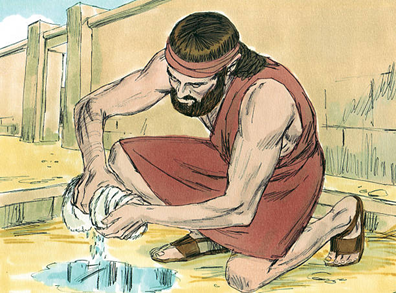
Then Gideon said to God, “If you are truly going to use me to rescue Israel as you promised, prove it to me in this way. I will put a wool fleece on the threshing floor tonight. If the fleece is wet with dew in the morning but the ground is dry, then I will know that you are going to help me rescue Israel as you promised.” And that is just what happened. Then Gideon said to God, “Please don’t be angry with me, but let me make one more request. Let me use the fleece for one more test. This time let the fleece remain dry while the ground around it is wet with dew.” So that night God did as Gideon asked. The fleece was dry in the morning, but the ground was covered with dew.
First, God tests Gideon, then God empowers Gideon. But then Gideon tests God. Notice that God does not become angry when Gideon asks for a double miracle. God knows that Gideon needs reassurance and He’s willing to do that.
There are all kinds of calls from God, some smaller and some larger. When God is calling someone to do something huge and magnificent, He may give reassurance as He has for Gideon. In 1981, my husband Bob was living and working in a town in western New York; however, he began feeling that God was calling him to move to the Charleston, SC, area to marry a lady from his church who had recently moved there. Bob had a whole list of things he wanted God to supply before he felt he could leave. Although Bob had been praying about the decision, nothing was happening. But as soon as Bob chose a departure date, God began to move. First, Bob got new tires for his van. Then Bob was able to settle matters in his hometown. Finally, someone told Bob about a young man willing to share driving duties to the Charleston area. Bob moved to Charleston in mid-June and almost immediately found a job as a fire fighter in Mount Pleasant, SC. Eventually, the relationship that brought Bob to South Carolina ended, and a few days later, I showed up at the little church Bob had been attending. And the rest is history.
When God is calling you, He might test you, but you can also “put out fleeces,” just as Gideon did. God will neither be offended nor angry. Just keep searching for His perfect will, and He will lead you.
PRAYER: Father God, thank You for loving us and caring for us. Lord, many of us feel you calling us, but we’re scared! Please help us to trust You and give us Your reassurance. In the mighty and precious Name of King Jesus. Amen.
Judges 6:1-10 The Israelites did evil in the Lord’s sight. So the Lord handed them over to the Midianites for seven years. The Midianites were so cruel that the Israelites made hiding places for themselves in the mountains, caves, and strongholds. Whenever the Israelites planted their crops, marauders from Midian, Amalek, and the people of the east would attack Israel, camping in the land and destroying crops as far away as Gaza. They left the Israelites with nothing to eat, taking all the sheep, goats, cattle, and donkeys. These enemy hordes, coming with their livestock and tents, were as thick as locusts; they arrived on droves of camels too numerous to count. And they stayed until the land was stripped bare. So Israel was reduced to starvation by the Midianites. Then the Israelites cried out to the Lord for help.
When they cried out to the Lord because of Midian, the Lord sent a prophet to the Israelites. He said, “This is what the Lord, the God of Israel, says: I brought you up out of slavery in Egypt. I rescued you from the Egyptians and from all who oppressed you. I drove out your enemies and gave you their land. I told you, ‘I am the Lord your God. You must not worship the gods of the Amorites, in whose land you now live.’ But you have not listened to me.”
You have to hand it to the Israelites! When it comes to ignoring God, these guys are tops. Repeatedly, God has begged, cajoled, promised, and ordered the Israelites to worship Him and Him alone, warning them of the dire consequences if they refuse; yet, the Israelites remain enticed by fertility cults and fancy idols that demand little and promise everything. Too bad these decisions are totally disastrous. Throughout the Mosaic Laws, God has warned the Israelites of the consequences of sinning against God, but the Israelites have evidently thought God was kidding. WRONG! Now the Israelites are fugitives in their own land, starving because the Midianites, Amalekites, and other marauders form the east are perpetually raiding, stealing all the livestock and crops. The idols have failed and fertility gods are worthless-after all, what good is fertility when marauders will steal everything anyway?
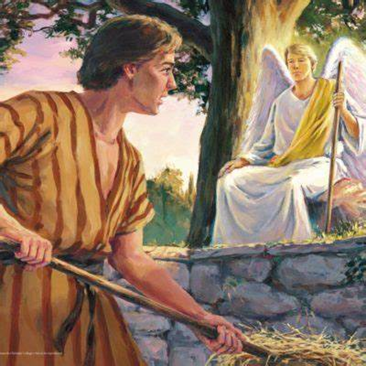
11-12 Then the angel of the Lord came and sat beneath the great tree at Ophrah, which belonged to Joash of the clan of Abiezer. Gideon son of Joash was threshing wheat at the bottom of a winepress to hide the grain from the Midianites. The angel of the Lord appeared to him and said, “Mighty hero, the Lord is with you!”
Gideon is hiding from the Midianites, threshing wheat in the bottom of a winepress in hopes of hiding the grain from robbers. When the angel of the Lord appears , hailing Gideon as “Mighty hero,” Gideon is looking around, thinking, “Who? Me?”
13 “Sir,” Gideon replied, “if the Lord is with us, why has all this happened to us? And where are all the miracles our ancestors told us about? Didn’t they say, ‘The Lord brought us up out of Egypt’? But now the Lord has abandoned us and handed us over to the Midianites.”
This angel is one patient guy! A lesser being would be smacking himself on the forehead and groaning, “Don’t you people ever learn ANYTHING?” And you can tell that the Israelites still don’t understand what’s going on because they are blaming God for all their problems. God is only carrying out His promises, but the Israelites have ignored His Word, refusing to honor God or to take responsibility for their own sins.
14 Then the Lord turned to him and said, “Go with the strength you have, and rescue Israel from the Midianites. I am sending you!”
15 “But Lord,” Gideon replied, “how can I rescue Israel? My clan is the weakest in the whole tribe of Manasseh, and I am the least in my entire family!” God is calling but Gideon has his fingers in his ears spiritually. It’s frightening to be called by God, and Gideon is vainly hoping that if he gives sufficiently valid excuses, God will simply go call someone else. But God is not giving up. God already knows Gideon’s entire situation; however, God knows He can work through Gideon.
16-19 The Lord said to him, “I will be with you. And you will destroy the Midianites as if you were fighting against one man.”
Gideon replied, “If you are truly going to help me, show me a sign to prove that it is really the Lord speaking to me. Don’t go away until I come back and bring my offering to you.”
He answered, “I will stay here until you return.”
Gideon hurried home. He cooked a young goat, and with a basket of flour he baked some bread without yeast. Then, carrying the meat in a basket and the broth in a pot, he brought them out and presented them to the angel, who was under the great tree.
20-24 The angel of God said to him, “Place the meat and the unleavened bread on this rock, and pour the broth over it.” And Gideon did as he was told. Then the angel of the Lord touched the meat and bread with the tip of the staff in his hand, and fire flamed up from the rock and consumed all he had brought. And the angel of the Lord disappeared.
When Gideon realized that it was the angel of the Lord, he cried out, “Oh, Sovereign Lord, I’m doomed! I have seen the angel of the Lord face to face!”
Until now, Gideon been trying to argue with himself that he is not meeting a messenger from the One True Living God. Never mind that this heavenly being has suddenly appeared in the secret place where Gideon has been working. Never mind that this being obviously is bearing messages from God. Mentally, Gideon has been arguing that he is suffering from hallucinations and that his morning porridge hasn’t set well. Now Gideon finally must face the fact that God IS calling him.
“It is all right,” the Lord replied. “Do not be afraid. You will not die.” And Gideon built an altar to the Lord there and named it Yahweh-Shalom (which means “the Lord is peace”). The altar remains in Ophrah in the land of the clan of Abiezer to this day.
At least Gideon responds appropriately once he faces the fact that God is calling him and is refusing to take no for an answer.
What can we learn from this part of Gideon’s story?
God knows our situations better than we do. At first, Gideon doesn’t appear to be very courageous or resourceful; however, God knows Gideon’s potential.
Humility is a good thing. Gideon has no illusions about his own strength or influence. This means that Gideon’s ego is less likely to get in the way of fulfilling God’s plans.
When God calls us, God doesn’t give up. Notice that each time Gideon comes up with an excuse, God simply ignores the excuses.
God is looking for people whom He can use, not for those full of their own importance. 1 Corinthians 1:26-29 tells us, “Remember, dear brothers and sisters, that few of you were wise in the world’s eyes or powerful or wealthy when God called you. Instead, God chose things the world considers foolish in order to shame those who think they are wise. And he chose things that are powerless to shame those who are powerful. God chose things despised by the world, things counted as nothing at all, and used them to bring to nothing what the world considers important. As a result, no one can ever boast in the presence of God.”
God is looking for those who will worship Him. After all his excuses fail, Gideon worships the Lord as a sign of contrition and agreement with God’s plans.
Perhaps you feel like Gideon. You look at yourself and see someone with few resources and little influence. But consider the story of Katie Stagliono, a nine-year-old girl who brought home a cabbage plant in a small paper cup as a school project. Other students let their plants die, but this little girl nurtured that plant until it grew into a 40-pound cabbage. Then Katie donated that cabbage to a local shelter, where it helped feed 275 people. That single cabbage was the start of Katie’s Krops, an NGO encouraging students to raise vegetables and donate them to the hungry in their communities. Fourteen years later, the organization could count more than 100 student groups in 32 states, with donations of food amounting to hundreds of thousands of pounds of free produce each year.
God can take a nobody from the weakest family in a tribe in Israel to save His people. The same God can take a nine-year-old girl with a single cabbage seed to raise a giant cabbage inspiring a home gardening movement among students throughout America. Now, what can God do with you, if you say “Yes” to His call?
PRAYER: Father God, thank You for loving us and caring for us. Lord, please help us to remember that You are the One who calls and You are the One who empowers. Help us to trust that You will also give us the strength and the courage to follow Your call. In the mighty and precious Name of King Jesus. Amen.
Judges 4:1-3 After Ehud’s death, the Israelites again did evil in the Lord’s sight. So the Lord turned them over to King Jabin of Hazor, a Canaanite king. The commander of his army was Sisera, who lived in Harosheth-haggoyim. Sisera, who had 900 iron chariots, ruthlessly oppressed the Israelites for twenty years. Then the people of Israel cried out to the Lord for help.
4-8 Deborah, the wife of Lappidoth, was a prophet who was judging Israel at that time. She would sit under the Palm of Deborah, between Ramah and Bethel in the hill country of Ephraim, and the Israelites would go to her for judgment. One day she sent for Barak son of Abinoam, who lived in Kedesh in the land of Naphtali. She said to him, “This is what the Lord, the God of Israel, commands you: Call out 10,000 warriors from the tribes of Naphtali and Zebulun at Mount Tabor. And I will call out Sisera, commander of Jabin’s army, along with his chariots and warriors, to the Kishon River. There I will give you victory over him.”
Barak told her, “I will go, but only if you go with me.”
Everybody knows Deborah. Deborah’s reputation as a wise woman led of God has resonated throughout all Israel, and people flock to her for godly advice. Now God is speaking through Deborah to Barak, that Barak should gather 10,000 warriors together to deliver Israel from the Canaanite king Jabin. God knows what He can do through Barak; however, Barak doesn’t know God. Barak has more faith in Deborah than he does in God, and he will lose the credit for victory as a consequence.
9-11 “Very well,” she replied, “I will go with you. But you will receive no honor in this venture, for the Lord’s victory over Sisera will be at the hands of a woman.” So Deborah went with Barak to Kedesh. At Kedesh, Barak called together the tribes of Zebulun and Naphtali, and 10,000 warriors went up with him. Deborah also went with him.
Now Heber the Kenite, a descendant of Moses’ brother-in-law Hobab, had moved away from the other members of his tribe and pitched his tent by the oak of Zaanannim near Kedesh.
At least Barak can follow instructions. But as battle looms, he’s still trusting more in Deborah than in God. Perhaps Barak thinks Deborah is some kind of miracle worker. Anyway, battle is about to start.
12-16 When Sisera was told that Barak son of Abinoam had gone up to Mount Tabor, he called for all 900 of his iron chariots and all of his warriors, and they marched from Harosheth-haggoyim to the Kishon River.
Then Deborah said to Barak, “Get ready! This is the day the Lord will give you victory over Sisera, for the Lord is marching ahead of you.” So Barak led his 10,000 warriors down the slopes of Mount Tabor into battle. When Barak attacked, the Lord threw Sisera and all his chariots and warriors into a panic. Sisera leaped down from his chariot and escaped on foot. Then Barak chased the chariots and the enemy army all the way to Harosheth-haggoyim, killing all of Sisera’s warriors. Not a single one was left alive.
WOW! What an incredible victory. God throws the enemy warriors and the horses of the 900 chariots into a panic. Once those chariot horses begin rearing and snorting, they run helter-skelter through the battlefield, mowing down many of their own troops. If the Canaanites have mounted sickle blades on the chariot wheels, the carnage might be even worse. As the Canaanite warriors flee, Barak’s soldiers begin picking them off with carefully aimed shots.
How accurate are these ancient slings and at what range? Online investigations reveal the following: Ancient slings (often mistakenly referred to as slingshots, which require 19th-century rubber) were considered highly accurate by contemporary standards, with an effective combat range often exceeding 200–400 meters for area targets and 20–50 yards for precision shots.
Key findings on the accuracy and range of ancient slings include:
Effective Combat Range: While maximum distance could exceed 400 meters, effective accuracy for hitting groups of soldiers was generally considered to be in the 100-meter range, often matching or exceeding the effective range of bows.
Precision Accuracy: Highly trained, expert slingers (such as those from the Balearic Islands) could hit small targets at distances of roughly 20 yards or more.
Ammo Impact: Using specially crafted lead bullets, Roman-era slingers could achieve lethal accuracy and force similar to a modern .44 magnum handgun.
Accuracy Factors: Accuracy depended heavily on the user’s skill, which required years of practice, and the use of consistent, molded ammunition (clay or lead) rather than random, irregularly shaped stones.
In summary, for accurate “sniper-like” shots, they were effective within 20–50 yards, while for military, battlefield-level accuracy (hitting large groups of men), they were effective at distances exceeding 100 meters.
In other words, if Barak has soldiers who are proficient with slings, they can pick off the enemy without risking themselves. It’s even possible that some of the enemy soldiers might die simply from sudden heart arrythmias brought on by panic. But the enemy commander remains at large.
17-24 Meanwhile, Sisera ran to the tent of Jael, the wife of Heber the Kenite, because Heber’s family was on friendly terms with King Jabin of Hazor. Jael went out to meet Sisera and said to him, “Come into my tent, sir. Come in. Don’t be afraid.” So he went into her tent, and she covered him with a blanket.
“Please give me some water,” he said. “I’m thirsty.” So she gave him some milk from a leather bag and covered him again.
“Stand at the door of the tent,” he told her. “If anybody comes and asks you if there is anyone here, say no.”
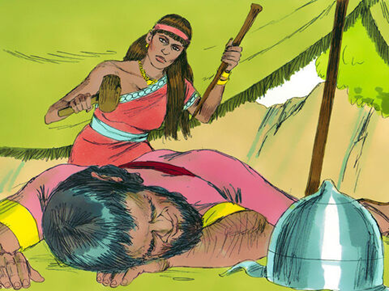
But when Sisera fell asleep from exhaustion, Jael quietly crept up to him with a hammer and tent peg in her hand. Then she drove the tent peg through his temple and into the ground, and so he died.
When Barak came looking for Sisera, Jael went out to meet him. She said, “Come, and I will show you the man you are looking for.” So he followed her into the tent and found Sisera lying there dead, with the tent peg through his temple.
So on that day Israel saw God defeat Jabin, the Canaanite king. And from that time on Israel became stronger and stronger against King Jabin until they finally destroyed him.
When Sisera finds Jael in Heber’s camp, he thinks he’s safe. After all, Heber is an ally of sorts, and as a mere woman, Jael must follow Sisera’s orders. But Jael has observed Sisera for a long time and she knows how dangerous he can be. Perhaps Sisera’s men have abducted and raped some of the girls from Heber’s camp. At any rate, Jael knows Sisera must not leave her tent alive. Fueled by the strength of desperation, Jael waits until Sisera is sleeping and then drives a tent peg through his temple, pinning his head to the ground and killing him. Deborah’s prediction has come true; God has given the ultimate victory to a woman, rather than to Barak.
While Romans 11:29 remains true- “The gifts and the calling of God are without repentance,” it’s also true that when God needs a job done, He will look for those available rather than those who are qualified. Jael is probably a sweet, gentle, peaceful lady known for her outstanding hospitality; violence is the last thing anyone would anticipate from Jael. But when God moves Jael, she acts rather than dithering. Barak is a ditherer, so although he does lead 10,000 troops into battle, he demands Deborah accompany him, and he loses credit for Sisera’s death to Jael.
God’s purposes will not be frustrated. If God is calling you to a work, rest assured that He will also empower you and provide everything you need to complete that work. But if you dither and refuse God’s call, He will find someone else. You might receive some credit, but the major credit will go to the one who allows himself/herself to be used without hesitation.
Does Barak lose out entirely? No, he does not. In Hebrews 11:32, Barak is listed along with “Gideon, Samson, Jephthah, David, Samuel, and all the prophets.” Barak does have some faith, and it undoubtedly expands exponentially as he watches his troops slaughter the Canaanites.
What can we learn from Barak?
If God calls you, God will equip you. Don’t look at your own weaknesses but remember that you are serving an Almighty God.
When God calls you, God will provide someone to stand with you. Deborah accompanies Barak throughout the battle and God raises up Jael to strike the final blow.
TRUST GOD!!! First and last, trust that the God who called you is able to do great things through you.
Remember Romans 15:13 I pray that God, the source of hope, will fill you completely with joy and peace because you trust in him. Then you will overflow with confident hope through the power of the Holy Spirit. We can overflow with confident hope, not because of our own strength but because of the power of the Holy Spirit.
PRAYER: Father God, thank You for loving us and caring for us. Lord, may all who read these words swiftly say “yes” to Your calling, knowing that You will send Your Holy Spirit to empower them. And may they overflow with joy. In the mighty and precious Name of King Jesus. Amen.
One day the Lord said to Moses, “Climb one of the mountains east of the river, and look out over the land I have given the people of Israel. After you have seen it, you will die like your brother, Aaron, for you both rebelled against my instructions in the wilderness of Zin. When the people of Israel rebelled, you failed to demonstrate my holiness to them at the waters.” (These are the waters of Meribah at Kadesh in the wilderness of Zin.)
Then Moses said to the Lord, “O Lord, you are the God who gives breath to all creatures. Please appoint a new man as leader for the community. Give them someone who will guide them wherever they go and will lead them into battle, so the community of the Lord will not be like sheep without a shepherd.”
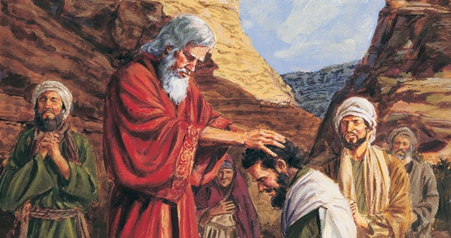
The Lord replied, “Take Joshua son of Nun, who has the Spirit in him, and lay your hands on him. Present him to Eleazar the priest before the whole community, and publicly commission him to lead the people. Transfer some of your authority to him so the whole community of Israel will obey him. When direction from the Lord is needed, Joshua will stand before Eleazar the priest, who will use the Urim—one of the sacred lots cast before the Lord—to determine his will. This is how Joshua and the rest of the community of Israel will determine everything they should do.”
So Moses did as the Lord commanded. He presented Joshua to Eleazar the priest and the whole community. Moses laid his hands on him and commissioned him to lead the people, just as the Lord had commanded through Moses.
Moses knew the day was coming, but he still hoped that God would relent. Moses obeyed God perfectly in every action save one. At the waters of Meribah, the crowd taunted and threatened Moses until he reached his breaking point. Although God had instructed Moses to speak to the rock so that it would yield water, Moses struck the rock twice with his staff, shouting, “Listen, you rebels!” he shouted. “Must we bring you water from this rock?” (Numbers 20:10) Although God did cause water to gush from the rock, He was angry at Moses for failing to honor Him by speaking to the rock, rather than hitting it. (The first time God brought water from a rock, he did have Moses strike the rock, but this time God wanted Moses to honor Him by speaking to the rock, instead of striking it. If water gushed when Moses spoke, then there could be no confusion that Moses had happened to strike a weak spot in the rock, releasing water. For this failing, God told Moses that he would never enter the Promised Land but would die on the east side of the Jordan.
But why was God choosing Joshua to succeed Moses? First, there was Joshua’s closeness to God. Exodus 33:11 Inside the Tent of Meeting, the Lord would speak to Moses face to face, as one speaks to a friend. Afterward Moses would return to the camp, but the young man who assisted him, Joshua son of Nun, would remain behind in the Tent of Meeting.
Joshua habitually spent time with God, praying and listening to Him. God wanted a man who would listen as closely as Moses had done. And then there was the spying incident as described in Numbers 13. The Israelites were on the border of Canaan and Moses sent twelve men, one from each tribe, to spy out the land. Caleb represented the tribe of Judah and Joshua represented the tribe of Ephraim. Although the spies came back raving about how fruitful the land was, they obsessed over the presence of giants, as if God was going to abandon them once they crossed the Jordan River. Only Caleb and Joshua responded in faith.
Numbers 14:6-9 tells us, “Two of the men who had explored the land, Joshua son of Nun and Caleb son of Jephunneh, tore their clothing. They said to all the people of Israel, “The land we traveled through and explored is a wonderful land! And if the Lord is pleased with us, he will bring us safely into that land and give it to us. It is a rich land flowing with milk and honey. Do not rebel against the Lord, and don’t be afraid of the people of the land. They are only helpless prey to us! They have no protection, but the Lord is with us! Don’t be afraid of them!”
At the end of the day, the Israelites made a half-hearted attempt to enter Canaan despite God’s orders to retreat and return to the wilderness. This sortie proved disastrous, and in addition, God ordained that all the people who had failed to trust Him would die in the wilderness while their children would enter Canaan. But God also vowed that both Caleb and Joshua would prosper and enter Canaan because they had acted faithfully. Now God was ordering Moses to anoint Joshua as his successor. Although righteous, Caleb was older than Joshua; hence, Joshua was chosen as leader.
But now Joshua has a major problem: Moses has been incredibly successful for forty years. How can Joshua possibly compete with that record? If we assume that Joshua was at least 20 when the Israelites left Egypt, he is now 60 years old. Joshua lives to the age of 110, so he has another 50 years in which he will lead the Israelites. During that time, the Israelites will cross the Jordan River, destroy most of the giants, and conquer most of the land of Canaan. There will be a few exceptions; however, those failures are not Joshua’s fault. Moses has never been a military man; he’s the one sitting on top of a mountain providing prayer support while Joshua leads the troops below. And Joshua will be highly successful in battle. But there’s another key to Joshua’s success.
Joshua 1:1-9 tells us, “After the death of Moses the Lord’s servant, the Lord spoke to Joshua son of Nun, Moses’ assistant. He said, “Moses my servant is dead. Therefore, the time has come for you to lead these people, the Israelites, across the Jordan River into the land I am giving them. I promise you what I promised Moses: ‘Wherever you set foot, you will be on land I have given you—from the Negev wilderness in the south to the Lebanon mountains in the north, from the Euphrates River in the east to the Mediterranean Sea in the west, including all the land of the Hittites.’ No one will be able to stand against you as long as you live. For I will be with you as I was with Moses. I will not fail you or abandon you.
“Be strong and courageous, for you are the one who will lead these people to possess all the land I swore to their ancestors I would give them. Be strong and very courageous. Be careful to obey all the instructions Moses gave you. Do not deviate from them, turning either to the right or to the left. Then you will be successful in everything you do. Study this Book of Instruction continually. Meditate on it day and night so you will be sure to obey everything written in it. Only then will you prosper and succeed in all you do. This is my command—be strong and courageous! Do not be afraid or discouraged. For the Lord your God is with you wherever you go.”
WOW! This is God Almighty giving these orders. Look at the promises:
The time has come for you to lead these people-OK, Joshua, no more soul-searching or agonizing over what to do. God is directing you.
“I promise you what I promised Moses: ‘Wherever you set foot, you will be on land I have given you—from the Negev wilderness in the south to the Lebanon mountains in the north, from the Euphrates River in the east to the Mediterranean Sea in the west, including all the land of the Hittites.’ No one will be able to stand against you as long as you live.” God is promising Joshua continuous victory in battle, even if there are giants.
“For I will be with you as I was with Moses. I will not fail you or abandon you.” Joshua already knows about Moses’ relationship with God, for Joshua accompanied Moses to the tabernacle and remained there to commune with God by himself.
““Be strong and courageous,” God repeats this three times, indicating that this command stands and cannot be revoked.
“Be careful to obey all the instructions Moses gave you. Do not deviate from them, turning either to the right or to the left.” This is not the time to divert from Moses’ teaching.
“Study this Book of Instruction continually. Meditate on it day and night so you will be sure to obey everything written in it. Only then will you prosper and succeed in all you do.” If you don’t follow God’s commands, you can’t get God’s results.
“Do not be afraid or discouraged. For the Lord your God is with you wherever you go.”
Here is the key to following a legend: Don’t worry about measuring up to the legend, but instead, follow the Lord. “For only then will you prosper and succeed in all you do.”
PRAYER: Father God, thank You for loving us and caring for us. Lord, many of us feel totally inadequate. You are calling us to follow highly successful people, and we are terrified that we will fail to measure up. Help us to remember that when You call us, You will enable us and help us. In the mighty and precious Name of King Jesus. Amen.
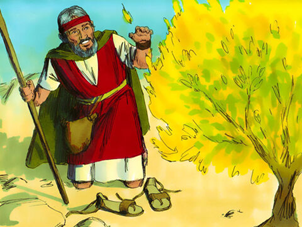
But wait! What was that in the distance? Some rare desert flower appeared to have suddenly blossomed in flaming colors.” Surely,” the shepherd mused, “I thought I knew all the common desert blossoms, but this is a new one.” As the shepherd moved closer, he realized that the bush was not bearing flowers but flames reaching to the heavens, and the bush was not consumed by the flames. Little did the shepherd realize that his life was about to change forever. Later, that same shepherd would record his experience in what we now know as Exodus 3:1-22, describing the morning that his life changed forever.
One day Moses was tending the flock of his father-in-law, Jethro, the priest of Midian. He led the flock far into the wilderness and came to Sinai, the mountain of God. There the angel of the Lord appeared to him in a blazing fire from the middle of a bush. Moses stared in amazement. Though the bush was engulfed in flames, it didn’t burn up. “This is amazing,” Moses said to himself. “Why isn’t that bush burning up? I must go see it.”
When the Lord saw Moses coming to take a closer look, God called to him from the middle of the bush, “Moses! Moses!”
“Do not come any closer,” the Lord warned. “Take off your sandals, for you are standing on holy ground. I am the God of your father—the God of Abraham, the God of Isaac, and the God of Jacob.” When Moses heard this, he covered his face because he was afraid to look at God.
Then the Lord told him, “I have certainly seen the oppression of my people in Egypt. I have heard their cries of distress because of their harsh slave drivers. Yes, I am aware of their suffering. So I have come down to rescue them from the power of the Egyptians and lead them out of Egypt into their own fertile and spacious land. It is a land flowing with milk and honey—the land where the Canaanites, Hittites, Amorites, Perizzites, Hivites, and Jebusites now live. Look! The cry of the people of Israel has reached me, and I have seen how harshly the Egyptians abuse them. Now go, for I am sending you to Pharaoh. You must lead my people Israel out of Egypt.”
But Moses protested to God, “Who am I to appear before Pharaoh? Who am I to lead the people of Israel out of Egypt?”
God answered, “I will be with you. And this is your sign that I am the one who has sent you: When you have brought the people out of Egypt, you will worship God at this very mountain.”
But Moses protested, “If I go to the people of Israel and tell them, ‘The God of your ancestors has sent me to you,’ they will ask me, ‘What is his name?’ Then what should I tell them?”
God replied to Moses, “I am who I am. Say this to the people of Israel: I am has sent me to you.” God also said to Moses, “Say this to the people of Israel: Yahweh, the God of your ancestors—the God of Abraham, the God of Isaac, and the God of Jacob—has sent me to you.
This is my eternal name, my name to remember for all generations.
“Now go and call together all the elders of Israel. Tell them, ‘Yahweh, the God of your ancestors—the God of Abraham, Isaac, and Jacob—has appeared to me. He told me, “I have been watching closely, and I see how the Egyptians are treating you. I have promised to rescue you from your oppression in Egypt. I will lead you to a land flowing with milk and honey—the land where the Canaanites, Hittites, Amorites, Perizzites, Hivites, and Jebusites now live.”’
“The elders of Israel will accept your message. Then you and the elders must go to the king of Egypt and tell him, ‘The Lord, the God of the Hebrews, has met with us. So please let us take a three-day journey into the wilderness to offer sacrifices to the Lord, our God.’
“But I know that the king of Egypt will not let you go unless a mighty hand forces him. So I will raise my hand and strike the Egyptians, performing all kinds of miracles among them. Then at last he will let you go. And I will cause the Egyptians to look favorably on you. They will give you gifts when you go so you will not leave empty-handed. Every Israelite woman will ask for articles of silver and gold and fine clothing from her Egyptian neighbors and from the foreign women in their houses. You will dress your sons and daughters with these, stripping the Egyptians of their wealth.”
While Moses had been raised in a palace as Pharoah’s daughter’s adopted son, he was forty years out from Egypt. After killing an Egyptian overseer who was beating a Hebrew slave, Moses had had to flee for his life, eventually finding his way to the camp of Jethro, a priest of Midian. Moses had found love and happiness with one of Jethro’s daughters, who had borne him two sons. Now Moses was a senior citizen, herding sheep and rejoicing in the peace of the desert. Life wasn’t easy but it was good, and Moses wanted nothing more than to herd the flocks and watch his sons marry and give him grandchildren. But God had other ideas.
Suddenly, Moses found himself in a confrontation with God, the same God about whom his parents had taught him when he was quite young, the same God whose presence he had sensed in the desert. And God was calling Moses to do something totally radical: he was to confront the most powerful ruler in the world and lead the Hebrews out of Egypt. Not only would Moses lead the Hebrews out of Egypt, but as they were leaving, the Hebrews would strip the Egyptians of their wealth.
Moses’ first reaction to God’s call was probably, “Huh? Who, me?” But as for separating the Egyptians from their wealth, Moses couldn’t believe it. Moses had grown up with the current Pharaoh and had been educated along with him. Moses knew just how class-conscious and materialistic the Egyptians were, particularly the upper classes. “Lord,” Moses thought to himself, “If You can strip the Egyptians of their wealth, You are truly a miracle worker!” God only smiled. He heard Moses thinking that thought, and He knew what He would do to convince the Egyptians. By the time God was through with the Egyptians, they would be thoroughly glad to be rid of the Hebrews and would give them everything just to get them out of their country.
Few callings from God are more dramatic than that of Moses. But consider the situation. Moses has been out of Egypt forty years and has established himself as a local leader with Jethro’s band. Moses is content to remain as a senior citizen, a chief of some kind, and an honored elder. Now God is calling Moses to do something so magnificent, so radical, that it boggles the imagination. God has to get Moses’ attention somehow, and He uses a burning bush.
God is calling Moses to do something that would challenge a much younger man. But all the time Moses has been herding sheep and goats in harsh places, God has been preparing him to lead the Israelites out of Egypt. God knows that herding Israelites is going to be far more challenging and stressful than herding sheep and goats. After forty years in this harsh environment, Moses is familiar with its demands and limitations. Such local knowledge is invaluable and cannot be gained overnight. Moses also has local connections in the wilderness, and these too will prove invaluable.
One mistake we might make as we age is assuming that God only calls young people to His work. If you believe, that, let me tell you about Nana Roberta Hampton. Nana Roberta taught school until she was 58, at which point, she joined Wycliffe Bible Translators and began teaching missionary children and progressed to training literacy teachers to teach their native tongues. One of Nana Roberta’s favorite phrases was “Rejoicing in Jesus!” In November 1994, we attended a retirement party for Nana Roberta in Ghana, and she was telling me she felt a little tired. Why? Well, it seems that two weeks previously, she had gone to a remote village. She began the journey in a pickup truck, then transferred to a motorcycle as far as a stream, then crossed the stream in a canoe, and then was picked on the back of a bicycle to the village. After fulfilling her purpose at that village, she repeated her journey in reverse and was now admitting she felt a little tired. Nana was 80 at the time. Even when Nana Roberta no longer lived in Ghana full-time, she still returned several times for various literacy conferences, last returning at age 85. Nana lived to be 93 and continued to praise God; in fact, she probably praised God and rejoiced in Him with her very last breath. Nana Roberta always promised that she would pray for us forever.
God knows that Moses will not only lead the Israelites out of Egypt but also shepherd them through the wilderness for forty years. God knows that He will give Moses all the laws necessary for the Israelites to live godly lives, even though they won’t want to obey. And God knows all the things Moses is going to suffer. But God also knows that He will give Moses the strength and the power to endure and that Moses will not only lead the Israelites but will also join Jesus and Elijah on the Mount of Transfiguration. While Moses is eyeing retirement, God is calling him into new employment.
Perhaps you are at mid-life and think you are too old for a radical change in your life. I was forty and my husband was forty-six when we first came to Ghana. Perhaps you are older and think all life has to offer you is retirement. My husband will soon be eighty-four and I will soon be seventy-eight. We are still ministering to the people God has placed in our hearts. What can we learn from the story of Moses’ call?
Sometimes God uses dramatic events to call us. On the other hand, sometimes, God simply gives us strong feelings that we must step out and serve in a certain area.
Age is no barrier. In many parts of the world, the elderly are respected for their wisdom. Age can be an advantage, for you might be weaker but also craftier!
If God calls you, He has already been preparing you and will continue to do so.
God can equip you even when you don’t realize it. Think about Moses spending forty years herding sheep and goats in the same wilderness through which he will later lead two million Israelites.
There’s a lot more to Moses’ call, and we will continue to examine it tomorrow. But remember that God loves you, God knows you, and God will never leave you or turn His back on you!
PRAYER: Father God, thank You for loving us and caring for us. Lord, speak to the hearts of all who read these words. Let them know that You have a purpose for their lives and that Your plans are far greater than theirs. In the mighty and precious Name of King Jesus. Amen.
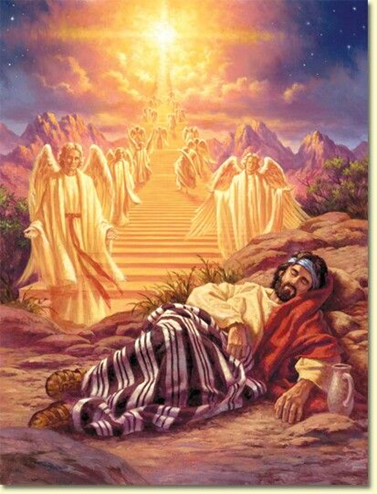
Genesis 28:10-12 Meanwhile, Jacob left Beersheba and traveled toward Haran. At sundown he arrived at a good place to set up camp and stopped there for the night. Jacob found a stone to rest his head against and lay down to sleep. 12 As he slept, he dreamed of a stairway that reached from the earth up to heaven. And he saw the angels of God going up and down the stairway.
13-19 At the top of the stairway stood the Lord, and he said, “I am the Lord, the God of your grandfather Abraham, and the God of your father, Isaac. The ground you are lying on belongs to you. I am giving it to you and your descendants. Your descendants will be as numerous as the dust of the earth! They will spread out in all directions—to the west and the east, to the north and the south. And all the families of the earth will be blessed through you and your descendants. What’s more, I am with you, and I will protect you wherever you go. One day I will bring you back to this land. I will not leave you until I have finished giving you everything I have promised you.”
Then Jacob awoke from his sleep and said, “Surely the Lord is in this place, and I wasn’t even aware of it!” But he was also afraid and said, “What an awesome place this is! It is none other than the house of God, the very gateway to heaven!”
The next morning Jacob got up very early. He took the stone he had rested his head against, and he set it upright as a memorial pillar. Then he poured olive oil over it. He named that place Bethel (which means “house of God”), although it was previously called Luz.
It all starts because Jacob is a greedy, self-serving jerk. Traditionally, if Jacob is cooking, and anybody arrives, Jacob is honor-bound to feed them, no questions asked. But there’s a problem. Jacob has a twin-a big strapping macho man so covered in red hair that even his name means “hairy.” Esau is only the eldest by a few minutes, but he takes whatever he wants, and today Esau wants Jacob’s stew NOW! Fed up with Esau strutting around currying favor with their father, Jacob decides to bargain a little. When Esau demands some of Jacob’s stew, Jacob agrees, but asks Esau to trade his rights as the first-born son. “Sure!” says Esau. “What good is a birthright if I starve to death?”
Then the twins’ mother Rebekah helps Jacob deceive his father Isaac into giving Jacob the blessing that should have gone to Esau. This blessing is irrevocable, so now Jacob has gained both the birthright and all the other benefits of the first born. Esau is furious, and Jacob knows he must leave quickly. Esau has married two Hittite women who make Rebekah’s life miserable. Rebekah demands that Isaac allow Jacob to return to Haran to Rebekah’s people to find a wife, and Isaac agrees. Now Jacob is on the run from his brother and evidently traveling alone and with few resources because he is using a stone for a pillow.
Jacob certainly doesn’t look much like patriarchal material-a pampered, selfish jerk who has hidden behind his mother to dodge his brother’s wrath. And yet, God is about to call Jacob in a spectacular fashion. Jacob is out there camped by the side of the road, sleeping on the ground when God gives him a phenomenal vision of angels and of God Himself, promising, “Your descendants will be as numerous as the dust of the earth! They will spread out in all directions—to the west and the east, to the north and the south. And all the families of the earth will be blessed through you and your descendants.”
God is calling Jacob to become much more than he ever has before. If God were to ask us, we might look at Jacob and say, “No way! This guy is a cheat, a thief, and a manipulator. God, what do You think You’re doing?” But God knows something we don’t: Jacob is about to enter a twenty-year-long apprenticeship in how to become a patriarch. God knows Jacob is going to work for Uncle Laban, who will be trickier and more deceptive than Jacob has ever thought of being. Jacob is going to learn first-hand how it feels to be manipulated and to have promised rewards pulled away or changed. By the time those twenty years are completed, Jacob will be a different man, one that God can use. \
Once more, we see God calling someone into a totally new phase of life. What can we learn from God’s call to Jacob?
God knows our potential better than we do. Jacob thinks he’s just a single guy going off to Haran to marry a wife. He hasn’t accomplished anything else apart from cheating Esau.
God has bigger plans for us than we do for ourselves. Jacob has no inkling of God’s magnificent plans, for when he finally returns twenty years later, he will have two wives, two concubines, twelve sons, and a daughter, plus huge herds of sheep and goats.
Once God calls us, God will continue to reaffirm that call by the way He arranges our circumstances. When Uncle Laban tries to cheat Jacob by repeatedly changing Jacob’s wages, God gives Jacob insight so that Laban’s plans fail.
When we accept God’s call and follow His leading, God can do miracles in our lives.
Perhaps today you feel like Jacob on the way to Haran. Your resources are slim and your prospects uncertain. Ask God to show you His perfect will for your life and then hang on! Tings are about to get exciting.
PRAYER: Father God, thank You for loving us and caring for us. Lord, many of us feel ashamed because we don’t think You have ever called us to do anything. But You are our Creator, the One who knows us better than we do ourselves. Lord, please reveal Your perfect will to those searching for Your purpose for their lives. In the mighty and precious Name of King Jesus. Amen.
There are as many kinds of callings as there are people. But first, let’s look at one of the common fallacies, the idea that God must speak in an audible voice for it to be a valid call.
“You keep saying, ‘God told me’, but God never tells me anything!” The words echoed in the church classroom where several of us were gathered for a prayer meeting. The speaker was a wonderful lady who was a great woman of faith. Daily, this lady who was legally blind, took two city buses to work and the same buses to return home. While some of us wanted to blather about walking in faith, this lady was literally doing so. But it was a typical charismatic prayer meeting in which people were sharing things God had revealed to them, and they were employing the phrase “God told me.”
While the members of the meeting were describing the quiet leading of the Holy Spirit, this poor lady thought God was speaking to the rest of us in an audible voice. It took a great deal of explaining that night before the lady realized that God was not ignoring her and that He was guiding her every movement as she made that perilous commute twice a day. In fact, this lady probably had more faith contained in her little finger than the rest of us altogether.
Throughout the month of January, we studied the ways in which God comforted King David. David was God’s choice to govern Israel, and yet, there is no evidence that God ever spoke to David audibly. When Samuel showed up and anointed David as a future king, nobody was more shocked than David. In fact, what the writer of 1 Samuel did not record was David’s likely reaction: “Who? ME???”
Years ago, we attended a church which had a vibrant Children’s Church. Leading the Children’s Church was Miss Donna. Knowing that most ministries always need help, we approached Miss Donna, offering assistance; however, Miss Donna refused our offer…until several months later. We were at a meeting for coaches of youth soccer/football teams when Miss Donna called me out of the meeting.
“Can you take Children’s Church for Sunday? The material is in the truck.” Donna began.
“Do you mean this Sunday or permanently?” I asked.
“Permanently!” replied Donna, as she grabbed a stack of printed paper, shoved it into my hands, and hopped in her truck, speeding out of the parking lot. We later learned that Donna was not only quitting the church, but also her marriage. And that encounter was our “calling” to lead Children’s Church, a story that demands its own telling at another time.
Later, when we tried to get other church members to help us with Children’s Church, the replies were always the same: “Oh, I don’t feel called!” My response was simple: “Can you read? Do you love Jesus? Then you are called!” Needless to say, I didn’t win many friends that way, nor did we succeed in recruiting help; nonetheless, sometimes God uses our availability to call us. For starters, let’s look at a 500-year-old guy living somewhere in Mesopotamia, who’s about to get the shock of his life.
Genesis 6:9-16 This is the account of Noah and his family. Noah was a righteous man, the only blameless person living on earth at the time, and he walked in close fellowship with God. Noah was the father of three sons: Shem, Ham, and Japheth.
Now God saw that the earth had become corrupt and was filled with violence. God observed all this corruption in the world, for everyone on earth was corrupt. So God said to Noah, “I have decided to destroy all living creatures, for they have filled the earth with violence. Yes, I will wipe them all out along with the earth!
“Build a large boat from cypress wood and waterproof it with tar, inside and out. Then construct decks and stalls throughout its interior. Make the boat 450 feet long, 75 feet wide, and 45 feet high. Leave an 18-inch opening below the roof all the way around the boat. Put the door on the side, and build three decks inside the boat—lower, middle, and upper.
17-22 “Look! I am about to cover the earth with a flood that will destroy every living thing that breathes. Everything on earth will die. But I will confirm my covenant with you. So enter the boat—you and your wife and your sons and their wives. Bring a pair of every kind of animal—a male and a female—into the boat with you to keep them alive during the flood. Pairs of every kind of bird, and every kind of animal, and every kind of small animal that scurries along the ground, will come to you to be kept alive. And be sure to take on board enough food for your family and for all the animals.”
So Noah did everything exactly as God had commanded him.
Noah already has a reputation for craziness with his neighbors. When everybody else is getting drunk and having orgies, Noah and his family members refuse to participate. When people are having sex indiscriminately, Noah isn’t interested. In fact, Noah’s neighbors can’t understand him at all and generally leave him alone. But now Noah is about to do the craziest thing the neighbors have ever seen, for he is about to build a huge boat hundreds of miles from any large body of water. And when the neighbors ask Noah why he is collecting wood for the boat, Noah answers, “God told me to do this.” The neighbors’ only reaction is “Huh?”
Does God speak to Noah audibly? Only God and Noah know for sure, but it’s quite possible. Somehow, Noah receives specific instructions about the size of the ark, the kind of wood to be used, and the animals and birds to be gathered. Considering the size of the boat and the diversity of the creatures, the writer of Genesis has obviously given us the condensed version of God’s instructions to Noah.
It takes Noah 100 years to build the ark; meanwhile, the neighbors view Noah as free entertainment. “Oh, let’s run over to Noah’s place and see what weird stuff he’s doing today!” For 100 years, God’s calling on Noah’s life tests him. We think we are doing well if we follow God specifically for a few days, a few weeks, a few months, or a few years. But Noah continues to fulfill God’s calling for an entire century, while the neighbors continue to jeer.
What can we learn about God’s calling from Noah’s story?
A calling is for a lifetime, not for a few days or weeks. The next time you’re feeling sorry for yourself because you are struggling to fulfill God’s will for your life, think about Noah and the length of his ministry.
A calling can be uncomfortable or even life-threatening. Does Noah get thrown out of the local council of elders? Do the neighbors complain about the noise of the construction? Does Noah lose what few friends he has had? Do men threaten Noah’s life?
A calling can work a hardship on one’s family. Think about Noah’s family. Do they believe in God’s call on Noah’s life as much as he does? Evidently, Noah’s sons help him build the ark, so they too are enduring 100 years of public disdain. When the women of Noah’s family go to the local well, the ladies titter behind their veils. When Noah’s sons go to market, the men with whom they have grown up slap them on the back and make vile jokes.
God’s calling is forever. Romans 11:29 tells us,“ForGod’s gifts and his call can never be withdrawn.” God never makes mistakes when He calls someone and He is willing to wait while humans vacillate between obedience and rebellion. We have no idea how long Noah has struggled with this calling before starting to build the ark.
God chooses the right people for the job, whether or not they feel qualified. There’s a saying that God does not call the qualified, but He qualifies the called. As far as we know, Noah has never built anything before in his life, but now he’s becoming a ship builder by the grace of God.
Do you feel God is calling you to do something, but you aren’t quite sure? Ask God to reveal Himself to you. God is a good Father and He never plays guessing games.
PRAYER: Father God, thank You for loving us and caring for us. Lord, many of us feel Your calling, but we are unsure and afraid we are deluding ourselves. Please comfort all those in this dilemma and confirm those calls. In the mighty and precious Name of King Jesus. Amen.






 Burunche's Blog