Archive for March, 2026

MARCH 25, 2026-GOD CARES FOR ISRAEL #6 THE JEWS INHERIT THROUGH ISAAC AND JACOB

March 25, 2026

Genesis 21:12 God repeats His promise to Abraham. But God told Abraham, “Do not be upset over the boy and your servant. Do whatever Sarah tells you, for Isaac is the son through whom your descendants will be counted. 

Genesis 26:2-5 God repeats His promise to Isaac. The Lord appeared to Isaac and said, “Do not go down to Egypt, but do as I tell you. Live here as a foreigner in this land, and I will be with you and bless you. I hereby confirm that I will give all these lands to you and your descendants, just as I solemnly promised Abraham, your father. I will cause your descendants to become as numerous as the stars of the sky, and I will give them all these lands. And through your descendants all the nations of the earth will be blessed. I will do this because Abraham listened to me and obeyed all my requirements, commands, decrees, and instructions.” 

Genesis 28:10-15 God repeats His promise to Jacob. Meanwhile, Jacob left Beersheba and traveled toward Haran. At sundown he arrived at a good place to set up camp and stopped there for the night. Jacob found a stone to rest his head against and lay down to sleep. As he slept, he dreamed of a stairway that reached from the earth up to heaven. And he saw the angels of God going up and down the stairway.

At the top of the stairway stood the Lord, and he said, “I am the Lord, the God of your grandfather Abraham, and the God of your father, Isaac. The ground you are lying on belongs to you. I am giving it to you and your descendants. Your descendants will be as numerous as the dust of the earth! They will spread out in all directions—to the west and the east, to the north and the south. And all the families of the earth will be blessed through you and your descendants. What’s more, I am with you, and I will protect you wherever you go. One day I will bring you back to this land. I will not leave you until I have finished giving you everything I have promised you.”

Sometimes people refuse to believe that God has given the Land of Israel to the Jews as an everlasting inheritance. But look at these promises. Multiple times to three successive generations, God persists in promising Israel to the Jews.

“But wait,” you say. “Didn’t the Jews fall into idolatry, and didn’t the Assyrians conquer the Northern Kingdom, carrying off many of its people? Didn’t the Babylonians conquer Judah, carrying off many of its people?” Yes. You are absolutely correct. But here’s the interesting thing about God: God doesn’t renege on His promises. Romans 11:29 tells us, For God’s gifts and his call can never be withdrawn.” Even as Jews were being dragged off to Babylon as captives, God knew that there were four young men who would distinguish themselves by their unwavering faith in Him. Daniel 1:6-7 tells us the story. Daniel, Hananiah, Mishael, and Azariah were four of the young men chosen, all from the tribe of Judah. The chief of staff renamed them with these Babylonian names: Daniel was called Belteshazzar. Hananiah was called Shadrach. Mishael was called Meshach. Azariah was called Abednego.

Daniel became a mighty prophet as well as an able administrator while his three friends survived one of the most severe ordeals ever demanded of believers, the fiery furnace. When Shadrach, Meshach, and Abednego refused to worship a huge golden statue of the king, he ordered them to be thrown into a furnace so hot that the guards died from the heat; yet, God sent an angel, possibly Jesus, to walk in the fire with them, and when they came out, they didn’t even smell as if the fire had touched them.

As things were falling apart, God sent Jeremiah to encourage His people. Jeremiah 33:12-14 “This is what the Lord of Heaven’s Armies says: This land—though it is now desolate and has no people and animals—will once more have pastures where shepherds can lead their flocks. Once again shepherds will count their flocks in the towns of the hill country, the foothills of Judah, the Negev, the land of Benjamin, the vicinity of Jerusalem, and all the towns of Judah. I, the Lord, have spoken! “The day will come, says the Lord, when I will do for Israel and Judah all the good things I have promised them.

When the Jews in exile were in despair, God sent the prophet Ezekiel to encourage them. Ezekiel 37:11-14 Then he said to me, “Son of man, these bones represent the people of Israel. They are saying, ‘We have become old, dry bones—all hope is gone. Our nation is finished.’ Therefore, prophesy to them and say, ‘This is what the Sovereign Lord says: O my people, I will open your graves of exile and cause you to rise again. Then I will bring you back to the land of Israel. When this happens, O my people, you will know that I am the Lord. I will put my Spirit in you, and you will live again and return home to your own land. Then you will know that I, the Lord, have spoken, and I have done what I said. Yes, the Lord has spoken!’”

At no point has God said to the Jews, “All right! This is it! You have been so sinful that I am taking Israel away from you.”

You might look at all these Bible verses and wonder. But the point is this: Throughout the ages, God has continued to promise Israel to the Jews and God has never gone back on His promises. As we continue, we will see how God has continued to fulfill those promises.

PRAYER: Father God, thank You for loving us and caring for us. Lord, help us to trust You and Your promises, even when things look bleak. In the mighty and precious Name of King Jesus. Amen.

MARCH 24, 2026 GOD CARES FOR ISRAEL #5 GOD, NOW YOU’RE CALLING ME ABRAHAM? NU?

March 24, 2026

Genesis 17:1-8 When Abram was ninety-nine years old, the Lord appeared to him and said, “I am El-Shaddai—‘God Almighty.’ Serve me faithfully and live a blameless life. I will make a covenant with you, by which I will guarantee to give you countless descendants.”

At this, Abram fell face down on the ground. Then God said to him, “This is my covenant with you: I will make you the father of a multitude of nations! What’s more, I am changing your name. It will no longer be Abram. Instead, you will be called Abraham, for you will be the father of many nations. I will make you extremely fruitful. Your descendants will become many nations, and kings will be among them! (Abram means “exalted father”; Abraham sounds like a Hebrew term that means “father of many.”)

“I will confirm my covenant with you and your descendants after you, from generation to generation. This is the everlasting covenant: I will always be your God and the God of your descendants after you. And I will give the entire land of Canaan, where you now live as a foreigner, to you and your descendants. It will be their possession forever, and I will be their God.”

Once again, God promises “the entire land of Canaan” to Abram and his descendants as “a possession forever.” God is so serious about His promise that He even renames Abram, “exalted father” as Abraham, “father of many” and Sarai as Sarah, “princess.” But there’s more. Now that God has made promises, He also requires Abraham to make a concrete response, circumcision of all males in the household, including ninety-nine-year-old Abraham.

The Mark of the Covenant

9-14 Then God said to Abraham, “Your responsibility is to obey the terms of the covenant. You and all your descendants have this continual responsibility. This is the covenant that you and your descendants must keep: Each male among you must be circumcised. You must cut off the flesh of your foreskin as a sign of the covenant between me and you. From generation to generation, every male child must be circumcised on the eighth day after his birth. This applies not only to members of your family but also to the servants born in your household and the foreign-born servants whom you have purchased. All must be circumcised. Your bodies will bear the mark of my everlasting covenant. Any male who fails to be circumcised will be cut off from the covenant family for breaking the covenant.”

What is the point of circumcision? For all generations to come, from now to eternity, all of Abraham’s descendants are to undergo circumcision, bearing permanent marks of the everlasting covenant in their bodies. Centuries later, there will be times when Israelites and Jews will be ashamed of circumcision, with those desiring to exercise in Greek and Roman gymnasia even having operations to reverse circumcision. But Jews continue to faithfully circumcise infant males even today, preserving that mark of the covenant.

And God’s grace is not limited to Abraham because He will also give Sarai the name Sarah. While both names mean “princess,” “Sarai” comes from the language of Ur while “Sarah” is the Hebrew form. God is graphically demonstrating that Abraham and Sarah are in a new land with new names and new promises.

Sarai Is Named Sarah

Then God said to Abraham, “Regarding Sarai, your wife—her name will no longer be Sarai. From now on her name will be Sarah.[Princess] And I will bless her and give you a son from her! Yes, I will bless her richly, and she will become the mother of many nations. Kings of nations will be among her descendants.”

Then Abraham bowed down to the ground, but he laughed to himself in disbelief. “How could I become a father at the age of 100?” he thought. “And how can Sarah have a baby when she is ninety years old?” So Abraham said to God, “May Ishmael live under your special blessing!”

But God replied, “No—Sarah, your wife, will give birth to a son for you. You will name him Isaac, (“he laughs) and I will confirm my covenant with him and his descendants as an everlasting covenant. As for Ishmael, I will bless him also, just as you have asked. I will make him extremely fruitful and multiply his descendants. He will become the father of twelve princes, and I will make him a great nation. But my covenant will be confirmed with Isaac, who will be born to you and Sarah about this time next year.” When God had finished speaking, he left Abraham.

On that very day Abraham took his son, Ishmael, and every male in his household, including those born there and those he had bought. Then he circumcised them, cutting off their foreskins, just as God had told him. Abraham was ninety-nine years old when he was circumcised, and Ishmael, his son, was thirteen. Both Abraham and his son, Ishmael, were circumcised on that same day, along with all the other men and boys of the household, whether they were born there or bought as servants. All were circumcised with him.

Imagine Abraham’s shock when God promises this ninety-nine-year-old man that he will become a father and that his wife will bear a child at age ninety. If the Yiddish language had existed in Abraham’s day, Abraham’s response would likely have been “NU!” as an expression of shock, disbelief, and hope. “Nu” is an all-purpose expression that can mean almost anything without long statements of explanation.

For a better explanation of this wonderful all-purpose expression, go to https://aish.com/the-abbreviated-dictionary-of-nu/ and for a complete explanation, check out Leo Rosten’s book The Joys of Yiddish. “Nu” which rhymes with “coo” is an interjection, interrogation, and expletive. In Yiddish usage it comes in second to “oy” and is equivalent to a sneer, a grunt, a grin, a frown, and can express anything from doubt, pride, disapproval, distrust, and scorn. The difference is in how it’s delivered, and yes, facial expressions count. Here are a few examples:

Acceptance: “OK, she’s not marrying a professional man. When we met you made zippers, nu?”

Aggravation: “Enough with the blinking, and twittzing! Get serious already, nu?!”

Anger: “So nu!? Why do you think it was me who drove the car in the lake?! There’s one other person in this house, nu??” (“OY”)

Boredom: “This speech she’s making about her trip to Israel? Nu, I could’ve walked their already!”

Cautious: “Nu, leave it to you to want to honeymoon near killer bugs? Nu, Niagara Falls isn’t good enough for you like normal people?”

Contentment: “Ai Ai Ai, Sarah darling, nu, this foot bath is such a mechaya. Maybe I’ll buy you one for Hanukkah.”

Defeat: “OK, she wants to join the circus. Irving, we did the best we could with her, nu?

Depressed: “Nu, I’ll just lie here in bed … until she leaves the circus and goes back to N.Y.U.”

Disapproval: “Crumbs under the couch and nu, you call this cleaning?”

Distress: “I must be allergic! NU, take me to Mt. Sinai already before I swell like a watermelon!”

Disturbed: “I need to hear your tsouris (sorrows)?! Nu, darling I’ve got my own. My daughter’s in a circus!”

The list of uses for “nu” is almost inexhaustible, but the take-home lessons are simple: Yes, God continues to promise the land of Israel to the Jews. Yes, Abraham is shocked but obedient. And yes, eventually, Sarah will become a mother at age ninety, Isaac will be the son of promise, and God will repeatedly demonstrate His faithfulness.

PRAYER: Father God, thank You for loving us and caring for us. Lord, You are the Promise Giver and the Promise Keeper. Please help us to trust You when we cannot see. In the mighty and precious Name of King Jesus. Amen.
MARCH 23, 2026 GOD CARES FOR ISRAEL #4 GOD DOESN’T PLAY GAMES WITH HIS PROMISES

March 23, 2026

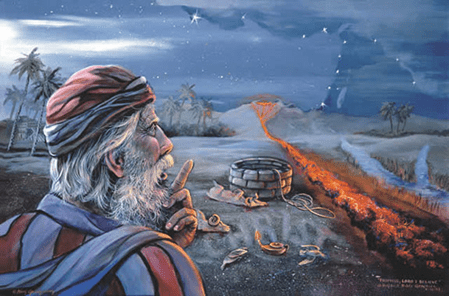
Genesis 15:1-5 Some time later, the Lord spoke to Abram in a vision and said to him, “Do not be afraid, Abram, for I will protect you, and your reward will be great.”

But Abram replied, “O Sovereign Lord, what good are all your blessings when I don’t even have a son? Since you’ve given me no children, Eliezer of Damascus, a servant in my household, will inherit all my wealth. You have given me no descendants of my own, so one of my servants will be my heir.”

Then the Lord said to him, “No, your servant will not be your heir, for you will have a son of your own who will be your heir.” Then the Lord took Abram outside and said to him, “Look up into the sky and count the stars if you can. That’s how many descendants you will have!”

At first, when Abram and Sarai married, they expected Sarai would get pregnant quickly; after all, her sisters had had no problems bearing children. But now decades have passed. Abram and Sarai have moved from Haran, where they had a comfortable home, and are living in tents, never certain where their drinking water will come from or if the Canaanites will suddenly choose to attack them. And Sarai has stopped menstruating, a sure sign that this couple will remain childless. Now the same God who has called Abram to journey all the way to Canaan is promising that Abram will have countless descendants. Talk about a test of faith!

6 And Abram believed the Lord, and the Lord counted him as righteous because of his faith.

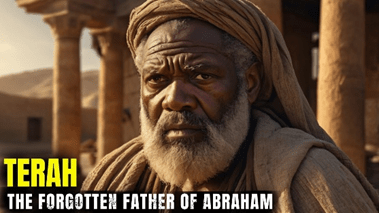
Think about it. Here’s this old man who has moved twice, first from Ur of the Chaldees to Haran and then on to Canaan. If Abram simply wants good grazing land, he can find it east of the Jordan River, for hundreds of years later the tribes of Reuben and Manasseh will settle that area because of the rich grazing. But Abram has passed right on through that area, crossing the Jordan River and moving up and out of the Jordan Valley, another place with rich grazing land. Only a man of great faith can continue to trust God rather than settling for security and comfort as his father Terah has done.

7-8 Then the Lord told him, “I am the Lord who brought you out of Ur of the Chaldeans to give you this land as your possession.”

8 But Abram replied, “O Sovereign Lord, how can I be sure that I will actually possess it?”

Ah, now we’re getting to the point of the discussion. Abram has come all this way on faith; however, that faith is getting a bit shaky. Does God punish Abram for shaky faith? No. Instead, God does something so magnificent that the images have burned themselves into the brains of believers for thousands of years. Before we consider what God will do to reassure Abram, let’s consider all the times when our faith has been shaky. Remember that God has not punished us for our small faith. The same God who can preserve crushed reeds and injured birds has no problems preserving us as well. When Brother Andrew, the man who smuggled thousands of Bibles behind the Iron Curtain, was coming to the Lord, those advising him asked him if he was “willing to be made willing” to believe in Jesus. Andrew said yes, and Jesus showed himself to Andrew many times over. When we offer God even a fingernail’s breadth of faith, God will take that tiny faith and multiply it. That is what God is doing for Abram at this moment. And now God is going to graphically demonstrate to Abram just how serious He really is about this covenant.

9-21 The Lord told him, “Bring me a three-year-old heifer, a three-year-old female goat, a three-year-old ram, a turtledove, and a young pigeon.”  Abram presented all these to him and killed them. Then he cut each animal down the middle and laid the halves side by side; he did not, however, cut the birds in half. Some vultures swooped down to eat the carcasses, but Abram chased them away.

As the sun was going down, Abram fell into a deep sleep, and a terrifying darkness came down over him. Then the Lord said to Abram, “You can be sure that your descendants will be strangers in a foreign land, where they will be oppressed as slaves for 400 years. But I will punish the nation that enslaves them, and in the end they will come away with great wealth. (As for you, you will die in peace and be buried at a ripe old age.) After four generations your descendants will return here to this land, for the sins of the Amorites do not yet warrant their destruction.”

After the sun went down and darkness fell, Abram saw a smoking firepot and a flaming torch pass between the halves of the carcasses. So the Lord made a covenant with Abram that day and said, “I have given this land to your descendants, all the way from the border of Egypt[a] to the great Euphrates River—the land now occupied by the Kenites, Kenizzites, Kadmonites, Hittites, Perizzites, Rephaites, Amorites, Canaanites, Girgashites, and Jebusites.”

Why did Abram cut these animals in half? David Guzik in his Enduring Word Commentary gives us the answer: Abram knew exactly what to do with these animals. He understood that according to the custom of his time, God told him to get a contract ready for signing.

i. In those days, contracts were sometimes made by the sacrificial cutting of animals, with the split carcasses of the animals lying on the ground. The covenant was made when parties to the agreement walked through the animal parts together, repeating the terms of the covenant. The Lord made a covenant in Genesis 15:18 is literally, “the Lord cut a covenant.”

ii. Jeremiah 34:18-20 refers to this same practice of a covenant made by cutting animals and repeating the oath of the covenant as one walks through the animal parts.

iii. The symbolism was plain. First, this was a covenant so serious, it was sealed with blood. Second, if one were to break this covenant, let this same bloodshed be poured out on their animals and on them.

iv. When Abram had his doubts and wanted assurance from the Lord, God said to him clearly, “Let’s sign a contract and settle this once for all.”

Think about it! The Lord of the Universe, the Creator of all things, was making an agreement and promising that if He failed to keep His side of the bargain, all his animals would die. Essentially, God was placing the weight of all creation on one side of a scale while balancing it with His faithfulness. All Abram could do was to stand by as a silent witness, gasping as he watched that smoking firepot and that flaming torch move between the pieces of animal carcass. God was demonstrating His sincerity as graphically as possible. And all Abram could do was to believe.

Once more, we see God promising the land of Israel to Abram, whom He later renames as Abraham. And once more, the gift of Israel is a gift rooted in faith on Abraham’s part and assurance on God’s part. Sometimes people lacking Biblical knowledge hold all kinds of misconceptions about Israel, failing to realize that God has already promised Israel to Abraham’s descendants and has pledged His sacred honor to fulfill that promise.

As we consider God’s promises and His care for Israel, let us remember the thousands of years those promises have lasted. Ask God to open your heart and your mind to His perfect will for Israel.

PRAYER: Father God, thank You for loving us and caring for us. Lord, thank You that when You make promises, You never go back on them but fulfill them. In the mighty and precious Name of King Jesus. Amen.
MARCH 22, 2026 GOD CARES FOR ISRAEL #3 GOD CALLS ABRAM TO STEP OUT IN FAITH

March 22, 2026

Genesis 12:1-9 Now the Lord had said to Abram: “Get out of your country, from your family and from your father’s house, to a land that I will show you. I will make you a great nation; I will bless you and make your name great; and you shall be a blessing. I will bless those who bless you, and I will curse him who curses you; and in you all the families of the earth shall be blessed.”

How did Abram hear the voice of God or even know that it was God who was calling him? Did Abram hear an audible voice or have a dream? And what caused Abram to trust God, pack up his family and all his belongings, and leave the comforts of Haran?

So Abram departed as the Lord had spoken to him, and Lot went with him. And Abram was seventy-five years old when he departed from Haran. Then Abram took Sarai his wife and Lot his brother’s son, and all their possessions that they had gathered, and the people whom they had acquired in Haran, and they departed to go to the land of Canaan. So they came to the land of Canaan. Abram passed through the land to the place of Shechem, as far as the terebinth tree of Moreh. And the Canaanites were then in the land.

Then the Lord appeared to Abram and said, “To your descendants I will give this land.” And there he built an altar to the Lord, who had appeared to him. And he moved from there to the mountain east of Bethel, and he pitched his tent with Bethel on the west and Ai on the east; there he built an altar to the Lord and called on the name of the Lord. So Abram journeyed, going on still toward the South.

What happened when Abram arrived in Canaan and found out that it was already inhabited? How did Abram explain his arrival to the Canaanites? Imagine that conversation.

“Greetings, stranger, what brings you to Canaan?”

“Thank you.” Certainly, Abram could be polite, but he would have to be circumspect about his reasons for coming; after all, if Abram were to announce that some God was going to give him the land these people were occupying, they would probably try to eliminate his party and him as swiftly as possible. It’s likely that Abram explained his travels as part of a search for grazing for his animals, a motive that the Canaanites could understand. Meanwhile, Abram was looking around, scoping things out, and trying to get a feel for the lay of the land.

Notice that God promised the land of Israel to Abram’s descendants. Throughout the Bible, God continued to reinforce that promise. Abram left the comforts of Haran for unknown hardships and dangers in Canaan, and it was that trust and faith that secured Canaan for Abram. Throughout the history of Israel, there were always people of faith who continued to trust that God would allow them to remain in the land if they would obey Him.

What can we learn from Abram’s risky behavior? If we want God’s best for our lives, we must be willing to lay aside everything we treasure, trusting that God will give us something better. We also need to copy Abram, for as soon as he had opportunity, he built altars and worshiped God. Although we might not build altars, we must continue to worship God to receive His best, for true worship means abandoning our will to receive God’s will for our lives instead. May God help us to trust, to have faith, to worship, and to follow His leading, even when things seem risky.

PRAYER: Father God, thank You for loving us and caring for us. Lord, help us to trust You when You are calling us to leave the familiar and comfortable for the unknown and risky. Help us to realize that Your best is always infinitely better than anything we can devise ourselves. In the mighty and precious Name of King Jesus. Amen.

MARCH 21, 2026 GOD CARES FOR ISRAEL #2 DID TERAH MISS GOD?

March 21, 2026

Genesis 11:31-32And Terah took his son Abram and his grandson Lot, the son of Haran, and his daughter-in-law Sarai, his son Abram’s wife, and they went out with them from Ur of the Chaldeans to go to the land of Canaan; and they came to Haran and dwelt there. So the days of Terah were two hundred and five years, and Terah died in Haran.

By the time Terah left Ur of the Chaldees, he was no longer a young man. Why did Terah leave Ur? An internet search reveals the following: According to Genesis 11:31, Terah took his family, including Abram and Lot, from Ur of the Chaldeans to move to Canaan, though the Bible does not explicitly state his specific motivation. Scholars and commentators suggest the move may have been driven by a divine prompting, a desire to leave a sinful region, or possibly as a response to the loss of a family member. 

Key details regarding Terah’s journey:

  • The Original Plan: Terah set out for Canaan but settled in Haran along the way, where he died.
  • Call of God: While Abraham is known for receiving a call, some commentators suggest that God may have first spoken to Terah, prompting him to leave the idolatrous land of Ur.
  • The Move from Ur: The move was likely intended to be a complete relocation from a city known to be wicked.
  • The Halt in Haran: Terah is often portrayed as stopping in Haran due to a lack of faith or comfort, only going halfway on the journey. Perhaps Terah simply stays in Haran long enough to become comfortable; at that point, staying in a comfortable place might be very appealing. While God has spoken to Abraham, Terah might not be completely convinced.
  • There’s also another possibility: Terah is not a young man, and travel is arduous. Perhaps Terah succumbs to a combination of grief over the loss of his son Haran, plus exhaustion in addition to old age.  
  •  While Terah left to go to Canaan, his journey ended early at Haran, setting the stage for Abraham to complete the journey under a direct call from God. Terah, Abraham’s father, was grieving for his son Haran. Terah, it seems, decided to stay in the northern Mesopotamian “city of Haran,” (no connection with his son Haran) rather than continue the journey to Canaan, which was the family’s original intent. The family were in the city of Haran for five years. The people of Haran served the same moon god as the people in Terah’s former location, the southern Mesopotamian “city of Ur”. Terah, Jewish literature records, was a craftsman who made idols. So he may have found a blossoming trade in Haran.

This seems to be upheld by Scripture: “This is what the LORD, the God of Israel, says: ‘Long ago your ancestors, including Terah the father of Abraham and Nahor, lived beyond the Euphrates River and served other gods'” (Josh 24:2). The Hebrew word for “served” can also mean to “work,” hence the tradition that Terah was a craftsman who made idols. And later in the story Rachel, Terah’s great-great-granddaughter, does seem keen to hold on to the Teraphim (household idols) as if they were a family heirloom (Gen 31:19). And, it may be worth noting, we see the name “Terah” alluded to in the word “Teraphim”.

When Isaiah received his call while he was in the temple, there were probably many others there at the same time; however, Isaiah was the only one who saw the Lord. God might have called Terah, only for Terah to obey partially.

What can we learn from Terah? Terah remained in Haran and died there while Abraham risked everything, leaving for Canaan with his family, his flocks, and his herds. Terah might have had a comfortable old age, but he missed the Promised Land. Abraham took the risk and gained incredible blessings, as well as securing the Promised Land for his descendants.

The question for us is simple: Will we listen to God, even if it means risk, or will we settle for comfort? We can settle for comfort, but that will never result in our receiving God’s best for our lives. May God help us so that we will risk everything for His Will.

PRAYER: Father God, thank You for loving us and caring for us. Lord, help us to be willing to lay down our hopes and our dreams so that You can lead us into the futures you have for us. In the mighty and precious Name of King Jesus. Amen.
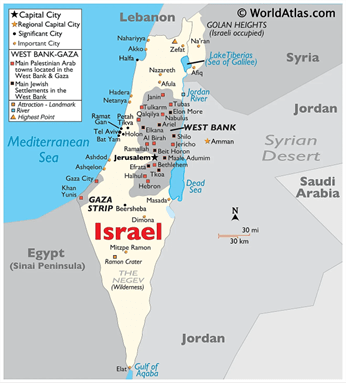
MARCH 20, 2026 GOD CARES FOR ISRAEL #1 WHY DOES GOD CALL ISRAEL “THE APPLE OF HIS EYE?”

March 20, 2026

Zechariah 2:6 -9 “Up, up! Flee from the land of the north,” says the Lord; “for I have spread you abroad like the four winds of heaven,” says the Lord. 7 “Up, Zion! Escape, you who dwell with the daughter of Babylon.”

8 For thus says the Lord of hosts: “He sent Me after glory, to the nations which plunder you; for he who touches you touches the apple of His eye (the pupil of His eye.) 9 For surely I will shake My hand against them, and they shall become spoil for their servants. Then you will know that the Lord of hosts has sent Me.

What does the “apple of God’s eye” refer to? It refers to the pupil of God’s eye. Just as we protect our eyes because they are so precious, so God promises to treasure and protect Israel as if that small country is the pupil of His eye. For the next few days, we are going to look at Israel as God describes it in His Word.

In Genesis 15:18-21 God promises the land of Israel to Abraham. “On the same day the Lord made a covenant with Abram, saying: “To your descendants I have given this land, from the river of Egypt to the great river, the River Euphrates—the Kenites, the Kenezzites, the Kadmonites, the Hittites, the Perizzites, the Rephaim, the Amorites, the Canaanites, the Girgashites, and the Jebusites.”

Genesis 17:1-8 When Abram was ninety-nine years old, the Lord appeared to Abram and said to him, “I am Almighty God; walk before Me and be blameless. And I will make My covenant between Me and you, and will multiply you exceedingly.” Then Abram fell on his face, and God talked with him, saying: “As for Me, behold, My covenant is with you, and you shall be a father of many nations. No longer shall your name be called Abram, but your name shall be Abraham; for I have made you a father of many nations. I will make you exceedingly fruitful; and I will make nations of you, and kings shall come from you. And I will establish My covenant between Me and you and your descendants after you in their generations, for an everlasting covenant, to be God to you and your descendants after you. Also I give to you and your descendants after you the land in which you are a stranger, all the land of Canaan, as an everlasting possession; and I will be their God.”

In Deuteronomy 11:10-12 God describes the Promised Land. “For the land which you go to possess is not like the land of Egypt from which you have come, where you sowed your seed and watered it by foot, as a vegetable garden; but the land which you cross over to possess is a land of hills and valleys, which drinks water from the rain of heaven, a land for which the Lord your God cares; the eyes of the Lord your God are always on it, from the beginning of the year to the very end of the year.”

How big is Israel?

Israel is a small country covering approximately 22,000–22,145 square kilometers (8,500-8,600 square miles.) It is about 470 km (290 miles) long and very narrow, ranging from only 15 km to 114 km in width. It is often compared in size to the US state of New Jersey or the country of El Salvador. But was this God’s will for Israel originally? Not at all! God promised the Israelites a vast territory stretching from the Nile River in Egypt to the Euphrates River in modern-day Iraq, and from the Mediterranean Sea to the Jordan River. This included the land of Canaan, encompassing modern-day Israel, Palestine, Jordan, and parts of Syria and Lebanon. 

Key details about the territory God intended for Israel include:

  • Boundaries: Defined as from the “river of Egypt to the great river, the Euphrates” (Genesis 15:18) and from the Mediterranean Sea east to the Euphrates.
  • The Land of Canaan: This was the core area intended for the 12 tribes, which they were instructed to conquer and inhabit, dividing it by lot.
  • Extent: It included lands occupied by the Hittites, Amorites, Canaanites, and others, stretching from the Negev in the south to the Lebanon mountains in the north.
  • Current Possession: Historically, Israel only reached this maximum extent during the reigns of David and Solomon, with many areas remaining unconquered during Joshua’s time.

Romans 11:29 tells us, “For the gifts and the calling of God are irrevocable.”When God gave the land of Israel to Abraham and his descendants, He didn’t make a mistake. Once God gives something, He does not take it back. As we continue to consider God’s Word about Israel, let’s ask God that He opens our minds and hearts to His will for Israel.

PRAYER: Father God, thank You for loving us and caring for us. Lord, open our minds and hearts to Your land of Israel and Your perfect Will for it. In the mighty and precious Name of King Jesus. Amen.

MARCH 19, 2026 ORIGINALLY PUBLISHED MARCH 7, 2023 “WHO KNOWS BUT WHAT YOU HAVE COME TO THE KINGDOM FOR SUCH A TIME AS THIS?” #12 ESTHER 10:1-3 YOUR SPHERE OF INFLUENCE MAY BE FAR LARGER THAN YOU REALIZE

March 19, 2026

The Greatness of Mordecai

“King Xerxes imposed tribute throughout the empire, to its distant shores. And all his acts of power and might, together with a full account of the greatness of Mordecai, whom the king had promoted, are they not written in the book of the annals of the kings of Media and Persia? Mordecai the Jew was second in rank to King Xerxes, preeminent among the Jews, and held in high esteem by his many fellow Jews, because he worked for the good of his people and spoke up for the welfare of all the Jews.”

The old fairy tales that had been sanitized used to end with the words, “And they lived happily ever after.” Some of the original fairy tales were not that optimistic about life, but the thought is still a lovely one. Here the Esther story ends with wise discerning Mordecai as the second most powerful man in the entire Persian Empire of fifty million people and untold numbers of nationalities. Although these short sentences only mention Mordecai’s attention to his fellow Jews, it is more than likely that many other minority races also benefited greatly from Mordecai’s actions. Why?

Mordecai worshiped the God of Israel and was obviously a learned man. Mordecai probably knew the Torah well; that meant that Mordecai would care for widows and orphans and refugees and other disadvantaged groups, that he would handle slaves compassionately, and that he would not behave capriciously. Xerxes was a drinker and when drunk could make horrific decisions. With Mordecai in a position of prominence, it is likely that most if not all the Jews in the kingdom were copying him. Living justly according to the Law of Moses, the Jews would have had a major impact on their neighbors and would have comprised a force for righteousness, even though they were only one of thousands of nationalities in the empire.

APPLICATION: We never realize how many lives we may have touched or the people whom we have influenced. Last weekend my husband attended part of the funeral services for the son of one of our friends. This twenty – eight-year-old man had been killed tragically in a road traffic accident. But my husband and I were totally unprepared for the credit the parents gave me for saving him as a premature infant.

At the funeral, the parents mentioned that the man had been born prematurely and that his life had been saved because I taught them how to do “kangaroo mother care.” “Kangaroo mother care” is a simple method of keeping babies warm in which a person swaddles the infant next to his or her bare skin, using the body warmth of the adult to keep the baby warm. At the time this young man was born, there was no electricity in our area, making kangaroo care the best option for maintaining body heat for premature infants. I have personally done emergency kangaroo care for newborns until their body temperatures have come up to normal. On more than one occasion, I have poured hot water into a large glass bottle, swathed it in a towel, and placed that in a traditional basket with the baby, covering the basket and thus creating a simple incubator. (Now we have a NICU with an incubator.)

Not long ago, one of the young men who worked for us in our house while he was in school visited us. During that visit, it became obvious that this newly – minted teacher viewed us as a second set of parents. We were taken aback, for we felt we had done nothing extraordinary.

You never know who might be watching you or the influence you will have on those around you. You may be struggling with a grief so deep you feel as if you have fallen into a bottomless pit; meanwhile, your friends are taking courage from the fact that you are continuing to work and carry out your other duties for your family. You may have turned to volunteer work upon retirement simply as a means of maintaining your sanity, while those whom you are helping are taking enormous courage from your actions. Let me share an experience/suggestion.

During the one year I was doing an MPH program at Tulane University, I volunteered once a week for a reading program in an inner city school. The program was quite organized; I worked with fourth grade students  who would read selected texts to me. Then the students got to pick three children’s stories from a large collection. We would snuggle together on a couch while I read to the kids. I frequently worked with two or three students at a time, and one of the highlights of my week was cuddling with those cute little girls while I shared their delight in the stories. The teacher for that class also ran after – school programs for children at her church in New Orleans’ Ninth Ward, the area most devastated by Hurricane Katrina. I hope the few efforts I was able to make helped those kids so that they are now reading to their children.

That program was quite low – tech, but its effects were far – reaching. The coordinator of the program later told the volunteers that she could track major improvements in the children’s school work, simply because someone took one hour a week to read to the kids. Several studies have demonstrated that children who are read to make far better grades than those who do not have this experience. If you are looking for something to do, why not see if your local school would be willing to start such a program?

Mordecai didn’t start out to become the second most powerful man in the Persian Empire. Mordecai was simply following God and doing His Will. It was God who promoted Mordecai for his faithfulness and righteousness. Until we reach heaven, we will never know how many people Mordecai saved and blessed. Until you reach heaven, you may never know either. So take heart! Don’t stop doing good. Continue to be faithful. Your actions today may bless far more people than you realize.

PRAYER: Father God, thank You for loving us and for caring for us. Lord, there are many of us who are becoming discouraged because we feel our actions are useless. Please strengthen and encourage all those who feel that way so that they will continue to fulfill Your perfect Will for their lives. In the matchless Name of King Jesus. Amen.

MARCH 18, 2026 ORIGINALLY PUBLISHED MARCH 6. 2023 “WHO KNOWS BUT WHAT YOU HAVE COME TO THE KINGDOM FOR SUCH A TIME AS THIS?” #11

March 18, 2026

ESTHER 9:1-32  GOD TURNS THE TABLES ON THE ENEMIES OF THE JEWS

“On the thirteenth day of the twelfth month, the month of Adar, the edict commanded by the king was to be carried out. On this day the enemies of the Jews had hoped to overpower them, but now the tables were turned and the Jews got the upper hand over those who hated them. The Jews assembled in their cities in all the provinces of King Xerxes to attack those determined to destroy them. No one could stand against them, because the people of all the other nationalities were afraid of them. And all the nobles of the provinces, the satraps, the governors, and the king’s administrators helped the Jews, because fear of Mordecai had seized them. Mordecai was prominent in the palace; his reputation spread throughout the provinces, and he became more and more powerful.

The Jews struck down all their enemies with the sword, killing and destroying them, and they did what they pleased to those who hated them. In the citadel of Susa, the Jews killed and destroyed five hundred men. They also killed Parshandatha, Dalphon, Aspatha, Poratha, Adalia, Aridatha, Parmashta, Arisai, Aridai and Vaizatha, the ten sons of Haman son of Hammedatha, the enemy of the Jews. But they did not lay their hands on the plunder.

The number of those killed in the citadel of Susa was reported to the king that same day. The king said to Queen Esther, “The Jews have killed and destroyed five hundred men and the ten sons of Haman in the citadel of Susa. What have they done in the rest of the king’s provinces? Now what is your petition? It will be given you. What is your request? It will also be granted.”

“If it pleases the king,” Esther answered, “give the Jews in Susa permission to carry out this day’s edict tomorrow also, and let Haman’s ten sons be impaled on poles.” So the king commanded that this be done. An edict was issued in Susa, and they impaled the ten sons of Haman. The Jews in Susa came together on the fourteenth day of the month of Adar, and they put to death in Susa three hundred men, but they did not lay their hands on the plunder.

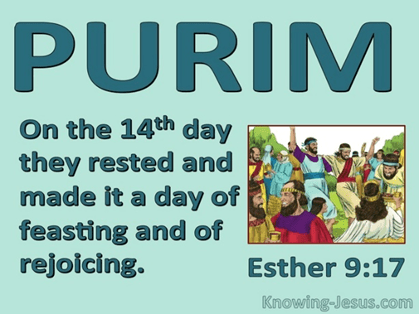
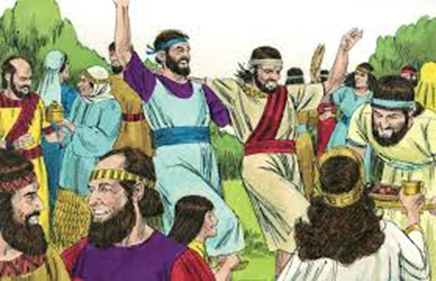
Meanwhile, the remainder of the Jews who were in the king’s provinces also assembled to protect themselves and get relief from their enemies. They killed seventy-five thousand of them but did not lay their hands on the plunder. This happened on the thirteenth day of the month of Adar, and on the fourteenth they rested and made it a day of feasting and joy. The Jews in Susa, however, had assembled on the thirteenth and fourteenth, and then on the fifteenth they rested and made it a day of feasting and joy.  That is why rural Jews—those living in villages—observe the fourteenth of the month of Adar as a day of joy and feasting, a day for giving presents to each other.

Purim Established  Mordecai recorded these events, and he sent letters to all the Jews throughout the provinces of King Xerxes, near and far, to have them celebrate annually the fourteenth and fifteenth days of the month of Adar as the time when the Jews got relief from their enemies, and as the month when their sorrow was turned into joy and their mourning into a day of celebration. He wrote them to observe the days as days of feasting and joy and giving presents of food to one another and gifts to the poor.

So the Jews agreed to continue the celebration they had begun, doing what Mordecai had written to them. For Haman son of Hammedatha, the Agagite, the enemy of all the Jews, had plotted against the Jews to destroy them and had cast the pur (that is, the lot) for their ruin and destruction. But when the plot came to the king’s attention, he issued written orders that the evil scheme Haman had devised against the Jews should come back onto his own head, and that he and his sons should be impaled on poles. (Therefore these days were called Purim, from the word pur.) Because of everything written in this letter and because of what they had seen and what had happened to them, the Jews took it on themselves to establish the custom that they and their descendants and all who join them should without fail observe these two days every year, in the way prescribed and at the time appointed. These days should be remembered and observed in every generation by every family, and in every province and in every city. And these days of Purim should never fail to be celebrated by the Jews—nor should the memory of these days die out among their descendants.

So Queen Esther, daughter of Abihail, along with Mordecai the Jew, wrote with full authority to confirm this second letter concerning Purim. And Mordecai sent letters to all the Jews in the 127 provinces of Xerxes’ kingdom—words of goodwill and assurance—to establish these days of Purim at their designated times, as Mordecai the Jew and Queen Esther had decreed for them, and as they had established for themselves and their descendants in regard to their times of fasting and lamentation. Esther’s decree confirmed these regulations about Purim, and it was written down in the records.”

75,800 people-that’s how many of their enemies the Jews slaughtered throughout the Persian Empire. In the capital of Susa, the Jews killed 800 men. While that figure sounds impressive, the population of the Persian Empire at that time stood at close to fifty million. That means that the percent of citizens killed by the Jews represented 0.15% of that population. Throughout the empire, the Jews refused to lay a hand on the plunder, leaving it for the families of their enemies. “No one could stand against them, because the people of all the other nationalities were afraid of them. And all the nobles of the provinces, the satraps, the governors, and the king’s administrators helped the Jews, because fear of Mordecai had seized them. Mordecai was prominent in the palace; his reputation spread throughout the provinces, and he became more and more powerful.”

Why were these people of other nationalities willing to help the Jews? The prophet Jeremiah had already sent the message to the exiles that they were to seek the peace and prosperity of the kingdoms to which they had been taken. The Jews weren’t trouble makers. There is compelling evidence to suggest that once the Jews were exiled, many of them actually became more serious about their religion than they had been before being captured. It was one thing to play with paganism in Israel where God was protecting the Jews and a different thing when dropped into a culture where paganism was the norm.

The people of other nationalities were also willing to help the Jews because they realized that Haman could just as easily have targeted them for destruction. Mordecai was obviously a wise man and a fair one and not given to making ridiculous decisions while drunk. God gave Mordecai favor and influence with all of these people, and his reputation spread throughout the empire. 

APPLICATION: The story of Esther and Mordecai has so many wonderful parts to it. First, there is the obvious love and respect between Esther and Mordecai. Had Mordecai not raised Esther to be kind and virtuous, no amount of physical beauty would have helped. It was Esther’s gentleness, charm, and bright spirit that won her the admiration of the eunuchs who supervised the harem. It was those eunuchs who wisely advised Esther on how to dress and how to comport herself when she was brought to King Xerxes. It was likely those same eunuchs who continued to advise Esther as she navigated the challenges of queenship.

Mordecai was a man of great faith and integrity, well known to the other citizens of Susa. Long before Mordecai came to prominence, there were probably many people who respected him and trusted him as a man of his word. But the real star of the Esther story is the One True Living God of Israel. Mordecai worshiped God, and God arranged for Mordecai to raise Esther. God further arranged for Esther to be taken into the palace and to please the king so that he made her the new queen. Because Mordecai worshiped God, he refused to bow before Haman; evidently, Mordecai had no problems meeting King Xerxes. It was Haman’s irritation at Mordecai’s refusal to bow that led Haman to plot extermination for the Jews. Why Haman? Had Haman not risen to prominence, someone else would have likely attacked the Jews. By soundly and completely defeating Haman and wiping out his family, God sent a strong message throughout the Persian Empire that the Jews were His people and were to be left alone.

Remaining faithful to God can be very difficult, and there are many temptations to relax, give up, give in, etc. At such times, it is good to remember Mordecai, that righteous man who remained faithful even in the face of extreme persecution. We should also take heart! The Bible says that “God is no respecter of persons.” That means that God doesn’t play favorites. The same God who used Mordecai and Esther to deliver the Jews and to preserve other minorities in the Persian Empire is still on the throne of the universe today. And God continues to hear the prayers of those who trust Him.

PRAYER: Father God, thank You for loving us and for caring for us. Lord, help us to trust You even when things seem at their most hopeless. Help us to follow You even when we are not sure where You are leading us. And thank You that You can save and deliver us just as You did Mordecai and Esther and the Jews of the Persian Empire. In the mighty and precious Name of King Jesus. Amen.
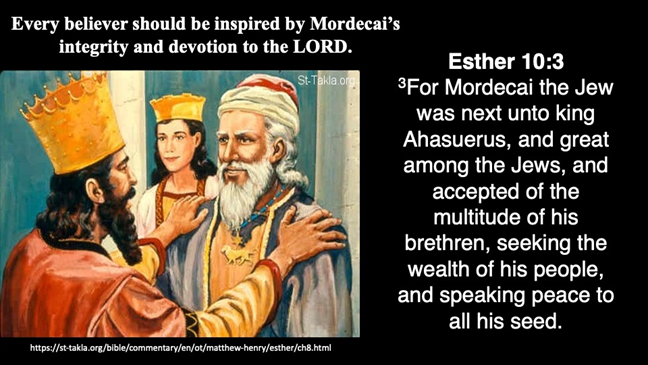
MARCH 17, 2026 ORIGINALLY PUBLISHED MARCH 5, 2023 “WHO KNOWS BUT WHAT YOU HAVE COME TO THE KINGDOM FOR SUCH A TIME AS THIS?” #10 ESTHER 8:1-16 HOW DO YOU SAVE PEOPLE MARKED FOR DESTRUCTION?

March 17, 2026

Ether Appeals for the Jews

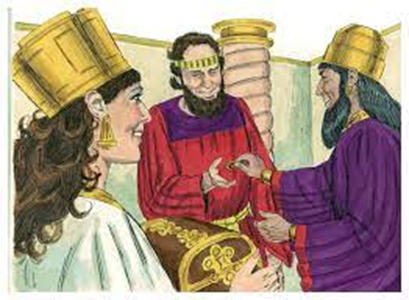
“That same day King Xerxes awarded Queen Esther the estate of Haman, the enemy of the Jews. And Mordecai entered the king’s presence because Esther had revealed his relation to her. The king removed the signet ring he had recovered from Haman and presented it to Mordecai. And Esther appointed him over the estate of Haman.

And once again, Esther addressed the king. She fell at his feet weeping and begged him to revoke the evil scheme of Haman the Agagite, which he had devised against the Jews.

The king extended the gold scepter toward Esther, and she arose and stood before the king.

“If it pleases the king,” she said, “and if I have found favor in his sight, and the matter seems proper to the king, and I am pleasing in his sight, may an order be written to revoke the letters that the scheming Haman son of Hammedatha, the Agagite, wrote to destroy the Jews in all the king’s provinces. For how could I bear to see the disaster that would befall my people? How could I bear to see the destruction of my kindred?”

The Decree of Xerxes

So King Xerxes said to Esther the Queen and Mordecai the Jew, “Behold, I have given Haman’s estate to Esther, and he was hanged on the gallows because he attacked the Jews. Now you may write in the king’s name as you please regarding the Jews, and seal it with the royal signet ring. For a decree that is written in the name of the king and sealed with the royal signet ring cannot be revoked.”

At once the royal scribes were summoned, and on the twenty-third day of the third month (the month of Sivan), they recorded all of Mordecai’s orders to the Jews and to the satraps, governors, and princes of the 127 provinces from India to Cush —writing to each province in its own script, to every people in their own language, and to the Jews in their own script and language.

Mordecai wrote in the name of King Xerxes and sealed it with the royal signet ring. He sent the documents by mounted couriers riding on swift horses bred from the royal mares.

By these letters the king permitted the Jews in each and every city the right to assemble and defend themselves, to destroy, kill, and annihilate all the forces of any people or province hostile to them, including women and children, and to plunder their possessions. The single day appointed throughout all the provinces of King Xerxes was the thirteenth day of the twelfth month, the month of Adar. (This was the same day on which the Jews were to be destroyed according to the edict written by Haman.)

A copy of the text, issued as law throughout every province, was distributed to all the peoples, so that the Jews would be prepared on that day to avenge themselves on their enemies. The couriers rode out in haste on their royal horses, pressed on by the command of the king. And the edict was also issued in the citadel of Susa.

Mordecai went out from the presence of the king in royal garments of blue and white, with a large gold crown and a purple robe of fine linen. And the city of Susa shouted and rejoiced.

esther 7 through 10For the Jews it was a time of light and gladness, of joy and honor. In every province and every city, wherever the king’s edict and decree reached, there was joy and gladness among the Jews, with feasting and celebrating. And many of the people of the land themselves became Jews, because the fear of the Jews had fallen upon them.”

WOW! When God turns things around, he doesn’t waste time! First, King Xerxes orders Haman to be hanged, awarding his estate to Esther. Next, Esther formally introduces Mordecai to King Xerxes, and Xerxes gives Mordecai the signet ring he had earlier handed to Haman. That ring gives Mordecai absolute power to issue edicts.

Then Esther, who has remained relatively calm during this entire ordeal, collapses in tears at the feet of King Xerxes, begging him to revoke Haman’s evil pronouncement. But King Xerxes still has to extend the golden scepter to Esther before she can make her request. Even at this point, Esther may still be put to death, should Xerxes fail to extend the golden scepter.

The original edict cannot be rescinded; however, Mordecai issues orders that give the Jews permission to defend themselves.By these letters the king permitted the Jews in each and every city the right to assemble and defend themselves, to destroy, kill, and annihilate all the forces of any people or province hostile to them, including women and children, and to plunder their possessions. The single day appointed throughout all the provinces of King Xerxes was the thirteenth day of the twelfth month, the month of Adar. (This was the same day on which the Jews were to be destroyed according to the edict written by Haman.)

Suddenly, Mordecai becomes the second most important person in the kingdom and leaves the palace with a large gold crown and dressed as a prince in royal robes of blue and white with an over-robe of fine purple linen, a material reserved for royalty. When the citizens of Susa see Mordecai in these robes, they shout and rejoice because they know Mordecai is a man of God with good judgement. All the other minority ethnic groups in Susa who have been fearing for their lives are celebrating; after all, had Haman survived, whom might he have targeted next?

Throughout all the Persian Empire, the Jews hold massive celebrations and many others decide to become Jews to avoid extermination. It’s also possible that these recent converts also have become Jews because they have seen what the God of Israel can do; after all, their pagan gods have failed to help them. One of the most beautiful lines in this chapter is this one: “For the Jews it was a time of light and gladness, of joy and honor.”

APPLICATION: “A time of light and gladness, of joy and honor-which of us does not need such times? In the Persian Empire, the Jews went from being a despised minority to a highly respected one overnight. Not only has Esther saved her own people, but she has undoubtedly saved any number of other small ethnic groups from destruction. Those people groups are probably also celebrating their deliverance.

There might be another reason people are celebrating: Mordecai is not a drinking man. Reading the Book of Esther closely, you realize that Xerxes has been making many of his decisions through an alcoholic haze. Xerxes is the archetypical mean drunk, and nobody knows the next disastrous decision he might take.

Sometimes God delivers us from situations and sometimes God delivers us in the midst of situations. Obviously, we would far rather be delivered from trying circumstances. In the old TV show “Star Trek,” the star ship crew had a special means of instantly transporting people from one location to another. Scotty was the engineer on the Star Ship Enterprise. The captain was always requesting, “Beam me up, Scotty!” indicating that Scotty should activate that means of instant tele transport. Given the opportunity, who would not like to ask God to “beam me up” out of a bad situation?

Spoiler alert:   Most of the time, God chooses to deliver us in our problems rather than from them. Most of us learn far more from suffering and mistakes than we do from pleasant circumstances. When our circumstances are pleasant, we blithely assume that we deserve comfort and leisure; we fail to recognize that God is giving us respite. Sadly, most of us are like the mule in the story that is told about a man who had a mule he wanted trained. When the trainer arrived, the first thing he did was to take a 2×4 board and whack the mule up alongside the head with it. “What are you doing?” cried the outraged mule owner. “Oh, that was just to get his attention,” replied the trainer.

God is also infinitely patient, and when we fail to learn our lessons the first time around, God brings us into similar circumstances again until we get it right. Moral: become a fast learner and suffer less!

May God help us to pay attention so that we don’t have to have the equivalent of a whack from a 2×4 before we will start learning the lessons God has for us. And may we too enjoy times of light and gladness and joy and honor.

PRAYER: Father God, thank You for loving us and for caring for us. Lord, give us teachable spirits so that You don’t have to do something drastic to get our attention. Help us to listen closely to Your blessed Holy Spirit and help us to follow hard after You all the days of our lives. In the mighty and precious Name of King Jesus. Amen.

MARCH 16, 2026 ORIGINALLY PUBLISHED MARCH 4, 2023 “WHO KNOWS BUT WHAT YOU HAVE COME TO THE KINGDOM FOR SUCH A TIME AS THIS?”#9 ESTHER 7:1-10 THE DOWNFALL OF A VILLAIN!

March 16, 2026

Esther Pleads for Her People

“So the king and Haman went to dine with Esther the queen, and as they drank their wine on the second day, the king asked once more, “Queen Esther, what is your petition? It will be given to you. What is your request? Even up to half the kingdom, it will be fulfilled.”

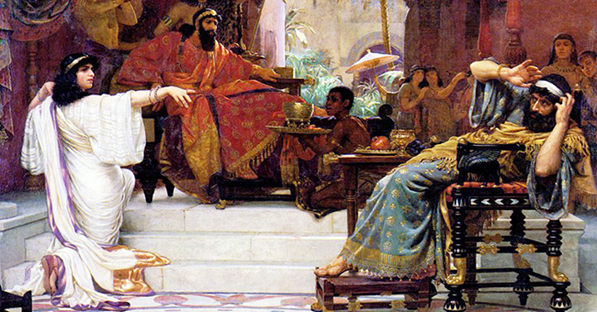
Then Queen Esther replied, “If I have found favor in your sight, O king, and if it pleases the king, grant me my life as my petition, and the lives of my people as my request. For my people and I have been sold out to destruction, death, and annihilation. If we had merely been sold as menservants and maidservants, I would have remained silent, because no such distress would justify burdening the king.”

Then King Xerxes spoke up and asked Queen Esther, “Who is this, and where is the one who would devise such a scheme?”

Esther replied, “The adversary and enemy is this wicked man—Haman!”

And Haman stood in terror before the king and queen.

The Hanging of Haman

In his fury, the king arose from drinking his wine and went to the palace garden, while Haman stayed behind to beg Queen Esther for his life, for he realized the king was planning a terrible fate for him. Just as the king returned from the palace garden to the banquet hall, Haman was falling on the couch where Esther was reclining. The king exclaimed, “Would he actually assault the queen while I am in the palace?” As soon as the words had left the king’s mouth, they covered Haman’s face.

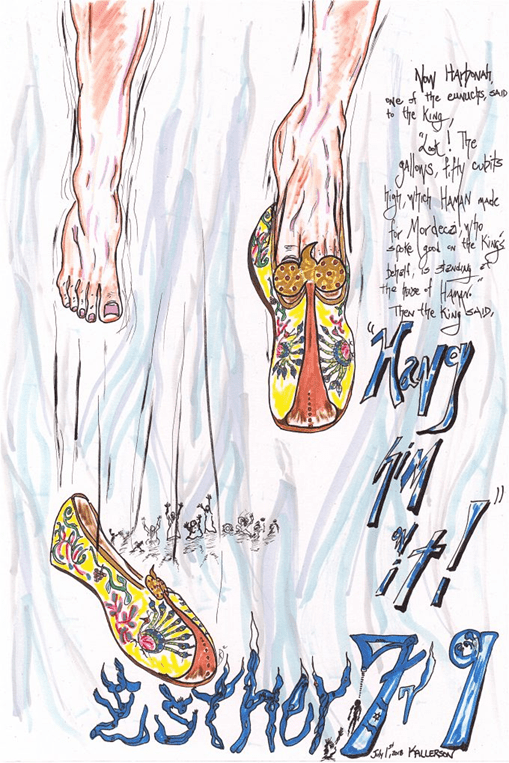
Then Harbonah, one of the eunuchs attending the king, said: “There is a gallows fifty cubits high (75 feet) at Haman’s house. He had it built for Mordecai, who gave the report that saved the king.” “Hang him on it!” declared the king. So they hanged Haman on the gallows he had prepared for Mordecai. Then the fury of the king subsided.

It’s the arch-typical story of the triumph of good over evil, and at this point we want to stand up and cheer loudly! Mordecai is saved! Haman is hanged! But wait, because that edict against the Jews is still out there, and the laws of the Medes and Persians cannot be changed when once they have been issued. Esther might be all right and Mordecai is safe for now, but if actions are not taken swiftly, the Jews might still be wiped out as a people in all the corners of the empire.

Why is Harbonah, one of the eunuchs attending the king, so willing to tell the king about the gallows Haman has already erected? Remember that Haman has been lording it over everyone he meets, forcing them to rise and then to bow in his presence. Harbonah has worked in the palace long enough to know royalty when he sees it and also to recognize a villain when he sees one. It’s likely that Haman has demanding that all the palace servants not merely bow but literally plant their faces on the floor when he walks by. Perhaps Haman is also a mean drunk who has abused the palace servants while Xerxes and he were getting plastered together. Any abuse of a servant would be reported immediately to all the other servants; who knows who might be the next target of Haman’s arrogance? Haman is just that kind of guy. Now the day of pay-backs has come and Harbonah is more than willing to drop a word in the ear of King Xerxes, suggesting Haman be hanged on his own gallows. “Perfect!” thinks Xerxes. “What could be better than hanging Haman on a gallows in front of his own home so everyone can see his downfall?” Remember that Xerxes thinks Haman has attacked Esther, so no punishment is really sufficient for such dastardly behavior. 

APPLICATION: Part of the charm and fascination of the Book of Esther is the way in which God turns a dreadful situation into a victorious one. One of my favorite African Gospel songs is entitled “I know that my God will turn it around!” Here are the lyrics: You can listen to the song at https://www.youtube.com/watch?v=CM8g78pkEJw

Are you weighed down by battles in life
Are you thinking of quitting the race
There is no need to give up on your journey
Because I know my God will turn it around

I know my God will turn it around
I have seen my God turn it around
There are so many many many times in my life
That I have seen my God turn it around

Have you suffered from disappointment
Have some people turn their backs on you
Just keep holding onto the one who cannot disappoint
I know my God will turn it around

I know my God will turn it around
I have seen my God turn it around
There are so many many many times in my life
That I have seen my God turn it around

Are you thinking that you’re alone
Do you feel God has forsaken you
He has promised to keep you to the end of the journey
I know my God will turn it around

I know my God will turn it around
I have seen my God turn it around
There are so many many many times in my life
That I have seen my God turn it around

I know my God will turn it around
I have seen my God turn it around
There are so many many many times in my life
That I have seen my God turn it around
There are so many many many times in my life
That I have seen my God turn it around.

PRAYER: Father God, thank You for loving us and for caring for us. Lord, there are many of us caught in terrible situations and we need You to turn things around. Speak to our hearts, calm our minds, and help us to trust that You will help us and deliver us. In the mighty and precious Name of King Jesus. Amen.
https://www.youtube.com/watch?v=CM8g78pkEJw