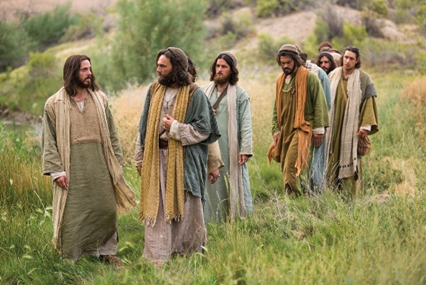
John 8:31-32 Jesus said to the people who believed in him, “You are truly my disciples if you remain faithful to my teachings. And you will know the truth, and the truth will set you free.”
Definition of a disciple: a follower or pupil of a teacher, leader, or philosopher.
When Jesus began his ministry, he had lots of interested people who followed him wherever he went for the sake of the teachings he gave. Matthew 7:28-29 tells us, “When Jesus had finished saying these things, the crowds were amazed at his teaching, for he taught with real authority—quite unlike their teachers of religious law.” The difference was simple; the teachers of the law could only transmit the law with all the arguments surrounding it. Much of that teaching must have sounded like this: “Well, on the one hand, this portion of the Law of Moses says ______. But on the other hand, another portion disagrees with it.” The problem wasn’t in the Law but in the myriads of attempts to explain the Law that had developed since God gave it to Moses. While these academic discussions might have satisfied those interested in such things, others seeking for spiritual knowledge would remain unsatisfied. Jesus, on the other hand, presented things plainly, simply, and with God-given authority, and his listeners recognized the difference. Later, when religious authorities sent their soldiers to arrest Jesus, the soldiers refused, stating that “No man has ever spoken like this one.” (John 7:46 Temple guards sent to arrest Jesus returned empty-handed and told the leading priests and Pharisees that they could not seize him because his teaching was uniquely authoritative and compelling.)
So Jesus had many followers; however, his disciples were far fewer. What makes the difference between a follower and a disciple, and why should we become disciples rather than remaining as followers?
Being a follower is simple; you go, you listen, and you only commit to the degree to which you feel comfortable. As a follower, you can always distance yourself, walking away if things become difficult. But discipleship is a totally different matter. The following aspects of discipleship are gleaned from a number of different sources, every one of which is well worth investigating on its own.
The Bible defines discipleship as a lifelong process of following Jesus, committing to his teachings, and transforming to be like him while helping others do the same. It requires self-denial, carrying one’s cross (Luke 9:23), and loving other believers (John 13:35), all centered on the Great Commission to make disciples of all nations (Matthew 28:19-20).
Key Biblical Aspects of Discipleship:
- Following and Abiding: Discipleship is not just learning, but adhering to Jesus’ teachings, which leads to freedom and truth (John 8:31-32) Mosaic International.
- The Cost: True discipleship requires placing Jesus above all else, including family and one’s own life (Luke 14:26-27) Bible Study Tools, C.S. Lewis Institute.
- The Great Commission: Disciples are called to actively make more disciples by teaching others to obey everything Jesus commanded (Matthew 28:19-20) {Link: Jesus Film Project, Cru.org.
- Bearing Fruit: Abiding in Christ results in producing spiritual fruit, such as love, obedience, and good works (John 15:5-8) GotQuestions.org.
- Mentoring/Replication: Paul emphasizes passing on the faith to others who will in turn teach others (2 Timothy 2:2) Life on Life.
Discipleship is essentially a transformation from self-centeredness to Christ-centeredness (Galatians 2:20), aimed at growing into spiritual maturity and service Discipleship.org.
In Colossians 1:28-29, Paul writes, “Him we proclaim, warning everyone and teaching everyone with all wisdom, that we may present everyone mature in Christ. For this I toil, struggling with all His energy that He powerfully works within me.”
Why should we passionately desire to become disciples when we know it might become difficult, painful, or even end in a violent death as it has for many people in places such as northern Nigeria or Sudan? The answer is simple: when we truly love Jesus, we want to grow as close to Him as possible. The more we learn about Jesus, the more we love Him, and the more we love Him, the more we will want to learn about Him. One friend who has since gone to be with Jesus always prayed, “Lord, help me to love you more today than I did yesterday.” We might echo that prayer and add, “Lord, help me to be more like You today than I was yesterday.”
C.H. Spurgeon, the famous British evangelist of the nineteenth century, once said, “Our knowledge of Christ is somewhat like climbing one of our Welsh mountains. When you are at the base you see but little… Climb the first rising knoll, and the valley lengthens and widens… Mount still, and the scene enlarges… Now, the Christian life is of the same order. When we first believe in Christ, we see but little of Him. The higher we climb the more we discover of His beauties.”
— C.H. Spurgeon (from Morning and Evening, based on Isaiah 40:9)
There’s an old Gospel song entitled “The Longer I Serve Him, The Sweeter He Grows.” This is absolutely true! Don’t settle for being a follower when you can become a disciple!
PRAYER: Father God, thank You for loving us and caring for us. Lord, please help all who read these words to become disciples, passionately in love with You. In the mighty and precious Name of King Jesus. Amen.
 Burunche's Blog
Leave a comment