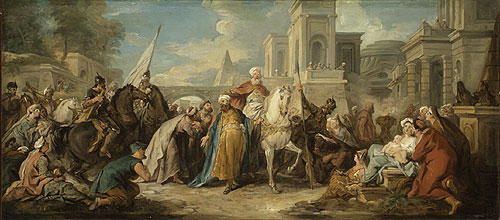
Mordecai Is Honored
“That night, sleep escaped the king; so he ordered the book of records, the chronicles, to be brought in and read to him. And there it was found recorded that Mordecai had exposed Bigthana and Teresh, two of the eunuchs who guarded the king’s entrance, when they had conspired to assassinate King Xerxes.
The king inquired, “What honor or dignity has been bestowed on Mordecai for this act?”
“Nothing has been done for him,” replied the king’s attendants.
“Who is in the court?” the king asked.
Now Haman had just entered the outer court of the palace to ask the king to hang Mordecai on the gallows he had prepared for him. So the king’s attendants answered him, “Haman is there, standing in the court.”
“Bring him in,” ordered the king.
Haman entered, and the king asked him, “What should be done for the man whom the king is delighted to honor?”
Now Haman thought to himself, “Whom would the king be delighted to honor more than me?”
And Haman told the king, “For the man whom the king is delighted to honor, have them bring a royal robe that the king himself has worn and a horse on which the king himself has ridden—one with a royal crest placed on its head. Let the robe and the horse be entrusted to one of the king’s most noble princes. Let them array the man the king wants to honor and parade him on the horse through the city square, proclaiming before him, ‘This is what is done for the man whom the king is delighted to honor!’”
“Hurry,” said the king to Haman, “and do just as you proposed. Take the robe and the horse to Mordecai the Jew, who is sitting at the King’s Gate. Do not neglect anything that you have suggested.”
So Haman took the robe and the horse, arrayed Mordecai, and paraded him through the city square, crying out before him, “This is what is done for the man whom the king is delighted to honor!”
Then Mordecai returned to the King’s Gate. But Haman rushed home, with his head covered in grief.
Haman told his wife Zeresh and all his friends everything that had happened. His advisers and his wife Zeresh said to him, “Since Mordecai, before whom your downfall has begun, is Jewish, you will not prevail against him—for surely you will fall before him.”
While they were still speaking with Haman, the king’s eunuchs arrived and rushed him to the banquet that Esther had prepared.”
God really has a sense of humor! King Xerxes can’t sleep, so he asks for the chronicles of the kingdom to be read to him, no doubt assuming that they will be boring enough to put him to sleep easily! But wait, suddenly the king discovers a fascinating tidbit about the plot hatched by two of the eunuchs who were planning to assassinate him. Suddenly, Xerxes is wide awake! He has a fascinating new project, one that can’t possibly wait until morning. Here’s a new and glorious way in Xerxes can advertise his generosity and his magnificence.
Xerxes calls Haman in and puts a question to Haman. “What should be done for the man whom the king is delighted to honor?” Now Haman thought to himself, “Whom would the king be delighted to honor more than me?” And Haman told the king, “For the man whom the king is delighted to honor, have them bring a royal robe that the king himself has worn and a horse on which the king himself has ridden—one with a royal crest placed on its head. Let the robe and the horse be entrusted to one of the king’s most noble princes. Let them array the man the king wants to honor and parade him on the horse through the city square, proclaiming before him, ‘This is what is done for the man whom the king is delighted to honor!’”
By now, Haman is rubbing his hands with glee! This is working out even better than he had hoped. Take a quick ride through the city on a royal horse while he wears a royal robe, have his name announced in the city, and then return to secure Xerxes’ approval to hang Mordecai. “No problem!” thinks Haman. But Haman is wrong. That insignificant scribe who scratched out that chronicle on clay tablets has saved Mordecai, and it’s MORDECAI whom Xerxes wants to honor and NOT Haman! Haman can scarcely believe it, but he still has that invitation to Esther’s banquet to buoy up his spirits. So Haman finds Mordecai and puts the royal robe on Mordecai and then parades Mordecai through the streets of Susa, proclaiming loudly for all to hear, “This is what is done for the man whom the king is delighted to honor!” But there’s worse yet to come.
Haman rushes home, seeking comfort from his friends and his wife. But look what these people tell Haman: “Since Mordecai, before whom your downfall has begun, is Jewish, you will not prevail against him—for surely you will fall before him.” WHAT? Why would Haman’s most trusted advisers and his wife say such a thing? The answer lies in the history of the Jews. Even though many of the Jews have little regard for their God, the same is not true for those from surrounding nations. These people remember how God wiped out the Egyptian army and how He led the Israelites across the Red Sea and the Jordan River on dry ground. Ironically, these people may have more respect for the God of Israel than do many of the Jews. And now, there’s no time left. The palace eunuchs rush in and hustle Haman off to Esther’s banquet.
APPLICATION: Such a short story but so many fascinating lessons! The clerk who recorded Mordecai’s original report that saved Xerxes was probably bored out of his mind the day he wrote it; however, he did his work properly. Xerxes couldn’t sleep and figured that nothing could be no more soporific than listening to a reading of the royal chronicles, never dreaming how God was going to use that entry. Haman appeared in the outer court at precisely the wrong time because he was hoping to gain permission to hang Mordecai; instead, he wound up leading the royal horse through the streets of Susa, proclaiming Mordecai’s praises.
But the most surprising responses of all are the ones from Haman’s own family. Evidently, until now, Haman’s people have been unaware of Mordecai’s nationality. Suddenly, the same people who were counseling Haman to hang Mordecai on a 75-foot gallows so everyone in Susa would see the body are now predicting Haman’s fall. Are these people fully conscious of what they are saying or is God putting words in their mouths? After all, God has been known to allow a donkey to speak when necessary.
God can use the smallest details to work out His perfect Will. The same Creator who spoke the universe into existence with a single word is quite capable of moving clerks to work diligently and kings to suffer from insomnia. And that same God can also move villains to appear in royal courts just in time for their evil schemes to be thwarted. Psalm 147:4-6 tells us, “He determines the number of the stars and calls them each by name. Great is our Lord and mighty in power; his understanding has no limit. The Lord sustains the humble but casts the wicked to the ground.”
Perhaps today you feel your situation is hopeless. If you were in ancient Susa, you too would be mourning in sackcloth and ashes. But take heart! God has not forgotten you and He knows every detail of your situation. The same God who saved Mordecai from hanging is still running the universe and He can deliver you as well.
PRAYER: Father God, thank You for loving us and for caring for us. Lord, there are those reading these words who feel that their situations are hopeless. But You are the God of heaven and earth, and nothing is too difficult for You! Move in all our hearts, so that we may know Your love for us and may see Your deliverance. In the mighty and precious Name of King Jesus. Amen.
 Burunche's Blog
Leave a comment