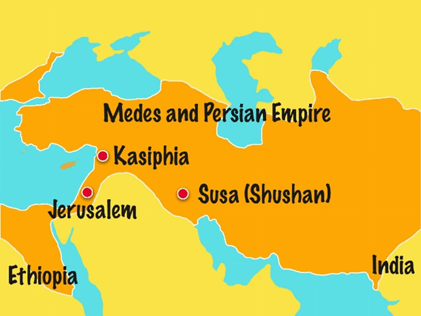
Ezra 1: 1 In the first year of King Cyrus of Persia,[a] the Lord fulfilled the prophecy he had given through Jeremiah. He stirred the heart of Cyrus to put this proclamation in writing and to send it throughout his kingdom:
“This is what King Cyrus of Persia says: “The Lord, the God of heaven, has given me all the kingdoms of the earth. He has appointed me to build him a Temple at Jerusalem, which is in Judah. Any of you who are his people may go to Jerusalem in Judah to rebuild this Temple of the Lord, the God of Israel, who lives in Jerusalem. And may your God be with you! Wherever this Jewish remnant is found, let their neighbors contribute toward their expenses by giving them silver and gold, supplies for the journey, and livestock, as well as a voluntary offering for the Temple of God in Jerusalem.”
Isaiah’s and Jeremiah’s prophecies have come true, and Cyrus has initiated the return of interested exiles to Jerusalem to rebuild the temple. Sounds fantastic, right? And Ezra continues.
Ezra 2:64-70 So a total of 42,360 people returned to Judah, 65 in addition to 7,337 servants and 200 singers, both men and women. They took with them 736 horses, 245 mules, 435 camels, and 6,720 donkeys.
When they arrived at the Temple of the Lord in Jerusalem, some of the family leaders made voluntary offerings toward the rebuilding of God’s Temple on its original site, and each leader gave as much as he could. The total of their gifts came to 61,000 gold coins, 6,250 pounds[f] of silver, and 100 robes for the priests.
So the priests, the Levites, the singers, the gatekeepers, the Temple servants, and some of the common people settled in villages near Jerusalem. The rest of the people returned to their own towns throughout Israel.
Well, it hasn’t taken long for enthusiasms to cool. Having made donations, most of the returnees leave Jerusalem to settle in their hometowns, leaving Ezra and others to carry on as best they can. This isn’t what Cyrus-or God-has envisioned. David Guzik in his Enduring Word Bible Commentary tells us this: But after 70 years of captivity in Babylon, they were given the opportunity to return to their homeland, the Promised Land. Out of some two or three million Jews deported from the land, only 50,000 decided to return to the Promised Land – approximately only 2%. But they did return, and in the days of Ezra, they rebuilt the temple and laid a spiritual foundation for Israel once again.
The Book of Nehemiah begins 15 years after the Book of Ezra ends; almost 100 years after the first captives came back to the Promised Land and some 150 years after the city of Jerusalem was destroyed. After this long time, the walls of the city of Jerusalem were still in rubble.
Before this, the citizens of Jerusalem had tried to rebuild the walls but had failed. In Ezra 4:6-23, we see that some 75 years before they tried to rebuild the walls but were stopped by their enemies. No one thought this obstacle could be overcome, so the walls lay in ruins, and the people were still vulnerable.
Once more, God’s chosen people have made a half-hearted attempt and have then stopped in the face of opposition. But God is not through with Jerusalem or with the Jews, a recurring theme throughout Jewish history. Guzik continues:
The words of Nehemiah the son of Hachaliah. It came to pass in the month of Chislev, in the twentieth year, as I was in Shushan the citadel, that Hanani one of my brethren came with men from Judah; and I asked them concerning the Jews who had escaped, who had survived the captivity, and concerning Jerusalem. And they said to me, “The survivors who are left from the captivity in the province are there in great distress and reproach. The wall of Jerusalem is also broken down, and its gates are burned with fire.”
a. In Shushan the citadel: Nehemiah lived in Shushan, the capital city of the Persians, and he lived in the citadel – that is, the fortified palace of the Persians. Right away, we know Nehemiah is someone important, living in the palace of the king of Persia.
b. I asked them concerning the Jews who had escaped, who had survived the captivity, and concerning Jerusalem: Nehemiah’s body was in Persia, but his heart and his interest were in Jerusalem – 800 miles (1,300 km) away. He wanted to know from those returning how the people and the city were doing.
i. We might think that a prominent man like Nehemiah had more important things to think about than a distant city he had never been to, and a people he was a stranger to. Yet, because his heart was for the things of God, his heart was not for himself, but for others.
ii. Nehemiah had the heart of Psalm 137:5-6: If I forget you, O Jerusalem, let my right hand forget its skill! If I do not remember you, let my tongue cling to the roof of my mouth; if I do not exalt Jerusalem above my chief joy. If Jerusalem was special to God, then it would also be special to Nehemiah.
c. The wall of Jerusalem is also broken down, and its gates are burned with fire: The news he received was not encouraging. The people were called survivors; this was not a hopeful title. They were in great distress and reproach, and the walls of the city itself were broken down and the city gates were burned with fire.
i. The bad state of the people and the bad state of the city walls were intimately connected. In the ancient world, a city without walls was a city completely open and vulnerable to its enemies. They had no defense, no protection at all.
ii. An unwalled city was always vulnerable, unable to safely house people and valuables. If there were anything of value in an unwalled city, it could be stolen away easily because there was no defense to stop it.
iii. Those living in an unwalled city lived in constant stress and tension; they never knew when they might be attacked and brutalized. Every man lived in constant fear for his wife and children. The temple could be rebuilt, but never made beautiful, because anything valuable would be taken easily.
iv. No wonder the people lived in constant distress, in constant disgrace (reproach), living only as survivors. God has more for us than to be mere survivors. God not only wants us to be conquerors, but more than conquerors through Him who loved us (Romans 8:37).
3. (4) Nehemiah’s reaction to the news about Jerusalem and its people.
So it was, when I heard these words, that I sat down and wept, and mourned for many days; I was fasting and praying before the God of heaven.
a. I sat down and wept: Nehemiah’s immediate reaction was extreme. He didn’t just feel bad for Jerusalem and its people; right away, there was no strength in his legs (I sat down), and he began to weep and to mourn.
b. Mourned for many days: God was going to use Nehemiah to do something about this situation. But first, God did something in Nehemiah. Any great work of God begins with God doing a great work in somebody.
i. God prepared this long ago, with Nehemiah’s important position in Persia, with a heart curious about the welfare of Jerusalem and its people. Now we see that he had a heart that broke over their needy state.
ii. God saw the need in heaven, but little would be done until the right man also felt the need. God would do something great to meet that need through Nehemiah.
iii. But there is no way Nehemiah could do this alone. He had to be a leader – one who influences other people – to get this job done. Nehemiah is a book all about leadership – something we obviously need today. Since leadership is influence, leadership applies to everyone. Everyone has an area of leadership. In some way, each one is a leader; the question is if they are a good leader or a bad leader.
iv. Leaders must prepare themselves for difficult work because it won’t be easy. “There is no winning without warfare; there is no opportunity without opposition; there is no victory without vigilance. For whenever the people of God say, ‘Let us arise and build,’ Satan says, ‘Let me arise and oppose.’” (Redpath)
v. Leaders must have a big vision, and Nehemiah had one. His mentality seemed to be, “Through me, God is going to correct a problem that’s been around a hundred and fifty years. Through me, God is going to do something that completely failed before.” We must have a vision, a goal, that is big enough.”
Nehemiah’s heart is prepared, and he is willing to risk everything, including his life and his extremely comfortable position as cup bearer-and confidant-to the king. Eventually, Nehemiah will travel all the way to Jerusalem and spearhead its reconstruction in a fashion that can only be described as miraculous.
Ezra and Nehemiah-two towering figures who only want to do God’s will in rebuilding Jerusalem. Nehemiah will complete what Ezra and his friends have started. For us, one of the most important lessons is that at any given moment, God can choose those dedicated to Him to fulfill His perfect Will. If you could interview either of these men, they would likely downplay their contributions, deflecting the praise to others. But the important thing about both these men is simple: when God called, they answered and continued to answer for the rest of their lives. The signatories to the Declaration of Independence pledged “their lives, their fortunes, and their sacred honor. Ezra and Nehemiah did likewise. May we follow their example!
PRAYER: Father God, thank You for loving us and caring for us. Lord, please help us to follow so close to You that when You call us to risk everything, we will not hesitate but say yes. In the mighty and precious Name of King Jesus. Amen.
 Burunche's Blog
Leave a comment