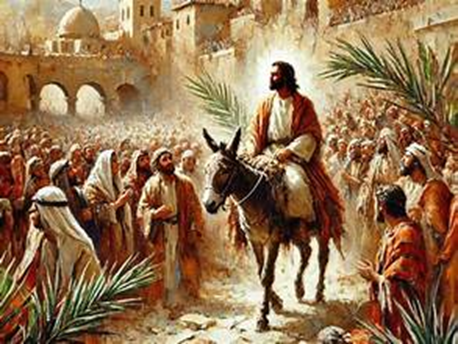
Matthew 21:1-11 Jesus’ Triumphant Entry
21 As Jesus and the disciples approached Jerusalem, they came to the town of Bethphage on the Mount of Olives. Jesus sent two of them on ahead. “Go into the village over there,” he said. “As soon as you enter it, you will see a donkey tied there, with its colt beside it. Untie them and bring them to me. If anyone asks what you are doing, just say, ‘The Lord needs them,’ and he will immediately let you take them.”
This took place to fulfill the prophecy that said, “Tell the people of Jerusalem, ‘Look, your King is coming to you. He is humble, riding on a donkey—riding on a donkey’s colt.’”
The two disciples did as Jesus commanded. They brought the donkey and the colt to him and threw their garments over the colt, and he sat on it.
Most of the crowd spread their garments on the road ahead of him, and others cut branches from the trees and spread them on the road. Jesus was in the center of the procession, and the people all around him were shouting, “Praise God for the Son of David! Blessings on the one who comes in the name of the Lord! Praise God in highest heaven!”
The entire city of Jerusalem was in an uproar as he entered. “Who is this?” they asked. And the crowds replied, “It’s Jesus, the prophet from Nazareth in Galilee.”
Jesus knew the day would come when he would enter Jerusalem as no other king had ever entered. Jesus knew the prophecies; the only thing he didn’t know was the timing. But as Jesus and his disciples approached the village of Bethphage, the “house of unripe figs,” the Holy Spirit spoke to Jesus and Jesus spoke to his disciples. “There’s a donkey and her foal over there. Please bring them both to me.” The disciples looked at each other, shrugged, and went off to fetch the donkeys, hoping that they wouldn’t get kicked or bitten in the process. But this was Jesus, and these men had learned that when Jesus gave orders, something extraordinary was going to happen. When the men returned, Jesus seated himself on the foal rather than its mother, and the foal behaved as if this were totally normal. And now Jesus and the disciples began descending the steep paths leading down the Mount of Olives to the Kidron Valley.
The crowd didn’t accumulate immediately, but as Jesus and his disciples kept on, people began streaming from all the surrounding villages. Someone who knew the ancient prophecies cried out, “He must be Messiah!” and others in the crowd took up the cry and then began throwing their cloaks on the ground and covering the path with palm branches. Now some of the crowd were beginning to shout, “Hosanna, Lord! Save us!” while others were shouting, “Glory to God!” By the time the crowd reached Jerusalem, it numbered several thousand people. Local religious authorities were aghast. Luke 19:39-40 tells us But some of the Pharisees among the crowd said, “Teacher, rebuke your followers for saying things like that!”
He replied, “If they kept quiet, the stones along the road would burst into cheers!”
Now the religious authorities were horrified. Dealing with the Roman overlords was always a touchy business and now this ridiculous Nazarene carpenter had just embarrassed them. Never mind that some of those men remembered the prophecies from Isaiah and Zechariah and were troubled by them.
Isaiah 62:11 The Lord has sent this message to every land: “Tell the people of Israel,‘Look, your Savior is coming. See, he brings his reward with him as he comes.’”
Zechariah 9:9 Rejoice, O people of Zion!Shout in triumph, O people of Jerusalem! Look, your king is coming to you. He is righteous and victorious,yet he is humble, riding on a donkey—riding on a donkey’s colt.
Jesus knew that he had taken a step that could not be reversed, for now everything that had been foretold about his death would come to pass. But as Jesus was entering Jerusalem, he also knew what the Romans would eventually do to that city of controversy. Luke 19:41-44 tells us, But as he came closer to Jerusalem and saw the city ahead, he began to weep. “How I wish today that you of all people would understand the way to peace. But now it is too late, and peace is hidden from your eyes. Before long your enemies will build ramparts against your walls and encircle you and close in on you from every side. They will crush you into the ground, and your children with you. Your enemies will not leave a single stone in place, because you did not recognize it when God visited you.”
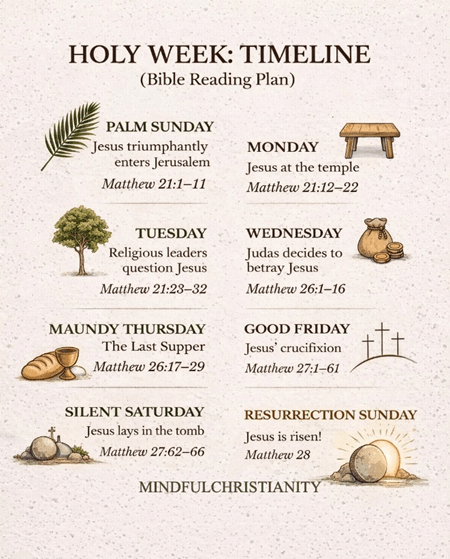
How does Jesus’ entry into Jerusalem on Palm Sunday demonstrate God’s care for Israel? The prophecies surrounding Jesus’ entry on a donkey’s colt were given centuries before Palm Sunday. Throughout all the chaos of repeated conquests, God never forgot Israel. The entry of Messiah was another fulfillment of God’s promises.
As we study the events of Holy Week, remember that each of these days brought new fulfillments of God’s promises and God’s perfect will for Israel.
PRAYER: Father God, thank You for loving us and caring for us. Lord, we praise You that You are a promise-keeping God and that You never go back on Your Word. Father help us to trust You, knowing that You will guide us if we will only let You. In the mighty and precious Name of King Jesus. Amen.
 Burunche's Blog
Leave a comment