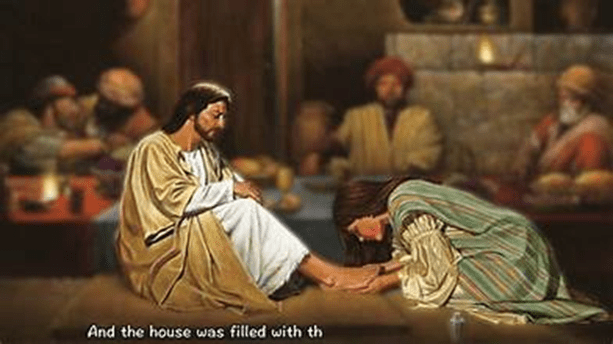
John 12:1-7 Jesus Anointed at Bethany
Six days before the Passover celebration began, Jesus arrived in Bethany, the home of Lazarus—the man he had raised from the dead. A dinner was prepared in Jesus’ honor. Martha served, and Lazarus was among those who ate with him. Then Mary took a twelve-ounce jar of expensive perfume made from essence of nard, and she anointed Jesus’ feet with it, wiping his feet with her hair. The house was filled with the fragrance.
But Judas Iscariot, the disciple who would soon betray him, said, “That perfume was worth a year’s wages. It should have been sold and the money given to the poor.” Not that he cared for the poor—he was a thief, and since he was in charge of the disciples’ money, he often stole some for himself.
Jesus replied, “Leave her alone. She did this in preparation for my burial. You will always have the poor among you, but you will not always have me.”
Those sitting with Jesus were shocked into disbelief! Mary, that paragon of virtue, had come in, snapping the neck of the delicate vase containing the perfume she had been keeping for her own burial. Pouring the perfume all over Jesus’ feet, Mary then wiped his feet with her HAIR, an act so shocking that all in the room were speechless. Why was Mary’s action so significant? The website https://divinenarratives.org/hair-in-biblical-culture-symbolism-vows-and-purity/ gives us insight into some of the cultural attitudes and practices towards hair in Bible times:
In ancient Israelite society, hair was imbued with layers of meaning that extended far beyond personal grooming. It was a visible marker of one’s social and religious identity, often reflecting one’s status and role within the community. For men, the length and style of hair could indicate their adherence to religious laws or their participation in specific vows. Women’s hair, on the other hand, was often associated with modesty and virtue, with societal expectations dictating how it should be worn in public and private settings.
The act of cutting or growing hair was not merely a personal choice but a communal statement. For instance, the Israelites would sometimes shave their heads as a sign of mourning or repentance, a practice that underscored the gravity of their emotional or spiritual state. Conversely, letting one’s hair grow long could be a sign of dedication and separation unto God, as seen in various biblical narratives. This duality in the treatment of hair highlights its role as a medium through which individuals could express their inner convictions and communal affiliations.
Hair also played a role in rites of passage and lifecycle events. During significant moments such as childbirth, marriage, or death, hair could be ritually altered to mark the transition from one stage of life to another. These practices were deeply embedded in the cultural fabric, serving as tangible expressions of intangible beliefs and values. The communal nature of these rituals reinforced the collective identity of the Israelites, binding them together through shared customs and traditions…
In the New Testament, hair continues to hold symbolic weight. Paul’s letters to the Corinthians touch on the cultural and spiritual significance of hair, particularly in the context of worship and gender roles. Paul advises that women should cover their heads while praying or prophesying, associating long hair with honor and a sign of authority. Conversely, he suggests that men should keep their hair short, aligning with notions of propriety and respect within the early Christian communities. These instructions highlight the broader cultural and theological implications of hair, reflecting the ways in which it was woven into the fabric of religious practice and community identity.
Traditionally, women’s hair was referred to as their “crowning glory,” and was kept long. It was believed that women honored God by allowing their hair to grow, and that modestly dressed hair symbolized obedience and reverence to God. When Mary wiped Jesus’ feet with her hair, she sacrificed the perfume she had been keeping for anointing her own body after death but in addition, she was also using her hair, the symbol of reverence to God, and wiping Jesus’ feet. Some of those seated might have remembered the prophet Isaiah as he said, “How beautiful on the mountains are the feet of the messenger who brings good news,
the good news of peace and salvation, the news that the God of Israel reigns! The watchmen shout and sing with joy, for before their very eyes they see the Lord returning to Jerusalem.
Let the ruins of Jerusalem break into joyful song, for the Lord has comforted his people. He has redeemed Jerusalem. The Lord has demonstrated his holy power before the eyes of all the nations. All the ends of the earth will see the victory of our God.” (Isaiah 52:7-10)
Mary’s gesture was not simply an act of kindness or generosity or even love; it was prophetic, helping to reinforce the prophecies of Isaiah. Now for our story.
It was early in 1998, and we were attending a Crossroads Discipleship Training Course at YWAM in Kona, Hawaii. The group of attendees was an international one, drawing people from many countries, especially from the South Pacific. One of our friends was a pastor from Fiji. This particular day, we were sitting near our friend when one speaker began describing the failures of early missionaries to truly minister to tribal groups, forcing them to reject their own languages and cultures, even though many of the cultural values were compatible with Christianity. This teaching resonated with us, for we had already witnessed some of the bad fallout from such efforts during our missionary service in Ghana. As the speaker led the whole group in prayers of repentance, my husband and I found ourselves weeping violently. Turning to our pastor friend from Fiji, we knelt and anointed his feet with our tears, wiping them with our hair. But what happened next was totally unexpected. Suddenly our friend began jumping up and down, shouting, “I’m free! I’m free!” As we resumed our seats, our friend informed us that when we anointed his feet, suddenly a spiritual weight lifted, and he felt so light he could almost fly. Our simple act had broken something in the spiritual realm, releasing our friend from a burden he didn’t even know he was carrying.
The act of anointing is holy and should never be entered upon lightly. To this day, priests, ministers, missionaries, and others are consecrated by leaders laying hands on them and praying over them. Frequently, anointing oil is also employed in these rituals. For Christians, anointing is a sign of the Holy Spirit coming to the individual. Although Jesus already had the Holy Spirit, when Mary anointed him, not only was her act symbolic, but God imparted some new power to him, the power he would need to endure the suffering and stresses of the week that would culminate in his death and resurrection.
This week, many churches will practice foot washing ceremonies in honor of Jesus’ example when he washed the disciples’ feet. As we go about these practices, let us pray that the Holy Spirit will descend and abide with all of us, causing our old natures to die and bringing forth new spiritual life in us.
PRAYER: Father God, thank You for loving us and caring for us. Lord, help us to serve all those around us, not caring about the cost, knowing that You are the One who provides and You will always renew our strength and our hope. In the mighty and precious Name of King Jesus. Amen.
 Burunche's Blog
Leave a comment