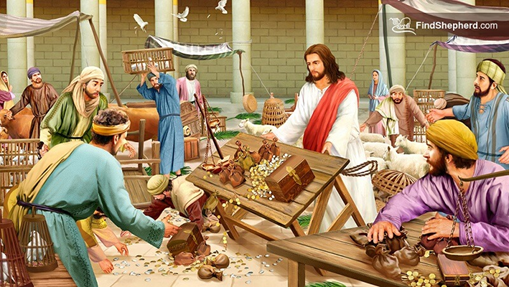
Jesus Clears the Temple
Matthew 21:12-17 Jesus entered the Temple and began to drive out all the people buying and selling animals for sacrifice. He knocked over the tables of the money changers and the chairs of those selling doves. He said to them, “The Scriptures declare, ‘My Temple will be called a house of prayer,’ but you have turned it into a den of thieves!”
The blind and the lame came to him in the Temple, and he healed them. The leading priests and the teachers of religious law saw these wonderful miracles and heard even the children in the Temple shouting, “Praise God for the Son of David.”
But the leaders were indignant. They asked Jesus, “Do you hear what these children are saying?”
“Yes,” Jesus replied. “Haven’t you ever read the Scriptures? For they say, ‘You have taught children and infants to give you praise.’” Then he returned to Bethany, where he stayed overnight.
It all began so innocently and yet wound up as such a moral quagmire. Although worshipers coming to the temple were supposed to bring their own perfect animals for sacrifice, many came from long distances, making such a thing impossible. Then there were those coming from distant lands to worship. As a consequence, a trade sprang up, with some hawkers selling animals for worship while others exchanged local currencies for a uniform temple currency. But the abuses soon proliferated. A dove that might cost a tiny amount outside the temple would cost twenty times that much inside the temple. And the same abuses could be seen when visitors exchanged money.
The priests had no reason to shut down this trade, for they were getting a cut of the profits. Rather than being a place of prayer, the temple took on all the trappings of a local market, with animals making noise, defecating and urinating all over the floor. Then there were the cries of competing hucksters, each vying for the business of harried pilgrims. The noise and the smell alone were horrific, making worship nearly impossible. Priests ordered visitors around, herding them much like the sacrificial animals. In the end, a visit to a grand temple that should have been a highlight of spiritual life became a costly endurance contest, leaving worshipers with bitter memories and empty pockets. Little wonder that Jesus referred to the temple as a den of thieves!
As Jesus overturned tables and chairs, the noise and uproar attracted two groups of marginalized people: the disabled and children. Rather than fleeing, the lame and the blind began flocking around Jesus. As Jesus spread out his hands, all those around him were healed and began crying out, delighted at their new-found freedom. The children recognized Jesus’ goodness and mercy and added their voices to those of the newly healed, so that a huge crowd now cried out, “Praise God for the Son of David!” Those who had come to the temple to worship began adding their voices to the praises, making the sounds of praise so loud that they even drowned out the noises of the sheep and cattle and the indignant cries of the offended merchants.
The temple rulers were aghast! How dare this ridiculous carpenter from Nazareth barge in and begin upsetting things? Who did he think he was and by what authority was he doing this?
Matthew 21:23-32 The Authority of Jesus Challenged When Jesus returned to the Temple and began teaching, the leading priests and elders came up to him. They demanded, “By what authority are you doing all these things? Who gave you the right?”
“I’ll tell you by what authority I do these things if you answer one question,” Jesus replied. “Did John’s authority to baptize come from heaven, or was it merely human?”
They talked it over among themselves. “If we say it was from heaven, he will ask us why we didn’t believe John. But if we say it was merely human, we’ll be mobbed because the people believe John was a prophet.” So they finally replied, “We don’t know.”
And Jesus responded, “Then I won’t tell you by what authority I do these things.”
Well! This upstart carpenter from Galilee obviously had no respect for religious leaders or elders. Rather than directly answer questions, he proceeded to query them. How embarrassing! In their hearts, these men fully realized that John the Baptist had been a prophet; however, since John didn’t meet their expectations, they had tried to ignore him. For years, these men had been troubled by the prophecy of Malachi 4:5-6. “Look, I am sending you the prophet Elijah before the great and dreadful day of the Lord arrives. His preaching will turn the hearts of fathers to their children, and the hearts of children to their fathers. Otherwise, I will come and strike the land with a curse.”
“Surely,” these men thought, “Surely, if a prophet were to arise in the spirit of Elijah, he would present himself to religious leaders first. But John persisted in ministering to all comers and in the wilderness at that! To consider John as the prophet foretold by Malachi was unthinkable, for if John was that prophet, then Messiah should be coming at any moment. But Jesus of Nazareth as Messiah? Unthinkable!” Watching the religious leaders, Jesus knew exactly what they were thinking, for he had seen the scornful looks and the immediate dismissal. But Jesus loved these men, even as they were rejecting him, so he told a story.
Parable of the Two Sons
Mattheq 21:28-32 “But what do you think about this? A man with two sons told the older boy, ‘Son, go out and work in the vineyard today.’ The son answered, ‘No, I won’t go,’ but later he changed his mind and went anyway. Then the father told the other son, ‘You go,’ and he said, ‘Yes, sir, I will.’ But he didn’t go.
“Which of the two obeyed his father?”
They replied, “The first.”
Then Jesus explained his meaning: “I tell you the truth, corrupt tax collectors and prostitutes will get into the Kingdom of God before you do. 3or John the Baptist came and showed you the right way to live, but you didn’t believe him, while tax collectors and prostitutes did. And even when you saw this happening, you refused to believe him and repent of your sins.”
Jesus’ words hung in the air, vibrating as if they had a life of their own. The background noises of the temple faded as the religious leaders glared at him. Were any of these men convicted by what Jesus had just said? It’s possible. But remember that in another place, John had this to say: Many people did believe in him, however, including some of the Jewish leaders. But they wouldn’t admit it for fear that the Pharisees would expel them from the synagogue. For they loved human praise more than the praise of God. (John 12:42-43)
Did Jesus’ actions in the temple change anything? No. Once Jesus taught and then left, the animal sellers and the money changers simply righted their tables and went back to business as usual. The priests sanctimoniously adjusted their robes and tried to appear as if nothing had happened. But the lame and the blind who had been healed knew miracles had occurred. And the children never forgot the day they were moved to shout, “Praise God for the Son of David!” The example Jesus set that day remains as vivid and as telling as it did when he upset those tables, for the temptation to turn worship into business will remain until Jesus returns in glory.
Several months ago, we attended a church service that was supposed to be a thanksgiving service for friends who had married the day before. But the pastor had a different agenda. Seeing all the visitors who had come for the wedding, the pastor thought this was an ideal opportunity to raise money for chairs for the Children’s Church. The fund raising took nearly an hour, while our friends’ marriage was barely acknowledged at all. Those of us who had remained in Accra to honor our friends were disappointed and disgusted. I doubt that our contributions to the special offering would even have purchased a single chair. That church service was one of the least satisfying worship experiences we had ever had.
What lessons was Jesus trying to teach all those in the temple that day? The Gospel of Mark was written by Mark, who got much of his information from Simon Peter. Peter did not believe in shilly-shallying. Mark quotes Jesus in the temple as having said, “The Scriptures declare, ‘My Temple will be called a house of prayer for all nations,’ but you have turned it into a den of thieves.” Mark 11:17
While churches require money to operate, we must always be mindful not to turn worship services into business meetings. Am I against fund raisers? No. Such things are necessary. But manipulating worshipers mars the worship experience and may even prevent some people from finding God. There were no exit polls at the temple in Jerusalem in Jesus’ day, but had such things existed, it’s likely that many worshipers if allowed to remain anonymous would have given their experience the lowest rating possible. May God help us, so that we don’t erect barriers preventing those seeking God’s presence!
PRAYER: Father God, thank You for loving us and caring for us. Lord, help us to worship You in Spirit and in truth. And help us to help others to do so also. In the mighty and precious Name of King Jesus. Amen.
 Burunche's Blog
Leave a comment