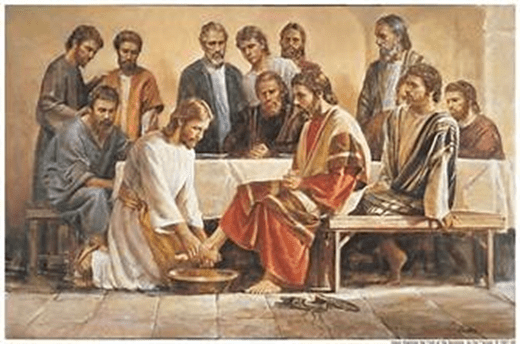
John 13:1-5Before the Passover celebration, Jesus knew that his hour had come to leave this world and return to his Father. He had loved his disciples during his ministry on earth, and now he loved them to the very end. It was time for supper, and the devil had already prompted Judas, son of Simon Iscariot, to betray Jesus. Jesus knew that the Father had given him authority over everything and that he had come from God and would return to God. So he got up from the table, took off his robe, wrapped a towel around his waist, and poured water into a basin. Then he began to wash the disciples’ feet, drying them with the towel he had around him.
10-11 Jesus replied, “A person who has bathed all over does not need to wash, except for the feet,[c] to be entirely clean. And you disciples are clean, but not all of you.” For Jesus knew who would betray him. That is what he meant when he said, “Not all of you are clean.”
Jesus Predicts His Betrayal
18 “I am not saying these things to all of you; I know the ones I have chosen. But this fulfills the Scripture that says, ‘The one who eats my food has turned against me.’
21 Now Jesus was deeply troubled, and he exclaimed, “I tell you the truth, one of you will betray me!”
It’s the night of the Passover meal, and Jesus knows his time is very short, and there are still many things he must teach his disciples. First, Jesus models servant leadership. In Bible times, travelers would always enjoy having their feet washed; however, foot washing was the job of the lowest servant in the household. But that meal was exclusive, involving only Jesus and his disciples. As the disciples entered the room, each of them looked sideways at the others. Lacking servants, somebody would have to wash feet, but who? Competition among the disciples for prominence was already stiff, so washing feet would cause a serious loss of status…or would it? Looking around the room, Jesus smiled wryly and shook his head slightly. That’s when Jesus took off his outside garments, wrapped a towel around his waist, and poured water into a basin, beginning to wash feet. Jesus wasn’t worried about his status, but he was concerned about the unhealthy friction among the disciples.
The foot washing was remarkable enough, but one thing we tend to overlook is this: Jesus washed ALL the disciples’ feet, including Judas Iscariot’s. Jesus already knew that Judas had gone to the religious leaders, plotting to betray him, so why would Jesus serve Judas? Reading the various accounts in the Gospels, it’s obvious that Jesus continued to give Judas every opportunity to repent, to back off, and to refuse to go through with the betrayal. Jesus even made sure Judas received his share of the Passover meal. Judas could have repented and accompanied Jesus and the others to Gethsemane, but he had hardened his heart.
Matthew 26:20-25 When it was evening, Jesus sat down at the table with the Twelve. While they were eating, he said, “I tell you the truth, one of you will betray me.”
Greatly distressed, each one asked in turn, “Am I the one, Lord?”
He replied, “One of you who has just eaten from this bowl with me will betray me. For the Son of Man must die, as the Scriptures declared long ago. But how terrible it will be for the one who betrays him. It would be far better for that man if he had never been born!”
Judas, the one who would betray him, also asked, “Rabbi, am I the one?”
And Jesus told him, “You have said it.”
Traditionally, sharing food indicated an extreme level of trust and a bond that should not be broken. When Judas left the meal, he broke that tradition as well as rejecting Jesus’ acts of service.
Numerous books have been written about Holy Week, about the activities of each day as well as the events of Jesus’ suffering, his death, and resurrection. Judas wasn’t the only disciple to disappoint Jesus that night, for when the soldiers came to arrest Jesus, most of the disciples took to their heels. When John and Peter followed Jesus to the High Priest’s house, onlookers spotted Peter as a Galilean by his regional accent, and Peter repeatedly denied that he even knew Jesus. Eventually, only John and the women would follow Jesus to Calvary, remaining faithful despite everything.
But remember this: Even though Jesus knew that everything was about to fall apart and that he was hours away from suffering and death, he still washed feet. John 13:12-17 After washing their feet, he put on his robe again and sat down and asked, “Do you understand what I was doing? You call me ‘Teacher’ and ‘Lord,’ and you are right, because that’s what I am. And since I, your Lord and Teacher, have washed your feet, you ought to wash each other’s feet. I have given you an example to follow. Do as I have done to you. I tell you the truth, slaves are not greater than their master. Nor is the messenger more important than the one who sends the message. Now that you know these things, God will bless you for doing them.”
So many of us are like the disciples. We are so concerned about appearances and status that we are afraid to look inferior or foolish. And we REALLY don’t want to have to do stinky tasks. I grew up in an old house without indoor plumbing. We had an outhouse 30 meters from the back door; however, during bitter winter weather, the family was forced to use a large chamber pot that then had to be carried out to the outhouse and emptied. As the oldest child, I was the one tasked with emptying that chamber pot. Was it stinky? Yes. I had to be extremely careful to avoid any unfortunate spillages. But I am grateful for having had to do that job. Why? Once you must carry the family chamber pot full of feces and urine to an outhouse to empty it, nothing else will bother you. You have already survived one of the worst tasks there is. When you encounter nauseating work later in life, it won’t matter. (Frankly, given a choice, I would rather have washed stinky feet!)
So remember, as we are considering Jesus’ last words and deeds, that the Son of God took off his robe, tied a towel around his waist, and then washed the stinky, dirty feet of all the disciples, including Judas. And also remember that Jesus told his disciples, “I tell you the truth, slaves are not greater than their master. Nor is the messenger more important than the one who sends the message. Now that you know these things, God will bless you for doing them.” (John 13:16-17)
PRAYER: Father God, thank You for loving us and caring for us. Lord, help us to remember Your example and gladly serve those around us, even those who might have hurt us. In the mighty and precious Name of King Jesus. Amen.
 Burunche's Blog
Leave a comment