Matthew 27:45-56 At noon, darkness fell across the whole land until three o’clock. 46 At about three o’clock, Jesus called out with a loud voice, “Eli, Eli, lema sabachthani?” which means “My God, my God, why have you abandoned me?”
Some of the bystanders misunderstood and thought he was calling for the prophet Elijah. 48 One of them ran and filled a sponge with sour wine, holding it up to him on a reed stick so he could drink. But the rest said, “Wait! Let’s see whether Elijah comes to save him.”
Then Jesus shouted out again, and he released his spirit. At that moment the curtain in the sanctuary of the Temple was torn in two, from top to bottom. The earth shook, rocks split apart, and tombs opened. The bodies of many godly men and women who had died were raised from the dead. They left the cemetery after Jesus’ resurrection, went into the holy city of Jerusalem, and appeared to many people.
The Roman officer and the other soldiers at the crucifixion were terrified by the earthquake and all that had happened. They said, “This man truly was the Son of God!”
And many women who had come from Galilee with Jesus to care for him were watching from a distance. Among them were Mary Magdalene, Mary (the mother of James and Joseph), and the mother of James and John, the sons of Zebedee.
The scene burned itself into the brains of all who witnessed it. As a bitter comment on the blindness of the Jews, Pontius Pilate had ordered a sign to be attached to the top of Jesus’ cross. The sign read INRI, Latin shorthand for “Jesus Nazareti Rex Judaorum,” “Jesus of Nazareth, King of the Jews.” (The Roman alphabet lacked the letter “J.”) Hour by hour, the huddled group watched in agony as Jesus struggled to breathe and as he eventually died. Those assembled knew that last cry would haunt them forever. But what would they do now?
The Burial of Jesus
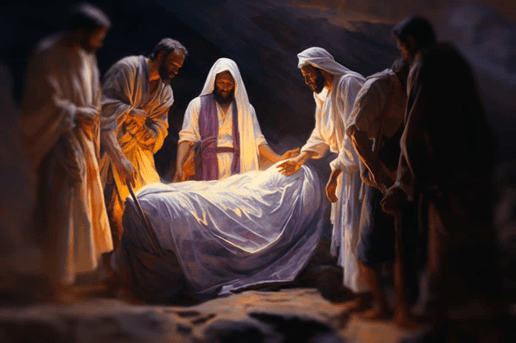
57-61 As evening approached, Joseph, a rich man from Arimathea who had become a follower of Jesus, went to Pilate and asked for Jesus’ body. And Pilate issued an order to release it to him. Joseph took the body and wrapped it in a long sheet of clean linen cloth. He placed it in his own new tomb, which had been carved out of the rock. Then he rolled a great stone across the entrance and left. Both Mary Magdalene and the other Mary were sitting across from the tomb and watching.
The women could only watch so long, for at evening they needed to be indoors, commemorating the Passover. Leaving that tomb was one of the hardest things any of them had ever done. Walking back into Jerusalem, their steps dragged. What would they do now? How could they possibly go on, now that all their hopes and dreams lay dead in that tomb with Jesus?
The Guard at the Tomb
62-66 The next day, on the Sabbath, the leading priests and Pharisees went to see Pilate. They told him, “Sir, we remember what that deceiver once said while he was still alive: ‘After three days I will rise from the dead.’ So we request that you seal the tomb until the third day. This will prevent his disciples from coming and stealing his body and then telling everyone he was raised from the dead! If that happens, we’ll be worse off than we were at first.”
Pilate replied, “Take guards and secure it the best you can.” So they sealed the tomb and posted guards to protect it.
The next day, Roman guards took up their positions. These battle-hardened men wondered what their officers were thinking. Jesus was dead, so what was the point of guarding a corpse? One of the guards, a burly man named Marcus, was joking with a fellow soldier. “So Sextus, the things we do for Mother Roma, right? What are these crazy Jews thinking of? Do they really think those cowardly disciples will come steal this body when most of them didn’t even turn up at the crucifixion? Oh well, things could be worse. We sit here for three days, and then they’ll move us on to another assignment.”
It was the Sabbath, and all Jerusalem was quiet. Those attending temple did so in a subdued fashion. The priests and religious leaders were heaving large sighs of relief. Finally, finally, FINALLY, they had succeeded in getting rid of Jesus of Nazareth. No more ridiculous processions through the streets of Jerusalem. No more embarrassing moments on the teaching steps at the temple. No, Jesus was dead, buried, and through. Now they could return to business as usual.
Meanwhile, somewhere in Jerusalem, Jesus’ followers were gathering for mutual comfort. “We were so sure he was Messiah. He fulfilled all the prophecies. How could all of this have ended so badly? And what’s going to happen to the rest of us? Will Caiaphas and his bunch engage soldiers to swoop down on us as well? And where is God in all of this?
Live long enough, and you will endure times of uncertainty that will echo that Easter Saturday. Someone on whom you have pinned your hopes disappoints you, leaving you wondering how you will cope. You might have left your job for a ministry, only to have the ministry fall apart after you have joined it. Perhaps you have followed a charismatic leader, only to realize you have been duped. The details are not as important as the sense of helplessness, the realization that you don’t know what to do next. At such times, it is important to stop anxious activities and WAIT. We want solutions, and we want them NOW. But God has His own timing, and He knows what He is doing.
What were Jesus’ followers thinking as they sat on that Sabbath? Were they remembering what Jesus had taught about his death and resurrection, or were they merely sunk in grief? And what do we do with Easter Saturday? After the emotional roller coaster that is Good Friday, do we simply go on with our business, anticipating Easter Sunday? This side of the resurrection, we know how the story has played out. Jesus rises from the dead. Marcus and Sextus and all those other guards at the tomb collapse as angels roll away the stone and Jesus calmly marches out, shedding the grave clothes. What’s the use of Easter Saturday?
Easter Saturday should be a time for reflection, for all the events that led up to the crucifixion and contemplating the enormity of Jesus’ sacrificial victory. When Jesus died, as many as 500 saints rose from their graves, showing themselves throughout Jerusalem to the shock of their friends and families. Obviously, Jesus could have died on Friday and arisen on Saturday, so why didn’t he? The answer lay in the hearts of Jesus’ followers. God wanted those men and women to have time to consider everything, to make up their minds to follow even though Jesus was dead. God knew that He was going to send the Holy Spirit to these people on Pentecost, but on Holy Saturday, He wanted them to settle their hearts and minds, even when their hopes appeared dead.
In the midst of his agonies, Job still avowed, “Though He slay me, yet will I trust Him.” (Job 13:15) God allowed Jesus’ followers to endure the uncertainty and hopelessness of Holy Saturday so that He could work in their hearts, preparing them for Jesus’ resurrection. As we contemplate the cross and Jesus’ sufferings, let us ask God to teach us those things He wants us to learn.
PRAYER: Father God, thank You for loving us and caring for us. Lord, help us to trust where we cannot see. Thank You for sending Jesus as the Sacrificial Lamb of God to die for our sins. But thank You even more for the promise of Easter, that because He lives, we can spend eternity with You. In the mighty and precious Name of King Jesus. Amen.
 Burunche's Blog
Leave a comment