Archive for the ‘Uncategorized’ Category

DECEMBER 13, 2025 WHAT’S SO IMPORTANT ABOUT BLOOD? #24 I JUST PUT $1 IN THE SALVATION ARMY COLLECTION BUCKET! NOW DO I GET TO GO TO HEAVEN?

December 13, 2025

Numbers 23:1Balaam said, “Build me seven altars here, and then prepare seven bulls and seven rams.

2 Balak did it. Then Balaam and Balak sacrificed a bull and a ram on each of the altars.

3 Balaam instructed Balak: “Stand watch here beside your Whole-Burnt-Offering while I go off by myself. Maybe God will come and meet with me. Whatever he shows or tells me, I’ll report to you.” Then he went off by himself.

4 God did meet with Balaam. Balaam said, “I’ve set up seven altars and offered a bull and a ram on each altar.”

5 Then God gave Balaam a message: “Return to Balak and give him this message.”

6-10 He went back and found him stationed beside his Whole-Burnt-Offering and with him all the nobles of Moab. Then Balaam spoke his message-oracle:

Balak led me here from Aram, the king of Moab all the way from the eastern mountains.
“Go, curse Jacob for me; go, damn Israel.”
How can I curse whom God has not cursed? How can I damn whom God has not damned?
From rock pinnacles I see them, from hilltops I survey them: Look! a people camping off by themselves, thinking themselves outsiders among nations.
But who could ever count the dust of Jacob or take a census of cloud-of-dust Israel?
I want to die like these right-living people! I want an end just like theirs!

11 Balak said to Balaam, “What’s this? I brought you here to curse my enemies, and all you’ve done is bless them.”

12 Balaam answered, “Don’t I have to be careful to say what God gives me to say?”

 13 Balak said to him, “Go with me to another place from which you can only see the outskirts of their camp—you won’t be able to see the whole camp. From there, curse them for my sake.”

14 So he took him to Watchmen’s Meadow at the top of Pisgah. He built seven altars there and offered a bull and a ram on each altar.

15 Balaam said to Balak, “Take up your station here beside your Whole-Burnt-Offering while I meet with him over there.”

16 God met with Balaam and gave him a message. He said, “Return to Balak and give him the message.”

17-24 Balaam returned and found him stationed beside his Whole-Burnt-Offering and the nobles of Moab with him. Balak said to him, “What did God say?” Then Balaam spoke his message-oracle:

On your feet, Balak. Listen, listen carefully son of Zippor: God is not man, one given to lies, and not a son of man changing his mind. Does he speak and not do what he says? Does he promise and not come through? I was brought here to bless; and now he’s blessed—how can I change that? He has no bone to pick with Jacob, he sees nothing wrong with Israel. God is with them, and they’re with him, shouting praises to their King. God brought them out of Egypt, rampaging like a wild ox. No magic spells can bind Jacob, no incantations can hold back Israel. People will look at Jacob and Israel and say, “What a great thing has God done!” Look, a people rising to its feet, stretching like a lion, a king-of-the-beasts, aroused, unsleeping, unresting, until its hunt is over and it’s eaten and drunk its fill.

25 Balak said to Balaam, “Well, if you can’t curse them, at least don’t bless them.”

26 Balaam replied to Balak, “Didn’t I tell you earlier: ‘All God speaks, and only what he speaks, I speak’?”

27-28 Balak said to Balaam, “Please, let me take you to another place; maybe we can find the right place in God’s eyes where you’ll be able to curse them for me.” So Balak took Balaam to the top of Peor, with a vista over the Jeshimon (Wasteland).

29 Balaam said to Balak, “Build seven altars for me here and prepare seven bulls and seven rams for sacrifice.”

30 Balak did it and presented an offering of a bull and a ram on each of the altars.

WOW! Seven altars, each with a prize bull burning on them. The smoke ascending to heaven is so thick it’s practically choking. And Balak is watching Balaam anxiously. When one is dealing with prophets and seers, one never quite knows what they will do, particularly Balaam, who has the reputation of hearing from an unknown God. And Balak is right to be nervous, for Balaam can’t say or do anything apart from whatever God demands.

Instead of cursing these people, Balaam returns, saying, “How can I curse whom God has not cursed? How can I damn whom God has not damned?” And things get even worse, for Balaam pronounces fantastic blessings over the Israelites. And when Balak sends Balaam to two additional places, building seven altars each time and offering bulls on them, things become terrible. Rather than Balaam cursing the Israelites, he returns with a message directly from God: “On your feet, Balak. Listen, listen carefully son of Zippor: God is not man, one given to lies, and not a son of man changing his mind. Does he speak and not do what he says? Does he promise and not come through? I was brought here to bless; and now he’s blessed—how can I change that?”

By now, Balak is tearing his hair and his robe! Inviting Balaam has turned out to be one of the worst ideas he’s had for a long time. 25-28 “Balak said to Balaam, “Well, if you can’t curse them, at least don’t bless them.”

Balaam replied to Balak, “Didn’t I tell you earlier: ‘All God speaks, and only what he speaks, I speak’?”

Balak said to Balaam, “Please, let me take you to another place; maybe we can find the right place in God’s eyes where you’ll be able to curse them for me.” So Balak took Balaam to the top of Peor, with a vista over the Jeshimon (Wasteland).

In desperation, Balak changes locations, builds seven more altars, and offers a bull on each of them. The chapter ends as Balak is waiting to hear the final edict from Balaam.

This is the first time Balak has had any dealings with the One True Living God, and now he’s sorry he ever invited Balaam. In the past when Balak was invoking demons, changing locations and offering more animals seemed to get the desired results. But this God doesn’t appear to be impressed by the quality of the sacrifices, their numbers, or the locations where the sacrifices are offered. What does it take to get this God to do what Balak wants Him to do?

Unfortunately for Balak, God has already given His answer: God has spoken and He’s not about to change His mind, period. While demons might hand out a few paltry results to encourage people to believe in them, God doesn’t play those games. Tomorrow, we hear God’s final verdict on all this, but meanwhile, look at Balaam. Balaam has already delivered God’s verdict, but Balaam is still hoping to gain a rich reward somehow. If Balaam weren’t worried about the money, he would have stopped after God’s first message. Balaam is going through the motions at this point in hopes that somehow God will say something that will pacify Balak and result in Balaam collecting wealth.

In the end, twenty-one bulls lose their lives for nothing. When one’s aim is wrong in the first place, no amount of sacrifice is going to sanitize bad motives. 1 Corinthians 13:1-7 tells us, “If I speak with human eloquence and angelic ecstasy but don’t love, I’m nothing but the creaking of a rusty gate. If I speak God’s Word with power, revealing all his mysteries and making everything plain as day, and if I have faith that says to a mountain, “Jump,” and it jumps, but I don’t love, I’m nothing. If I give everything I own to the poor and even go to the stake to be burned as a martyr, but I don’t love, I’ve gotten nowhere. So, no matter what I say, what I believe, and what I do, I’m bankrupt without love.”

Balak neither knows God nor loves Him. Balaam knows God but is hoping for a pay-off. Under such circumstances, sacrifices of any kind-blood or otherwise-are useless. Psalm 51:7 tells us, “The sacrifices of God are a broken spirit; a broken and a contrite heart, O God, You will not despise.” This Christmas, why not give God the only gift you can possibly give Him? Give God your heart and let Him change your life forever.

PRAYER: Father God, thank You for loving us and caring for us. Lord, we confess that we are sinners and nothing we can do will wipe out that sin. But You have sent Jesus as a blood sacrifice to save us from our sins. Here are our hearts. Please take them and help us follow hard after You all the days of our lives. In the mighty and precious Name of King Jesus. Amen.

DECEMBER 12, 2025 WHAT’S SO IMPORTANT ABOUT BLOOD? #23 MANIPULATING GOD IS USELESS!

December 12, 2025

Numbers 22:1The People of Israel marched on and camped on the Plains of Moab at Jordan-Jericho. 2-3 Balak son of Zippor learned of all that Israel had done to the Amorites. The people of Moab were in a total panic because of Israel. There were so many of them! They were terrorized.

4-5 Moab spoke to the leaders of Midian: “Look, this mob is going to clean us out—a bunch of crows picking a carcass clean.”

Balak son of Zippor, who was king of Moab at that time, sent emissaries to get Balaam son of Beor, who lived at Pethor on the banks of the Euphrates River, his homeland.

5-6 Balak’s emissaries said, “Look. A people has come up out of Egypt, and they’re all over the place! And they’re pressing hard on me. Come and curse them for me—they’re too much for me. Maybe then I can beat them; we’ll attack and drive them out of the country. You have a reputation: Those you bless stay blessed; those you curse stay cursed.”

7-8 The leaders of Moab and Midian were soon on their way, with the fee for the cursing tucked safely in their wallets. When they got to Balaam, they gave him Balak’s message.

“Stay here for the night,” Balaam said. “In the morning I’ll deliver the answer that God gives me.”

The Moabite nobles stayed with him.

9 Then God came to Balaam. He asked, “So who are these men here with you?”

10-11 Balaam answered, “Balak son of Zippor, king of Moab, sent them with a message: ‘Look, the people that came up out of Egypt are all over the place! Come and curse them for me. Maybe then I’ll be able to attack and drive them out of the country.’”

12 God said to Balaam, “Don’t go with them. And don’t curse the others—they are a blessed people.”

13 The next morning Balaam got up and told Balak’s nobles, “Go back home; God refuses to give me permission to go with you.”

14 So the Moabite nobles left, came back to Balak, and said, “Balaam wouldn’t come with us.”

15-17 Balak sent another group of nobles, higher ranking and more distinguished. They came to Balaam and said, “Balak son of Zippor says, ‘Please, don’t refuse to come to me. I will honor and reward you lavishly—anything you tell me to do, I’ll do; I’ll pay anything—only come and curse this people.’”

18-19 Balaam answered Balak’s servants: “Even if Balak gave me his house stuffed with silver and gold, I wouldn’t be able to defy the orders of my God to do anything, whether big or little. But come along and stay with me tonight as the others did; I’ll see what God will say to me this time.”

20 God came to Balaam that night and said, “Since these men have come all this way to see you, go ahead and go with them. But make sure you do absolutely nothing other than what I tell you.”

21-23 Balaam got up in the morning, saddled his donkey, and went off with the noblemen from Moab. As he was going, though, God’s anger flared. The angel of God stood in the road to block his way. Balaam was riding his donkey, accompanied by his two servants. When the donkey saw the angel blocking the road and brandishing a sword, she veered off the road into the ditch. Balaam beat the donkey and got her back on the road.

24-25 But as they were going through a vineyard, with a fence on either side, the donkey again saw God’s angel blocking the way and veered into the fence, crushing Balaam’s foot against the fence. Balaam hit her again.

26-27 God’s angel blocked the way yet again—a very narrow passage this time; there was no getting through on the right or left. Seeing the angel, Balaam’s donkey sat down under him. Balaam lost his temper; he beat the donkey with his stick.

28 Then God gave speech to the donkey. She said to Balaam: “What have I ever done to you that you have beat me these three times?”

29 Balaam said, “Because you’ve been playing games with me! If I had a sword I would have killed you by now.”

30 The donkey said to Balaam, “Am I not your trusty donkey on whom you’ve ridden for years right up until now? Have I ever done anything like this to you before? Have I?”

He said, “No.”

31 Then God helped Balaam see what was going on: He saw God’s angel blocking the way, brandishing a sword. Balaam fell to the ground, his face in the dirt.

32-33 God’s angel said to him: “Why have you beaten your poor donkey these three times? I have come here to block your way because you’re getting way ahead of yourself. The donkey saw me and turned away from me these three times. If she hadn’t, I would have killed you by this time, but not the donkey. I would have let her off.”

34 Balaam said to God’s angel, “I have sinned. I had no idea you were standing in the road blocking my way. If you don’t like what I’m doing, I’ll head back.”

35 But God’s angel said to Balaam, “Go ahead and go with them. But only say what I tell you to say—absolutely no other word.”

And so Balaam continued to go with Balak’s nobles.

36 When Balak heard that Balaam was coming, he went out to meet him in the Moabite town that was on the banks of the Arnon, right on the boundary of his land.

37 Balak said to Balaam, “Didn’t I send an urgent message for help? Why didn’t you come when I called? Do you think I can’t pay you enough?”

38 Balaam said to Balak, “Well, I’m here now. But I can’t tell you just anything. I can speak only words that God gives me—no others.”

39-40 Balaam then accompanied Balak to Kiriath Huzoth (Street-Town). Balak slaughtered cattle and sheep for sacrifices and presented them to Balaam and the nobles who were with him.

41 At daybreak Balak took Balaam up to Bamoth Baal (The Heights of Baal) so that he could get a good view of some of the people.

This is a great story that gets even better in the next chapter. The Israelites have already wiped out the Amorites, and now Balak, the king of Moab, is sweating bullets-or arrow heads, since bullets don’t exist at this point. Balak knows his people are the next target for the Israelites, and he is desperate to gain some kind of advantage, including a spiritual one. Balak sends emissaries hundreds of miles east to Balaam, who lives on the banks of the Euphrates River. Balaam is a seer and a magician famous for blessing and cursing people. Evidently, Balaam has a close relationship with God, because God advises him. To ensure Balaam’s agreement, Balak sends nobles with a large amount of money, but God orders Balaam to refuse.

The delegation returns to Balak, who sends out even higher-ranking nobles with more money. At this point, Balaam realizes he might be on to a great thing and makes a crafty remark that even if Balak were to give him Balak’s house stuffed with gold and silver, Balaam still can’t disobey God. Sounds as if Balaam has decided to go and is now entering negotiations. God tells Balaam he can go, but Balaam must absolutely follow God’s orders. Notice that Balaam doesn’t question God to see why God has changed His mind. Bad mistake.

The next morning, Balaam sets off with the Moabite delegation; however, along the way, the angel of the Lord confronts Balaam and his donkey. The donkey refuses to go further and Balaam is furious until the angel reveals himself. God wants to make sure that Balaam will obey completely. Shaken, Balaam agrees.

When Balaam arrives in Moab, King Balak slaughters cattle and sheep for sacrifices, presenting them to Balaam in readiness for the following day. We will continue the story tomorrow; however, look at Balaam. Balaam is a man who hears from God frequently and who knows God’s will in this matter; yet, enticed by the prospect of untold riches, Balaam travels to Moab and is about to make sacrifices. Why is Balaam going to sacrifice? Balaam thinks that if he burns enough animal bodies, surely God is going to change His mind and allow Balaam to curse the Israelites. God has already made His will perfectly clear, but Balaam’s heart is dazzled by the vision of incredible wealth and so he is willing to compromise.

You might not realize it, but Balaam is a tragic figure. Here is a man who has heard from God-the One True Living God-regularly for years; yet, he is willing to sell himself out if the price is right. Even though God has warned Balaam repeatedly, Balaam is still hoping to manipulate God.

We read this story and think, “Oh, I would never do anything like that!” Oh? How many times have ministers remained silent for fear they would suffer financially or socially? We know of missionaries who have been sent away from their mission groups in disgrace for standing for uncomfortable truths. One of the temptations in ministry is to assume that God will never allow bad things to happen to a minister or missionary because of their service.

James 1:2-4 tells us, “Consider it a sheer gift, friends, when tests and challenges come at you from all sides. You know that under pressure, your faith-life is forced into the open and shows its true colors. So don’t try to get out of anything prematurely. Let it do its work so you become mature and well-developed, not deficient in any way.” God uses suffering to perfect those who follow Him.

God cannot be manipulated. The One who has created us, the One who knows our hearts better than we do, this is the God whom we should serve. Attempting to manipulate God by any kind of sacrifice is abhorrent. This is why Jesus mocked the Pharisees who made a great show of their donations, thinking they were gaining divine favor in the process.

This Christmas, as we give to the needy through various means, we must ask ourselves if we are trying to gain favor with God by doing so. God wants us to give cheerfully and even sacrificially; however, manipulation is an insult to God.

PRAYER: Father God, thank You for loving us and caring for us. Lord, You know our hearts better than we do. We give You our hearts and pray that You will forgive us for ever trying to manipulate You. In the mighty and precious Name of King Jesus. Amen.

DECEMBER 11, 2025 WHAT’S SO IMPORTANT ABOUT BLOOD? #22 YUCK! SPLASHING BLOOD ON AN ALTAR!

December 11, 2025

Leviticus 1: 1-2 “God called Moses and spoke to him from the Tent of Meeting: “Speak to the People of Israel. Tell them, when anyone presents an offering to God, present an animal from either the herd or the flock.

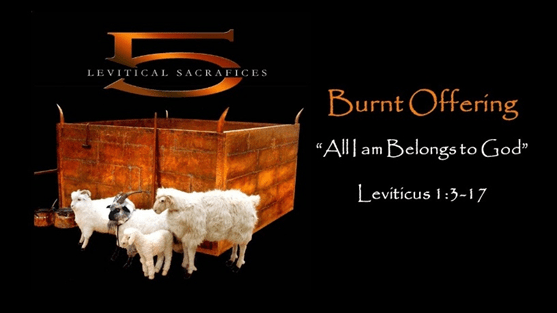
3-9 “If the offering is a Whole-Burnt-Offering from the herd, present a male without a defect at the entrance to the Tent of Meeting that it may be accepted by God. Lay your hand on the head of the Whole-Burnt-Offering so that it may be accepted on your behalf to make atonement for you. Slaughter the bull in God’s presence. Aaron’s sons, the priests, will make an offering of the blood by splashing it against all sides of the Altar that stands at the entrance to the Tent of Meeting. Next, skin the Whole-Burnt-Offering and cut it up. Aaron’s sons, the priests, will prepare a fire on the Altar, carefully laying out the wood, and then arrange the body parts, including the head and the suet, on the wood prepared for the fire on the Altar. Scrub the entrails and legs clean. The priest will burn it all on the Altar: a Whole-Burnt-Offering, a Fire-Gift, a pleasing fragrance to God.”

The Book of Leviticus is full of descriptions about blood sacrifices and the various times and fashions in which they are to be presented. I am only including this one description as an example. Why include this description? It’s great to speak generally about blood sacrifices as if they were some kind of sanitized ritual, but the truth is that they were anything but sanitized! When God decreed the regulations for the Aaronic priesthood, only men between 25-50 years of age could actively serve as priests because making those sacrifices demanded a great deal of strength. Hacking animals apart and splashing blood all over was not for weaklings. The priests had special clothes they were to wear to offer sacrifices, but it was understood that after they finished, they would bathe and change clothes.

If you continue to read in Leviticus, it describes other animal sacrifices for those too poor to afford a bull. Blood sacrifices are to be offered at several various times of the year as described in Matthew 27: But the principles are still the same: perfect animal or bird, handled respectfully and in a precise manner. Compare those sacrifices with the sacrifice of Jesus on the cross in Matthew 27:

35-40 After they had finished nailing him to the cross and were waiting for him to die, they killed time by throwing dice for his clothes. Above his head they had posted the criminal charge against him: this is Jesus, the king of the Jews. Along with him, they also crucified two criminals, one to his right, the other to his left. People passing along the road jeered, shaking their heads in mock lament: “You bragged that you could tear down the Temple and then rebuild it in three days—so show us your stuff! Save yourself! If you’re really God’s Son, come down from that cross!”

41-44 The high priests, along with the religion scholars and leaders, were right there mixing it up with the rest of them, having a great time poking fun at him: “He saved others—he can’t save himself! King of Israel, is he? Then let him get down from that cross. We’ll all become believers then! He was so sure of God—well, let him rescue his ‘Son’ now—if he wants him! He did claim to be God’s Son, didn’t he?” Even the two criminals crucified next to him joined in the mockery.

Jesus has already begun shedding blood, for the Roman soldiers have whipped him with a flagrum. We learn “the flagrum is a type of whip that typically has multiple thongs or lashes, usually with shards of pottery and pieces of bone tied in the ends to do the maximum amount of damage. The use of the flagrum was part of the Roman practice of scourging, which was a common method of punishment before crucifixion.” The Romans wanted tidy crucifixions in which victims would die within a few hours, so scourging helped shorten the survival time.

Note that although the priests are ordered to offer the blood sacrifices carefully and respectfully, Jesus endures satanic mocking, including scorn from the various religious leaders who should have been recognizing him as Messiah. The Romans drag Jesus to Calvary, “the place of the skull,” where they nail his harms and legs to a cross and set him between two thieves who are also being crucified.

45-46 From noon to three, the whole earth was dark. Around mid-afternoon Jesus groaned out of the depths, crying loudly, “Eli, Eli, lama sabachthani?” which means, “My God, my God, why have you abandoned me?”

47-49 Some bystanders who heard him said, “He’s calling for Elijah.” One of them ran and got a sponge soaked in sour wine and lifted it on a stick so he could drink. The others joked, “Don’t be in such a hurry. Let’s see if Elijah comes and saves him.” 50 But Jesus, again crying out loudly, breathed his last.

That “sponge soaked in sour wine?” Turns out, the Roman soldiers carried sponges with them to wipe their buttocks after defecating. That’s the kind of sponge the guy offered Jesus. Jesus died without tasting any wine on the cross, just as he had promised his disciples at the Last Supper.

By now, you might be so revolted that you are ready to stop reading and scroll to something more uplifting. You might also be asking why God allowed His own Son to be put to death in such a shameful manner while for centuries, the priests had been treating their sacrificial animals with respect. But those animals were only a stop-gap measure to secure forgiveness from sin while Jesus’ death purchased forgiveness for all who would believe for eternity.

When Mary gave birth to Jesus, she already knew that he was going to be “Immanuel,” meaning “God with us.” The Jesus originates from the Hebrew Yeshua, a shortened form of Yehoshua (Joshua), which combines “Yah” (the shortened form of Yahweh) with “shua,” meaning “to save.” Thus, the name Jesus literally translates to “The Lord saves” or “Yahweh is salvation.” This meaning is significant as it encapsulates the mission and purpose of Jesus’ life and ministry. https://faithandformulas.com/the-amazing-biblical-meaning-of-the-name-jesus/

When John the Baptist saw Jesus for the first time, he cried out, “Here he is, God’s Passover Lamb! He forgives the sins of the world!” (John 1:29) Jesus suffered far more than any animal sacrifice ever suffered, for those animals were killed swiftly and mercifully while Jesus endured mocking and scourging before being crucified. There’s an old hymn that says,

“But the pains which He endured, alleluia! our salvation have procured; alleluia!
now above the sky He’s King, alleluia! where the angels ever sing: alleluia!

As we are preparing our hearts for Christmas, let’s remember that Jesus wasn’t born just so that we could have celebrations and eat delicious food and exchange presents. Jesus came to give mankind the greatest gift of all: eternal life to all those who would believe in his Name.

PRAYER: Father God, thank You for loving us and caring for us. Lord, thank You for sending Jesus to die for our sins. We accept the sacrifice that Jesus has made, and we promise to follow hard after You all the days of our lives. In the mighty and precious Name of King Jesus. Amen.
DECEMBER 10, 2025 WHAT’S SO IMPORTANT ABOUT BLOOD?  #21 I’M NOT JEWISH, SO WHAT DOES PASSOVER HAVE TO DO WITH ME? EVERYTHING!

December 10, 2025

Exodus 13:13-16 “Redeem every firstborn child among your sons. When the time comes and your son asks you, ‘What does this mean?’ you tell him, ‘God brought us out of Egypt, out of a house of slavery, with a powerful hand. When Pharaoh stubbornly refused to let us go, God killed every firstborn in Egypt, the firstborn of both humans and animals. That’s why I make a sacrifice for every first male birth from the womb to God and redeem every firstborn son.’ The observance functions like a sign on your hands or a symbol on the middle of your forehead: God brought us out of Egypt with a powerful hand.”

It’s a sad mistake when we look at the Bible and say, “Well, God threw out everything that happened in the Old Testament once Jesus came.” WRONG!!!! God doesn’t make mistakes and God isn’t sitting in heaven, whacking His forehead, and exclaiming, “Oy! Why didn’t I just send Jesus in the first place?” The New Testament builds on the Old Testament, and everything in the Old Testament is necessary. The Exodus story is a perfect example.

Whenever we see God doing something, we must remember that he’s likely accomplishing seven or eight more things that have yet to be revealed. We are incredibly arrogant, so sure that we understand the Will of God that we totally ignore miracles happening right in front of us. It’s easy to read the story of the first Passover and mouth sanctified nonsense –“Oh, what a wonderful deliverance! Oh, what great miracles!” But the story of God’s deliverance of the Israelites from Egypt applies equally to us.

Forget all the programs glorifying the ancient Egyptians you might have watched on TV. Yes, the Egyptians were brilliant in many respects, producing magnificent temples and incredible artifacts that have been found in tombs; however, they worshiped a pantheon of more than 2,000 gods and were obsessed with death. Society was organized in a strict hierarchy, with the pharaoh at the top, followed by priests, nobles, and commoners. Slaves ranked below commoners, and once a slave, always a slave. Joseph’s elevation to becoming the second most powerful man in Egypt was an anomaly born from the warnings God sent Pharoah in dreams.  

Once the Israelites were reduced to the level of slaves, they were condemned to remain slaves forever. The King James version mentions “a Pharoah who knew not Joseph…” In other words, once enough time had passed, Joseph was ancient history and the Egyptians didn’t care. Besides, the pharoahs wanted big construction projects and slave labor was cheap.

Why re-examine the situation of the ancient Israelites? John 8:34 tells us,“Jesus said, “I tell you most solemnly that anyone who chooses a life of sin is trapped in a dead-end life and is, in fact, a slave. A slave can’t come and go at will.”  No matter how virtuous we might think we are, all of us are slaves to sin. Just like those ancient Israelites in Egypt, we are trapped with no way out. We need a Savior, someone from outside who can come and do what we cannot possibly do for ourselves.

In the NALC Church in which I grew up, this is the Confession of Sin: “Beloved in the Lord! Let us draw near with a true heart, and confess our sins unto God our Father, beseeching him, in the name of our Lord Jesus Christ, to grant us forgiveness.

Almighty God, our Maker and Redeemer, we poor sinners confess unto you that we are by nature sinful and unclean, and that we have sinned against you by thought, word, and deed. Wherefore, we flee for refuge to your infinite mercy, seeking and imploring your grace. For the sake of our Lord Jesus Christ.

O most merciful God, who has given your only begotten Son to die for us, have mercy on us, and for His sake grant us forgiveness of all our sins: and by your Holy Spirit increase in us true knowledge of you and of your will, and true obedience to your word, to the end that by your grace we may come to everlasting life; through Jesus Christ our Lord. Amen.

The pastor then assures the congregation: Almighty God, our Heavenly Father, has had mercy upon us, and has given His Only Son to die for us, and for His sake forgives us all our sins. TO those who believe on His Name, He gives power to become the sons of God, and bestows upon them His Holy Spirit. Whoever believes and is baptized, shall be saved. Grant this, O Lord, unto us all. Amen.”

If you have read this closely, you might be agitated. “What happens if someone cannot be baptized? Will they go to hell even if they believe in Jesus?” Absolutely not! Luke tells the story in Luke 23:39-43 “One of the criminals hanging alongside cursed him: “Some Messiah you are! Save yourself! Save us!”

But the other one made him shut up: “Have you no fear of God? You’re getting the same as him. We deserve this, but not him—he did nothing to deserve this.” Then he said, “Jesus, remember me when you enter your kingdom.”

He said, “Don’t worry, I will. Today you will join me in paradise.”

Baptism is a sign of faith in Jesus Christ; however, just like that criminal on the cross, sometimes baptism isn’t possible. What’s most important is faith in what Jesus has done for us.

These days, there’s a series of short stories on Facebook in which heroic grizzled veterans belonging to motorcycle clubs rescue women and children from horrible situations. No matter how independent you might think you are, such stories are appealing, for each of us can find ourselves in untenable situations from which we cannot escape. When we celebrate Christmas, we aren’t merely celebrating the birth of a cute little baby; we celebrate the birth of the Savior Hero who can deliver us from our slavery to sin.

PRAYER: Father God, thank You for loving us and caring for us. Lord, we confess that we are slaves to sin and desperately need a Savior. Thank You for sending Jesus to live as a sinless man and to die for our sins. We accept that blood sacrifice and beg You to help us follow hard after You all the days of our lives. In the mighty and precious Name of King Jesus. Amen.
Centuries ago, Charles Wesley wrote a wonderful hymn that clearly expresses that deliverance:

1. Come, thou long expected Jesus,                               2. Born thy people to deliver,
born to set thy people free;                                             
born a child and yet a King,
from our fears and sins release us,                                 born to reign in us forever
let us find our rest in thee.                                               now thy gracious kingdom bring.
Israel’s strength and consolation,                                   By thine own eternal spirit
hope of all the earth thou art;                                         rule in all our hearts alone;
dear desire of every nation,                                              by thine all sufficient merit,
joy of every longing heart.                                               raise us to thy glorious throne.

DECEMBER 9, 2025 WHAT’S SO IMPORTANT ABOUT BLOOD?  #20 BLOOD AS A SIGN OF REDEMPTION

December 9, 2025

Exodus 13:13 1-2 God spoke to Moses, saying, “Set apart every firstborn to me—the first one to come from the womb among the Israelites, whether person or animal, is mine.”

3 Moses said to the people, “Always remember this day. This is the day when you came out of Egypt from a house of slavery. God brought you out of here with a powerful hand. Don’t eat any raised bread.

4-5 “You are leaving in the spring month of Abib. When God brings you into the land of the Canaanite, the Hittite, the Amorite, the Hivite, and the Jebusite, which he promised to your fathers to give you, a land lavish with milk and honey, you are to observe this service during this month:

6 “You are to eat unraised bread for seven days; on the seventh day there is a festival celebration to God.

7 “Only unraised bread is to be eaten for seven days. There is not to be a trace of anything fermented—no yeast anywhere.

8 “Tell your child on that day: ‘This is because of what God did for me when I came out of Egypt.’

9-10 “The day of observance will be like a sign on your hand, a memorial between your eyes, and the teaching of God in your mouth. It was with a powerful hand that God brought you out of Egypt. Follow these instructions at the set time, year after year after year.4

God is continuing to lay out the rules for observing Passover. Why are these rules so important? God knows that His people will spend 40 years in the wilderness before they reach the Promised Land and that they will adapt the pagan religions of the tribes there. Furthermore, God knows that many of His people will be carried off as exiles and that His people will eventually find their way into every country and every kingdom. God is ordaining Passover so that no matter where the Israelites/Jews are, they will continue to observe it. The observance of Passover and the other feasts God will order will help the Jews retain their cultural identity wherever they are throughout the centuries. Jewish children will continue to praise God for the miraculous deliverance from Egyptian slavery forever.  

11-13 “When God brings you into the land of the Canaanites, as he promised you and your fathers, and turns it over to you, you are to set aside the first birth out of every womb to God. Every first birth from your livestock belongs to God. You can redeem every first birth of a donkey if you want to by substituting a lamb; if you decide not to redeem it, you must break its neck.

First-born animals are to be dedicated to the Lord. Donkeys can be redeemed because they are not generally sacrificed; however, a lamb must be sacrificed as a blood offering to redeem a first-born donkey. If someone fails to redeem a first-born donkey, they must kill it by breaking its neck.

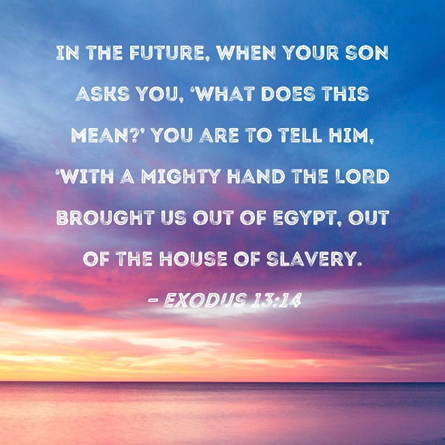
13-16 “Redeem every firstborn child among your sons. When the time comes and your son asks you, ‘What does this mean?’ you tell him, ‘God brought us out of Egypt, out of a house of slavery, with a powerful hand. When Pharaoh stubbornly refused to let us go, God killed every firstborn in Egypt, the firstborn of both humans and animals. That’s why I make a sacrifice for every first male birth from the womb to God and redeem every firstborn son.’ The observance functions like a sign on your hands or a symbol on the middle of your forehead: God brought us out of Egypt with a powerful hand.”

Once more, God is laying out practices that will help the Israelites remember and celebrate their escape from losing their firstborn children. Interestingly, there is no mention of blood sacrifices being necessary to redeem firstborn daughters, only firstborn sons. Perhaps a blood sacrifice for a daughter is unnecessary because women menstruate, shedding their own blood monthly for many years. And women giving birth also shed blood.

It is wrong to assume that God thinks less of women than He does of men; after all, God sent the Angel Gabriel to the Virgin Mary first. God only informed Joseph in a dream after Mary had consented for the Holy Spirit to impregnate her. Throughout both the Old Testament and the New Testament, there are stories of godly women such as Rahab, Ruth, and Deborah.

The need for blood sacrifices stopped the day Jesus Christ was crucified. In Herod’s temple in Jerusalem, there was an enormous curtain that separated the Holy of Holies from the rest of the temple. As Jesus was dying, that curtain was torn in two from top to bottom, indicating that God was tearing open the way to the holiest place because of the blood Jesus was shedding. Now we don’t need to sacrifice lambs; instead, we come to belief in Jesus and what he has done for us. When we confess our sins and call on God to forgive us and to clean us up, Jesus’ blood sacrifice takes care of our sins.

PRAYER: Father God, thank You for loving us and caring for us. Lord, thank You for sending your Lamb, Jesus Christ, to live a sinless life and to die for our sins. We confess that we are sinners and that we cannot free ourselves. We praise You for giving us the way of salvation through Jesus’ blood sacrifice. It’s in the mighty and precious Name of King Jesus that we pray. Amen.

DECEMBER 8, 2025 WHAT’S SO IMPORTANT ABOUT BLOOD? #19 SACRIFICIAL BLOOD CAN PROTECT!

December 8, 2025

Exodus 12:21-23 Moses assembled all the elders of Israel. He said, “Select a lamb for your families and slaughter the Passover lamb. Take a bunch of hyssop and dip it in the bowl of blood and smear it on the lintel and on the two doorposts. No one is to leave the house until morning. God will pass through to strike Egypt down. When he sees the blood on the lintel and the two doorposts, God will pass over the doorway; he won’t let the destroyer enter your house to strike you down with ruin.

24-27 “Keep this word. It’s the law for you and your children, forever. When you enter the land which God will give you as he promised, keep doing this. And when your children say to you, ‘Why are we doing this?’ tell them: ‘It’s the Passover-sacrifice to God who passed over the homes of the Israelites in Egypt when he hit Egypt with death but rescued us.’”

God is about to deliver the final plague0the death of the first-born of families, both human and animal. But God wants to protect His people, so He orders them to use the blood of the sacrificial Passover lambs to paint their doorposts and lentils. When the Angel of Death sees that blood, he will pass over the house. And God keeps that promise!

Exodus 12: 29 At midnight God struck every firstborn in the land of Egypt, from the firstborn of Pharaoh, who sits on his throne, right down to the firstborn of the prisoner locked up in jail. Also, the firstborn of the animals. 30 Pharaoh got up that night, he and all his servants and everyone else in Egypt—what wild wailing and lament in Egypt! There wasn’t a house in which someone wasn’t dead. 31-32 Pharaoh called in Moses and Aaron that very night and said, “Get out of here and be done with you—you and your Israelites! Go worship God on your own terms. And yes, take your sheep and cattle as you’ve insisted, but go. And bless me.”

33 The Egyptians couldn’t wait to get rid of them; they pushed them to hurry up, saying, “We’re all as good as dead.”

The people of Egypt are already fed up with the Israelites; now Pharaoh is also terrified. Pharaoh orders the Israelites to get out immediately, leaving them only time to grab everything. Prior to the Passover, the Israelites have already asked their Egyptian neighbors for gold, silver, and clothing. Now the Israelites are heading out of Egypt as rapidly as possible.

34-36 The people grabbed their bread dough before it had risen, bundled their bread bowls in their cloaks, and threw them over their shoulders. The Israelites had already done what Moses had told them; they had asked the Egyptians for silver and gold things and clothing. God saw to it that the Egyptians liked the people and so readily gave them what they asked for. Oh yes! They picked those Egyptians clean.

37-39 The Israelites moved on from Rameses to Succoth, about 600,000 on foot, besides their dependents. Hebrews and non-Hebrews alike set out, not to mention the large flocks and herds of livestock. They baked unraised cakes with the bread dough they had brought out of Egypt; it hadn’t raised—they’d been rushed out of Egypt and hadn’t time to fix food for the journey.

This unraised bread is the first matzoth bread, the flat bread that continues to be eaten wherever Jews celebrate Passover throughout the world. Although the Israeli housewives originally bake unraised dough out of necessity, God has already ordered the Israelites to avoid eating any yeast products during Passover week.

The Passover

40-42 The Israelites had lived in Egypt 430 years. At the end of the 430 years, to the very day, God’s entire army left Egypt. God kept watch all night, watching over the Israelites as he brought them out of Egypt. Because God kept watch, all Israel for all generations will honor God by keeping watch this night—a watchnight.

Not only does God deliver the Israelites right on time, but He also ensures that all of them are safe. The Bible states that there are 600,000 Israelite men, plus women and children, plus non-Israelites who have learned to fear the God of the Israelites. Estimates indicate that there might be as many as two million four hundred thousand people who leave Egypt.

Has God delivered the Israelites because they are so virtuous and faithful in worshiping Him? Are you kidding! When Moses and Aaron come to Egypt, many of the Israelites want nothing to do with them. But those first nine plagues aren’t simply to change Pharoah’s heart or the hearts of the Egyptians. Those nine plagues also remind the Israelites of the power of the When God of Abraham, Isaac, and Jacob. The Israelites have spent 430 years in Egypt, and many of them are worshiping Egyptian deities rather than the One True Living God. When the Angel of Death passes over the Israelite families with lamb’s blood on their doorposts, many of those Israelites also become convinced!

In the end, it’s not virtue or faith that protects the Israelites; it’s that sacrificial blood. In the fullness of time, God will send Jesus Christ, the Lamb of God, to sacrifice himself for the sins of the world. As we approach Christmas, let’s remember that it’s not about presents or carols or Christmas trees, or celebrations. It’s about the Lamb of God.

PRAYER: Father God, thank You for loving us and caring for us. Lord, thank You for sending Jesus as the ultimate sacrifice so that we will not have to pay the penalty for our sins. We confess that we are sinners and that only the Blood of Jesus is sufficient to pay for our sins. We accept that sacrifice and promise to follow Jesus all of our lives. In the mighty and precious Name of King Jesus. Amen.
DECEMBER 7, 2025 WHAT’S SO IMPORTANT ABOUT BLOOD? #18 THE FIRST PASSOVER

December 7, 2025

Exodus 12: 12 1-10 God said to Moses and Aaron while still in Egypt, “This month is to be the first month of the year for you. Address the whole community of Israel; tell them that on the tenth of this month each man is to take a lamb for his family, one lamb to a house. If the family is too small for a lamb, then share it with a close neighbor, depending on the number of persons involved. Be mindful of how much each person will eat. Your lamb must be a healthy male, one year old; you can select it from either the sheep or the goats. Keep it penned until the fourteenth day of this month and then slaughter it—the entire community of Israel will do this—at dusk. Then take some of the blood and smear it on the two doorposts and the lintel of the houses in which you will eat it. You are to eat the meat, roasted in the fire, that night, along with bread, made without yeast, and bitter herbs. Don’t eat any of it raw or boiled in water; make sure it’s roasted—the whole animal, head, legs, and innards. Don’t leave any of it until morning; if there are leftovers, burn them in the fire.”

These verses are among the most thrilling in the Old Testament. God has sent Moses and Aaron to argue with Pharoah to allow the Israelites to go. But after nine plagues of escalating severity, Pharoah has remained obdurate. And now God is preparing to extract the Israelites from Egypt with the most horrific plague of all-the death of all first-born people in animals in Egypt who are not under the protection of a blood sacrifice. The Angel of Death will know which homes are under God’s protection by the sacrificial blood smeared on the doorposts and the lintel. But God has further instructions:

11 “And here is how you are to eat it: Be fully dressed with your sandals on and your stick in your hand. Eat in a hurry; it’s the Passover to God.

12-13 “I will go through the land of Egypt on this night and strike down every firstborn in the land of Egypt, whether human or animal, and bring judgment on all the gods of Egypt. I am God. The blood will serve as a sign on the houses where you live. When I see the blood, I will pass over you—no disaster will touch you when I strike the land of Egypt.

But not only is God going to protect the Jews, but He is instituting a festival for His people to celebrate forever.

14-16 “This will be a memorial day for you; you will celebrate it as a festival to God down through the generations, a fixed festival celebration to be observed always. You will eat unraised bread (matzoth) for seven days: On the first day get rid of all yeast from your houses—anyone who eats anything with yeast from the first day to the seventh day will be cut off from Israel. The first and the seventh days are set aside as holy; do no work on those days. Only what you have to do for meals; each person can do that.”

What’s the importance of leaven? Why is God forbidding anything that has leaven? Leaven symbolizes Egypt, for it is used to brew beer. God wants His people to get rid of ANYTHING that might remind them of Egypt and to continue to eat unraised bread for seven days so that they will definitely remember. And the festival is to last for a week with worship services on the first and seventh days so that people will respect the celebration as a major festival. Not only that, but anyone who breaks the terms of Passover is to be cut off from Israel, to be an outcast. Few things are more horrible than losing one’s national identity.

17-20 “Keep the Festival of Unraised Bread! This marks the exact day I brought you out in force from the land of Egypt. Honor the day down through your generations, a fixed festival to be observed always. In the first month, beginning on the fourteenth day at evening until the twenty-first day at evening, you are to eat unraised bread. For those seven days not a trace of yeast is to be found in your houses. Anyone, whether a visitor or a native of the land, who eats anything raised shall be cut off from the community of Israel. Don’t eat anything raised. Only matzoth.”

1-23 Moses assembled all the elders of Israel. He said, “Select a lamb for your families and slaughter the Passover lamb. Take a bunch of hyssop and dip it in the bowl of blood and smear it on the lintel and on the two doorposts. No one is to leave the house until morning. God will pass through to strike Egypt down. When he sees the blood on the lintel and the two doorposts, God will pass over the doorway; he won’t let the destroyer enter your house to strike you down with ruin.

24-27 “Keep this word. It’s the law for you and your children, forever. When you enter the land which God will give you as he promised, keep doing this. And when your children say to you, ‘Why are we doing this?’ tell them: ‘It’s the Passover-sacrifice to God who passed over the homes of the Israelites in Egypt when he hit Egypt with death but rescued us.’”

The people bowed and worshiped.

28 The Israelites then went and did what God had commanded Moses and Aaron. They did it all.

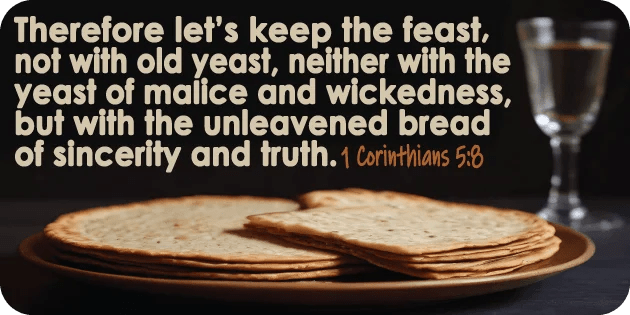
Yeast has spiritual connotations. Centuries later, Saint Paul is writing to the Corinthians, castigating them for tolerating a grossly immoral situation within their church. Referring to God’s commands regarding Passover, Paul says, “Your flip and callous arrogance in these things bothers me. You pass it off as a small thing, but it’s anything but that. Yeast, too, is a “small thing,” but it works its way through a whole batch of bread dough pretty fast. So get rid of this “yeast.” Our true identity is flat and plain, not puffed up with the wrong kind of ingredient. The Messiah, our Passover Lamb, has already been sacrificed for the Passover meal, and we are the Unraised Bread part of the Feast. So let’s live out our part in the Feast, not as raised bread swollen with the yeast of evil, but as flat bread—simple, genuine, unpretentious.” (1 Corinthians 5:6-8)

God is about to deliver His people, but He wants to do it on His terms and not on theirs. The Israelites have no idea of what is about to happen; all they know for now is that they need to follow God’s instructions completely and to make sure they and their families are protected by the blood of the sacrificial lamb.

Later, Jesus will become the Lamb of God, giving His blood for the sins of the world. For those who believe in that ultimate sacrifice, God promises eternal life and joy with Him in heaven forever. Let’s pray.

PRAYER: Father God, thank You for loving us and caring for us. Lord, we confess that we are sinners and nothing we do is good enough to make up for that sin or to earn our way into heaven. Lord, please forgive us our sins. We accept Jesus as our Savior and Lord. We thank You for the promises of eternal life. In the mighty and precious Name of King Jesus. Amen.
DECEMBER 6, 2025 WHAT’S SO IMPORTANT ABOUT BLOOD? #17 THE STRANGEST CIRCUMCISION STORY EVER! OBEY OR ELSE!

December 6, 2025

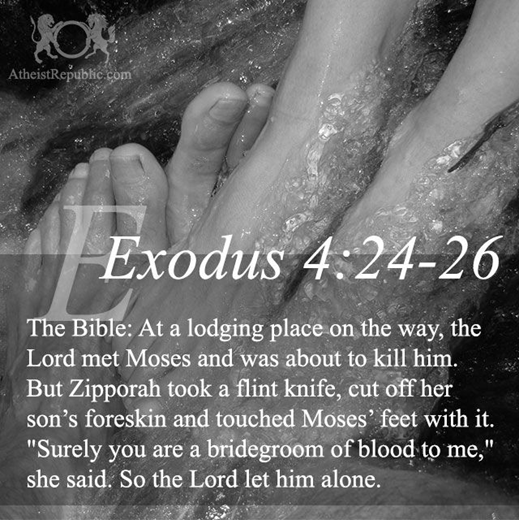
Exodus 4:24-26 On the journey back, as they camped for the night, God met Moses and would have killed him but Zipporah took a flint knife and cut off her son’s foreskin, and touched Moses’ member with it. She said, “Oh! You’re a bridegroom of blood to me!” Then God let him go. She used the phrase “bridegroom of blood” because of the circumcision.

At first glance, this is a weird story! Read it again, and it seems even weirder! God has already interviewed Moses at the burning bush, ordering Moses to return to Egypt to deliver the Israelites. Moses and his family are on their way when God meets Moses and is about to kill him. Why??? That’s when Zipporah, Moses’ wife, quickly circumcises their son, touching Moses’ penis with the foreskin she has just removed. Zipporah proclaims that Moses is a “bridegroom of blood” to her because she has had to shed their son’s blood during the circumcision.

This story obviously describes a type of blood sacrifice Zipporah uses to save Moses’ life. But why is God trying to kill the man He has already ordained as His messenger? Despite the fact that Moses is a Jew and was undoubtedly circumcised as an infant, he has failed to circumcise his own son. Moses knows that God has ordered circumcision for all Jewish males. Who knows? Perhaps Moses has wanted to circumcise his son and Zipporah has refused. Now in desperation, Zipporah carries out the circumcision, saving Moses’ life in the process.

God knows what Moses is about to endure in Egypt, and He also knows that compromise is deadly. By this incident, God is warning Moses that Moses must obey implicitly-no second guessing, no half-hearted measures, no shilly-shallying. Nothing less than Moses’ complete obedience will succeed. It is estimated that the ancient Egyptians worshiped more than 2,000 gods. Although Moses might not realize it, God knows that Egypt is full of demons and is a Satanic stronghold. If Moses fails to obey in the slightest detail, Satan will be able to destroy Moses, Aaron, and the Jews. The fate of an entire nation-more than two million people-depends on Moses obeying in every particular, even something as small as the circumcision of a male infant.

We have been in missions nearly 38 years and have worked with several different groups. We can personally testify that failure to obey in the minutiae can result in disaster. In the Upper East Region of Ghana, there is a shrine whose keepers demand that anyone visiting must strip naked before entering the shrine. Friends of ours working with that people group told us the story of two young men who came in, eager to begin a ministry in that area. But full of curiosity, these men insisted they should visit this shrine before starting their work. As experienced missionaries steeped in the traditions and culture of the people, our friends did everything they could to convince these young men not to visit the shrine, but the young men went anyway. Somehow, after visiting the shrine, the enthusiasm for evangelism faded, and the young men left the country.

1 Samuel 15 tells the story of how King Saul lost his kingship. Samuel orders Saul to eradicate the Amalekites and everything they have; however, Saul saves Agag, the Amalekite king, and the best sheep and cattle. Saul’s disobedience costs him everything.

Then Samuel said, “Do you think all God wants are sacrifices—empty rituals just for show? He wants you to listen to him! Plain listening is the thing, not staging a lavish religious production. Not doing what God tells you is far worse than fooling around in the occult. Getting self-important around God is far worse than making deals with your dead ancestors. Because you said No to God’s command, he says No to your kingship.” 1 Samuel 15:22-23

Evidently, Moses learns this valuable lesson, for he continually obeys God throughout his ministry…until the day he loses his temper. The first time God brings water out of a rock, He orders Moses to strike it with his rod. But the second time God is going to bring water out of a rock, he orders Moses to speak to the rock. Frustrated and pushed to the limit by the strident demands of the Israelites, Moses makes a terrible mistake. Instead of speaking to the rock, he speaks to the people, saying, “Listen, rebels! Do we have to bring water out of this rock for you?” Then Moses strikes the rock twice. Sounds OK, right? Water gushes from the rock. But because Moses fails to completely follow God’s orders, he forfeits his chance to enter Canaan. Eventually, God will send Moses to the top of Mount Nebo and show him Canaan, but Moses will die without entering it after forty years of successfully leading the Israelites, all because he failed to honor God at Meribah. (The name “Meribah” means “bickering.”)

What can we learn from the short story of Zipporah’s blood sacrifice? Don’t joke with God! God is not a God of confusion but a God of peace. When God tells you to do something, obey without questioning. “But,” you complain, “how can I possibly know what God wants?”

George Mueller founded orphanages that cared for more than 10,000 children, supported many ministries, and circled the globe preaching and teaching. Mr. Mueller was a great man of faith. Here is his testimony about ascertaining the will of God:

  1. I seek in the beginning to get my heart into such a state that it has no will of its own in regard to a given matter. Nine-tenths of the trouble with people is right here. Nine-tenths of the difficulties are overcome when our hearts are ready to do the Lords’ will, whatever it may be. When one is truly in this state it is usually but a little way to the knowledge of what His will is.
  2. Having surrendered my own will, I do not leave the result to feeling or simply impressions. If I do so, I make myself liable to great delusions.
  3. I seek the will of the Spirit of God through, or in connection with the Word of God. The Spirit and the Word must be combined. If the Holy Ghost guides us at all, He will do it according to the Scriptures and never contrary to them.
  4. Next, I take into account providential circumstances. These often plainly indicate God’s will in connection with His Word and Spirit.
  5. I ask God in prayer to reveal His will to me aright.

Thus, through prayer to God, the study of His Word, and reflection, I come to a deliberate judgment and if my mind is thus at peace and continues so after two or three more petitions, I proceed accordingly. In trivial matters and in transactions involving most important issues, I have found this method always effective. (Quoted in November 10th Springs in the Valley Devotional.)

Want God’s results in your life? Do God’s will! As Samuel told Saul, “Obedience is better than sacrifice.”

PRAYER: Father God, thank You for loving us and caring for us. Lord, help us to obey You in the small things as well as the big ones. In the mighty and precious Name of King Jesus. Amen.

DECEMBER 5, 2025 WHAT’S SO IMPORTANT ABOUT BLOOD? #16 ARE WE TAKING GOD FOR GRANTED?

December 5, 2025

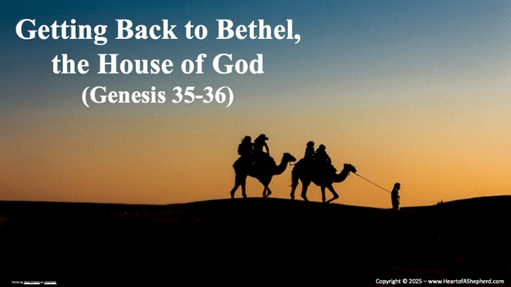
 Genesis35:1 God spoke to Jacob: “Go back to Bethel. Stay there and build an altar to the God who revealed himself to you when you were running for your life from your brother Esau.”

2-3 Jacob told his family and all those who lived with him, “Throw out all the alien gods which you have, take a good bath and put on clean clothes, we’re going to Bethel. I’m going to build an altar there to the God who answered me when I was in trouble and has stuck with me everywhere I’ve gone since.”

4-5 They turned over to Jacob all the alien gods they’d been holding on to, along with their lucky-charm earrings. Jacob buried them under the oak tree in Shechem. Then they set out. A paralyzing fear descended on all the surrounding villages so that they were unable to pursue the sons of Jacob.

6-7 Jacob and his company arrived at Luz, that is, Bethel, in the land of Canaan. He built an altar there and named it El-Bethel (God-of-Bethel) because that’s where God revealed himself to him when he was running from his brother.

8 And that’s when Rebekah’s nurse, Deborah, died. She was buried just below Bethel under the oak tree. It was named Allon-Bacuth (Weeping-Oak).

9-10 God revealed himself once again to Jacob, after he had come back from Paddan Aram and blessed him: “Your name is Jacob (Heel); but that’s your name no longer. From now on your name is Israel (God-Wrestler).”

11-12 God continued, “I am The Strong God. Have children! Flourish! A nation—a whole company of nations!—will come from you. Kings will come from your loins; the land I gave Abraham and Isaac I now give to you, and pass it on to your descendants.”

13 And then God was gone, ascended from the place where he had spoken with him.

14-15 Jacob set up a stone pillar on the spot where God had spoken with him. He poured a drink offering on it and anointed it with oil. Jacob dedicated the place where God had spoken with him, Bethel (God’s-House).

Although this map is entitled “Abraham in the Promised Land,” it also shows important locations for Jacob. Jacob has been staying north near Shechem; now God orders him to return to Bethel to worship. Jacob has few illusions about his family or his servants, for he knows they have amulets, trinkets, and all kinds of household gods they have been carrying around. But for this company to meet the One True Living God, all that stuff has to go completely. In addition, Jacob orders everybody to bathe and don clean clothes. In a land where water is scarce and herdsmen fight over water rights, bathing is a big deal. But those in Jacob’s company can’t argue with the way God has prospered Jacob, so they comply. Rather than save all that gold and silver in those charms and amulets and statues, Jacob buries everything under one giant oak tree.

When Jacob leaves for Bethel, God sends the fear of Him on all the surrounding tribes so they leave Jacob and his company strictly alone. Jacob reaches Bethel and builds an altar on which he makes sacrifices, and God meets him there.  

9-13 God revealed himself once again to Jacob, after he had come back from Paddan Aram and blessed him: “Your name is Jacob (Heel); but that’s your name no longer. From now on your name is Israel (God-Wrestler).” God continued, “I am The Strong God. Have children! Flourish! A nation—a whole company of nations!—will come from you. Kings will come from your loins; the land I gave Abraham and Isaac I now give to you, and pass it on to your descendants.” And then God was gone, ascended from the place where he had spoken with him.

Once God leaves, Jacob sets up a stone pillar, pouring a drink offering on it and anointing it with oil of dedication. Then Jacob calls that pillar “Bethel” or “God’s house.”

By now, you’re probably getting tired of all these stories about altars and blood sacrifices. Big deal! What’s so important about this particular story? Actually, quite a few things. First, there’s the preparations. For many of us, taking our kids to church on Sunday morning is enough of an ordeal, but Jacob is moving flocks and herds and perhaps 100 or more people from Shechem down to Bethel.

Next, there’s the preparation for worship. No matter whether these people choose to worship Jacob’s God or not, Jacob demands that they hand over all their pagan jewelry and statues. Jacob doesn’t want anybody sneaking off to worship a sun god or a star god while he is meeting with the One True Living God. And Jacob demands that his people bathe and put on clean clothes as a sign of respect for God, which means that they must also wash those clothes. In a place where water is scarce, bathing and doing washing takes a lot of water and a lot of work. And then when the company reaches Bethel, everybody must behave properly. While the Scripture doesn’t mention it, I am certain that Jacob puts out the word-no drunkenness, no parties, no unnecessary noise. Keep the herds away from the altar area so they don’t make a clamor and defecate all over the place.

At the end of this story, Jacob erects a pillar, a standing stone for remembrance, and pours out a drink offering before anointing it with oil. I’m sure Jacob uses the best wine and the best oil available; after all, God has just made incredible promises and has re-confirmed Jacob as Israel, “God-Wrestler.” For the rest of Jacob’s life, whenever he passes that way, he will see that pillar and remember the day he met with God.

As we read these verses, the question for us is simple: How much do we respect God? Are we treating God as some kind of a divine dispensing machine-put in a prayer and get an answer? When we pray, do we remember that we are meeting with the One who has created everything around us? Are we disrespectful or casual? And do we misuse God’s name, texting “OMG!” without thinking about it? God still meets people and gives them new names. But we must be willing to slow down, to be quiet, and to wait silently for Him to speak to our hearts. May God help us to be good listeners!

PRAYER: Father God, thank You for loving us and for caring for us. Lord, help us to listen reverently and quietly for Your Voice. In the mighty and precious Name of King Jesus. Amen.

DECEMBER 4, 2025 WHAT’S SO IMPORTANT ABOUT BLOOD? #15 SACRIFICES OF GRATITUDE

December 4, 2025

Genesis 33:1-4 Jacob looked up and saw Esau coming with his four hundred men. He divided the children between Leah and Rachel and the two maidservants. He put the maidservants out in front, Leah and her children next, and Rachel and Joseph last. He led the way and, as he approached his brother, bowed seven times, honoring his brother. But Esau ran up and embraced him, held him tight and kissed him. And they both wept.

5 Then Esau looked around and saw the women and children: “And who are these with you?”

Jacob said, “The children that God saw fit to bless me with.”

6-7 Then the maidservants came up with their children and bowed; then Leah and her children, also bowing; and finally, Joseph and Rachel came up and bowed to Esau.

8 Esau then asked, “And what was the meaning of all those herds that I met?”

“I was hoping that they would pave the way for my master to welcome me.”

9 Esau said, “Oh, brother. I have plenty of everything—keep what is yours for yourself.”

10-11 Jacob said, “Please. If you can find it in your heart to welcome me, accept these gifts. When I saw your face, it was as the face of God smiling on me. Accept the gifts I have brought for you. God has been good to me and I have more than enough.” Jacob urged the gifts on him and Esau accepted.

12 Then Esau said, “Let’s start out on our way; I’ll take the lead.”

13-14 But Jacob said, “My master can see that the children are frail. And the flocks and herds are nursing, making for slow going. If I push them too hard, even for a day, I’d lose them all. So, master, you go on ahead of your servant, while I take it easy at the pace of my flocks and children. I’ll catch up with you in Seir.”

15 Esau said, “Let me at least lend you some of my men.”

“There’s no need,” said Jacob. “Your generous welcome is all I need or want.”

16 So Esau set out that day and made his way back to Seir.

17 And Jacob left for Succoth. He built a shelter for himself and sheds for his livestock. That’s how the place came to be called Succoth (Sheds).

18-20 And that’s how it happened that Jacob arrived all in one piece in Shechem in the land of Canaan—all the way from Paddan Aram. He camped near the city. He bought the land where he pitched his tent from the sons of Hamor, the father of Shechem. He paid a hundred silver coins for it. Then he built an altar there and named it El-Elohe-Israel (Mighty Is the God of Israel).

It’s an absolute miracle! After weeks of agonizing over how to handle the meeting with Esau, Jacob finds that God has already been working in Esau’s heart. Esau has just arrived heading an army of 400 warriors. Trembling with fear, Jacob leads the way, followed by the maid servants with their children, Leah with her children, and finally, Rachel and Joseph. To indicate complete subservience, Jacob approaches Esau, falling to his knees and bowing seven times. But Esau runs to Jacob, pulling him up from the ground, hugging him and kissing him, weeping as he does so. When Jacob realizes what Esau is doing, he immediately bursts into tears as well. Jacob is weeping for two reasons: he’s weeping at the sight of his brother but also with relief that Esau is not going to slaughter his family and him.

Eventually, Esau takes the lead back to Canaan and Jacob settles near Shechem. In gratitude for all God has done, Jacob builds an altar and names it El-Elohe-Israel, or “Mighty is the God of Israel.” Although the Bible doesn’t specifically mention blood sacrifices, nobody builds an altar unless they are going to perform sacrifices as well. Why would Jacob do such a thing? Jacob left Canaan as a penniless young man, running for his life. Now Jacob has 2 wives, 2 concubines, 11 sons, and so much livestock that he can afford to give Esau herds as a present. Genesis 32:13-15 tells us, “Then he prepared a present for his brother Esau from his possessions: two hundred female goats, twenty male goats, two hundred ewes and twenty rams, thirty camels with their nursing young, forty cows and ten bulls, twenty female donkeys and ten male donkeys.” Not only has God prospered Jacob, but He has also given Jacob a special blessing.

These days, we don’t perform animal sacrifices to show our gratitude. But there are still other ways we can make sacrifices. We can sacrifice our time, our money, or our talents. We can see those around us who are suffering. I have become addicted to online stories about people like store clerks, waiters and waitresses, laundromat attendants, janitors, school crossing guards, and school lunch ladies who notice those quietly suffering and begin doing small things to relieve that suffering and encourage those struggling to survive. One farmer in the American South quietly donated money to a local pharmacy for years so that those short of funds would still be able to fill their prescriptions.

Never underestimate the value of small donations. The used clothing you have in your closet might bless someone who is shivering in rags. Those running shoes you aren’t wearing because they look shabby would warm someone else’s feet. The trick is to find ways of connecting people in need with the answers to their needs. Some people can’t even afford the small amounts of money charged at resale shops such as Salvation Army or St. Vincent de Paul.

My husband and I help patients and their families make up the difference in their bills, and sometimes the amounts that help are less than the cedi equivalent of $3. But for people who have nothing, those small amounts mean the difference between their successful discharge from the hospital or being forced to remain in hopes that a relative will bring money from the village. Sadly, those in the village are just as poor as the patients and their families, making discharge difficult.

I do not tell these stories to boast, for we feel we must help. We give because God impels us to do so. But we also give out of gratitude, knowing that no matter how much we give, God will always bring more so that we can help more people. You cannot out-give God.

May God help each one of us so that we will find new ways of sacrificing and honoring Him as we do so!

PRAYER: Father God, thank You for loving us and caring for us. Lord, help us to give as You lead us, knowing that You can always provide more. In the mighty and precious Name of King Jesus. Amen.