(There are innumerable sources for the history of Israel. One of these sources is https://palestinehistorybook.com/ This source contains much more detailed information than I can possibly include in Bible studies, it is excellent for its historical summaries, although many might object to the use of the term Palestine rather than Israel.)
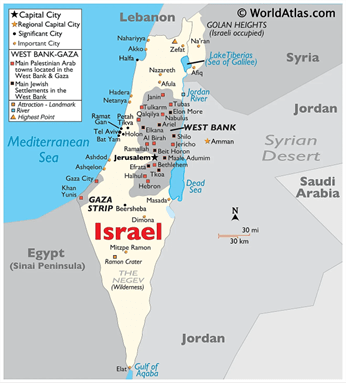
What’s one of the most important things about any piece of real estate? Location! The land of Israel has always found itself being conquered because it was on the way to someplace else. After Ezra and Nehemiah led the progressive reconstruction of Jerusalem, Israel again became a hotly contested property because of the trade routes through it and ocean access.
The Palestine History Book site gives the following information: In 301 BCE, Judea, Samaria, Phoenicia, and the entire coastal plain were captured by the forces of Ptolemy, an Egyptian general who had Egypt as his power base. The Ptolemies, one of the four powers that emerged after the breakup of the Macedonian empire, controlled Palestine for most of the third century BCE. They integrated Palestine’s towns and cities into the Greek culture. Hellenism had been penetrating the Near East for many decades prior to Alexander’s invasion of the region. Northern Palestine’s coastal cities, which were part of the Mediterranean trade routes, were affected the most. Other cities located on the main inland trade routes, such as Gaza and Petra, were also influenced by the Greek culture. Jerusalem had little contact with the Greeks, as it was a poor city lacking the raw materials needed for the development of industry; it was also far from the trade routes.
The Ptolemies, like most of the previous imperial forces who ruled Palestine, did not interfere in the local affairs of the different Palestinian regions. They introduced an efficient administration that was flexible enough to treat each region of their kingdom according to its particular social, economic, or religious situation. They appointed their own governors and installed garrisons in the different cities, but left people to follow their own traditions. Some parts of Palestine were crown lands ruled directly by royal officials. In addition, Greek colonists established their own cities (polis) modeled after the democratic Greek republics in several towns such as Gaza, Shechem, Marissa, and Amman, which were self-governing. Greek soldiers, merchants, and entrepreneurs took advantage of the opportunities that opened to them in the east. At the same time, the local people were eager to learn the Greek language and were attracted to Greek culture.
The Hellenistic culture was secular, advocating the separation of the government from religion. Apparently, the people of Jerusalem initially opposed this secular concept; however, the city was gradually dragged into the Greek world, and by the end of the third century BCE, Jerusalem’s citizens had begun to acquire Greek education and were giving their children Greek names.
Eventually those pushing Greek culture made every attempt to remove high priests promoting Torah law with their own appointees who would promote the vague worship of any major deity, including the Greek pantheon of gods. The struggle became fierce, prolonged, and complicated, as various forces warred for decades over Israel, Syria, and other nearby nations. Eventually, the Romans finally took over Jerusalem in 37 B.C.E. The year 37 BCE marked the beginning of the Roman rule over Palestine. It was the beginning of the reign of Herod the Great as king over a large part of Palestine, including Judea, Idumaea, Perea, and Galilee. During his reign as a client king, people in Herod’s kingdom did not have to pay taxes directly to Rome. Herod’s administration, rather than the Roman tax collectors, was responsible for collecting taxes from the kingdom’s inhabitants. The Palestinians under his rule were spared the humiliations of the Roman soldiers, as the Roman armies were not allowed to enter the country to demand tribute and sell off defaulters into slavery. Herod was responsible for the protection of the empire’s borders against any attack, and for keeping his kingdom in good order and loyal to Rome. He devoted great effort to keeping the kingdom an integral part of the Roman Empire by suppressing any tendency toward resistance in Judea’s population. As a Jew, he encouraged nonpolitical manifestations of the Jewish traditions, such as the legal studies of the Pharisees, but suppressed any manifestations of Palestinian nationalism. He worked to make Jerusalem a Roman city by introducing “the Actian Games” in the Greco-Roman style, with chariot races, theatrical performances, athletic events, and gladiatorial contests. Several buildings were constructed in the city, including an impressive palace for himself.
During Herod’s reign, Jerusalem became a distinguished Roman city, home to about 120,000 inhabitants. Pilgrims visited the city in massive numbers—between 300,000 and 500,000 every year, especially during major religious holidays. 78
Jerusalem’s temple played a major and essential role in the Jewish life not just in Judea, but in the lives of Jews throughout the world. As one of the most important structures in Jerusalem, it drew Herod’s attention. He provided the necessary funds to rebuild it and expand its platform. It included a spacious plaza where merchants and moneychangers conducted their business. The moneychangers’ mission was to exchange foreign currency for shekels, which were the official currency of the temple. The moneychangers were also in charge of collecting the temple tax. Pilgrims would use their new currency to buy offerings that they then passed to the priests who usually were roaming in the plaza.
When Herod died in 4 BCE, the Pharisees, who adhered to the strictest interpretation of the Bible, led an uprising in Jerusalem. Herod’s older son Arcelaus promptly sent the troops into the temple’s courts and brutally crushed the rebels, killing three thousand people. Arcelaus was then summoned with his brothers to Rome to meet Emperor Augustus. While they were away, Varus, the governor of Damascus, sent Roman troops to Jerusalem to crush any protests. The soldiers robbed Herod’s palace and plundered the temple, carrying off a large amount of money.
Augustus split the kingdom among Herod’s three sons: Arcelaus was appointed governor over Judea, Samaria, and Idumaea; Herod Antipas became the governor of Galilee and Perea; and Philip was given Gaulanitis (modern-day Golan). Arcelaus was not given the title of king; he was put on probation, and after ten years he was removed from his post. With this, Palestine (Israel) was no longer an autonomous princedom; it became a Roman province administered by the Roman governor of Damascus.
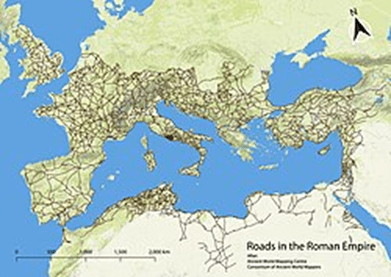
“Wait a minute!” you say. “The term “pax Romanus” means “Roman peace.” All the struggles you have just described are anything but peaceful. True. But look what God did during the centuries between the return of Jews from Babylon and the coming of Jesus. Jerusalem and the temple were rebuilt; in fact, Jerusalem underwent numerous building campaigns. Even though the Hellinists were pushing for Jerusalem to become a Greek city, the structures that resulted were excellent. Throughout each rebellion, each religious argument, God was still protecting Israel and still developing Israel. When the Romans finally took over completely, they brought in a strong central government. Wikipedia tells us: At the peak of Rome’s development, no fewer than 29 great military highways radiated from the capital, and the empire’s 113 provinces were interconnected by 372 great roads.[3][5] The whole comprised more than 400,000 kilometres (250,000 miles) of roads, of which over 80,500 kilometres (50,000 mi) were stone-paved.[6][7] In Gaul alone, no less than 21,000 kilometres (13,000 mi) of roadways are said to have been improved, and in Britain at least 4,000 kilometres (2,500 mi).[3] The courses (and sometimes the surfaces) of many Roman roads survived for millennia; some are overlaid by modern roads.
By the time Jesus was born, there were Roman roads as well as some common languages. Because of the strong Greek influence in Israel, many educated people spoke Greek. Now because of the Roman influence, Latin also became a widely spoken trade language. Why were all these developments necessary? Although traditionally, many Jews believed that Messiah would come just for them, God had already promised Abraham, Isaac, and Jacob that all the nations of the world would be blessed through them. Through all the years, all the political upheavals, and all the threats to the Jews, God continued to preserve Israel. God had His timing, and nothing could interfere with it.
Reading all this, you might think, “But what about me? God has promised me things, and I am still waiting!” Yes, God has promised. But God’s timing and ours are generally quite different. May God help us so that we trust His timing and remain patient.
PRAYER: Father God, thank You for loving us and caring for us. Lord, help us to trust Your timing, realizing that You know all the details while we can only guess. In the mighty and precious Name of King Jesus. Amen.



 Burunche's Blog