Archive for the ‘Uncategorized’ Category

SEPTEMBER 27, 2025 WHEN HAVING IT ALL ISN’T ENOUGH #5 ARE THE UNBORN REALLY MORE FORTUNATE THAN THE LIVING?

September 27, 2025

Ecclesiastes 4 The Evil of Oppression

“Again I looked, and I considered all the oppression taking place under the sun. I saw the tears of the oppressed, and they had no comforter; the power lay in the hands of their oppressors, and there was no comforter. So I admired the dead, who had already died, above the living, who are still alive. But better than both is he who has not yet existed, who has not seen the evil that is done under the sun.”

Wait just an all-fired minute, Solomon! You are the richest and wisest king-and one of the most powerful-in the entire earth. How dare you merely sit there in your palace and whine when you have the power to change things?

If you know Solomon’s story, you remember that Solomon had 700 hundred wives and 300 concubines. Most of these women were idolaters and demanded Solomon build places of worship for the demons they followed. There’s an old saying: “You lie down with dogs; you get up with fleas.” In Solomon’s case, it can be modified to “You have sex with idolaters and you wind up with demons.”

Yes, demons can transfer from one person to another through sex. Witches’ covens have been using that strategy to seduce new members for centuries. Sadly, Solomon has been influenced by these demons rather than by the One True Living God, even though he has dedicated a magnificent temple in Jerusalem. The tragedy of Solomon’s life illustrates the fact that faith is not a one-time affair, but a continual walk with the Lord. Only an idolater can refuse to correct problems and then whine that unborn souls are better off than anybody else.

“I saw that all labor and success spring from a man’s envy of his neighbor. This too is futile and a pursuit of the wind.” Speak for yourself, Solomon! Many people work for the joy of doing a job well and to support themselves and their families. Yes, there are those who envy others, but the vast majority of us are too busy to waste time in envy.

“The fool folds his hands and consumes his own flesh.” This is true. When we fold our hands and refuse to work, we are inviting disaster.  

“Better one handful with tranquility than two handfuls with toil and pursuit of the wind.” Tranquility is vastly under-rated. Proverbs 16:7 tells us, “When a person’s ways please the Lord, He makes even their enemies to be at peace with them.” The mark of the Holy Spirit is peace, a peace that passes all understanding. There’s also the question of the nature of the toil. Are we pursuing God’s will for our lives or are we speeding off in some other direction and begging God to bless our misguided efforts?  

“Again, I saw futility under the sun. There is a man all alone, without even a son or brother. And though there is no end to his labor, his eyes are still not content with his wealth: “For whom do I toil and bereave my soul of enjoyment?” This too is futile—a miserable task.”

I once read an interview with a Chinese billionaire who had no family. The man spoke of the wonderful philanthropic things he wanted to do….just as soon as he had enough. But he couldn’t tell the interviewer how much more he needed before he would reach that point. Sadly, this man would fit Solomon’s description.  

“Two are better than one, because they have a good return for their labor. For if one falls down, his companion can lift him up; but pity the one who falls without another to help him up! Again, if two lie down together, they will keep warm; but how can one keep warm alone? And though one may be overpowered, two can resist. Moreover, a cord of three strands is not quickly broken.”

For centuries, people have braided all kinds of fibers into ropes with at least three strands. The more strands a rope has, the stronger it will be and the more it will resist breaking. The same thing is true for fellow workers and for friends. In a country where a poor man might be forced to shiver in the cold, two or three huddling together could mean the difference between life and death. The story is told of two prisoners in an open box car on their way to a concentration camp during World War II. The one man was a bit stronger and feared for his companion, so all night long, he kept chafing the other man’s hands and feet. In the morning, only those two men were still alive; all the others in the box car had frozen to death in the night. When we help others, we are also helping ourselves.

The Futility of Power

“Better is a poor but wise youth than an old but foolish king who no longer knows how to take a warning. For the youth has come from the prison to the kingship, though he was born poor in his own kingdom. I saw that all who lived and walked under the sun followed this second one, the youth who succeeded the king. There is no limit to all the people who were before them. Yet the successor will not be celebrated by those who come even later. This too is futile and a pursuit of the wind.”

This is a fascinating observation. Is Solomon referring to the story of Joseph, who came from the prison to become the second most powerful man in Egypt? Has Solomon caught wind of some kind of palace intrigue and is now giving a veiled threat to an ambitious young man? Or has Solomon been studying Rehoboam who will succeed him? Does Solomon already realize that Rehoboam is a foolish young man who will make disastrous decisions?

There is no leader who will live forever; at the same time, successors to famous leaders are frequently swiftly forgotten. All any leader can aspire to do is to seek God’s help and do the best he/she can with the time given. May God help us, so that we will trust in Him and do our best, refusing to lose hope, no matter how difficult things might be.

PRAYER: Father God, thank You for loving us and caring for us. Lord, help us to remember that You call us to do Your Will, not to be successful or to compete with others. Help us to follow hard after You all the days of our lives. In the mighty and precious Name of King Jesus. Amen.

SEPTEMBER 26, 2025 WHEN HAVING IT ALL ISN’T ENOUGH #4 “GOD’S TIME IS THE BEST!”

September 26, 2025

Ecclesiastes 3: A Time for Everything

“There is a time for everything, and a season for every activity under the heavens: a time to be born and a time to die, a time to plant and a time to uproot, a time to kill and a time to heal, a time to tear down and a time to build, a time to weep and a time to laugh, a time to mourn and a time to dance, a time to scatter stones and a time to gather them, a time to embrace and a time to refrain from embracing, a time to search and a time to give up, a time to keep and a time to throw away, a time to tear and a time to mend, a time to be silent and a time to speak, a time to love and a time to hate, a time for war and a time for peace.”

These verses are some of the most encouraging and comforting in all of Scripture. But many of us aren’t interested in God’s time table; we try to demand God work by our time tables instead. The problem is that as long as we fight God’s timing, we accomplish nothing but exhaustion and frustration. Relax and allow God to work; the results are much better.

“What do workers gain from their toil? I have seen the burden God has laid on the human race. He has made everything beautiful in its time. He has also set eternity in the human heart; yet no one can fathom what God has done from beginning to end. I know that there is nothing better for people than to be happy and to do good while they live. That each of them may eat and drink, and find satisfaction in all their toil—this is the gift of God. I know that everything God does will endure forever; nothing can be added to it and nothing taken from it. God does it so that people will fear him. Whatever is has already been, and what will be has been before; and God will call the past to account.”

Many times, we demand results far too early. It’s very difficult to remember that God will make everything beautiful in its time. Only we relinquish control can God begin to work. Many times, our attempts at fixing things interfere with God’s perfect will.

What does it mean that God has put eternity in the human heart? Centuries ago, Blaise Pascal pointed out the fact that people have a God-sized hole in their hearts that can only be filled by God and nothing less. But many of us try to fill that hole with all kinds of things-possessions, food, success, entertainments-the list is endless but futile. St. Augustine of Hippo said in his ConfessionsThou movest us to delight in praising Thee; for Thou hast formed us for Thyself, and our hearts are restless till they find rest in Thee.” Augustine was a wild young man who tried to fill that God-sized hole with pleasure until committing his life to Christ.

“And I saw something else under the sun: In the place of judgment—wickedness was there, in the place of justice—wickedness was there. I said to myself, “God will bring into judgment both the righteous and the wicked, for there will be a time for every activity, a time to judge every deed.”

There have always been unjust judges. The Law of Moses warned against unjust judgments centuries earlier while later Jesus told a story about such a man in Luke 18:1-5. Obviously, there were still corrupt judges in Solomon’s day, even though Solomon might have appointed the best men he could. How frustrating to be a king striving for righteousness, only to find the men you have put in positions of trust have failed. Solomon can only hope that God will bring the final judgment. Sometimes, that’s all any of us can do, no matter how much we might want things to be different.

“I also said to myself, “As for humans, God tests them so that they may see that they are like the animals. Surely the fate of human beings is like that of the animals; the same fate awaits them both: As one dies, so dies the other. All have the same breath; humans have no advantage over animals. Everything is meaningless. All go to the same place; all come from dust, and to dust all return. Who knows if the human spirit rises upward and if the spirit of the animal goes down into the earth?”

“So I saw that there is nothing better for a person than to enjoy their work, because that is their lot. For who can bring them to see what will happen after them?”

OUCH!! Really, Solomon? Is that all there is to life? At this point, we need to return to St. Augustine for a reply: “Lord, teach me to know and understand which of these should be first, to call on Thee, or to praise Thee; and likewise to know Thee, or to call upon Thee… Behold, Lord, the ears of my heart are before Thee; open Thou them, and “say unto my soul, I am thy salvation.” When I hear, may I run and lay hold on Thee. Hide not Thy face from me. Let me die, lest I die, if only I may see Thy face.”

The Westminster Shorter Catechism Shorter Catechism tells us that the chief end of man is “to glorify God and to enjoy Him forever.” May we strive to glorify God in everything we do so that we might enjoy Him forever!

PRAYER: Father God, thank You for loving us and caring for us. Lord, help us to truly glorify You and to enjoy You forever. In the mighty and precious Name of King Jesus. Amen.

In an earlier generation, the Byrds popularized a song taken from Ecclesiastes 3. Here is the YouTube connection: https://www.youtube.com/watch?v=pKP4cfU28vM&list=RDpKP4cfU28vM&start_radio=1

IN MEMORIAM BILLY GENE PROCTOR SEPTEMBER 22, 2025 PART 3 COMMON SENSE IS NOT COMMON! AND NEITHER IS KINDNESS! BILLY HAD AN ENDLESS SUPPLY OF BOTH!

September 25, 2025

I’ve said it before, but one of the things we appreciated most about Billy Proctor was his endless fund of common sense. These days, we keep realizing that common sense is anything but common; in other words, getting good advice that actually works is a major challenge.

In a previous generation, those in the military rejoiced when they encountered recruits who were farm kids, for these people had not only learned how to work diligently but they also were used to coming up with practical solutions on the fly. Billy P. was that kind of a guy-someone who could analyze details, identify fundamental problems, and devise practical workable solutions. We can’t count the number of times we would call Billy, posing problems, and Billy would always come up with solutions. If Billy couldn’t come up with solutions himself, he would seek out advice or ask leading questions that would aid us in finding solutions.

Billy was also incredibly kind. Billy’s mama had raised him right, so he was a true Southern gentleman who would be polite under all circumstances, even when someone was trying to insult him. Even when Billy found himself engaged in an argument, he remained calm and courteous. Billy was also genuinely kind to all those around him. Repeatedly, we would learn that Billy had quietly helped someone or that Miss Carla and he were volunteering in an outreach to those in inner city Memphis or in some other helping ministry. The Proctors were faithful supporters of the efforts of Getwell Church to aid the community. It was also common to find the Proctors carrying food to shut-ins, offering rides to those needing transport to church or doctors’ appointments, etc.

As a faithful member of Getwell Church, Billy also helped represent us to the church at large and to several Sunday School classes. We can only pray that God will raise up someone to continue to spread our story at Getwell.

Billy was a faithful friend. Until the last few years of Billy’s life, he got together weekly with a group of men to eat lunch at a local restaurant. There were also the men who attended early morning Bible studies and prayer groups, a passion Billy shared with my husband Bob whenever we were staying with the Proctors.

Billy was a CPA’s CPA, someone so passionate about figures and reports being complete that he couldn’t stand to do shoddy work. This passion for correctness was evident in every task Billy tackled. Billy generously applied his talents to helping us manage our finances, multiplying donated monies to fund a host of projects at our mission hospital. Had we adequately compensated Billy for his work, he would have been a millionaire.

We continue to pray for Billy’s family and friends even as we grieve our own loss. The Navajo Indians have a saying that someone is a “valuable man,” meaning that individual’s contributions to society are immeasurable. By anybody’s standards, Billy Gene Proctor was a valuable man. Our loss is heaven’s gain. Rest well, friend, we’ll see you at the feet of Jesus.

SEPTEMBER 25, 2025 WHEN HAVING IT ALL ISN’T ENOUGH #3 SELF INDULGENCE IS A DEAD-END STREET!

September 25, 2025

Ecclesiastes 2:1-3 I said to myself, “Let’s go for it—experiment with pleasure, have a good time!” But there was nothing to it, nothing but smoke. What do I think of the fun-filled life? Insane! Inane! My verdict on the pursuit of happiness? Who needs it? With the help of a bottle of wine and all the wisdom I could muster, I tried my level best to penetrate the absurdity of life. I wanted to get a handle on anything useful we mortals might do during the years we spend on this earth.

I Never Said No to Myself

4-8 Oh, I did great things: built houses, planted vineyards, designed gardens and parks and planted a variety of fruit trees in them, made pools of water to irrigate the groves of trees. I bought slaves, male and female, who had children, giving me even more slaves; then I acquired large herds and flocks, larger than any before me in Jerusalem. I piled up silver and gold, loot from kings and kingdoms. I gathered a chorus of singers to entertain me with song, and—most exquisite of all pleasures—voluptuous maidens for my bed.

9-10 Oh, how I prospered! I left all my predecessors in Jerusalem far behind, left them behind in the dust. What’s more, I kept a clear head through it all. Everything I wanted I took—I never said no to myself. I gave in to every impulse, held back nothing. I sucked the marrow of pleasure out of every task—my reward to myself for a hard day’s work!

I Hate Life

11 Then I took a good look at everything I’d done, looked at all the sweat and hard work. But when I looked, I saw nothing but smoke. Smoke and spitting into the wind. There was nothing to any of it. Nothing.

12-14 And then I took a hard look at what’s smart and what’s stupid. What’s left to do after you’ve been king? That’s a hard act to follow. You just do what you can, and that’s it. But I did see that it’s better to be smart than stupid, just as light is better than darkness. Even so, though the smart ones see where they’re going and the stupid ones grope in the dark, they’re all the same in the end. One fate for all—and that’s it.

15-16 When I realized that my fate’s the same as the fool’s, I had to ask myself, “So why bother being wise?” It’s all smoke, nothing but smoke. The smart and the stupid both disappear out of sight. In a day or two they’re both forgotten. Yes, both the smart and the stupid die, and that’s it.

17 I hate life. As far as I can see, what happens on earth is a bad business. It’s smoke—and spitting into the wind.

18-19 And I hated everything I’d accomplished and accumulated on this earth. I can’t take it with me—no, I have to leave it to whoever comes after me. Whether they’re worthy or worthless—and who’s to tell?—they’ll take over the earthly results of my intense thinking and hard work. Smoke.

20-23 That’s when I called it quits, gave up on anything that could be hoped for on this earth. What’s the point of working your fingers to the bone if you hand over what you worked for to someone who never lifted a finger for it? Smoke, that’s what it is. A bad business from start to finish. So what do you get from a life of hard labor? Pain and grief from dawn to dusk. Never a decent night’s rest. Nothing but smoke.

24-26 The best you can do with your life is have a good time and get by the best you can. The way I see it, that’s it—divine fate. Whether we feast or fast, it’s up to God. God may give wisdom and knowledge and joy to his favorites, but sinners are assigned a life of hard labor, and end up turning their wages over to God’s favorites. Nothing but smoke—and spitting into the wind.

My verdict on the pursuit of happiness? Who needs it?” Well, hello, Mr. Gloomypants! Now poor bored King Solomon is going to give us all the details of his pursuit of happiness. Drinking! Carousing! Wealth! Expanding the palace grounds! Tumbling into bed with voluptuous maidens! “Oh, how I prospered! I left all my predecessors in Jerusalem far behind, left them behind in the dust. What’s more, I kept a clear head through it all. Everything I wanted I took—I never said no to myself. I gave in to every impulse, held back nothing. I sucked the marrow of pleasure out of every task—my reward to myself for a hard day’s work!”

At this point, many of Solomon’s servants would undoubtedly like to speak up about what actually constitutes real work. Certainly, Solomon wasn’t out there building all these things and digging those lakes and canals, etc. And at the end of all this alleged suffering, Solomon concludes: “So what do you get from a life of hard labor? Pain and grief from dawn to dusk. Never a decent night’s rest. Nothing but smoke.

24-26 The best you can do with your life is have a good time and get by the best you can. The way I see it, that’s it—divine fate. Whether we feast or fast, it’s up to God. God may give wisdom and knowledge and joy to his favorites, but sinners are assigned a life of hard labor, and end up turning their wages over to God’s favorites. Nothing but smoke—and spitting into the wind.”

J.D. Rockefeller was the first true American billionaire with a fortune that defied description. But he found his real purpose in his last 40 years when he endowed universities and foundations that advanced medicine, science, and other avenues of learning.

Rockefeller spent much of the last 40 years of his life in retirement at Kykuit, his estate in Westchester County, New York, defining the structure of modern philanthropy, along with other key industrialists such as Andrew Carnegie.[10] His fortune was used chiefly to create the modern systematic approach of targeted philanthropy through the creation of foundations that supported medicine, education, and scientific research.[11] His foundations pioneered developments in medical research and were instrumental in the near-eradication of hookworm in the American South,[12] and yellow fever[13] in the United States. He and Carnegie gave form and impetus through their charities to the work of Abraham Flexner, who in his essay “Medical Education in America” emphatically endowed empiricism as the basis for the US medical system of the 20th century.[14](Wikipedia)

The Book of Ecclesiastes gives us a clear picture of the tragedy of Solomon. Incredibly gifted and wealthy beyond belief, Solomon tried to satisfy himself with things rather than God. Millions of others have made the same mistake; however, only God can truly satisfy.

PRAYER: Father God, thank You for loving us and caring for us. Lord, help us to find our fulfillment and purpose in You and nothing else. In the mighty and precious Name of King Jesus. Amen.

SEPTEMBER 24, 2025 WHEN HAVING IT ALL ISN’T ENOUGH #2 THE PREACHER INTRODUCES HIMSELF-HO HUM!

September 24, 2025

Ecclesiastes 1 The Quester

1 These are the words of the Quester, David’s son and king in Jerusalem:

2-11 Smoke, nothing but smoke. [That’s what the Quester says.]
    There’s nothing to anything—it’s all smoke. What’s there to show for a lifetime of work, a lifetime of working your fingers to the bone?
One generation goes its way, the next one arrives, but nothing changes—it’s business as usual for old planet earth. The sun comes up and the sun goes down, then does it again, and again—the same old round. The wind blows south, the wind blows north.
    Around and around and around it blows, blowing this way, then that—the whirling, erratic wind. All the rivers flow into the sea, but the sea never fills up. The rivers keep flowing to the same old place, and then start all over and do it again. Everything’s boring, utterly boring—no one can find any meaning in it. Boring to the eye, boring to the ear.

What was will be again, what happened will happen again. There’s nothing new on this earth. Year after year it’s the same old thing.

Does someone call out, “Hey, this is new”? Don’t get excited—it’s the same old story.
Nobody remembers what happened yesterday. And the things that will happen tomorrow? Nobody’ll remember them either. Don’t count on being remembered.

I’ve Seen It All

12-14 Call me “the Quester.” I’ve been king over Israel in Jerusalem. I looked most carefully into everything, searched out all that is done on this earth. And let me tell you, there’s not much to write home about. God hasn’t made it easy for us. I’ve seen it all and it’s nothing but smoke—smoke, and spitting into the wind.

15 Life’s a corkscrew that can’t be straightened, a minus that won’t add up.

16-17 I said to myself, “I know more and I’m wiser than anyone before me in Jerusalem. I’ve stockpiled wisdom and knowledge.” What I’ve finally concluded is that so-called wisdom and knowledge are mindless and witless—nothing but spitting into the wind.

18 Much learning earns you much trouble. The more you know, the more you hurt.

Well! If you were looking for uplifting inspiration this morning, don’t read the first chapter of Ecclesiastes! Here’s King Solomon, the richest and wisest king who ever lived, courted by rulers from the ends of the earth, living in unimaginable splendor, and he’s BORED OUT OF HIS MIND!!! AND FRUSTRATED!!! Did I say frustrated?

Here’s a guy who literally has it all, and now he’s finding that it’s not enough. Look at some of these statements:

There’s nothing to anything—it’s all smoke. What’s there to show for a lifetime of work, a lifetime of working your fingers to the bone?

Everything’s boring, utterly boring—no one can find any meaning in it. Boring to the eye, boring to the ear.

Life’s a corkscrew that can’t be straightened, a minus that won’t add up.

What I’ve finally concluded is that so-called wisdom and knowledge are mindless and witless—nothing but spitting into the wind.

What’s wrong with this guy? He has everything others envy and he’s not satisfied. The big problem is that Solomon is looking for meaning and satisfaction in the wrong places. As we continue through this book, Solomon will give us more details, but it’s simple: Solomon needs God and he’s trying to fill a God-sized hole in his heart with something less.

Solomon’s complaints are eerily echoed in a poem by Edgar Arlington Robinson.

Richard Cory

By Edwin Arlington Robinson

Whenever Richard Cory went down town,

We people on the pavement looked at him:

He was a gentleman from sole to crown,

Clean favored, and imperially slim.

And he was always quietly arrayed,

And he was always human when he talked;

But still he fluttered pulses when he said,

“Good-morning,” and he glittered when he walked.

And he was rich—yes, richer than a king—

And admirably schooled in every grace:

In fine, we thought that he was everything

To make us wish that we were in his place.

So on we worked, and waited for the light,

And went without the meat, and cursed the bread;

And Richard Cory, one calm summer night,

Went home and put a bullet through his head.

It’s been said that “A man wrapped up in himself makes a very small package.” Forget the bling, the palaces, the entertainers, the wealth, and the learning. Solomon is wrapped up in himself. And we can make similar mistakes!! May God help us to seek Him above everything else.

PRAYER: Father God, thank You for loving us and caring for us. Lord, help us to realize that You are our greatest treasure. Help us to realize that our hearts will always be restless until they find their rest in You. In the mighty and precious Name of King Jesus. Amen.

IN MEMORIAM BILLY GENE PROCTOR SEPTEMBER 22, 2025 PART 2 PRECIOUS MEMORIES

September 23, 2025
  1. Precious mem’ries, unseen angels,
    Sent from somewhere to my soul;
    How they linger, ever near me,
    And the sacred past unfold.
    1. Refrain:
      Precious mem’ries, how they linger,
      How they ever flood my soul;
      In the stillness of the midnight,
      Precious, sacred scenes unfold.
  2. Precious father, loving mother,
    Fly across the lonely years;
    And old home scenes of my childhood,
    In fond memory appear.
  3. As I travel on life’s pathway,
    Know not what the years may hold;
    As I ponder, hope grows fonder,
    Precious mem’ries flood my soul.

As the movie “Driving Miss Daisy” ends, the theme music continues to play, and scenes from Hoke and Miss Daisy’s relationship flash across the screen. That’s how I feel remembering Billy Proctor. The sweet pictures just keep coming. The music in the background is country Gospel with fiddles, banjoes, and guitars.

Billy loved to travel. After spending three years working in Mexico at the beginning of his career and traveling throughout the United States for Terminix, Billy was a travel specialist who had more practical tips than the average web site. Billy could tell you the best times to travel, when to catch the red-eye specials, when to use your frequent flier miles, and when to hold on to them. Back when travel agents were still available, we used Billy’s friend Harriet on many occasions. In his work, Billy also traveled extensively through the South and was an expert on the best local restaurants. We fondly remember one place near Morgan City, Louisiana, housed in an old airplane hanger that had outstanding Cajun food.

Eventually Billy became the head of the IRS Division of Terminix and it was a tremendous shock when he went in to work one morning at the age of 63, only to face a horrible choice: move to Chicago with his division or take early retirement with a retirement bonus. Billy chose to remain in Olive Branch, preferring to practice as a CPA with a select clientele. While that choice was difficult, it gave Billy the freedom to cherish children and grandchildren and to travel more extensively. Meanwhile, Carla continued to work as a social worker facilitating adoptions for several more years, creating many happy families.

Billy, and Carla became globe trotters. Israel, Scotland with the Edinburgh Tattoo, leaf tours in the fall-Billy and Carla did it all. It was no surprise when I learned that Billy and Carla were two of the few wedding guests who made it to a destination wedding in the Florida Keys, for that was typical for the Proctors.

Billy was a passionate follower of Jesus Christ. Living close to Getwell Church allowed Billy the chance to attend men’s breakfasts and Bible studies as well as small group meetings with Miss Carla. For many years, Billy was involved in the financial affairs of the churches he attended-first at Faith United Methodist and later at Getwell.

One of Billy’s most endearing characteristics was his enormous fund of common sense. As a Mississippi farm boy, Billy never “got beyond his raising” but always remembered the practicalities of situations. We frequently used Billy as a sounding board for a variety of decisions and always found his advice to be sound and helpful.

As the days go on, there will be more visions. For now, we can label these glimpses as more precious memories.

IN MEMORIAM BILLY GENE PROCTOR SEPTEMBER 22, 2025

September 23, 2025

He was a bright farm boy from North Mississippi when he went off to Mississippi State to see what life had to offer apart from driving a tractor. Somewhere during those four years, he found his passion was accounting, a passion that would define the rest of his life even into so-called retirement. While at Mississippi State, he also met a shy coed a bit younger than he, and they fell in love. That second passion would also define the rest of his life. Throughout the years, he grew professionally to become a CPA’s CPA, someone who simply had to ensure that things lined up-columns of figures, family life, and faith.

We first met Billy Proctor in 1983 shortly after we moved to the Memphis area. We were searching for a church home. At that time, Billy and Carla were moving out of their home on the south side of Memphis into a house in Southaven; however, they were in the process of building a home in Olive Branch. We attended church with them and then went to lunch with them. Billy and Carla introduced us to Faith United Methodist. Little did we know that that lunch would only be the first of hundreds of meals that we would share with the Proctors through the years.

We all wound up at Faith United Methodist Church together. At Faith, Billy and his son Michael handled the sound equipment. Billy was always fascinated by machines-farm machines, sound equipment, computers, and cameras. Billy supplemented his income as an accountant by shooting wedding photographs, and he had an artist’s eye for composition. Billy was also a main stay of the MOFIA, Men of Faith In Action, the men’s group at Faith United Methodist.

Those were the halcyon years for Faith. The Holy Spirit was moving powerfully every Sunday, and people were getting saved, baptized, re-dedicated, and called into ministry.

In the fall of 1985 Billy and Carla were preparing to move into their new home in Olive Branch; however, there was a problem. Faith had scheduled an event for the same night the Proctors were supposed to be moving. I reached the Proctor home late in the afternoon to find that the water heater had overflowed, flooding the garage. Somehow, I was able to get the water heater turned off safely without getting electrocuted, and then Bob and I helped the Proctors move. (Bob is a wizard at packing moving trucks!) Little did we realize that the Proctors’ new home would also become one of our “homes away from home” when we left for the mission field.

Sometime in 1987, we asked Billy to help us manage our finances while we were on the mission field. Billy agreed, and that commitment continued up to the day he died. Only God knows how much Billy helped us over the years. Billy handled investments and taxes and a host of other smaller problems.

The only thing in life that is constant is change, and eventually, Faith underwent a series of transformations, including changing the name to Lifespring. Somewhere along in there, the Proctors changed from Faith to Getwell Road United Methodist Church, now Getwell Church. Eventually, we followed the Proctors to Getwell, and in October 2005, Getwell sent a short term mission team to work with us in Saboba. That might have been the first short term mission team Getwell had sent out; since then, they’ve regularly sent teams to a number of places, including Honduras and Ghana. We suspect that Billy had a great deal to do with the team coming to Saboba. The Getwell group bonded with our local pastors, eventually building the Local Council of Churches meeting hall and guest house, a facility that continues to bless our entire community. The Sunday School class Billy attended also donated small refrigerators to our wards, something we desperately needed.

We laughingly refer to our location in Saboba as “Domeabra,” a phrase in Twi that means “if you love me, you will come.” Only dedicated people will journey all the way to Saboba! Billy traveled to Saboba twice, and the first time he came, he told us, “Now I know why I must continue to help you.”

There are no words to describe all the help Billy has given us through the years. Billy and his wife have hosted us numerous times and have shared their passions with us. Billy has handled our taxes, our funds, and other miscellaneous things such as social security and driver’s license renewals. The Proctors have allowed us to use their address as an accommodation address, a big thing when you spend most of your life overseas.

Billy Proctor was one of the bravest people we knew. Sometimes bravery consists of lying there in bed knowing everything hurts and getting up and working anyway. For the last twenty or thirty years, Billy struggled with a host of chronic health problems, any one of which might have incapacitated a lessor individual. Billy rarely complained and persisted in doing as much as he could.

Billy shared friendships with us. Billy was part of a group of men who got together for lunch once a week-most of those men preceded Billy into heaven. Billy faithfully attended the men’s groups and the Wednesday night meetings at Getwell, as well as Sunday morning services and Sunday School.

Billy’s story would be incomplete without telling some of the story of his beloved wife Carla. Born into an upper-class family in the Mississippi Delta, Miss Carla is a stickler for doing things properly, and a delight to all of us who know her. In an earlier age, Miss Carla would have donned white gloves before leaving the house. Were it not for Miss Carla’s devoted care, Mister Billy’s life might have been several years shorter, simply because Miss Carla refused to let him give up. Carla has been a wife, a mother, and a social worker passionate about placing the right children with the right homes.

When we returned from a shattering first missionary term in 1990, Miss Carla was the one who connected me with a Christian psychologist just in time to save me from having to enter a mental hospital with severe depression. For that help alone, my husband and I owe the Proctors a debt we can never adequately repay. Thanks to Carla’s timely help, I made the connection, saw Dr. Philip Gentry as an emergency, and got started on the necessary treatment. That treatment allowed me to work part-time while recovering and healing from long-time emotional hurts. My ability to later upgrade a health center to a small hospital in the middle of a tribal war is directly due to that healing.

When we think of Billy’s entry into heaven yesterday, we think of all the friends with whom he has re-connected-Pastor Curtis Petrey, Dr. Jack, Cecil Williamson, his parents. We can almost hear Curtis greeting Billy in that distinctive LA–Lower Alabama-accent.

For Billy, the words of Saint Paul in 2 Timothy 4:7-8 have come true: “I have fought the good fight, I have finished the race, I have kept the faith.Now there is in store for me the crown of righteousness, which the Lord, the righteous Judge, will award to me on that day—and not only to me, but also to all who have longed for his appearing.”

To Billy, we say, “We have always loved you and continue to love you. We will see you in the morning when Jesus comes to free all of us.” To Billy’s family and many friends, we say, “We grieve with you. We pray for you. May God help us all to be as faithful as Billy has been!” And we also say, “Maranatha! Come, Lord Jesus!”

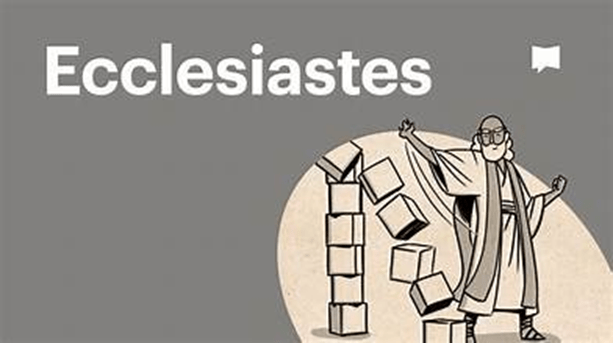
SEPTEMBER 23, 2025 WHEN HAVING IT ALL ISN’T ENOUGH #1 INTRODUCTION TO ECCLESIASTES

September 23, 2025

For the next several weeks, we will be studying the Book of Ecclesiastes. Here is what Pastor Chuck Swindoll has to say about this book.

Who wrote the book?

The title “Ecclesiastes” comes from a Greek word indicating a person who calls an assembly, so it makes sense that the author identified himself in Ecclesiastes 1:1 by the Hebrew word qoheleth, translated as “Preacher.” Despite leaving only this rather mysterious name to indicate his identity, evidence in the book, along with most Jewish and Christian tradition, suggests that King Solomon authored Ecclesiastes.

The Preacher went on to call himself “the son of David, king in Jerusalem,” one who has increased in “wisdom more than all who were over Jerusalem before me,” and one who has collected many proverbs (Ecclesiastes 1:11612:9). Solomon followed David on the throne in Jerusalem as the only Davidic son to rule over all Israel from that city (1:12). He was the wisest man in the world during his time (1 Kings 4:29–30) and wrote most of the book of Proverbs (Proverbs 1:110:125:1). Therefore, we can safely identify Solomon as the qoheleth of the opening verse.

Where are we?

With Solomon as the author of the book, we know it had to have been written sometime before his death in 931 BC. The content of Ecclesiastes reflects someone looking back on a life that was long on experience but short on lasting rewards. As king, he had the opportunity and resources to pursue the rewards of wisdom, pleasure, and work in and of themselves. Yet the world-weary tone of the writing suggests that late in life, he looked back on his folly with regret, pointing us to a better, simpler life lived in light of God’s direction (Ecclesiastes 12:13–14).

Why is Ecclesiastes so important?

Ecclesiastes presents us a naturalistic vision of life—one that sees life through distinctively human eyes—but ultimately recognizes the rule and reign of God in the world. This more humanistic quality has made the book especially popular among younger audiences today, men and women who have seen more than their fair share of pain and instability in life but who still cling to their hope in God.

What’s the big idea?

Ecclesiastes, like much of life, represents a journey from one point to another. Solomon articulated his starting point early in the book: “Vanity of vanities! All is vanity” (Ecclesiastes 1:2), indicating the utter futility and meaninglessness of life as he saw it. Nothing made sense to him because he had already tried any number of remedies—pleasure, work, and intellect—to alleviate his sense of feeling lost in the world.

However, even in the writer’s desperate search for meaning and significance in life, God remained present. For instance, we read that God provides food, drink, and work (2:24); both the sinner and the righteous person live in God’s sight (2:26); God’s deeds are eternal (3:14); and God empowers people to enjoy His provision (5:19). Ultimately, the great truth of Ecclesiastes lies in the acknowledgment of God’s ever-present hand on our lives. Even when injustice and uncertainty threaten to overwhelm us, we can trust Him and follow after Him (12:13–14). 

How do I apply this?

We all desire meaning in life. Often that search takes us along winding, up-and-down paths filled with bursts of satisfaction that shine bright for a time but eventually fade. In one sense, it’s satisfying to see that experience echoed throughout Ecclesiastes. An appreciation for our common humanity emerges from reading its pages. We relate to the journey of Solomon because, for so many of us, it is our own. When we attempt to find meaning in the pursuit of pleasure, the commitment to a job, or through plumbing intellectual depths, we all eventually find in each of these pursuits a dead end.

Ecclesiastes shows us a man who lived through this process and came out on the other side with a wiser, more seasoned perspective. When we’re surrounded by the temptation to proclaim life’s ultimate emptiness, we can find in Ecclesiastes a vision tempered by experience and ultimately seen through divinely colored lenses. Life is destined to remain unsatisfying apart from our recognition of God’s intervention. It only remains to be seen whether or not we will place our trust in His sure and able hands.

Have you struggled with misplaced pursuits in life? Does your life lack the meaning and purpose you desire? Hear the words of Solomon that they might encourage you to place your trust solely in the Lord.

How do I decide which book of the Bible to write about next? God tells me. God knows human hearts and God knows what each of us needs to hear from Him. Rest assured that somewhere in these studies, God wants to speak to you individually and that He wants to give light on the problems you’re facing. As we begin this study, let’s pray for guidance.

PRAYER: Father God, thank You for loving us and caring for us. Lord, You are the Creator and Sustainer of all of us. We are nothing without You. Please open our eyes so that we might see wonderful things in Your Word and hide Your Word in our hearts, that we might not sin against You. In the mighty and precious Name of King Jesus. Amen.

SEPTEMBER 22, 2025 DARE TO BE A DANIEL! #24 LORD, HELP US TO BE TRUE TO THE END!

September 22, 2025

Daniel 12 The Time of the End

“At that time Michael, the archangel who stands guard over your nation, will arise. Then there will be a time of anguish greater than any since nations first came into existence. But at that time every one of your people whose name is written in the book will be rescued. Many of those whose bodies lie dead and buried will rise up, some to everlasting life and some to shame and everlasting disgrace. Those who are wise will shine as bright as the sky, and those who lead many to righteousness will shine like the stars forever. But you, Daniel, keep this prophecy a secret; seal up the book until the time of the end, when many will rush here and there, and knowledge will increase.”

Once more, we are left wondering when these events are going to take place. Clearly, these prophecies speak of the end times, and once more, we can’t be certain where we stand with the end time calendar. But we know that there will be a persecution of the Jews that will dwarf anything that has happened previously, including the Holocaust, during which six million Jews were slaughtered. God knows His people and will rescue them and raise them from the dead, many to everlasting life and many more to “shame and everlasting disgrace.”

But while darkness threatens to envelop the earth, “those who are wise will shine as bright as the sky, and those who lead many to righteousness will shine like the stars forever.” Oh, how wonderful! Oh, how magnificent! Oh Lord, may we be found faithful! May we be among those who lead many to righteousness, so that we will “shine like the stars forever!”

Then I, Daniel, looked and saw two others standing on opposite banks of the river. One of them asked the man dressed in linen, who was now standing above the river, “How long will it be until these shocking events are over?”

The man dressed in linen, who was standing above the river, raised both his hands toward heaven and took a solemn oath by the One who lives forever, saying, “It will go on for a time, times, and half a time. When the shattering of the holy people has finally come to an end, all these things will have happened.”

I heard what he said, but I did not understand what he meant. So I asked, “How will all this finally end, my lord?”

But he said, “Go now, Daniel, for what I have said is kept secret and sealed until the time of the end. Many will be purified, cleansed, and refined by these trials. But the wicked will continue in their wickedness, and none of them will understand. Only those who are wise will know what it means.

“From the time the daily sacrifice is stopped and the sacrilegious object that causes desecration is set up to be worshiped, there will be 1,290 days. And blessed are those who wait and remain until the end of the 1,335 days!

“As for you, go your way until the end. You will rest, and then at the end of the days, you will rise again to receive the inheritance set aside for you.”

When Jesus’ disciples begged him to tell them when the end would come, Jesus told them that only the Heavenly Father knew the day and the hour. No matter how many theories are generated, it’s still true that only God the Father knows precisely when the end will come.

But we know one thing: God’s timing is perfect. Acts 2:1 tells us, “When the day of Pentecost had fully come…” God’s timing is split second and when the time has come for the fulfillment of these prophecies, nothing and nobody can delay the sovereign Will of God.

What is left for us to do? We must dare to pursue righteousness just as Daniel did. We must not flinch in the face of attacks or adversity. And we must remain true to God and His Holy Word, even at the cost of our lives. Recently, in parts of West Africa, Christians have been martyred during baptism services and other worship services. Those of us living in safer places must realize that we too can die for our faith, just as Charlie Kirk has done recently.

May God help us to remain true and may we love God more each day than we did the day before!

PRAYER: Father God, thank You for loving us and caring for us. Lord, help us to follow hard after You, no matter the price. In the mighty and precious Name of King Jesus. Amen.

SEPTEMBER 21, 2025 DARE TO BE A DANIEL! #23 THE PEOPLE WHO KNOW GOD WILL BE STRONG AND DO EXPLOITS!

September 21, 2025

Daniel 11:21-44 “The next to come to power will be a despicable man who is not in line for royal succession. He will slip in when least expected and take over the kingdom by flattery and intrigue. Before him great armies will be swept away, including a covenant prince. With deceitful promises, he will make various alliances. He will become strong despite having only a handful of followers. Without warning he will enter the richest areas of the land. Then he will distribute among his followers the plunder and wealth of the rich—something his predecessors had never done. He will plot the overthrow of strongholds, but this will last for only a short while.”

Guzik explains:  In his place shall arise a vile person: The angel told Daniel that after the brief reign of the former king of the North, the next king would be a vile person. He would not be recognized as royalty, but shall take power by intrigue.

b. In his place: This was fulfilled in the successor of Seleucis III, named Antiochus IV. He did not come to the throne legitimately because it was strongly suspected that he murdered his older brother, the previous king. The other potential heir (the son of Seleucus III) was imprisoned in Rome.

i. He shall come in peaceably: Apart from the murder of his older brother, Antiochus IV didn’t use terror to gain power. He used flattery, smooth promises, and intrigue.

ii. “He flattered Eumenes, king of Pergamus, and Attalus his brother, and got their assistance. He flattered the Romans, and sent ambassadors to court their favour, and pay them the arrears of the tribute. He flattered the Syrians, and gained their concurrence.” (Clarke)

iii. Antiochus IV took the title Epiphanes, meaning illustrious. Others derisively called him Epimanes, meaning madman.

“Then he will stir up his courage and raise a great army against the king of the south. The king of the south will go to battle with a mighty army, but to no avail, for there will be plots against him. His own household will cause his downfall. His army will be swept away, and many will be killed. Seeking nothing but each other’s harm, these kings will plot against each other at the conference table, attempting to deceive each other. But it will make no difference, for the end will come at the appointed time.”

Again, Guzik tells us: a. He shall act deceitfully: The angel told Daniel that the new king of the North (the vile person of Daniel 11:21) would attempt a deceitful covenant with the king of the South. This would fail, and there would be a great battle that would not change the balance of power.

b. He shall stir up his power: This was fulfilled when Antiochus Epiphanes carried on the feud between the dynasties but pretended friendship and alliance to catch them off guard. Despite massive efforts and epic battles, Antiochus Epiphanes did not stand, and his army was swept away.

i. The defeat of Antiochus Epiphanes at his second campaign against Egypt was important, because Egypt beat Antiochus with the help of Rome. At the end of it all, Antiochus Epiphanes and his kingdom were under the dominion of Rome.

ii. In a famous battle, the Roman Navy defeated the navy of Antiochus Epiphanes. After the battle, a Roman general drew a circle around Antiochus in the dirt and demanded to know if he would surrender and pay tribute to Rome – and demanded to know before he stepped out of the circle. From that point on there was no doubt: Antiochus Epiphanes took his orders from Rome and was under Roman dominion.

iii. Those who eat of the portion of his delicacies shall destroy him: This was fulfilled in the treachery against Antiochus IV by his own counselors.

“The king of the north will then return home with great riches. On the way he will set himself against the people of the holy covenant, doing much damage before continuing his journey.

29 “Then at the appointed time he will once again invade the south, but this time the result will be different. 30 For warships from western coastlands[e] will scare him off, and he will withdraw and return home. But he will vent his anger against the people of the holy covenant and reward those who forsake the covenant.

While returning to his land with great riches: Failing in his invasion of Egypt, Antiochus Epiphanes returned home with only great plunder to soothe his wounded pride.

ii. Ships from Cyprus shall come against him: This was naval assistance from the Romans, who helped the Egyptians turn back Antiochus Epiphanes.

iii. They shall take away the daily sacrifices, and place there the abomination of desolation: Antiochus Epiphanes set up an image of Zeus at the temple altar. He demanded sacrifice to this image, and later desecrated the temple by sacrificing a pig on it. “It was in truth an abomination, which brought a desolate condition to the Temple, for now no one would come to worship at all.” (Wood)

31 “His army will take over the Temple fortress, pollute the sanctuary, put a stop to the daily sacrifices, and set up the sacrilegious object that causes desecration. 32 He will flatter and win over those who have violated the covenant. But the people who know their God will be strong and will resist him.”  (Some translations read “The people who know their God will be strong and will do exploits.”) When Antiochus Epiphanes turned on Jerusalem, the Jewish people were divided. Some forsook their covenant with God and embraced Greek culture. Those who knew their God made a stand for righteousness in the face of incredible persecution.

33 “Wise leaders will give instruction to many, but these teachers will die by fire and sword, or they will be jailed and robbed. 34 During these persecutions, little help will arrive, and many who join them will not be sincere. 35 And some of the wise will fall victim to persecution. In this way, they will be refined and cleansed and made pure until the time of the end, for the appointed time is still to come.

36 “The king will do as he pleases, exalting himself and claiming to be greater than every god, even blaspheming the God of gods. He will succeed, but only until the time of wrath is completed. For what has been determined will surely take place. 37 He will have no respect for the gods of his ancestors, or for the god loved by women, or for any other god, for he will boast that he is greater than them all. 38 Instead of these, he will worship the god of fortresses—a god his ancestors never knew—and lavish on him gold, silver, precious stones, and expensive gifts. 39 Claiming this foreign god’s help, he will attack the strongest fortresses. He will honor those who submit to him, appointing them to positions of authority and dividing the land among them as their reward.”

For many days they shall fall by sword and flame, by captivity and plundering: In his attack on Jerusalem Antiochus IV is said to have killed 80,000 Jews, taken 40,000 more as prisoners, and sold another 40,000 as slaves. He also plundered the temple, robbing it of approximately $1 billion by modern calculations.

vi. Until the time of the end; because it is still for the appointed time: This terror could only last for as long as God had appointed it, and God had a purpose even for such persecution and blasphemy.

a. He shall exalt and magnify himself above every god: The angel explained to Daniel that this king would blaspheme God and exalt himself until the wrath has been accomplished and what has been determined shall be done.

b. Above every god: Here we shift from what was fulfilled in the Ptolemies and the Selucids to what will be fulfilled in the Antichrist, the final world dictator. Daniel was told that this revelation pertained to the latter days (Daniel 10:14), and Daniel 11:36 begins to look more towards this final world dictator, who is sort of a “last days Antiochus Epiphanes.”

i. We know that everything about this prophecy was not fulfilled during the career of Antiochus Epiphanes. Jesus specifically said the real abomination of desolation was still in the future (Matthew 24:15). The Apostle Paul paraphrased Daniel 11:36 in reference to the coming Antichrist: Let no one deceive you by any means; for that Day will not come unless the falling away comes first, and the man of sin is revealed, the son of perdition, who opposes and exalts himself above all that is called God or that is worshiped, so that he sits as God in the temple of God, showing himself that he is God (2 Thessalonians 2:3-4).

ii. Antiochus Epiphanes is important, but mostly as a historical preview of the Antichrist. This is why so much space is given to describing the career of one evil man – because he prefigures the ultimate evil man. Antiochus Epiphanes is the “trailer” released well before the Antichrist, who is like the “feature.”

c. He shall exalt and magnify himself above every god: Antiochus Epiphanes certainly did this in the general sense that all sinners oppose God. Yet he remained loyal to the Greek religious tradition, which revered the entire Olympian pantheon. Antiochus Epiphanes put a statue of Zeus in the temple, not of himself. This statement will be far more precisely fulfilled in the Antichrist, who sits as God in the temple of God, showing himself that he is God (2 Thessalonians 2:4).

d. Shall prosper till the wrath has been accomplished: Antichrist will do much damage, but he is on a short chain and will only work into God’s plan. God’s purpose will be accomplished.

40 “Then at the time of the end, the king of the south will attack the king of the north. The king of the north will storm out with chariots, charioteers, and a vast navy. He will invade various lands and sweep through them like a flood. 41 He will enter the glorious land of Israel,[h] and many nations will fall, but Moab, Edom, and the best part of Ammon will escape. 42 He will conquer many countries, and even Egypt will not escape. 43 He will gain control over the gold, silver, and treasures of Egypt, and the Libyans and Ethiopians will be his servants.

44 “But then news from the east and the north will alarm him, and he will set out in great anger to destroy and obliterate many. 45 He will stop between the glorious holy mountain and the sea and will pitch his royal tents. But while he is there, his time will suddenly run out, and no one will help him.

He shall regard neither the God of his fathers nor the desire of women, nor regard any god; for he shall exalt himself above them all. But in their place, he shall honor a god of fortresses; and a god which his fathers did not know he shall honor with gold and silver, with precious stones and pleasant things. Thus, he shall act against the strongest fortresses with a foreign god, which he shall acknowledge, and advance its glory; and he shall cause them to rule over many, and divide the land for gain.

a. He shall regard neither the God of his fathers nor the desire of women: Based on this, some Bible scholars believe that the Antichrist will be of Jewish descent… These things may not be popularly known about the man, but they may be true nonetheless.

i. But many commentators believe that the desire of women refers to Jesus, in that all women desired the honor of bearing the Messiah and understanding “desire” as it is used in Haggai 2:7. Seeing the desire of women as Jesus makes most sense in light of the flow of context.

b. He shall honor a god of fortresses: The Antichrist will take and hold power with military might and the shrewd use of great riches.

3. (40-45) The final conflict.

At the time of the end the king of the South shall attack him; and the king of the North shall come against him like a whirlwind, with chariots, horsemen, and with many ships; and he shall enter the countries, overwhelm them, and pass through. He shall also enter the Glorious Land, and many countries shall be overthrown; but these shall escape from his hand: Edom, Moab, and the prominent people of Ammon. He shall stretch out his hand against the countries, and the land of Egypt shall not escape. He shall have power over the treasures of gold and silver, and over all the precious things of Egypt; also the Libyans and Ethiopians shall follow at his heels. But news from the east and the north shall trouble him; therefore he shall go out with great fury to destroy and annihilate many. And he shall plant the tents of his palace between the seas and the glorious holy mountain; yet he shall come to his end, and no one will help him.

a. At the time of the end: The angel described to Daniel a confederation of kings coming against this great leader, with a battle in and near the Holy Land.

b. King of the South shall attack him; and the king of the North shall come against him like a whirlwind: Prophetically speaking, a precise identification of peoples mentioned is difficult. The king of the South may be Egypt or represent the Arab community. The king of the North may be the Antichrist’s domain (as the “new Antiochus Epiphanes”) or it may be Russia.

i. The precise points may be cloudy, but the general idea is clear. The end will be marked by great conflict, culminating in the world’s armies gathering in the Promised Land to do final battle.

c. Yet he shall come to his end, and no one will help him: In the end there is no hope for the Antichrist or for any of his followers.

Once more, prophecy functions on two levels, the centuries immediately after Daniel and the end times. Where are we on the divine time line? Who knows? For centuries, believers have claimed they were living through the end times, only for more tragedies to occur. The key lesson for us from this chapter comes in 11:32. But the people who know their God will be strong and will resist him.” Some translations read “The people who know their God will be strong and will do exploits.”

The title of these studies is “Dare to be a Daniel!” Throughout Daniel’s life, he continued to pray, to worship, and to remain true to God. Not even growling lions could sway Daniel. Can the same be said of us? In the wake of the murder of Charlie Kirk, many of his enemies have said vicious hateful things. Evil has thrown away its mask and it’s worse than our wildest dreams. Will we stand for God, for truth, for justice, and for the right, or will we falter and fail? May God give us the courage to stand, no matter what!

PRAYER: Father God, thank You for loving us and caring for us. Lord, help us to stand firm against all attacks, strengthened and emboldened by You. In the mighty and precious Name of King Jesus. Amen.