Archive for the ‘Uncategorized’ Category

JULY 25, 2025 WHEN TRAGEDY STRIKES, HOW DO WE RESPOND #8 HOW DO YOU COUNSEL SOMEONE WHO HAS LOST HOPE? COULD JOB BE SUFFERING FROM PTSD?

July 25, 2025

Job 7 Job Sees No Hope New Living Translation

“Is not all human life a struggle? Our lives are like that of a hired hand, like a worker who longs for the shade, like a servant waiting to be paid. I, too, have been assigned months of futility, long and weary nights of misery. Lying in bed, I think, ‘When will it be morning?’ But the night drags on, and I toss till dawn. My body is covered with maggots and scabs. My skin breaks open, oozing with pus.”   

When I was growing up on a Midwestern farm, we did much of our field work on tractors with no cabs or even shades. Raking hay in July meant wearing a hat, sunscreen, and drinking lots of water as the summer sun beat down. It was wonderful when someone would bring cold water or iced tea and snacks so we could take a break and sit in the shade for a while. Here Job is comparing his suffering to that of a farm worker in the hot sun or a servant longing to get paid. But the difference is that Job’s suffering appears endless while the farm worker can go home at the end of the day and the servant will eventually get paid.

Job Cries Out to God

“My days fly faster than a weaver’s shuttle. They end without hope. O God, remember that my life is but a breath, and I will never again feel happiness. You see me now, but not for long. You will look for me, but I will be gone. Just as a cloud dissipates and vanishes, those who die will not come back. They are gone forever from their home—never to be seen again.” Job is caught in a paradox: the days seem endless and yet they are flying by with no relief or hope in sight. Job is trying to remind God that he, Job is only mortal and may soon die.

“I cannot keep from speaking. I must express my anguish. My bitter soul must complain. Am I a sea monster or a dragon that you must place me under guard? I think, ‘My bed will comfort me, and sleep will ease my misery,’ but then you shatter me with dreams and terrify me with visions. I would rather be strangled—rather die than suffer like this.”

Even at night, Job can’t get any rest. Sleep brings nightmares, likely brought on by fever from those infected sores. And if Job isn’t careful, he will turn in the wrong direction, opening new sores that will drain more pus on his sleeping mat. Tormented by “itchy-stingy-burning” pain, Job cannot rest no matter how hard he tries.


“I hate my life and don’t want to go on living. Oh, leave me alone for my few remaining days. “What are people, that you should make so much of us, that you should think of us so often? For you examine us every morning and test us every moment. Why won’t you leave me alone,
 at least long enough for me to swallow! If I have sinned, what have I done to you, O watcher of all humanity? Why make me your target? Am I a burden to you? Why not just forgive my sin and take away my guilt? For soon I will lie down in the dust and die. When you look for me, I will be gone.”

In the musical “Fiddler on the Roof,” Tevya, the milkman, is complaining to the Lord. “God,” Tevya says, “I know we (Jews) are Your chosen people, but why can’t you choose someone else for a change?” Job would definitely agree! All Job wants at this point is for God to forgive him, take away his guilt, and allow him to die quietly.

During World War I and II they called it “shell shock,” that condition that left soldiers and others emotionally wounded and fearful. These days, we recognize the condition as PTSD, Post Traumatic Stress Disorder, and we also realize that PTSD is not limited to soldiers but that people in all walks of life who suffer traumas may fall victim. There are various levels of PTSD with some people finding relief and healing swiftly while others suffer for years. Sometimes PTSD doesn’t appear immediately but hits months or years after the triggering incident.

In its worst forms, PTSD can drive people to suicide or murder. One of the problems is recognizing PTSD and then being able to get the help needed. Yet another problem is for the sufferer to admit that he or she is suffering from PTSD and needs urgent help. Here Job fully realizes that he needs relief; Job’s problem is friends who believe that if he just prays the right prayer or repents from some imagined sin, everything will be fine.

There are no simple solutions to PTSD. Long-term counseling done by someone who has recovered from PTSD can be extremely helpful, for such people fully realize that healing is a long-term process with no simple solutions. Many times, PTSD sufferers struggle to erase horrific videos from their minds. Little wonder then, that drugs and alcohol become attractive as temporary escapes.

As we continue to study Job, please remember the mistakes Job’s friends are making. May God help us, so that we will truly comfort and not merely inflict our sentiments on those who suffer.

PRAYER: Father God, thank You for loving us and caring for us. Lord, help us to be guided by You when we are trying to help others. In the mighty and precious Name of King Jesus. Amen.

JULY 24, 2025 WHEN TRAGEDY STRIKES, HOW DO WE RESPOND #7 HOW DO WE RESPOND TO UNFAIR CRITICISM?  

July 24, 2025

  Job 6: Job’s Second Speech: A Response to Eliphaz

“Then Job spoke again: “If my misery could be weighed and my troubles be put on the scales, they would outweigh all the sands of the sea. That is why I spoke impulsively. For the Almighty has struck me down with his arrows. Their poison infects my spirit. God’s terrors are lined up against me.”

Poor Job! Not only has he lost virtually everything, but Eliphaz has begun pontificating about Job’s alleged secret sins. Obviously, Eliphaz has never suffered very much himself; those who have suffered are far more compassionate.

“Don’t I have a right to complain? Don’t wild donkeys bray when they find no grass, and oxen bellow when they have no food? Don’t people complain about unsalted food? Does anyone want the tasteless white of an egg? My appetite disappears when I look at it; I gag at the thought of eating it!”

Job is suffering from two different kinds of nausea, nausea at his situation and physical nausea, likely due to the infections in his boils. Why shouldn’t Job complain? Any of these self-styled comforters would complain loudly if they were in his position.

“Oh, that I might have my request, that God would grant my desire. I wish he would crush me. I wish he would reach out his hand and kill me. At least I can take comfort in this: Despite the pain, I have not denied the words of the Holy One. But I don’t have the strength to endure. I have nothing to live for. Do I have the strength of a stone? Is my body made of bronze? No, I am utterly helpless, without any chance of success.”

One of the toughest parts of suffering is when a chronic condition sets in, forcing us to change our lives and our goals. We have a friend who suffers from fibromyalgia, a condition that causes her to “hurt all over more than anyplace else.” Despite the pain, our friend remains the bread winner in her family, working long hours from home. One of the biggest challenges with chronic diseases is that the sufferer may appear perfectly normal, causing others to assume that there’s really nothing wrong or that the person must simply be a complainer. Job might identify with our friend.

 “One should be kind to a fainting friend, but you accuse me without any fear of the Almighty. My brothers, you have proved as unreliable as a seasonal brook that overflows its banks in the spring when it is swollen with ice and melting snow. But when the hot weather arrives, the water disappears. The brook vanishes in the heat. The caravans turn aside to be refreshed, but there is nothing to drink, so they die. The caravans from Tema search for this water; the travelers from Sheba hope to find it. They count on it but are disappointed. When they arrive, their hopes are dashed.”

Obviously, Job lives in a part of the Middle East where water is at a premium and caravans must search carefully, lest they get lost in the desert. In the same way, false friends are just as disappointing, promising comfort but giving nothing but pain.

“You, too, have given no help. You have seen my calamity, and you are afraid. But why? Have I ever asked you for a gift? Have I begged for anything of yours for myself? Have I asked you to rescue me from my enemies, or to save me from ruthless people? Teach me, and I will keep quiet. Show me what I have done wrong. Honest words can be painful, but what do your criticisms amount to? Do you think your words are convincing when you disregard my cry of desperation? You would even send an orphan into slavery or sell a friend. Look at me! Would I lie to your face? Stop assuming my guilt, for I have done no wrong. Do you think I am lying? Don’t I know the difference between right and wrong?”

Ah, now we’re getting at the meat of the matter. Job’s friends continue to remain at a distance emotionally because they fear something similar might happen to them. Since these men aren’t sure why Job is suffering in the first place, they are afraid they too might suffer. Truly, Job is correct when he dismisses their criticism and their assumptions of his guilt.

One of the most difficult parts of suffering is the simple endurance of it. When we begin to suffer, we assume that there will be a swift end to our problems and that we will soon get relief. But what happens if we have a chronic condition that sets in early and plagues us for the rest of our lives?

Annie Johnson Flint lost her mother when she was an infant and subsequently was raised by family friends. Just as this young woman was about to begin a teaching career, she began developing signs of severe rheumatoid arthritis that would progress, crippling her for the rest of her life. But this courageous woman of faith forced her suffering to yield precious fruit in the form of poems and hymns that still continue to bless believers throughout the world. Here is one of her most famous poems that has become a beloved hymn.

He Giveth More Grace

He giveth more grace when the burdens grow greater,
He sendeth more strength when the labors increase;
To added affliction He addeth His mercy;
To multiplied trials, His multiplied peace.

Chorus: His love has no limit; His grace has no measure.
His pow’r has no boundary known unto men;
For out of His infinite riches in Jesus,
He giveth, and giveth, and giveth again!

When we have exhausted our store of endurance,
When our strength has failed ere the day is half done,
When we reach the end of our hoarded resources,
Our Father’s full giving is only begun.

Chorus

Fear not that thy need shall exceed His provision,
Our God ever yearns His resources to share;
Lean hard on the arm everlasting, availing;
Chorus: His love has no limit; His grace has no measure.
His pow’r has no boundary known unto men;
For out of His infinite riches in Jesus,
He giveth, and giveth, and giveth again!

PRAYER: Father God, thank You for loving us and for caring for us. Lord, help us to remain calm when we are unfairly criticized and to remember that You are the One who gives us the grace to bear up under every trial. In the mighty and precious Name of King Jesus. Amen.

JULY 23, 2025 WHEN TRAGEDY STRIKES, HOW DO WE RESPOND #6 DON’T AFFLICT SUFFERING FRIENDS WITH PIOUS CODSWALLOP!

July 23, 2025

“Cry for help, but will anyone answer you? Which of the angels will help you? Surely resentment destroys the fool, and jealousy kills the simple. I have seen that fools may be successful for the moment, but then comes sudden disaster. Their children are abandoned far from help; they are crushed in court with no one to defend them. The hungry devour their harvest, even when it is guarded by brambles. The thirsty pant after their wealth.”

OUCH! As if Eliphaz’s earlier accusations weren’t enough, now he’s accusing Job of being a fool, claiming that Job’s alleged foolishness will keep heaven from helping him. Eliphaz is also taking a swipe at Job’s handling of his children, as if Job’s neglect of his children is somehow responsible for the tornado that collapsed the house they were all in, killing them. And then Eliphaz implies that Job’s financial losses must stem from some secret foolishness, despite a total lack of evidence for such a claim. Then Eliphaz continues.

 
“But evil does not spring from the soil, and trouble does not sprout from the earth. People are born for trouble as readily as sparks fly up from a fire.”
Eliphaz, say what??? If you know that trouble is the common human lot, then WHY are you accusing Job of secret sins?

“If I were you, I would go to God and present my case to him. He does great things too marvelous to understand. He performs countless miracles. He gives rain for the earth and water for the fields. He gives prosperity to the poor and protects those who suffer. He frustrates the plans of schemers so the work of their hands will not succeed. He traps the wise in their own cleverness so their cunning schemes are thwarted. They find it is dark in the daytime, and they grope at noon as if it were night. He rescues the poor from the cutting words of the strong, and rescues them from the clutches of the powerful. And so at last the poor have hope, and the snapping jaws of the wicked are shut.”

Well pin a rose on you, Eliphaz! Having stringently criticized Job, implying that he has somehow either sinned grievously or has made foolish mistakes, now you want to hide under a cover of pious verbiage.

“But consider the joy of those corrected by God! Do not despise the discipline of the Almighty when you sin. For though he wounds, he also bandages. He strikes, but his hands also heal. From six disasters he will rescue you; even in the seventh, he will keep you from evil. He will save you from death in time of famine, from the power of the sword in time of war. You will be safe from slander and have no fear when destruction comes. You will laugh at destruction and famine; wild animals will not terrify you. You will be at peace with the stones of the field, and its wild animals will be at peace with you. You will know that your home is safe. When you survey your possessions, nothing will be missing. You will have many children; your descendants will be as plentiful as grass! You will go to the grave at a ripe old age, like a sheaf of grain harvested at the proper time! We have studied life and found all this to be true. Listen to my counsel, and apply it to yourself.”

The term “codswallop” is a British term meaning senseless talk or writing; nonsense; rubbish.” Here Eliphaz continues to criticize Job while attempting to disguise his disdain by invoking pious platitudes about God. Having attacked Job for having committed some secret sin, now Eliphaz tries to redeem himself by exalted pronouncements about those corrected by God. Problem is, it’s tough to know where Eliphaz thinks Job fits into this picture. Although there are individual statements that are true and quotable, overall, Eliphaz’s speech is nothing but a load of codswallop. Eliphaz criticizes Job and then tries to redeem himself by describing how God can heal. The problem is that Eliphaz has already implied that Job doesn’t deserve healing.

I am writing these Bible studies in the wake of the flooding disasters in Texas on July 4, 2025. At this point, the criticism of various groups and individuals has mounted nearly as high as did the record floods! Self-appointed critics have targeted camp owners, campers, emergency services, weather forecasters, and anybody else they can think of; meanwhile, thousands of people are left to grieve and pick up pieces and a few worn tokens of their loved ones. In an especially tragic turn of events, those owning trailers and recreational vehicles that were destroyed by the floods have been deemed to be visitors and therefore not eligible for government assistance. In some cases, entire families have been destroyed, leaving their relatives not only to grieve but also to take up payments on vehicles that now look as if they’ve been through a car crusher.

Despite the heroism that saved hundreds and perhaps thousands of people, these critics are certain that SOMEONE should be held responsible. These floods have constituted a tragedy, the scope of which nobody could possibly have predicted. Just as Job has done nothing to deserve his sufferings, so none of these families have done anything either.

When we closely examine Eliphaz’s pronouncements about God, we realize that he’s whistling in the dark, speaking hopefully but not realistically. The reality is that bad things happen to good people and that God does not necessarily restore everything someone has lost. Is God good? Yes! Absolutely! But our ideas of how God should restore things are not necessarily God’s. Isaiah 55:8-9 says, “My thoughts are nothing like your thoughts,” says the Lord. “And my ways are far beyond anything you could imagine. For just as the heavens are higher than the earth, so my ways are higher than your ways and my thoughts higher than your thoughts.”

Only in eternity will we understand the reasons behind the Texas flood disasters. But we do know that we are living in a fallen sinful world-the same world that Job inhabited-and therefore, disasters will happen. The same week that floods hit Texas, forest fires hit several parts of the West, destroying the Lodge at the Grand Canyon, as well as thousands of acres of forest. Floods also hit several parts of the Middle West as well as North Carolina. Although the Texas disasters have received the most publicity, people in these other areas are suffering as well.

How can we help in tragic situations? Find what you can do and begin doing it! Some kids have been running lemonade stands, raising thousand of dollars for flood relief. One lady has a ministry cleaning up the toys and stuffed animals recovered from the floods and then placing photos on Facebook so that families can claim treasured mementoes. Others have moved in trailers with showers and washing machines and driers for rescuers. Still others have begun providing clean new socks for those who have been trudging through mud and filthy snake-infested water up to their necks. Many groups are feeding volunteers and some groups are housing them. Even if you can’t do anything else, you can still pray, trusting that God will move people to do His work. What is NOT helpful is criticism and pious codswallop!

PRAYER: Father God, thank You for loving us and caring for us. Lord, help us to help and comfort those caught in tragedies and not to become part of the problem. In the mighty and precious Name of King Jesus. Amen.

JULY 22, 2025 WHEN TRAGEDY STRIKES, HOW DO WE RESPOND #5 ARE YOU REALLY QUALIFIED TO JUDGE ANOTHER’S SUFFERING?

July 22, 2025

Job 4 Eliphaz’s First Response to Job

“Then Eliphaz the Temanite replied to Job: “Will you be patient and let me say a word? For who could keep from speaking out? In the past you have encouraged many people; you have strengthened those who were weak. Your words have supported those who were falling; you encouraged those with shaky knees”

Well, it had to happen sooner or later. Once Job’s friends have spent seven days and nights sitting quietly with him on the ground, they figure they have earned the right to start giving advice. Too bad they didn’t simply tell Job they were sympathizing with him and return home! Eliphaz begins well by complimenting Job on the way Job has comforted others in the past. But unfortunately, Eliphaz can’t let well enough alone.

“But now when trouble strikes, you lose heart. You are terrified when it touches you. Doesn’t your reverence for God give you confidence? Doesn’t your life of integrity give you hope? Stop and think! Do the innocent die? When have the upright been destroyed?”

Here Eliphaz graphically demonstrates his naivety. Even in Biblical times, innocent people might die in wars or natural disasters. The question of why bad things happen to good people is as old as humanity. But Eliphaz has led a charmed life and has never suffered himself, so he feels uniquely qualified to give advice.

“My experience shows that those who plant trouble and cultivate evil will harvest the same. A breath from God destroys them. They vanish in a blast of his anger. The lion roars and the wildcat snarls, but the teeth of strong lions will be broken. The fierce lion will starve for lack of prey, and the cubs of the lioness will be scattered.” Eliphaz is speaking out of both supreme ignorance and arrogance. But Eliphaz is only getting started.

“This truth was given to me in secret, as though whispered in my ear. It came to me in a disturbing vision at night, when people are in a deep sleep. Fear gripped me, and my bones trembled. A spirit swept past my face, and my hair stood on end. The spirit stopped, but I couldn’t see its shape. There was a form before my eyes.” Notice where Eliphaz is getting his inspiration? Eliphaz is claiming he has gotten advice in a dream, but there are all kinds of spirits that might show up at night, and not all of them are from God. The Bible tells us in 1 John 4:1-4 “Beloved, do not believe every spirit, but test the spirits to see whether they are from God, for many false prophets have gone out into the world.” It’s tempting to jump to conclusions after a “spiritual” experience, but any of us might be tragically misled.


“In the silence I heard a voice say, ‘Can a mortal be innocent before God? Can anyone be pure before the Creator?’ “If God does not trust his own angels and has charged his messengers with foolishness, how much less will he trust people made of clay! They are made of dust, crushed as easily as a moth. They are alive in the morning but dead by evening, gone forever without a trace. Their tent-cords are pulled and the tent collapses, and they die in ignorance.”

Poor Job! Not only has he lost most of his family and his possessions, not only has his wife proven to be no encouragement whatsoever, not only has he been afflicted with a horrible painful rash, but now comes the crowning suffering-his friends turn against him and begin accusing him of all kinds of imagined sins.

Okay, Eliphaz, you do have a point. No mortal can be innocent before God, so obviously, Job is not completely innocent, but neither are you. Why are you insisting on going on like this? You are speaking to a man who has lost everything through a series of undeserved disasters. Is this really the time to show off the depth of your presumed spirituality?

There are true comforters and then there are “Job’s comforters.” Through the centuries, the diatribes Job’s friends utter against him have become prime examples of how NOT to comfort someone.

Look at Eliphaz. As far as we know, Eliphaz has never had anything bad happen to him. Years ago, during a very trying time, I found myself fed up with people offering specious advice. Finally, I exploded to one of my friends that I didn’t want to hear from anyone who had not earned his/her PhD in suffering! I also described such people to my friend as living “shrink-wrapped” lives. Shrink wrap is the tight-fitting clear plastic that covers packages of fresh vegetables, protecting them from anything. It’s amazing but true that the less people have suffered, the more likely they are to offer useless harmful advice.

2 Corinthians 1:3-4 tells us, “Blessed be the God and Father of our Lord Jesus Christ, the Father of mercies and God of all comfort, who comforts us in all our affliction, so that we may be able to comfort those who are in any affliction, with the comfort with which we ourselves are comforted by God.”  

It’s critically important that when we are trying to comfort others, we don’t wind up inflicting more damage than our friends have already suffered. We need to listen to God and not to bizarre dreams such as the one described by Eliphaz. May God help us, so that we will comfort sensitively!

PRAYER: Father God, thank You for loving us and caring for us. Lord, help us to comfort others as You would have us, and not to speak thoughtlessly. In the mighty and precious Name of King Jesus. Amen.

JULY 21, 2025 WHEN TRAGEDY STRIKES, HOW DO WE RESPOND? #4 DEALING WITH PEOPLE STUCK IN HORRIBLE SITUATIONS

July 21, 2025

Job 3 Job’s First Speech

“At last Job spoke, and he cursed the day of his birth. He said: “Let the day of my birth be erased, and the night I was conceived. Let that day be turned to darkness. Let it be lost even to God on high, and let no light shine on it. Let the darkness and utter gloom claim that day for its own. Let a black cloud overshadow it, and let the darkness terrify it. Let that night be blotted off the calendar, never again to be counted among the days of the year, never again to appear among the months.

Let that night be childless. Let it have no joy. Let those who are experts at cursing—whose cursing could rouse Leviathan—curse that day. Let its morning stars remain dark. Let it hope for light, but in vain; may it never see the morning light. Curse that day for failing to shut my mother’s womb, for letting me be born to see all this trouble. “Why wasn’t I born dead? Why didn’t I die as I came from the womb? Why was I laid on my mother’s lap? Why did she nurse me at her breasts?

Had I died at birth, I would now be at peace. I would be asleep and at rest. I would rest with the world’s kings and prime ministers, whose great buildings now lie in ruins. I would rest with princes, rich in gold, whose palaces were filled with silver. Why wasn’t I buried like a stillborn child, like a baby who never lives to see the light? For in death the wicked cause no trouble, and the weary are at rest. Even captives are at ease in death, with no guards to curse them. Rich and poor are both there, and the slave is free from his master.

“Oh, why give light to those in misery, and life to those who are bitter? They long for death, and it won’t come. They search for death more eagerly than for hidden treasure. They’re filled with joy when they finally die, and rejoice when they find the grave.

Why is life given to those with no future, those God has surrounded with difficulties? I cannot eat for sighing; my groans pour out like water. What I always feared has happened to me. What I dreaded has come true. I have no peace, no quietness. I have no rest; only trouble comes.”

Nobody can blame Job for wishing for relief from this suffering; the poor guy is miserable. Now Job is wishing that he had never been born or that he would have died at birth. Again, Job’s losses are so staggering that his grief is understandable. But what is most interesting is Job’s final statement. “What I always feared has happened to me. What I dreaded has come true.” All this time, even though Job has been enjoying a wealthy lifestyle, he has been living in fear, but fear of what? Evidently, Job has feared losing everything, including his family, his wealth, and his standing in the community. Yes, Job is a man of faith; however, he has also been making those sacrifices in hopes of protecting his children and his way of life.

Notice something:  Even though Job wishes he had never been born, he is not threatening to kill himself.  Job is committed to continuing to live, even though he is miserable. Job is a man in search of the God who has been leading him and keeping him all his life. Even though Job is in despair, he isn’t giving up.

We have friends who for the last eight months have endured sufferings rivaling those of Job. When Pastor Rus led a small group on a short-term mission to Guatemala, he expected to be there a few weeks at the most and then to return to the small town where he pastors a church. But while in a remote mountain village, Rus suddenly developed severe pancreatitis and had to be carried down the mountain and then sent to a big city hospital where he remained for several weeks. Thousands of people were praying for our friend, for there were times when his life was at risk due to repeated infections. Eventually, Rus was transferred to an excellent hospital in his home area; however, he continued to suffer repeated infections and all kinds of other problems for several more months. There were undoubtedly times when Rus might have wished that the misery and pain would simply stop. Rus’s wife was forced to become his advocate, arguing with health care workers and reporting problems as they became evident.

Blessedly, Pastor Rus’s story has a very glorious ending, for Rus has made a miraculous recovery. Not only has Rus returned home but he is also gradually returning to ministry a little at a time. Both Rus and his wife give all glory to God for answering the prayers of those who continued to storm heaven, refusing to give up.

Throughout the world there are millions of people suffering from chronic diseases that make them miserable. How can we help such people? First, Pray! Pray! Pray! God can give relief or the courage to continue to move forward. Second, ask God to show small things you can do to help-doing shopping, doing laundry, running kids to activities, cleaning house, driving the sufferer to medical appointments-the list of possibilities is virtually endless. And don’t overlook the value of simple text messages or short encouraging phone calls.

May God help us to be sensitive to the needs of others and to help and not hinder.

PRAYER: Father God, thank You for loving us and caring for us. Lord, inspire us so that we will find new ways to help those around us. In the mighty and precious Name of King Jesus. Amen.
JULY 20, 2025 WHEN TRAGEDY STRIKES, HOW DO WE RESPOND #3 HOW CAN WE HELP SOMEONE WHO IS GRIEVING? SHOW UP!

July 20, 2025

 Job 2 Job’s Second Test

“One day the members of the heavenly court came again to present themselves before the Lord, and the Accuser, Satan, came with them. “Where have you come from?” the Lord asked Satan.

Satan answered the Lord, “I have been patrolling the earth, watching everything that’s going on.”

Then the Lord asked Satan, “Have you noticed my servant Job? He is the finest man in all the earth. He is blameless—a man of complete integrity. He fears God and stays away from evil. And he has maintained his integrity, even though you urged me to harm him without cause.”

Satan replied to the Lord, “Skin for skin! A man will give up everything he has to save his life. But reach out and take away his health, and he will surely curse you to your face!”

“All right, do with him as you please,” the Lord said to Satan. “But spare his life.” So Satan left the Lord’s presence, and he struck Job with terrible boils from head to foot.

Job scraped his skin with a piece of broken pottery as he sat among the ashes. His wife said to him, “Are you still trying to maintain your integrity? Curse God and die.”

But Job replied, “You talk like a foolish woman. Should we accept only good things from the hand of God and never anything bad?” So in all this, Job said nothing wrong.”

Ever have shingles? Shingles is a viral rash caused by the same virus that causes chicken pox. Those suffering from shingles will tell you that the pain is itching, stinging, burning, and among the worst pains they have ever experienced. Sometimes shingles rashes can produce large blisters, inciting the sufferers to dig at themselves as they try to gain any kind of relief possible. While we don’t know if Job is suffering from shingles, this description certainly fits. Now Job is applying ashes and scraping at his sores with a broken piece of pottery, probably bleeding from the sores and mixing blood with ashes.

Sadly, Job’s wife is not a woman of faith. Mrs. Job likely married her husband when he was a prominent businessman. Now this lady’s children are dead, the family has lost most of its wealth as well as most of its servants, and her husband is suffering from a loathsome disease. As far as Madam Job is concerned, she would be happy if her husband would just go ahead and die; at least she would get sympathy as a widow and she might be able to re-marry. But Job continues to trust God and tells his wife, “You talk like a foolish woman. Should we accept only good things from the hand of God and never anything bad?” So in all this, Job said nothing wrong.”

Job’s Three Friends Share His Anguish

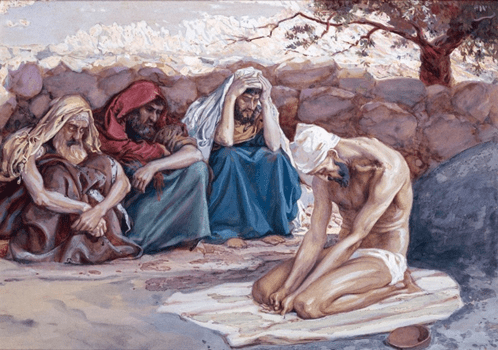
“When three of Job’s friends heard of the tragedy he had suffered, they got together and traveled from their homes to comfort and console him. Their names were Eliphaz the Temanite, Bildad the Shuhite, and Zophar the Naamathite. When they saw Job from a distance, they scarcely recognized him. Wailing loudly, they tore their robes and threw dust into the air over their heads to show their grief. Then they sat on the ground with him for seven days and nights. No one said a word to Job, for they saw that his suffering was too great for words.”

If you’ve ever read the Book of Job before, you might have found yourself thoroughly irritated with Job’s friends and the arrogant nature of the advice they give him later; however, look at their initial response. These three men tear their clothing, ruining it, and throw dust into the air over their heads. Next these men sit on the ground with Job seven days and nights without saying anything.

Compare the response of Job’s three friends to the responses we generally give to someone else’s grief. First, none of us are about to tear any of our clothing, let alone throw dust on our heads. We might send text messages or emails or show up at the house of the grieving family with food. These men sit for a full week on the ground without saying anything. What an amazing response! By spending this time quietly sitting with Job, these men are witnesses that they feel his pain and are grieving with him. It’s likely that 99.99% of us when given the opportunity will furnish all kinds of unwanted and/or unnecessary advice, much of it starting with foolish statements such as “I know how you feel.” Rubbish! Grief is an individual matter and none of us knows precisely how someone else feels.  

Although none of these men is Jewish as far as we know, the ritual of Shiva that Job and his friends are going through is one commonly practiced by Jews since Bible times. Here is what Wikipedia says about Shiva.  “Shiva is the week-long mourning period in Judaism for first-degree relatives. The ritual is referred to as “sitting shiva” in English. The shiva period lasts for seven days following the burial. Following the initial period of despair and lamentation immediately after the death, shiva embraces a time when individuals discuss their loss and accept the comfort of others.[1]

Its observance is a requirement for the parents, siblings, spouses, and children of the person who has died. At the funeral, mourners wear an outer garment that is torn before the procession in a ritual known as keriah. In some traditions, mourners wear a black ribbon that is cut in place of an everyday garment.[2][3] The torn article is worn throughout the entirety of shiva. Typically, the seven days begin immediately after the deceased has been buried. Following burial, mourners[4] assume the halakhic status of avel (Hebrew: אבל, ‘mourner’). This state lasts for the entire duration of shiva.

It is necessary for the burial spot to be entirely covered with earth in order for shiva to commence. During the period of shiva, mourners remain at home. Friends and family visit those in mourning in order to give their condolences and provide comfort. The process, dating back to biblical times, formalizes the natural way an individual confronts and overcomes grief. Shiva allows for the individual to express their sorrow, discuss the loss of a loved one, and slowly reenter society.[

Job’s friends make a good beginning by just being with him in his anguish and not offering quick solutions. Too bad they don’t continue in this vein. As we go through the Book of Job, let’s remember that these men are friends and also remember that we too can wound people in the name of friendship.

PRAYER: Father God, thank You for loving us and caring for us. Lord, help us to be sensitive to the griefs of others and to encourage rather than discourage them. In the mighty and precious Name of King Jesus. Amen.

JULY 19, 2025 WHEN TRAGEDY STRIKES, HOW DO WE RESPOND #2 HOW DO YOU FACE LOSS OF WEALTH OR FAMILY?

July 19, 2025

Job 1 Prologue

“There once was a man named Job who lived in the land of Uz. He was blameless—a man of complete integrity. He feared God and stayed away from evil. He had seven sons and three daughters. He owned 7,000 sheep, 3,000 camels, 500 teams of oxen, and 500 female donkeys. He also had many servants. He was, in fact, the richest person in that entire area.

Job’s sons would take turns preparing feasts in their homes, and they would also invite their three sisters to celebrate with them. When these celebrations ended—sometimes after several days—Job would purify his children. He would get up early in the morning and offer a burnt offering for each of them. For Job said to himself, “Perhaps my children have sinned and have cursed God in their hearts.” This was Job’s regular practice.”

Personally, I vote with Pastor Swindoll, that Job himself is telling this story. Does Job keep a diary during his suffering? We don’t know. We do know that Job belongs to a culture and an era that values memorization of large amounts of material, so perhaps Job memorizes everything and writes it down later. But if this is Job telling his own story, he would definitely know all the details of his family and his wealth, and he would be fully aware of the steps he was taking to try to purify his children. But there’s a problem.

Can we purify someone else, even a beloved child? Each one of us must stand before God individually and answer to God for ourselves. All that we can do is to try to teach our children the way to God and set an example by our actions. Certainly, Job is setting an example; however, are Job’s kids relaxing, assuming that they can coast along on their father’s holiness? Sadly, that doesn’t work. And although most young people secretly believe they’re immortal, young people can die in disasters.

Job’s First Test

“One day the members of the heavenly court came to present themselves before the Lord, and the Accuser, Satan, came with them. “Where have you come from?” the Lord asked Satan.

Satan answered the Lord, “I have been patrolling the earth, watching everything that’s going on.”

Then the Lord asked Satan, “Have you noticed my servant Job? He is the finest man in all the earth. He is blameless—a man of complete integrity. He fears God and stays away from evil.”

Satan replied to the Lord, “Yes, but Job has good reason to fear God. You have always put a wall of protection around him and his home and his property. You have made him prosper in everything he does. Look how rich he is! But reach out and take away everything he has, and he will surely curse you to your face!”

“All right, you may test him,” the Lord said to Satan. “Do whatever you want with everything he possesses, but don’t harm him physically.” So Satan left the Lord’s presence.

One day when Job’s sons and daughters were feasting at the oldest brother’s house, a messenger arrived at Job’s home with this news: “Your oxen were plowing, with the donkeys feeding beside them, when the Sabeans raided us. They stole all the animals and killed all the farmhands. I am the only one who escaped to tell you.”

While he was still speaking, another messenger arrived with this news: “The fire of God has fallen from heaven and burned up your sheep and all the shepherds. I am the only one who escaped to tell you.”

While he was still speaking, a third messenger arrived with this news: “Three bands of Chaldean raiders have stolen your camels and killed your servants. I am the only one who escaped to tell you.”

While he was still speaking, another messenger arrived with this news: “Your sons and daughters were feasting in their oldest brother’s home. Suddenly, a powerful wind swept in from the wilderness and hit the house on all sides. The house collapsed, and all your children are dead. I am the only one who escaped to tell you.”

Job stood up and tore his robe in grief. Then he shaved his head and fell to the ground to worship. He said, “I came naked from my mother’s womb, and I will be naked when I leave.
The Lord gave me what I had, and the Lord has taken it away. Praise the name of the Lord!” In all of this, Job did not sin by blaming God.”

WOOF! In a few brief hours Job loses most of his servants and all of his camels, oxen, donkeys, and sheep through marauding bands and lightning strikes. Now Job learns that all his children have died when the house they were in collapsed during a tornado. When Job got up that morning, he was happy, healthy, and wealthy. Now he is destitute and grieving over the loss of his seven sons and three daughters, not to mention the servants who have also died. If Job is an animal lover, he might also be grieving over the loss of those animals. How much grief can one man stand?

Fortunately for Job, social media did not exist at this time; otherwise, Job’s suffering might have been far worse. News pundits would have been trying to interview everyone in the household-“Exclusive! Job’s servant reveal that his animals were grazing in an endangered area!” “Were these deaths really necessary? An analysis of the house where Job’s children died.” “I alone escaped! The harrowing details given by one of Job’s most trusted servants.” “Rich man but poor decisions-Did Job sufficiently protect his property?”

In the wake of the flooding in various parts of Texas, people in other parts of the world have reveled in criticizing everything and everybody, including the poor weather forecasters, who did their best under horrible circumstances. At least in Job’s day, people were willing to accept tragedies as just that, tragedies. These days, blaming and shaming has become the name of the game. It is eerily reminiscent of practices in remote villages in Ghana where as soon as someone dies, sooth sayers begin trying to ascertain which old lady in the village has performed witchcraft to kill that person.

Job responds beautifully; he tears his robe in grief, shaves his head, and then falls to the ground and worships God. “The Lord gave me what I had, and the Lord has taken it away. Praise the name of the Lord!” One of our village friends had a bright son in university. The young man was not only a diligent student but also a fine Christian and a leader in his local church. The morning after this young man suddenly died from liver failure due to Hepatitis B, this man’s father, a strong Christian, quoted Job’s words.

Repeatedly, I have argued with God when young patients have died. And repeatedly, God has reminded me that the day each of these patients was born, He already knew the day they would die. Isaiah 55:8-9 tells us, “My thoughts are nothing like your thoughts,” says the Lord.
  “And my ways are far beyond anything you could imagine. For just as the heavens are higher than the earth, so my ways are higher than your ways and my thoughts higher than your thoughts.”
One of our pastor friends who has gone to be with Jesus used to remind us that God is in management and that we are only in advertising.

How do we face unspeakable tragedies? In the end, we must either bless God or curse Him. The families of little girls who were swept away from their camp by the Texas floods are choosing to bless God and to establish foundations that will bless others. Let us follow their example!

PRAYER: Father God, thank You for loving us and caring for us. Lord, help us to trust Your sovereignty, even when tragedy strikes and to be grateful for all the years of blessings. In the mighty and precious Name of King Jesus. Amen.

JULY 18, 2025 WHEN TRAGEDY STRIKES, HOW DO WE RESPOND #1 INTRODUCTION TO THE BOOK OF JOB

July 18, 2025

Well, you never know what God is going to do! After completing the Pilgrim Psalms, I thought God wanted me to write about the fruits of the Spirit. But floods are raging in Texas, Oklahoma, Iowa, Illinois, and North Carolina. A huge fire has destroyed National Park Service Headquarters and several other buildings at the Grand Canyon. Photos of those lost in the Texas floods are dominating many news feeds. While we are demanding to know where God is in all these disasters, it’s time to take another look at the Book of Job. Pastor Chuck Swindoll in his Insight for Living teaching gives us this introduction to this complicated but important book. https://www.insight.org/resources/bible/the-wisdom-books/job

Who wrote the book?

The author of the book of Job is unknown. Several suggestions have been put forth as plausible authors: Job himself, who could have best recalled his own words; Elihu, the fourth friend who spoke toward the end of the story; various biblical writers and leaders; or many editors who compiled the material over the years. While there is no definitive answer, it was most likely an eyewitness who recorded the detailed and lengthy conversations found in the book. In Old Testament times, authors sometimes referred to themselves in the third person, so Job’s authorship is a strong possibility.

Who was Job? This wealthy landowner and father is one of the best-known biblical heroes. But we know little more than that he was stripped of everything, without warning, and that his faith was severely tested.

Where are we?

Though the text does not directly identify its setting, internal clues indicate that Job lived during the time of the patriarchs, approximately 2100 to 1900 BC. According to Job 42:16, Job lived an additional 140 years after his tragedies occurred, perhaps to around 210 years total. His long lifespan generally corresponds to that of Terah (Abraham’s father), Abraham, Isaac, and Jacob. Also, Job’s wealth was measured in livestock (Job 1:342:12), as was Abraham’s (Genesis 12:16). Like the patriarchs, Job used God’s unique title “El Shaddai” (God Almighty). The book of Job does not mention the Mosaic Law; indeed, Job’s daughters were equal heirs with his sons, and Job himself, though not a priest, offered sacrifices—things not possible under the Law (Leviticus 4:10Numbers 27:8). Though we cannot be certain, Job may have lived during the time of Jacob or shortly thereafter.

Job lived in the land of Uz (Job 1:1), but no one really knows where Uz was located. Scholars believe it was outside of Canaan, near the desert because “the customs, vocabulary, and references to geography and natural history relate to northern Arabia.”

Why is Job so important?

The Israelites categorized Job within their wisdom literature. The book includes language from ancient legal proceedings, laments, and unique terms not found elsewhere in the Bible. In addition, the majority of Job is written in parallel lines which are indicative of poetry.

The book delves into issues near to the heart of every human who experiences suffering. The prologue provides a fascinating peek into the back story—why God allowed Satan to afflict Job with such pain and turmoil. Then, through a series of dialogues and monologues arranged in a pattern of threes, human wisdom attempts to explain the unexplainable, until finally God Himself speaks.

The final chapters of Job record God’s masterful defense of His majesty and unique “otherness”—of God’s eternal transcendence above creation—in contrast with Job’s humble and ignorant mortality. “Where were you when I laid the foundation of the earth? / Tell Me, if you have understanding” (Job 38:4).

What’s the big idea?

Job’s plight of undeserved suffering compels us to ask the age-old question, “Why do bad things happen to good people?” The answer given to Job may or may not satisfy the reader. God allows pain for good reason, but He may never reveal those reasons.

Job did not reject God, but Job did challenge and accuse Him. The Almighty quieted Job decisively when He finally thundered His own perspective on the situation. God did not answer Job’s question of “Why?”—He instead overwhelmed Job and his friends with the truth of His majesty and sovereignty. Job came away with a deeper sense of God’s power and splendor, trusting Him more:

“I have heard of You by the hearing of the ear;
But now my eye sees You;
Therefore I retract,
And I repent in dust and ashes.” (
Job 42:5–6

How do I apply this?

Pain inevitably afflicts each one of us. Suffering is unavoidable in this life. Will your relationship with God be enough when trials come? Will you trust Him through your suffering? Read Job 38–42. Spend time with the Almighty. Pray for a stronger faith in the powerful Creator described in those chapters. Pray for a right perspective of Him so that you might see your situation through His eyes.

Instead of asking where God is in the midst of your pain, the book of Job affirms God’s control and asks us, “Where are we in our pain? Are we trusting our Creator, even though we cannot understand our circumstances?”

Job is neither a simple book nor an easy one, but there are lessons we need to learn from it. So, come to the Land of Uz, where we are about to meet a very wealthy landowner, even a prince, named Job.

PRAYER: Father God, thank You for loving us and for caring for us. Lord, help us to learn as much as we can from the Book of Job, knowing that there will always be more for us to gain as we continue with You. We ask this in the mighty Name of King Jesus. Amen.

JULY 17, 2025 WE’RE ALL PILGRIMS HEADED SOMEWHERE #15 WHAT’S KEEPING YOU UP AT NIGHT?

July 17, 2025

Psalm 134 Praise to God in His Temple

A song for pilgrims ascending to Jerusalem.

“Oh, praise the Lord, all you servants of the Lord, you who serve at night in the house of the Lord.
Lift your hands toward the sanctuary, and praise the Lord.

May the Lord, who made heaven and earth, bless you from Jerusalem.”

Consider the priests on duty at the temple in Jerusalem. Obviously, these men were organized into shifts, including priests to offer prayers, singers, musicians, etc. Now think about what it was like in the temple during the daytime.

During the day, the temple would be packed with worshipers praying, making offerings and sacrifices, and meeting and greeting one another.Anyone working the day shift could look forward to an interesting and stimulating time. But what about night in the temple?

Once the evening prayers and sacrifices had been offered, things would be very quiet. There were lights that were to be kept burning at all times, and night workers would be responsible for ensuring that these lights were supplied with purest oil, that the wicks were properly trimmed, and that everything was in its place. But none of these duties would take very long, so what were the temple workers to do for the rest of the night? This psalm tells us that they were to “praise the Lord,” and that they were to “lift their hands toward the sanctuary and praise the Lord.”

We might imagine that even though music would have been softer than in the daytime, musicians would still have been playing, singers singing, and those assigned to special prayer would be praying.

There are several important things about this psalm. First, worship is to continue even when there’s no audience. These days, much of what passes for worship in many churches has actually become performance. Sadly, many lead singers behave as if they are auditioning for Christian music videos, not leading people into the throne room of God.  

Next, worship and prayer at night are particularly important. During the daytime, many of us are so distracted that even when we repeat prayers, we may be doing it by rote rather than by heart. But at night when things are quiet, it’s much easier to pray effectively and also much easier to hear the Holy Spirit. While the Holy Spirit may come as a rushing wind on occasion, it’s far more common for the Holy Spirit to speak very softly. Daytime events can make it impossible to hear the Holy Spirit. Remember that prayer is a two-way conversation, not a recitation. If all we are doing is dumping our problems and grievances on God without listening for His answers, we have accomplished nothing.

Yet another reason for nighttime prayer and worship is the spiritual danger many people find themselves in at night. When we are tired, Satan can appeal to our fatigue to lead us into self-pity, a useless endeavor that precludes hearing from God. Those wishing to hurt us may try to attack us in dreams. There have been many occasions when God has awakened me and ordered me to pray for people. Sometimes I eventually get feedback but many times, I do not. No matter. God is the One handing out prayer assignments. My job is to obey, not to argue.

When I can’t sleep, I do my devotional reading for the next day, assuming that I might be called out for a medical emergency at the time I would normally be doing devotions.

How can we hear from God at night? The prayer Eli told the boy Samuel to pray gives us the answer. “Speak, Lord, for your servant is listening.” We can also ask God to help quiet our hearts and minds so that we will hear His still small voice speaking in our minds.

Very few believers ever hear God speaking in an audible voice. I was once in a Bible study where several believers were testifying, saying, “God told me…..” After several of these testimonies, one sweet lady broke down and wept, saying, “You keep saying ‘God told me’ but God never tells me anything!” Sadly, this lady was legally blind and yet bravely took two different city buses to and from work each day. Obviously, God had to be guiding her, but she misunderstood our enthusiasm to mean that God was speaking to the rest of us audibly. It took quite a bit of time that night to let this lady see that she was receiving just as much guidance from God as the rest of us were.

There’s a meme that says, “If you can’t sleep, don’t count sheep. Talk to the Shepherd.” Find a quiet place. Spend time with God and ask Him to speak to you. Even if you don’t feel as if God has said anything to you, you will still find you have peace and you can go to sleep.

Psalm 4:8 tells us, “In peace I will lie down and sleep,
    for you alone, O Lord, will keep me safe.”
Come bless the Lord, lifting up your hands in worship. And then go to sleep, knowing that the Shepherd is keeping watch.

PRAYER Father God, thank You for loving us and caring for us. Lord, many of us feel helpless, confused, conflicted and exhausted. Please speak to the hearts of all who read these words, comforting them and letting them know that You are with them and that You will never leave them or forsake them. In the mighty and precious Name of King Jesus. Amen.
JULY 16, 2025 WE’RE ALL PILGRIMS HEADED SOMEWHERE #14 “GENTLEMEN, EITHER WE MUST ALL HANG TOGETHER OR WE WILL ALL HANG SEPARATELY!”

July 16, 2025

Psalm 133 Brotherly Fellowship and Unity

A song for pilgrims ascending to Jerusalem. A psalm of David.

“How wonderful and pleasant it is when brothers live together in harmony!
For harmony is as precious as the anointing oil that was poured over Aaron’s head, that ran down his beard and onto the border of his robe.
Harmony is as refreshing as the dew from Mount Hermon that falls on the mountains of Zion.”
And there the Lord has pronounced his blessing, even life everlasting.”

It was 1776 and in Philadelphia, representatives of the thirteen colonies were arguing over the Declaration of Independence. Finally, Benjamin Franklin, fed up with his fellow delegates told the assembly, “Gentlemen, either we must all hang together or we will all hang separately!” Faced with the reality possibility of dying at the hands of the British, delegates eventually signed, pledging “our lives, our fortunes, and our sacred honor.” Who were these individuals? What happened to the 56 men who signed the Declaration of Independence? What kind of men were they? Here is the information from https://ultimateflags.com/blog/56-men-pledge-our-lives-our-fortunes-and-our-sacred-honor/

The men were lawyers, jurists, merchants, farmers, large plantation owners; men of means, well educated. But they signed the Declaration of Independence knowing full well what they were putting at risk. They were British subjects at the time, and knew that the penalty for treason was death by hanging.

They were not wild-eyed, rabble-rousers, but mostly soft-spoken men of means and education. They had security, but valued liberty more. Each one surely had more to lose from revolution than he had to gain by it. But they stood tall, and unwavering and pledged:  

“For the support of this declaration, with firm reliance on the protection of the divine providence, we mutually pledge to each other, our lives, our fortunes, and our sacred honor.”

Here are the fates of the signers:

Nine fought and died from wounds or hardships during the war. Five were captured by the British, charged with treason, and were tortured before they died. Twelve had their homes ransacked and burned. Two lost their sons serving in the Revolutionary Army. Another had two sons captured. Several lost wives, sons, or entire families. One lost his 13 children. Two wives were brutally treated. All were at one time or another the victims of manhunts and driven from their homes. Seventeen lost everything they owned. Yet not one of them defected or went back on his pledged word.

Of note is the New Jersey Signer, Abraham Clark. He had two sons serving in the Revolutionary Army . They were captured and sent to the infamous British prison boat known as the hell ship “Jersey” in New York Harbor where 11,000 Americans were to die.

The sons received extra brutal treatment because of their father. One was in solitary and given no food. With the war almost over and won, no one could have blamed Abraham Clark if he had accepted the British offer of sparing his sons’ lives if he would recant and come out for the King and Parliament. Certainly, with utter despair and anguish in his heart and soul, his answer was “No.” The 56 signers of the Declaration of Independence proved by their every deed that they made no idle boast when they composed` that magnificent pledge. They ultimately gave us a free and independent America whose liberties should never be taken for granted.”

Galatians 5:22-23 tells us, “But the Holy Spirit produces this kind of fruit in our lives: love, joy, peace, patience, kindness, goodness, faithfulness,gentleness, and self-control. There is no law against these things!” No organization or corporation can function properly when members or workers are fighting and arguing. As soon as one faction begins speaking out, other factions will also begin complaining. Before long, petty grievances that have lain dormant for years are suddenly being aired.

The same thing can happen in families. As a physician, I must be extremely careful in the way I handle families losing a loved one. Any failure to communicate properly may result in some family members forming factions against others. I once cared for an elderly chief with a life-threatening condition who was recovering. But a struggle erupted between the traditionalists who believed the man was dying and were demanding he return to the village to die there and the educated members who realized the man might recover and who wanted him to remain in the hospital. Negotiating this situation strained every bit of my poor talents as a diplomat!

For harmony is as precious as the anointing oil that was poured over Aaron’s head, that ran down his beard and onto the border of his robe.” The anointing oil was made from very precious ingredients and its recipe guarded so closely that anybody foolish enough to duplicate the recipe could be put to death. That anointing oil carried a wonderful fragrance that penetrated every part of Aaron’s body as well as his garments. For the rest of his days, Aaron would carry that fragrance with him. When we are people of peace, we carry the fragrance of peace with us, and others will sense that peace as well.

Harmony is as refreshing as the dew from Mount Hermon that falls on the mountains of Zion.” Dew falls on Mount Hermon and then forms streams that flow down the mountainside and then come together to form the River Jordan. In a country where water is very precious, such dew will refresh and encourage all fortunate enough to experience it.

When we encounter people of peace, we find ourselves refreshed and relaxed. May God help us so that we ourselves will become people of peace!

PRAYER: Father God, thank You for loving us and caring for us. Lord, help us to become people of peace and to seek peace and pursue it. In the mighty and precious Name of King Jesus. Amen.