Archive for the ‘Uncategorized’ Category

SEPTEMBER 23, 2024 SO YOU WANT TO BE A DISCIPLE? #54 YOU MAY HAVE TO INTERRUPT YOUR PRAYERS AND DEVOTIONS TO SAVE LIVES

September 23, 2024

Matthew 14:22-33 Jesus Walks on the Sea

“Immediately Jesus made His disciples get into the boat and go before Him to the other side, while He sent the multitudes away. And when He had sent the multitudes away, He went up on the mountain by Himself to pray. Now when evening came, He was alone there. But the boat was now in the middle of the sea, tossed by the waves, for the wind was contrary.

Now in the fourth watch of the night Jesus went to them, walking on the sea. And when the disciples saw Him walking on the sea, they were troubled, saying, “It is a ghost!” And they cried out for fear.

But immediately Jesus spoke to them, saying, “Be of good cheer! It is I; do not be afraid.”

And Peter answered Him and said, “Lord, if it is You, command me to come to You on the water.”

So He said, “Come.” And when Peter had come down out of the boat, he walked on the water to go to Jesus. But when he saw that the wind was boisterous, he was afraid; and beginning to sink he cried out, saying, “Lord, save me!” And immediately Jesus stretched out His hand and caught him, and said to him, “O you of little faith, why did you doubt?” And when they got into the boat, the wind ceased. Then those who were in the boat came and worshiped Him, saying, “Truly You are the Son of God.”

FINALLY! Finally, Jesus is going to be able to pray by himself and hear from his Heavenly Father as to why John had to die and receive comfort from his Heavenly Father. Even while the disciples are still marveling over the miraculous feeding of thousands of people, Jesus urges them to get into the boat and begin the journey across the Sea of Galilee.

Jesus climbs up on a mountain overlooking the sea to pray and listen to God. But as Jesus is praying, he can feel the wind picking up from the east and he can hear the waves beginning to crash on the shore. The Sea of Galilee is long and narrow, and the mountains on either side form natural wind tunnels that funnel wind right onto the water, creating enormous waves that can easily swamp a small boat.

The Romans have divided the night into 3-hour long watches so that soldiers won’t fall asleep. The fourth watch is from 3 AM to 6 AM, and now the wind has really picked up and the waves are crashing over the disciples’ boat. If the winds had been favorable, the disciples would have reached the other shore by now, but they are stuck in the middle of the storm. Jesus realizes that he will have to do something to save these poor men who are only obeying his orders.

Jesus has wanted to be by himself to deal with his reaction to the death of John the Baptist. First, the crowds have made praying impossible and so Jesus has waited until night when everyone else is sleeping. Needing to be alone with God, Jesus has sent the disciples on ahead of him. But in the middle of Jesus’ prayers, he realizes that the disciples are in trouble. At this point, Jesus has a choice: continue praying or save the disciples. But if Jesus chooses to keep praying, what good are those prayers? God the Father is merciful, and Jesus must also merciful, so Jesus must decide that he has prayed enough and leave that mountain.

Jesus comes to the men by walking on the water, frightening them and inspiring awe. Peter impulsively jumps out of the boat and then has a lapse of faith, but Jesus takes his hand and lifts him back up. As soon as Jesus and Peter climb into the boat, the storm ceases. Only at this point do the disciples worship Jesus, proclaiming, “Truly, you are the Son of God!”

Crises don’t neatly schedule themselves, nor do they have the slightest regard for our sleep schedules. Times without number, I have hauled myself out of bed to operate on patients. In the years before we had a stand-by generator at the hospital, we might have to send our own small petrol generator to the hospital so we would have light in the theater (OR). As long as I am in Ghana, I can receive calls from any of the wards asking for orders or for advice. How can a disciple cope with such uncertainty? Ask God for strength and endurance. Through the years, I have prayed all kinds of “God! HELP!!!” prayers, and He has always answered and given me strength.

One aspect that is sometimes neglected by disciples is physical exercise. You cannot minister to people effectively if you don’t exercise regularly, chiefly because you won’t feel good enough to give of your best. Exercise also helps drain off the stress and results in endorphins that can boost your spirits. Periods of rest are also important. Sabbath rests allow us to recharge so that we can minister more effectively. When we are rested and refreshed, we can also respond more positively to emergencies, and for disciples of any kind, there are always emergencies. If you don’t take time to regenerate, you will feel as if “you are a Coca-Cola and everybody has a straw,” to quote one missionary’s grandfather.  

In the story, Jesus gave the disciples enough time to reach the other shore on their own before going to them at the third watch. It’s important to allow people to help themselves if they can, but it’s also important to intervene when necessary. Jesus could have given all kinds of excuses and remained on the mountain; however, he knew his Heavenly Father would not approve and therefore further prayers would be worthless. May God help us so that we can strike a balance between private devotions and public ministry!  

PRAYER: Father God, thank You for loving us and for caring for us. Lord, help us to follow hard after You all the days of our lives. Help us to love You better each day. Help us to respond to those in need of our help, realizing that ministry is also a form of active prayer. In the mighty and precious Name of King Jesus. Amen.
SEPTEMBER 22, 2024 SO YOU WANT TO BE A DISCIPLE? #53 YOU MIGHT HAVE TO MINISTER EVEN WHEN YOUR HEART IS BREAKING!

September 22, 2024

Matthew 14:1-21 John the Baptist Beheaded

“At that time Herod the tetrarch heard the report about Jesus and said to his servants, “This is John the Baptist; he is risen from the dead, and therefore these powers are at work in him.” For Herod had laid hold of John and bound him, and put him in prison for the sake of Herodias, his brother Philip’s wife. Because John had said to him, “It is not lawful for you to have her.” And although he wanted to put him to death, he feared the multitude, because they counted him as a prophet.

But when Herod’s birthday was celebrated, the daughter of Herodias danced before them and pleased Herod. Therefore, he promised with an oath to give her whatever she might ask. So she, having been prompted by her mother, said, “Give me John the Baptist’s head here on a platter.”

And the king was sorry; nevertheless, because of the oaths and because of those who sat with him, he commanded it to be given to her. So he sent and had John beheaded in prison. And his head was brought on a platter and given to the girl, and she brought it to her mother. Then his disciples came and took away the body and buried it, and went and told Jesus.

Jesus knew it was coming. Herod Antipas, also called Herod the Tetrarch, the ruler of Galilee, was a son of Herod the Great who had ordered the death of all the babies of Bethlehem at the time of Jesus’ birth. (Herod the Great died shortly after this wicked order.) Jesus’ cousin John was never shy, so when Herod Antipas insisted on taking his brother Philip’s wife, Herodias, for himself, John naturally spoke out. Infuriated, Herod longed to find some excuse to put John to death, even though he realized that John was a true prophet. That excuse came during Herod’s birthday celebration.

Herodias arranged for her nubile daughter to dance before Herod as part of the birthday party. Drunk with wine and lust, Herod promised the girl to give her whatever she asked, and Herodias promptly saw a means of destroying this pestilential prophet who had dared to criticize her adultery. John was beheaded and his head brought before the entire party on a platter for the girl to give to her mother. John’s disciples collected his body and went to inform Jesus. Meanwhile, Herod shook off his drunkenness long enough to realize that he had committed a heinous crime against a holy man who had only spoken the truth. Herod was sorry, but it was too late. John was dead and Herod’s crime would become one more wicked act perpetrated by his family.

Feeding the Five Thousand

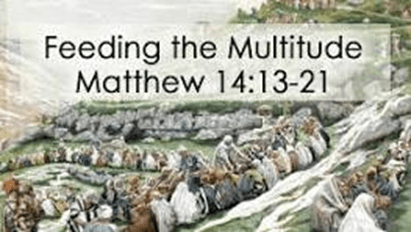
When Jesus heard it, He departed from there by boat to a deserted place by Himself. But when the multitudes heard it, they followed Him on foot from the cities. And when Jesus went out, He saw a great multitude; and He was moved with compassion for them, and healed their sick. When it was evening, His disciples came to Him, saying, “This is a deserted place, and the hour is already late. Send the multitudes away, that they may go into the villages and buy themselves food.”

But Jesus said to them, “They do not need to go away. You give them something to eat.”

And they said to Him, “We have here only five loaves and two fish.”

He said, “Bring them here to Me.” Then He commanded the multitudes to sit down on the grass. And He took the five loaves and the two fish, and looking up to heaven, He blessed and broke and gave the loaves to the disciples; and the disciples gave to the multitudes. So they all ate and were filled, and they took up twelve baskets full of the fragments that remained. Now those who had eaten were about five thousand men, besides women and children.

When Jesus received the news of John’s death, all he wanted to do was to withdraw to some remote and quiet place so he could grieve. John was not only Jesus’ cousin, but when Jesus’ mother Mary visited John’s mother Elizabeth, John had leaped in Elizabeth’s womb as he was filled with the Holy Spirit. John the Baptist had been fearless and faithful to the day of his death, only begging word from Jesus after he was imprisoned to make sure that Jesus really was the Messiah and that John’s labors had not been in vain. John was the one who had baptized Jesus and who had witnessed the Holy Spirit descending on Jesus in the form of a dove. John was the only one apart from Jesus who heard God the Father say, “This is my beloved Son., in whom I am well pleased.” Jesus and John may have met together many times to encourage each other. Now the one man who had never failed to believe in Jesus’ ministry was dead, and Jesus was hurting.

But even though Jesus and his disciples had withdrawn to a deserted and desolate area, the crowds who were watching followed them.  We don’t know if Jesus was sitting in a cave or on a hillside. All we know is that when Jesus saw the crowds, he had compassion on them and began healing their sick. At the close of the day, Jesus even fed 5,000 men plus women and children, perhaps 12,000 altogether, after multiplying five loaves of bread and two fish.

Many times, we might read the account of the miraculous multiplication of food and focus on this miracle without realizing that a greater miracle had already taken place, namely, Jesus’ willingness to minister in the face of his own grief. The demands of ministry don’t wait for us to be in excellent shape physically, mentally, emotionally, or spiritually. Many times, we might have to minister when we are sick, weak, depressed, and wrung out.

Make no mistake, many times, ministry costs dearly. A friend once asked Oral Roberts about the sacrifices he had made for his highly successful ministry. Roberts said that among others, he had had to refuse to have a normal social life so that he could spend time in prayer and Bible study. Once we say “yes” to God as disciples, we become God’s property and He gets to direct us.

In the fall of 2011, we knew my father was dying and that it was only a matter of time. We left America in September with my father’s blessing, knowing that we would never see him again this side of eternity. I begged God to allow me to close my father’s eyes when he died, even though I realized that might be impossible. At noon on December 16th, I suddenly felt severe chest pain that lasted for 30 minutes and then left as swiftly as it had come. A few hours later, I received an email from one of my brothers informing me of Dad’s death. When I worked out the time, I realized that God had allowed me to feel the pain of Dad’s last heart attack.

Our village was remote and travel to the capital city took time, let alone arranging for plane fare back to the U.S. In addition, this event took place during the Christmas season, a time when most doctors in small district hospitals returned to their home villages, sometimes for several weeks. I was the only doctor for our hospital, and I knew people would be counting on me to handle surgical emergencies. My husband and I decided that it would honor my dad more if we were to remain at post than if we were to struggle to return to the U.S. for the funeral.

During our time in our current station, I have sometimes had to perform emergency surgeries when I was on IV antibiotics for typhoid. I have pulled cannulas out of my hand so that I could scrub my hands to operate. In 1995 when I was recovering from hepatitis, I was so weak that I had to have one of the workers pick me to the hospital on the back of a bicycle. Blessedly, nobody has ever demanded that I feed several thousand people; however, there have been times when God has had to multiply our drugs and supplies to care for our patients.

If ministry costs so much, why do it? Because the rewards are literally out of this world. Eric Liddle, the Olympic champion and missionary to China told someone that when he ran, he could feel God’s pleasure. When we are fulfilling our callings, we know we are pleasing God and things feel right. Liddle told an audience, “Many of us are missing something in life because we are after the second best, I put before you what I have found to be the best – one who is worthy of all our devotion – Jesus Christ. He is the Saviour for the young and the old. Lord, here I am.” God is faithful, and when you commit to Him, he will never leave you or forsake you. If you are called to minister when you are weak or sick or grieving, God will give you the strength to do His work, even in your weakness. Is ministry worth the cost? Absolutely!

PRAYER: Father God, thank You for loving us and for caring for us. Lord, help all who read these words to dedicate themselves to You, knowing that You have already bought their salvation through the blood of Jesus Christ. We ask this in the precious Name of King Jesus. Amen.

SEPTEMBER 21, 2024 SO YOU WANT TO BE A DISCIPLE? #52 PREPARE FOR REJECTION BY YOUR NEAREST AND DEAREST!

September 21, 2024

Matthew 13: 53-58 Jesus Rejected at Nazareth

Now it came to pass, when Jesus had finished these parables, that He departed from there. When He had come to His own country, He taught them in their synagogue, so that they were astonished and said, “Where did this Man get this wisdom and these mighty works? Is this not the carpenter’s son? Is not His mother called Mary? And His brothers James, Joses, Simon, and Judas? And His sisters, are they not all with us? Where then did this Man get all these things?” So they were offended at Him.

But Jesus said to them, “A prophet is not without honor except in his own country and in his own house.” Now He did not do many mighty works there because of their unbelief.”

Until now, Jesus has been ministering all over the Galilee, using the homes of some of his disciples in Capernaum as a base of operations. Crowds in the thousands have been following Jesus everywhere he goes, to the point that he has to climb into fishing boats floating just off-shore so the people coming to hear him won’t crush him. Today he is back in Nazareth. The leaders of the synagogue are curious enough to allow him to teach, and everybody is amazed at his wisdom…but they are also perplexed and angry. What does Jesus mean by coming up with such great spiritual insights? Where does Jesus get the authority with which he teaches? 

Popular sentiment tends to support Jesus, but the “buts” start coming. “We should support Jesus because he’s a home town boy…but he is a carpenter…but…he is not from the tribe of Levi…but as far as we know, he has only had basic schooling. Sure, what Jesus is saying makes perfect sense and sure, he is giving incredible spiritual insights….but he shouldn’t be able to come up with such stuff! Where has Jesus gotten his material? Is somebody writing things for him to memorize and repeat in public? Why does Jesus think he’s so special?” The men in the crowd remember when they attended school with Jesus, and they certainly don’t have the depth of knowledge that Jesus is exhibiting.

No audience is harder to please than those with whom you’ve grown up in a small town. Generally, relatives represent an even harder audience because relatives remember when you were a naked infant crawling around on a blanket on the floor. There’s always some auntie who can regale onlookers with stories of how you spit up on her shoulder when she was burping you. Never mind that such stories have no bearing on what you have become; as far as relatives are concerned, familiarity definitely breeds contempt.

Then there’s the response from Jesus’ family members. Even though eventually many of the family are mentioned as followers, in the beginning, the family views Jesus as a major embarrassment. Frankly, Jesus’ brothers and sisters wish that he would stay home and keep  the carpenter shop going. Why does Jesus have to show off like this? Doesn’t Jesus understand his place in society?

Why is it so difficult to please a home town crowd containing many of your childhood friends and relatives? For those who have remained at home and who have not distinguished themselves in any way, a returning home town hero is proof that someone from those humble circumstances can make it big. But the corollary is this: if this person has distinguished himself/herself, why haven’t others from the same town or family done likewise? Because these people are allowing themselves to become offended at Jesus’ success, they cannot possibly accept the idea that he is the Messiah and therefore in a different class than they are. Humanity cannot possibly compete with divinity, but these people refuse to believe that Jesus can possibly be divine.

The people of Nazareth have heard about all the miracles Jesus has been doing-healing lepers, raising the dead, opening blind eyes, dumb lips, and closed ears, and restoring withered limbs to wholeness. Now these people are expecting Jesus to put on a show for them; perhaps if he does enough miracles, they MIGHT consider believing in him. But there’s a major problem: unbelief. The people of Nazareth want to be entertained, but their “knowledge” of Jesus blocks their ability to believe that he can actually work miracles. Matthew tells us, “But Jesus said to them, “A prophet is not without honor except in his own country and in his own house.” Now He did not do many mighty works there because of their unbelief.”

Notice something: it does not say that Jesus did not do ANY mighty works. Somewhere in the back streets of Nazareth, there were humble people who did believe, and for them, Jesus did accomplish miracles. Jesus was in his home town, knowing the lame, the blind, the deaf and dumb, and the lepers. It’s quite possible that Jesus quietly stole away from the crowd of critics to help the poor who were not offended at him. For years, Jesus had longed to make things right for these people, and now God had given him the approval to do so. While the religious leaders in town were busy organizing a meeting and considering how to get rid of Jesus, Jesus was continuing to bring the Kingdom of God to those who would receive it. You can almost see Jesus stretching out his hand, “Zacharia, come here and let me touch you. You are freed from your leprosy; go report yourself to the priests as Scripture demands. Isaac, can you hear me now? Samuel, can you see those people over there? Mariam, speak to me and tell me what you are thinking?”

The Kingdom of God is unshakable and unstoppable; only unbelief can resist the spread of the Kingdom for a short time. But just as a river will flow around an obstacle, so God’s love will continue to flow also. What does this story tell potential disciples? We must realize that we too may face opposition and unbelief from the very people who feel they know us best. We must be sure of our calling and equally sure that God is inspiring us and moving us to minister; otherwise, when our family members begin to criticize, we might be tempted to quit.

When I received the call to be a missionary in a dream at the age of eleven, nobody else in my family believed me. I learned to keep such things to myself. When we finally began preparing for the mission field, close relatives demanded to know why we couldn’t just do good works at home rather than leaving for Africa. When God had us give away a car to a family who really needed it just as we were about to return to Ghana, my father demanded to know why we didn’t sell the vehicle to raise extra money. We could only answer that God had ordered us to give away the vehicle.

Those who become disciples in Muslim countries have a much worse time. Relatives may kill such people and boast about it, feeling that they are heroes of their faith. Being a disciple is not for the faint-hearted. No matter where you are, you must be sure of your calling.

PRAYER: Father God, thank You for loving us and for caring for us. Lord, help us to follow hard after You all the days of our lives, refusing to listen to critics who want us to abandon Your call. In the mighty and precious Name of King Jesus. Amen.

SEPTEMBER 20, 2024 SO YOU WANT TO BE A DISCIPLE? #51 WILL GOD REALLY SORT OUT GOOD PEOPLE FROM BAD PEOPLE?

September 20, 2024

Matthew 13: 47-50 The Parable of the Dragnet

“Again, the kingdom of heaven is like a dragnet that was cast into the sea and gathered some of every kind, which, when it was full, they drew to shore; and they sat down and gathered the good into vessels, but threw the bad away. So it will be at the end of the age. The angels will come forth, separate the wicked from among the just,and cast them into the furnace of fire. There will be wailing and gnashing of teeth.”

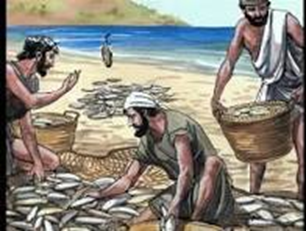
Jesus is probably walking along the seashore as he is talking with his disciples. As the crowd watches, local fishermen are sorting out the fish they have caught during the night. While some fish are highly desirable, there are other fish that are simply trash fish and are considered inedible. The fishermen are gathering up the good fish to sell while they are throwing the trash fish into a pile to be discarded. Jesus is using the normal activities of these fishermen as a teaching moment.

Jesus tells us that at the end of the age, God will sort out the righteous from the unrighteous, condemning the wicked to eternal damnation. We might ask why a holy and just God would condemn the wicked, but think about it. If God is truly holy and just, how can He possibly tolerate wickedness? And can truly wicked people tolerate God in His righteousness and holiness?

God by His very nature requires people to be righteous; however, the entire universe tilts on the axis of free will. God does not condemn anybody to hell, but people condemn themselves by their bad choices. But what about good people? How good must we be to meet God’s standards? Ah, there’s the problem! No matter how good we are, we can never be good enough because none of us is perfect.

The Message version of Romans 3:9-20 tells us, “There’s nobody living right, not even one,
nobody who knows the score, nobody alert for God. They’ve all taken the wrong turn;
they’ve all wandered down blind alleys. No one’s living right; I can’t find a single one.
Their throats are gaping graves, their tongues slick as mudslides. Every word they speak is tinged with poison. They open their mouths and pollute the air. They race for the honor of sinner-of-the-year, litter the land with heartbreak and ruin, don’t know the first thing about living with others. They never give God the time of day.”

But if this is the case for the entire human race, how will anyone ever be considered as righteous? This is where God has stepped in to deliver us from ourselves and from our sin. Again, The Message says, “But in our time something new has been added. What Moses and the prophets witnessed to all those years has happened. The God-setting-things-right that we read about has become Jesus-setting-things-right for us. And not only for us, but for everyone who believes in him. For there is no difference between us and them in this. Since we’ve compiled this long and sorry record as sinners (both us and them) and proved that we are utterly incapable of living the glorious lives God wills for us, God did it for us. Out of sheer generosity he put us in right standing with himself. A pure gift. He got us out of the mess we’re in and restored us to where he always wanted us to be. And he did it by means of Jesus Christ.

God sacrificed Jesus on the altar of the world to clear that world of sin. Having faith in him sets us in the clear. God decided on this course of action in full view of the public—to set the world in the clear with himself through the sacrifice of Jesus, finally taking care of the sins he had so patiently endured. This is not only clear, but it’s now—this is current history! God sets things right. He also makes it possible for us to live in his rightness.” Romans 3:21-26

Jesus Christ has become the ultimate blood sacrifice for the sins of the world; however, we must choose to believe in Jesus or turn away from him. When we turn away from Jesus, we are saying in effect that we think we are good enough to make it on our own. Such thinking is not only completely wrong but will damn us for eternity. Acts 4:12 tells us that There is salvation in no one else! Under all heaven there is no other name (apart from the Name of Jesus) for men to call upon to save them.”

An old Gospel song says, “He paid a debt he did not owe. I owed a debt I could not pay. I needed someone to wash my sins away.” Christians call Jesus their Savior because he has sacrificed himself to save them from their sins and from eternal damnation.

The one thing that is different about our situation from that of the fish in the net is that if we believe in Jesus Christ, we are certain of being kept as “good fish.” If we trust in our own goodness, we are doomed.

PRAYER: Father God, thank You for loving us and for caring for us. Lord, help all who read these words to choose to follow Jesus and to accept him as Savior. In the mighty and preious Name of King Jesus. Amen.

SEPTEMBER 19, 2024 SO YOU WANT TO BE A DISCIPLE? #50 HOW MUCH IS THE KINGDOM OF GOD WORTH TO YOU?

September 19, 2024

Matthew 13:44-46 The Parable of the Hidden Treasure

“Again, the kingdom of heaven is like treasure hidden in a field, which a man found and hid; and for joy over it he goes and sells all that he has and buys that field.

The Parable of the Pearl of Great Price

“Again, the kingdom of heaven is like a merchant seeking beautiful pearls,who, when he had found one pearl of great price, went and sold all that he had and bought it.

Jesus is telling these parables to his disciples to encourage them. The disciples have walked away from thriving businesses, comfortable homes, families who love them and who don’t understand what they are doing. The longer Jesus’ ministry goes on, the more likely it is that the religious authorities are going to conspire with the Romans to wipe out Jesus and his disciples as well. What can Jesus say that will encourage these men to remain faithful? These two parables are the answer.

Many of those hearing these parables will eventually pay with their lives for their commitment, but not before the good news of Jesus Christ’s sacrificial death and resurrection has begun spreading throughout the known world.

Unless you are a student of mission literature, you may never have heard of William Borden, but you should. Borden was born into a very wealthy family in Chicago in which prayer and Bible reading were daily events. At age seven Borden committed his life to Christ. By the time Borden began college at Yale, he was a deeply committed Christian. At Yale, Borden started prayer groups that eventually involved 1,000 of the 1300 students then at Yale. Using his family’s fortune, Borden founded the Yale Hope Mission to minister to the drunkards, tramps, and vagabonds of New Haven, a port city.

During Borden’s first year at Yale, he attended the Student Volunteer Movement conference in Nashville and heard Dr. Samuel Zwemer beg for workers to reach the huge Muslim population in China. Zwemer warned that responding to this call might result in the death of the missionary. Borden immediately began preparing to minister to the Chinese Muslims, earning a master’s degree in Theology from Princeton. Borden left America for Egypt in December 1912 to study Arabic in Egypt. While in Egypt, Borden began adapting national dress and circulated throughout the city where he was living with a family and learning Arabic.

Tragically, Borden died from spinal meningitis on April 9, 1913, barely five months after his arrival; however, he bequeathed one million dollars to China Inland Mission and other groups. In addition, Borden wrote three phrases in his Bible that sparked an enormous response from others. “No reserve. No retreat. No regrets.”  

Since Borden’s death more than a century ago, his story has continued to inspire thousands, if not millions, to answer the call of Christ to take the Gospel to the world. Only in eternity will we know how many people have come to a saving knowledge of Jesus Christ because William Borden turned his back on family wealth and position to go to Egypt.

John 12:24-26 tells us, “Most assuredly, I say to you, unless a grain of wheat falls into the ground and dies, it remains alone; but if it dies, it produces much grain.He who loves his life will lose it, and he who hates his life in this world will keep it for eternal life.If anyone serves Me, let him follow Me; and where I am, there My servant will be also. If anyone serves Me, him My Father will honor.”

Notice that when Jesus is telling these stories, he refuses to sugar coat things. Both the magnificent pearl and the field containing the treasure demand their buyers sell all they have first before they can gain the treasure. Jesus is warning all disciples-and would-be disciples-that being heralds of the Kingdom will cost them everything. But when disciples lay down their lives to follow Jesus, the reward will be eternal life.

 How did Jesus’ original disciples die? The writer of the Faith On Hill blog gives this answer: (https://www.faithonhill.com/blog/what-happened-to-the-12-disciples)

PETER-Peter was crucified around 66AD in Rome under the persecution of Emperor Nero. There are all kinds of unverified traditions about his death, most notably that he was crucified upside down because he didn’t consider himself worthy to die the same way Jesus did.

JAMES-James was the first of the 12 to be put to death. King Herod had him killed by the sword in Jerusalem (Acts 12).

JOHN-The writer of the Gospel of John, the book of the Revelation and three epistles bearing his name, John is the only one of the 12 that history says was not put to death for his faith, although he suffered greatly because of Jesus throughout his long life. Tradition says he ended his life ministering in the region around Ephesus in modern day Turkey and is buried there.

ANDREW-The brother of Peter, Andrew traveled north, bringing the good news to what is now Russia and the western regions of the former Soviet Union. He later traveled through modern day Turkey and Greece where he was martyred.

PHILIP-Philip ministered in North Africa and then Asia Minor. Traditions says that a Roman Proconsul was so enraged that his wife had converted to Christianity because of Philip’s preaching that he had Philip brutally put to death.

BARTHOLOMEW/NATHANIEL-Bartholomew was apparently someone who loved to travel. Some accounts have him going to India with Thomas, then Armenia before heading along the trade routes between Ethiopia and the southern Arabian regions. While we are not sure how he met his end, tradition agrees that he was martyred for his faith. In some places he is listed as “Nathaniel” which could have been a family name or a name he was known by in the church.

MATTHEW/LEVI-The gospel writer who had previously been a tax collector, Matthew traveled to modern day Iran and then down to Ethiopia, probably following established trade routes and preaching the gospel along the way. While some accounts do not include how he died, others say he was stabbed to death in Africa.

THOMAS-Although he doubted the resurrection at first, Thomas’ faith in the risen Jesus was strong enough to send him traveling east to Syria and Iraq to preach the gospel, eventually ending up in India were the Marthoma Christian tradition considers him to be their founder. The Marthoma tradition says that Thomas died by stabbing at the hands of four soldiers.

JAMES THE SON OF ALPHAEUS-Very possibly the brother of Matthew/Levi, James is believed to have preached in the regions north of Israel. A non-Christian historical account says that he was stoned and then clubbed to death

SIMON THE ZEALOT-Simon’s ultimate end is somewhat unclear. … there are non-biblical traditions regarding the apostles. In the 12th century, a Spanish bishop began to promote the idea that James had come to Spain, despite the account of James’ martyrdom in Acts 12. The same is true with Simon the Zealot with different groups and agendas making claim to Simon’s legacy. The majority view seems to be that Simon was sawn in half in Persia.

PHILIP-Little is known about Philip’s life after Acts 2…Tradition says that he preached in the Phrygia region of Asia Minor (modern day Turkey) and was martyred for his faith in Jesus in the town of Hierapolis.

JUDAS THADDEUS-The early church father Jerome called Jude “Trinomius” which means three names. Mark and Matthew list him by his family name “Thaddeus”, while Luke refers to him as Judas the brother of James. Some have tried to link him with Jude, the half-brother of Jesus who wrote the book of the same name but we reject this view. Tradition holds that he preached the gospel in the area we could think of as Northern Syria, Iraq and Turkey. He was said to have been killed with arrows in Turkey’s mountainous northern region.

MATTHIAS-Tradition says that Matthias traveled north, possibly as far as the Caspian Sea. He was martyred for his faith although the method of his death is unclear.

PAUL-Paul suffered for the Lord throughout his life. In addition to imprisonment and multiple threats to his life, Paul wrote in 2 Corinthians 11:25 that “Three times I was beaten with rods. Once I was stoned. Three times I was shipwrecked. Once I spent a whole night and a day adrift at sea.” Paul was beheaded in Rome in 66 AD, possibly at the same time as Peter.

JUDAS-Judas committed suicide after betraying Jesus. I mention this because every one of Jesus’ followers died. 10 of them as martyrs. John died of old age. But Judas chose a cursed path. He was not the only one who betrayed Jesus; all of the other disciples abandoned Jesus, Peter directly denied knowing him. Paul persecuted Jesus’ followers. Yet all of them embraced the grace and forgiveness of God and that same grace was available to Judas.

If you’ve read this and have ever felt like Judas, thinking there is no hope, you need to know that each and every apostle was at some point in a place of “no hope,“ but un like Judas they turned their eyes to Jesus and embraced his grace. The same is available to you.”

The disciples were just ordinary men until they met Jesus. William Borden might have become a captain of industry, might have married a society beauty, and might have sired a large family and added to their wealth. But once Borden met Jesus at the age of seven, he turned his life over to Jesus completely and from then on, his course was determined. Listen to the words from another missionary, Jim Elliot, martyred at the hands of Auca Indians in 1956. “He is no fool who gives what he cannot keep to gain what he cannot lose.”  

What will you give for the priceless treasure of eternal life? Say “yes” to God’s invitation! You will never regret it.

PRAYER: Dear Jesus, we want to give You our lives, but we are afraid. We fear for ourselves and for our families. Lord, help all who read these words to realize that when we turn our lives over to You, You give us everything we can possibly need and more, including eternal life. Help us to follow hard after You all the days of our lives. In Your mighty and precious Name, King Jesus. Amen.

SEPTEMBER 18, 2024 SO YOU WANT TO BE A DISCIPLE? #49 BEWARE LEAVEN! HUH? WHAT’S LEAVEN ANYWAY?

September 18, 2024

Matthew 13:33 The Parable of the Leaven

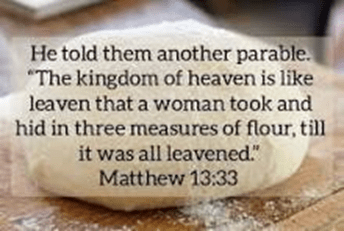
Another parable He spoke to them: “The kingdom of heaven is like leaven, which a woman took and hid in three measures of meal till it was all leavened.”

I began this study thinking that leaven could be a positive thing… Many commentators have used this verse to encourage Christians to spread throughout their society, pointing people to the Kingdom of God. But then I read David Guzik’s Enduring Word Commentary on this verse. Here is what Guzik says: “a. The kingdom of heaven is like leaven: Jesus used a surprising picture here. Many, if not most, regard this as a beautiful picture of the kingdom of God working its way through the whole world. Yet leaven is consistently used as a picture of sin and corruption (especially in the Passover narrative of Exodus 12:812:15-20). Again, both the content and the context point towards this being a description of corruption in the kingdom community.

i. “There would be a certain shock in hearing the Kingdom of God compared to leaven.” (Barclay)

b. Leaven, which a woman took and hid in three measures of meal till it was all leavened: This was an unusually large amount of meal. It was much more than any normal woman would prepare, and again suggests the idea of massive or unnatural size.

i. “Three measures of meal would be about 40 liters, which would make enough bread for a meal for 100 people, a remarkable baking for an ordinary woman.” (France)

c. Hid in it: The idea of hiding leaven in three measures of meal would have offended any observant Jew. This certainly isn’t a picture of the church gradually influencing the whole world for good. Rather, in the context of increasing opposition to His work, Jesus announced that His kingdom community would also be threatened by corruption and impurity.

i. G. Campbell Morgan wrote that the leaven represents “paganizing influences” brought into the church.”

What’s so bad about leaven? In Egypt, leaven was used to brew beer. When the Israelites escaped from Egypt, they didn’t have time for bread to rise, so they had to carry unleavened dough in their mixing bowls on their shoulders. In those days, housewives saved a small amount of dough, allowing it to absorb wild yeasts, and then using that as starter to make the next batch of bread, in effect baking sour dough bread.

1 Corinthians 5:1-8 describes a terrible situation in which a Christian has married his father’s wife, an act so abhorrent that it’s something not even the Gentiles would do. Paul goes on to say,” And you are puffed up (arrogant), and have not rather mourned, that he who has done this deed might be taken away from among you.” (Verse 2) Paul continues, “Your glorying is not good. Do you not know that a little leaven leavens the whole lump? Therefore purge out the old leaven, that you may be a new lump, since you truly are unleavened. For indeed Christ, our Passover, was sacrificed for us. Therefore, let us keep the feast, not with old leaven, nor with the leaven of malice and wickedness, but with the unleavened bread of sincerity and truth.” (Verses 6-8)

A key question for would-be disciples is this: Are you changing the world around you, or is the world changing you? We have a close Ghanaian friend who is a Muslim, and we discuss all kinds of things with him. One area in which Christian young people, particularly young Christian women, are falling short is the manner in which they dress. These days, it’s quite common to see pretty girls wearing short tight skirts and low-cut dresses to church in Ghana. If you question these young ladies, they will undoubtedly assert their right to dress anyway they wish; yet, for us, many of these outfits resemble those worn by prostitutes in the big cities. 1 Corinthians 6:18-19 tells us, “Flee sexual immorality. Every sin that a man does is outside the body, but he who commits sexual immorality sins against his own body. Or do you not know that your body is the temple of the Holy Spirit who is in you, whom you have from God, and you are not your own? For you were bought at a price; therefore, glorify God in your body and in your spirit, which are God’s.”

Nobody is demanding that these young women don burkas; however, it is quite possible to look attractive without appearing to be soliciting sexual partners. These girls are distracting men who have come to church to worship, inciting a spirit of lust instead of the Holy Spirit. In addition, when these girls insist on dressing in a blatantly provocative fashion, it is an instant turn-off to any Muslims who might be considering the claims of Christ.

One former Nigerian witch who eventually became a Christian has described church services she attended while she was still in witchcraft. Due to this woman’s spiritual sensitivity, she could walk into a church and see the demons that had accompanied many of the church members. When the congregation was singing about victory over Satan, the demons were laughing hysterically, for they knew that songs without commitment were mere entertainment. It’s likely that if one of these scantily clad young women were to attempt to lead spiritual warfare prayers, the demons would be laughing at her as well.

The question for all Christians is simple: are you influencing the world around you, or is the world influencing you? When I was growing up, I would sometimes attempt to wheedle favors from my mother using the argument that “everyone is doing it.” The instant response would be, “I don’t care about everyone else; you’re my child and you are not doing it.”

If we truly love God the Father, the Holy Spirit, and Jesus-if we truly love the Holy Trinity, we will refuse to do anything that might bring shame to their names or offend them. If we must argue that “everyone is doing it” and that we are merely going along with our society, then we are in trouble spiritually, mentally, physically, and emotionally.

Years ago, the chief of our town invited a fetish priestess to come in and prophesy over people. For the three days that the woman was in town, the spiritual atmosphere was heavy with the presence of evil. Despite warnings from local pastors, many Christian young people flocked to the chief’s compound to watch this woman perform, and one pastor’s son attempted to rape a girl while he was under demonic influence. Blessedly, the young woman was able to resist and the rape did not happen; however, had the young woman remained at home, she would never have been in danger in the first place.

These days, there are all kinds of movies and videos full of violence, sex, and witchcraft. Frequently, Christian parents allow their children to watch such filth, little realizing the damage they are inflicting on those children’s spirits. Such movies are another form of leaven.

The question for would-be disciples is simple: Are we out to change the world for Jesus, or will we allow the world to change us?

PRAYER: Father God, thank You for loving us and for caring for us. Lord, stop us when we begin compromising and trying to resemble the world around us. Help us to run away from corruption, not embrace it. Let Your light shine through us so that people will be drawn to You. In the mighty and precious Name of King Jesus. Amen.
 

SEPTEMBER 17, 2024 SO YOU WANT TO BE A DISCIPLE? #48 YOU MIGHT BE A MUSTARD SEED! DON’T LIMIT GOD!

September 17, 2024

Matthew 13:31-32 The Parable of the Mustard Seed

Another parable He put forth to them, saying: “The kingdom of heaven is like a mustard seed, which a man took and sowed in his field, which indeed is the least of all the seeds; but when it is grown it is greater than the herbs and becomes a tree, so that the birds of the air come and nest in its branches.”

There once was a cobbler in a small village in England named William Carey. As this small man was pursuing his village life, he began learning languages, teaching himself Latin, Greek, Hebrew, Italian, Dutch, and French. He would frequently read books in these languages while working on shoes. Carey was also quite active in his local church, becoming both a school master and a pastor. After reading Jonathan Edwards’ account of the life of David Brainerd and other Puritan missionaries in America, Carey realized that Christians were obligated to spread the Gospel throughout the world. Carey authored a book entitled An Enquiry into the Obligations of Christians to use Means for the Conversion of the Heathens. This book is regarded as the manifesto for modern missions.

Not content with writing, teaching, and ministering in England, Carey eventually went to India as a missionary where his work flourished. Not only was Carey a skilled botanist who helped classify many of the plants in India, but he also was a minister, translator, social reformer and cultural anthropologist who founded the Serampore College and the Serampore University, the first degree-awarding university in India. Carey’s translations included the Hindu classic, the Ramayana, into English, and the Bible into Bengali, Punjabi, Oriya, Assamese, Marathi, Hindi, and Sanskrit. Truly, Carey was a mustard seed that grew into an enormous tree.

Mary Slessor was a small Scottish Presbyterian missionary who went to Nigeria in 1876. Within a few years, Slessor left the missionary compound to live with the local people whose languages she spoke fluently. Slessor eventually moved even further inland, working to bring peace among tribes and also working to halt the practice of killing twin infants who were believed to be witches. At one point, the British government had a choice: they could send in 4,000 crack troops to settle a disturbance or they could call for Mary Slessor. Mary settled the matter by calmly knitting and listening while all those involved in the dispute spoke at length. Finally, Mary uttered her decision, and the problem was solved.

Both Carey and Slessor were mustard seeds whose ministries became enormous blessings to those around them and to the world. Both of these people came from humble beginnings but allowed God to use them mightily. But God is no respecter of persons-He will use anybody who will make themselves available. When we first went to Ghana, veteran missionaries assured us that God was not nearly so concerned about our ABILITY as He was about our AVAILABILITY.

As long as you love God and are willing to serve Him wherever He sends you, He can make you a mustard seed that will become a tree to bless all those around you. Don’t look at yourself and despise whatever gifts you might have. One career missionary friend was happy when he was assigned to Ghana in the 1940’s because Ghana was English-speaking and he was certain that he could never learn tribal languages. Before this man left the mission field 30 years later, he spoke seven northern Ghanaian languages perfectly and also played some of the local instruments. God always is planning to use us in ways that we cannot imagine.

PRAYER: Father God, thank You for loving us and for caring for us. Lord, here we are. We give you ourselves, our resources, and everything we have. Please use us as You wish. In the mighty and precious Name of King Jesus. Amen.
SEPTEMBER 16, 2024 SO YOU WANT TO BE A DISCIPLE? #47 DON’T DESTROY THE WHEAT WITH THE WEEDS!

September 16, 2024

Matthew 13:24-30 The Parable of the Wheat and the Tares

Another parable He put forth to them, saying: “The kingdom of heaven is like a man who sowed good seed in his field; but while men slept, his enemy came and sowed tares among the wheat and went his way. But when the grain had sprouted and produced a crop, then the tares also appeared. So the servants of the owner came and said to him, ‘Sir, did you not sow good seed in your field? How then does it have tares?’ He said to them, ‘An enemy has done this.’ The servants said to him, ‘Do you want us then to go and gather them up?’ But he said, ‘No, lest while you gather up the tares you also uproot the wheat with them. Let both grow together until the harvest, and at the time of harvest I will say to the reapers, “First gather together the tares and bind them in bundles to burn them, but gather the wheat into my barn.”

Anyone wishing to be a disciple should study this parable very closely. Jesus is describing those who accept the message of the Kingdom of Heaven who are mixed in with those who do not. The problem is that many times, we have no idea which is which. We assume that because someone attends church and is active in church programs, that person must automatically be a strong Christian. But that might not be the case.

As a young man, a pastor friend of ours was a highly successful businessman, and a faithful church member, even serving on the church board; however, he had never actually made Jesus Lord of his life, nor did he realize that he needed to do so. Our friend’s life changed the Sunday that speakers for a Lay Witness Mission came to his church to give their testimonies. Standing at the back of the church listening, our friend suddenly realized that he was NOT a Christian, but only a church member. Our friend went forward, committing his life to Christ. Shortly after that conversion, our friend left the business world to attend seminary and become a pastor.

By the time we knew this man, he had been a successful pastor for several years; yet, before his conversion, he would have counted as a weed in this parable, even though he appeared to be a wheat plant. We also have a friend who loves motorcycles and looks very menacing; yet, he has gone to Sturgis, South Dakota several times to witness to those attending the annual bikers’ gathering. Our friend looks very much like a weed, but he is actually part of the wheat.

Why is this short parable so important? Many of us judge by appearances while God knows people’s hearts. In the parable, the land owner wisely refuses to allow his servants to try to uproot the weeds, fearing that the roots of the weeds are intertwined with those of the wheat. Tear up the weeds and you might also tear up the wheat before it’s ready to harvest.

How should disciples proceed? We must view everyone as “potential wheat; that is, as a potential citizen of God’s Kingdom.” Disciples should always exhibit the character of Jesus, who had no problems socializing with the dregs of society. But Jesus knew that those people were just as hungry for God as anyone else; they simply needed someone to show them the way.

Galatians 5:22-23 tells us that the fruits of the Holy Spirit are love, joy, peace, patience, kindness, goodness, faithfulness, gentleness, and self-control. As disciples, these are the characteristics that we are to exhibit to all those around us. May God help us so that we will continue to see people as He does-seekers after God who only need someone to point them in the right direction and to assist them to find God so that He can change them from weeds to wheat.

PRAYER: Father God, thank You for loving us and for caring for us. Lord, help us to remember that all those around us are potential citizens of Your Kingdom and to treat them as such. Help us to continue to point people to You. In the mighty and precious Name of King Jesus. Amen.

SEPTEMBER 15, 2024 SO YOU WANT TO BE A DISCIPLE?#46 YOU ARE TO SOW THE WORD – RESULTS MAY VARY

September 15, 2024

Matthew 13:1-23 The Parable of the Sower

“On the same day Jesus went out of the house and sat by the sea. And great multitudes were gathered together to Him, so that He got into a boat and sat; and the whole multitude stood on the shore.

Then He spoke many things to them in parables, saying: “Behold, a sower went out to sow. And as he sowed, some seed fell by the wayside; and the birds came and devoured them. Some fell on stony places, where they did not have much earth; and they immediately sprang up because they had no depth of earth. But when the sun was up they were scorched, and because they had no root they withered away. And some fell among thorns, and the thorns sprang up and choked them. But others fell on good ground and yielded a crop: some a hundredfold, some sixty, some thirty. He who has ears to hear, let him hear!”

The Parable of the Sower Explained

Matthew 13:18-23 “Therefore hear the parable of the sower: When anyone hears the word of the kingdom, and does not understand it, then the wicked one comes and snatches away what was sown in his heart. This is he who received seed by the wayside. But he who received the seed on stony places, this is he who hears the word and immediately receives it with joy; yet he has no root in himself, but endures only for a while. For when tribulation or persecution arises because of the word, immediately he stumbles. Now he who received seed among the thorns is he who hears the word, and the cares of this world and the deceitfulness of riches choke the word, and he becomes unfruitful. But he who received seed on the good ground is he who hears the word and understands it, who indeed bears fruit and produces: some a hundredfold, some sixty, some thirty.”

Jesus is telling stories, and there are so many people that he sits in a boat moored just off shore so that the crowd won’t crush him. Now Jesus is describing a scene common to everyone who lives in a rural area with little arable land. In the area where Jesus is speaking, the fields are small with good soil mixed in with lots of rocks. All that farmers can do is to scatter seed throughout the fields and then wait to see what grows up.

There are paths through the fields, so some seed naturally falls on the paths, where the birds eagerly gobble it up. Some seed falls on rocks resulting in plants that spring up but that shrivel in the sun. Some seed falls among the thorns that are impossible to eradicate, and the thorns grow faster than the plants, choking the plants. If a farmer is lucky, most of the seed will fall on good soil, rewarding the farmer for his hard work.

When the disciples demand an explanation for this parable, Jesus explains that he is describing the manner in which various groups of people will respond to the Gospel, the word of the kingdom. What the disciples fail to realize at this point is that Jesus is advising them on the manner in which people will respond to news of his death and resurrection.

As modern disciples, we have the advantage of viewing the parable from the experiences of two millenia. There’s a warning label that is common on some products: “Results may vary.” Here Jesus is warning his disciples, present and future, about the variability of people’s responses to the Gospel.  

Why should we as disciples study this parable closely? First notice that the sower goes out and spreads the seed throughout the entire field, regardless of beaten paths, rocks, thorns, or poor soil. The sower works hopefully, for who knows which seed might germinate and produce? Sometimes seed sown in poor soil or among rocks or thorns proceeds to yield anyway.

Nicky Cruz came from a family in Puerto Rico that practiced spiritualism. Cruz’s mother used to call him “son of Satan.” The family sent Cruz to live in New York City with his brother when he was 15; however, Cruz soon began living on the streets and became a gang leader. When David Wilkerson, a gangling young pastor from a small town in Pennsylvania, suddenly turned up and began spreading the Gospel, Cruz told him, “You come near me and I’ll kill you!” David Wilkerson replied, “Yeah, you could do that. You could cut me up into a thousand pieces and lay them in the street, and every piece will still love you.” Despite everything, Cruz not only got saved himself, but led many other gang members to accept Jesus. Cruz went on to become a world-famous evangelist. Cruz has been described as “the Billy Graham of the streets.”

On the face of it, Cruz’s background was as stony and as thorny as possible; yet, God reached down and saved him. Stories such as this should cause disciples to remember that sometimes the most hopeless cases can turn into the biggest miracles.

One of our late pastor friends used to say that “We’re only in advertising while God’s in management.” Our business as disciples is to advertise Jesus whenever and wherever we go, regardless of the circumstances. We have no idea when a simple prayer or a loving touch will result in someone coming to a saving knowledge of Jesus Christ.

Simon Peter summed it up well when he said that “There is no other name under heaven given among men by which we must be saved.” (Acts 4:12) Nothing we can do will earn our way into heaven because each one of us has a sin problem that we cannot overcome by ourselves. But Jesus Christ has died on a cross, shedding his blood for our sins so that those of us who believe in him can have eternal life.

No matter what the condition of your life is, you can become a disciple, a follower of Jesus, and the possessor of eternal life. Let’s pray.

PRAYER: Father God, thank You for login us and for caring for us. Lord, we confess that we are sinners and that nothing we do is good enough to make up for those sins. We beg you to forgive us. Thank you for sending Jesus Christ to die as a blood sacrifice in our place so that all of us who believe in him can have eternal life. Help us to follow hard after You all the days of our lives. In the mighty and precious Name of King Jesus. Amen.   

SEPTEMBER 14, 2024 SO YOU WANT TO BE A DISCIPLE?#45 IF YOU’RE A DISCIPLE, JESUS BECOMES YOUR BROTHER

September 14, 2024

Matthew 12:46-50  Jesus’ Mother and Brothers Send for Him

“While He was still talking to the multitudes, behold, His mother and brothers stood outside, seeking to speak with Him. Then one said to Him, “Look, Your mother and Your brothers are standing outside, seeking to speak with You.”

But He answered and said to the one who told Him, “Who is My mother and who are My brothers?” And He stretched out His hand toward His disciples and said, “Here are My mother and My brothers! For whoever does the will of My Father in heaven is My brother and sister and mother.”

Jesus’ family has shown up to speak with him. Is this the first time the family has shown up when Jesus is ministering and teaching? Are they coming to admire him as he does miracles or are they coming because they are embarrassed and hope to get him to stop confronting the Pharisees? Are Jesus’ relatives worried that he is attracting too much attention from the Romans and that the Romans may seek to annihilate him and every member of the family? Which of those watching has taken it upon himself to inform Jesus that his family has come? Perhaps it is one of the Pharisees, hoping to escape Jesus’ questions by diverting his attention. Perhaps it is a nosy onlooker who wants to observe Jesus’ reaction so he can go off and gossip about it. We really don’t know what Jesus’ mother and brothers are thinking, but here they are.

Jesus seldom does the expected thing and today is no exception. While the crowd is expecting Jesus to stop speaking and go greet his family, Jesus turns this small incident into another teaching moment. “But He answered and said to the one who told Him, “Who is My mother and who are My brothers?”  By this point, everybody in the crowd is thinking, “HUH? Your family members are standing right there. Why ask such a question?”

“And He stretched out His hand toward His disciples and said, “Here are My mother and My brothers! For whoever does the will of My Father in heaven is My brother and sister and mother.”  WOW! This means that each of the disciples has now joined the Family of God, since Jesus is the son of a Heavenly Father.

If we overlook this short story, we are overlooking a precious truth. Very few of us come from families that are trouble-free. Many adults bear the scars of verbal, physical, emotional, mental, or sexual abuse that has taken place during childhood. In many families, love is conditional, based totally on the child’s performance as a student or athlete or musician or artist. Sometimes parents play favorites while other times, each child thinks that some other child is the parents’ favorite when such is not the case. In one family with twins, each twin thought the other was the father’s favorite because the father was unable to praise his sons to their faces. “Look at your brother! See how well he is doing!” The process of settling estates frequently brings hidden family tensions into the open, sometimes with disastrous results.

What if you could have a brother who loved you unconditionally, no matter how much you failed or how poorly you behaved? What if you could have a brother who would always support and encourage you, regardless of circumstances? What if this brother knew more about you than you knew about yourself and still loved you anyway? And what if this same brother could protect you from evil? “Great!” you say. “So what?” So Jesus!

If you become a follower of Jesus Christ, Jesus automatically becomes your brother, loving you unconditionally, knowing everything about you, encouraging you, helping you, protecting you, and guiding you. And this relationship is an eternal one. Brothers from your family of origin eventually die, but Jesus is the same yesterday, today, and forever. No matter where you go, no matter what you are doing, Jesus is always there.

With some earthly relatives, you have to be careful when you talk to them or when you call them. Call too early in the morning or too late at night and you’re automatically on the bad list. But Jesus is available 24/7 because he runs on eternal time, not on earthly time. Jesus lives in the Eternal Now.

You cannot shock Jesus; he’s seen everything and has always been there. Jesus was there when the first Christians were being martyred by being torn apart by lions in the arena or used as human torches to light Nero’s gardens. Jesus was there when earthquakes, typhoons, hurricanes, blizzards, and other disasters struck. When the twin towers fell on September 11, 2001, Jesus was there, guiding fire fighters and police officers to save lives as they gave up their own.

Jesus is there when you are young and healthy and hopeful. Jesus is there when middle age begins to creep up on you and you realize that you aren’t going to achieve everything you have hoped to accomplish. Jesus is there as you become a senior citizen and cope with new health challenges for your spouse, your children, and yourself. At the end of your life, however long or short that life might be, Jesus will be there, waiting to receive you into his heavenly kingdom.

That day when Jesus first uttered these words, his disciples must have been thrilled. Many of the disciples had left thriving businesses and families who were still puzzled at their choices. At least some of the disciples already realized that things might not end well. But to be a disciple and to have Jesus call them brothers was a gift beyond all price.

Today Jesus is offering you the same gift he offered those disciples so long ago. You can become Jesus’ brother or sister. What will it cost you? You must choose to follow Jesus and to allow him to be the ruler of your life. What will you gain? Love, joy, peace, patience, kindness, goodness, faithfulness, gentleness, self-control. These are the gifts of the Holy Spirit, and when you accept Jesus as Savior and Lord and as Brother, the Holy Spirit will come and live in your heart and help you become like Jesus. What will you lose? Fear, doubt, unbelief, misery, despair.

PRAYER: Father God, thank You for loving us and for caring for us. Lord Jesus, we give up our rights to ourselves and ask You to come into our hearts, to clean us up, and to make us like You. It’s in Your Name that we are asking this, Jesus. Amen.