
Exodus 21: 28 – 32 “If an ox gores a man or woman to death, the ox must surely be stoned, and its meat must not be eaten. But the owner of the ox shall not be held responsible. But if the ox has a habit of goring, and its owner has been warned yet does not restrain it, and it kills a man or woman, then the ox must be stoned and its owner must also be put to death. If payment is demanded of him instead, he may redeem his life by paying the full amount demanded of him. If the ox gores a son or a daughter, it shall be done to him according to the same rule. If the ox gores a manservant or maidservant, the owner must pay thirty shekels of silver to the master of that servant, and the ox must be stoned.“
When the Israelites left Egypt, the only animals they had with them were probably cattle, sheep, goats, and donkeys, plus possibly poultry. Of these animals, the only dangerous ones likely to attack people were the cattle because they were larger, stronger, could kick from any angle, and had horns. Strictly speaking, oxen are castrated male cattle and therefore unable to breed and to reproduce. It’s possible that the term “ox” here refers to any bovine, whether male or female.
God is trying to teach the Israelites that they must be responsible not only for their own actions but for the actions of their animals. There are several questions:
1. Does the animal have a reputation for having attacked people in the past? If this is the first time the animal has gored someone and killed them, the owner is not responsible; however, the animal will be killed and the owner cannot benefit by selling the meat for food.
2. If the animal is known to be vicious and the owner has been warned but has failed to adequately control the animal, the owner may pay with his life or else pay a heavy fine and he still loses the animal completely.
3. If the animal kills a child, the same rules still apply; the child has a right to life just as an adult does.
4. If the animal kills a servant, the animal must be put to death and the owner must pay blood money to the master of the dead servant. Servants are recognized as people of worth, and the death of a servant still demands payment of blood – guilt.
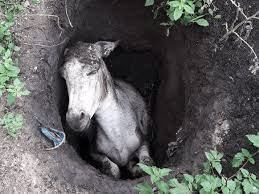
v. 33 – 34 “If a man opens or digs a pit and fails to cover it, and an ox or a donkey falls into it, the owner of the pit shall make restitution; he must pay its owner, and the dead animal will be his.
They called him “Shmuel the Fool.” Nobody cared to guess why Shmuel was digging pits in the desert. Was he looking for water? Was he trying to bury rubbish? Was he planning to store grain there? All anybody knew was that in the afternoon they saw Shmuel digging a hole, and the following morning one of the donkeys was missing. When they went to look for the donkey, it had fallen into the hole Shmuel had and had dug and had left open. The donkey had broken its neck! What a disaster! Now Shmuel was out the cost of a live donkey and he was also stuck with the body of a dead one! The modern equivalent might be someone who has a swimming pool but who fails to build a high enough fence with a locked gate around the pool.
v. 35-36 “If a man’s ox injures his neighbor’s ox and it dies, they must sell the live one and divide the proceeds; they also must divide the dead animal. But if it was known that the ox had a habit of goring, yet its owner failed to restrain it, he shall pay full compensation, ox for ox, and the dead animal will be his.” For farmers in those days, owning an ox was like owning a tractor and it was a major investment. To lose an ox could prove to be the financial undoing of an entire family, forcing them to sell themselves into slavery/servitude to survive. The principles at work here were those of fairness and justice, with judges trying to determine intent and negligence.
APPLICATION: Although it’s likely that none of us have ever owned an ox or a donkey, the principles of fairness and responsibility remain the same. God is trying to teach the Israelites that they are responsible for one another and must care for one another.
In the last year many major cities have been convulsed by violent demonstrations. Many times entire neighborhoods have been devastated, leaving local businesses in ruins and depriving the local citizens of basic services such as clinics, drug stores, grocery stores, banks, etc. Ironically, these demonstrators have claimed to care about the very groups whose businesses they have carelessly destroyed. The violent actions of these groups belie their assertions. While it is easy to criticize, we must ask ourselves how much do we really care about our neighbors? Do we really have their best interests at heart?
PRAYER: Father God, help us to care about those around us and to take responsibility for our actions. Help us to assess the potential damage we or our children or our pets might do to others and to be careful to act in the best interests of those around us. In the mighty and precious Name of King Jesus. Amen.


Leave a Reply