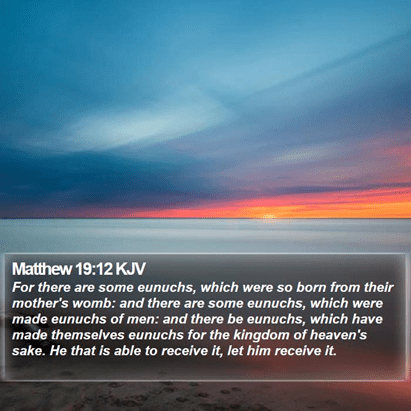
Matthew 19:11-12 Jesus Teaches on Celibacy
But He said to them, “All cannot accept this saying, but only those to whom it has been given:For there are eunuchs who were born thus from their mother’s womb, and there are eunuchs who were made eunuchs by men, and there are eunuchs who have made themselves eunuchs for the kingdom of heaven’s sake. He who is able to accept it, let him accept it.”
The disciples are forever plaguing Jesus with questions. In Jesus’ culture, proper Jewish men are supposed to marry and father children in response to the commands in Genesis to be fruitful and multiply. But what about those who for whatever reason cannot or do not father children? Jesus himself is unmarried and thirty when he begins his ministry. What the disciples are really getting at is this: “Jesus, we have left everything to follow you, including our wives. Some of us have not even married yet. All this time we could have been fathering children, but we have not done so. Where do we stand in the kingdom of God? What about those who are physically incapable of fathering children or those who have been castrated?”
Used to the Pharisees and the Sadducees assigning places in the religious hierarchy, the disciples assume that Jesus will do the same thing in his kingdom. The driving force behind the disciples’ questions is simple: they fear that they will be in the lower ranks of Jesus’ kingdom.
Jesus reassures the disciples and goes on to describe three different situations in which men might not father children. The first such situation is a man who is congenitally incapable of impregnating a woman. The second is the situation of those who have been castrated. Abhorrent as this practice sounds, sometimes young men would be castrated because castrated men were frequently employed in the harems of rulers where they obviously would not be tempted to have sex with the women in the harem. Sometimes men might incur testicular injuries. And then some men might feel so called to ministry that they would refuse to marry, choosing instead to focus all their time and energy on the work God has called them to do.
Ladies reading this passage might wonder, “Hey, Jesus! What about us? Some of us are childless as well. Where do we fit into the Kingdom of God?” Although Jesus is speaking to men in a male-dominated society, the same categories equally apply to women. Some women are physically strong and healthy but find themselves incapable of achieving pregnancy. Other women may be born with some problems that render them sterile while others must undergo the removal of uterus or ovaries for cancer, rendering them sterile. And then there is the example of nuns in various denominations who have chosen to remain celibate and have served sacrificially throughout their lives. But does childlessness mean someone is a poor disciple?
For many years in Ghana, we were friends with a childless missionary couple, Bill and Myra Chapman, whose ministry was unusually fruitful. Starting by establishing churches in remote areas, this couple went on to found a highly successful Bible school that has since developed into a major university. Although the Chapmans never had children of their own, every young person who came into their presence was automatically accepted as their son or daughter. In a culture where polygamy was rife and where it was common for parents to die at an early age, these young people were in dire need of effective and loving parents. The Chapmans filled that need gloriously. Physical childlessness moved the Chapmans to parent hundreds of young people, inspiring them and teaching them how to become good parents themselves. Only in heaven will we see the full results of this ministry.
I myself am childless, not by choice but by God’s choosing. For years, we have worked in very demanding environments. Throughout my career I have worked nearly 24 years as the only doctor or one of a few doctors in various mission hospitals. That work has been so strenuous that I could not possibly have parented children effectively. Failures as a mother might have rendered me emotionally incapable of fulfilling God’s call to heal the children of others. We have seen other missionary health workers struggle. One missionary doctor friend had to leave the field due to problems with his children and his marriage. Another friend changed from working as a surgeon to counseling to reduce the stress on his family.
The three keys of working as a childless disciple are acceptance, gratitude, and joy. First, we must accept the fact that we will never become physical parents. In cultures where childlessness is viewed as a curse, acceptance may be very difficult. Family members may criticize while colleagues may also be unkind. We must settle the matter with God and then refuse to listen to the critics. Obedience to God’s will is the key to spiritual peace and to acceptance of childlessness.
How can we be grateful for childlessness? In my case, I have realized the work God has given me would have been impossible had I borne children. Despite my state of barrenness, many Ghanaians call me “Mama.” I am grateful for the opportunity to save mothers and children so that other families will go on. I am grateful for the health workers whom I have inspired, who return to share their joys and triumphs with me. And I am grateful that God continues to call me to do even more.
How can we be joyful in childlessness? Again, it is the achievements of our spiritual children that justify our involvement in their lives. We can rejoice as we see these people progress, marry, and bear children of their own, realizing that we have helped make their success possible. And finally, there is the joy of knowing that we are fulfilling God’s perfect will for our lives. But we can only enter into this joy if we have already accepted childlessness and have become grateful for it.

God has no second-class disciples. No matter what God has called you to do or the state in which you find yourself, you can always be a first-class disciple. A slogan from a few decades ago ran “Bloom where you’re planted.” No statement could be truer. When we find ourselves in difficult circumstances, we glorify God when we bloom where He has planted us.
PRAYER: Father God, thank You for loving us and for caring for us. Lord, help those of us who are childless to realize that You are always sufficient and that You are always there for us. Help us to realize that we are surrounded by people who need parenting and that there is no upper age limit on that need. Help us to accept childlessness if that is You will for us, to be grateful that You are calling us to a particular work, and to be joyful, no matter where You place us or what You call us to do. In the mighty and precious Name of King Jesus. Amen.


Leave a Reply