Archive for November, 2024

NOVEMBER 30, 2024 HOW CAN WE POSSIBLY BE HOLY? #17 GOD GIVE ME PATIENCE, AND GIVE IT TO ME RIGHT NOW!

November 30, 2024

Galatians 5:22-23 “But the fruit of the Spirit is love, joy, peace, patience, kindness, goodness, faithfulness, gentleness, and self-control. Against such things there is no law.”

Patience is probably one of the most necessary virtues and the most difficult to practice. James 1:2-4 tells us, “My brethren, count it all joy when you fall into various trials, knowing that the testing of your faith produces patience. But let patience have its perfect work, that you may be perfect and complete, lacking nothing.”  

Most of us want to be more patient, provided we don’t have to suffer to achieve it. But if we believe James, we only learn patience when we suffer or are forced to wait.

This is an era of instant gratification. Thanks to smart phones, we no longer have to struggle in libraries to look up things but we can simply “Google” them. When radios and televisions first were available, a family would have one radio or one TV and everyone would have to decide which programs to listen to or watch. Now we can stream things on cell phones and computers. Through the 1950’s, most families only had one telephone and family members had to take turns using it. I grew up in a rural area in which we still had party line telephone service. Several families would be on one line, meaning that families had to take turns to make phone calls and the neighbors could listen in your phone calls. Want patience? Just be on a party line with a family that has a popular teen-age girl who will tie up the line for hours.

In those days, we shopped for clothing before school started, for Christmas presents, and perhaps for birthday or anniversary or graduation presents. Given time, my mom would order things from Sears and Roebuck or Montgomery Ward, mailing in her order along with a check. The Christmas catalogues from those two marketing giants gave us entertainment for weeks, not to mention later being recycled as targets for BB guns or even as toilet paper. We had to remain patient while waiting for those orders to arrive.

Growing up in a farm family also taught patience. Raising crops and animals, one never knows what might happen. One year, much of our hog crop was wiped out by TGE, a terrible diarrheal disease that hit baby pigs hard. There were other years when drought or excess rain caused problems with grain crops. You learn to endure and to be patient because there’s nothing else you can do.

Our problem is that we all still need Holy Spirit patience. No smart phone is going to make up for the loss of a job, or the need to wait nine months to see if a baby will be born healthy. Perhaps the area in which we require the most patience is in human relations. No matter how much we try, we can still find ourselves burdened with coworkers or relatives who get on our last nerve. Work situations may try our patience almost past endurance. And then there are the challenges of parenting.

The late Sam Levenson was fond of saying that “Insanity is hereditary; you get it from your children.” Levenson, an experienced teacher, was referring to the crying need every parent has for patience as they raise children. And these days, many people find themselves in the “sandwich” generation, parenting children and dealing with their own parents at the same time.

How do we get patience? Unfortunately, unlike the items we used to order from Sears or Montgomery Ward, there’s only one sure way to get patience: suffering. If everything is going smoothly in our lives, we don’t need patience. We need patience for the times when things are going badly, when we are frustrated, and when everything seems to be falling apart.

One of the most common phrases in the Twi language of Ghana is “Di abotere,” meaning “exercise patience.” Yet another similar phrase is “Abotere y3,” meaning “patience is good.” Every language in Ghana likely has phrases that translate that way because the Ghanaians have realized that things don’t always happen instantly and that patience is very necessary. Just try to exercise patience and you find it’s one of the most difficult things you have ever attempted.

We can suffer without learning how to be patient. We can gripe and complain and post things on social media and generally throw hissy fits about our problems. Or we can ask God to teach us what we need to learn and “let patience have its perfect work, that you may be perfect and complete, lacking nothing.”  When we ask, God will give us the strength to endure the trials and to learn from them.

Yesterday was a very frustrating day. My husband lost one of his hearing aids at the guest house where we were staying in Accra. The meeting we were to have turned into a less than satisfactory phone conversation. I was supposed to be on Zoom meetings that would give me CPD points toward my medical license, but I didn’t learn how to access them until noon, losing out on at least two hours of the meetings. And the trip between Accra and Kumasi that used to take 4 hours took nearly 8 hours due to heavy traffic. What helped was the friend who was driving for us. Our friend is a man of great wisdom, understanding, and patience. For years he tolerated a difficult work situation, retiring successfully. As we vented to our friend, he kept repeating, “It shall be well.”

Our friend was right. Romans 8:18 tells us, For I consider that the sufferings of this present time are not worthy to be compared with the glory which shall be revealed in us.” No matter what we are enduring here, if we believe in the Lord Jesus Christ, we are citizens of heaven and will be there when we die. We can be patient because we know that our problems here are not the end of the story. God has a glorious inheritance waiting for us. And we can be patient because God will give us patience when we ask. We don’t have to try to pull ourselves up by our own bootstraps to gain patience. Sometimes, the harder we try, the more frustrated we will become. But God is infinitely patient and therefore can give us divine patience when we ask. Just remember though, patience is borne out of suffering and not out of ease.

PRAYER: Father God, thank You for loving us and for caring for us. Lord, help us to welcome the Holy Spirit into our hearts and lives, knowing that if Your Spirit lives in us, we will exhibit Your patience. In the mighty and precious Name of King Jesus. Amen.

NOVEMBER 29 2024 HOW CAN WE POSSIBLY BE HOLY? #16 IT’S BLACK FRIDAY! I NEED PEACE AND I NEED IT NOW!

November 29, 2024

Galatians 5:22-23 “But the fruit of the Spirit is love, joy, peace, patience, kindness, goodness, faithfulness, gentleness, and self-control. Against such things there is no law.”

For many shoppers in America, this is the day when they camp out in front of department stores, waiting for the doors to open early so that they can rush in and grab bargains. It’s sort of like a roller derby without roller skates. The stated objective is to buy Christmas presents for friends and loved ones; however, as one comedian observed in her video, shoppers frequently wind up with things for themselves. How can you survive amid such chaos, let alone find peace?

Perhaps you’re not a shopper but someone who has worked on a project for a year, only to discover that the people for whom you have been struggling have chosen to abandon the project without informing you. How can you have peace?

Perhaps you are separated from those you love the most with no way to join them for Thanksgiving or Christmas. How can you have peace?

Perhaps you are facing health challenges that appear to multiply with each passing day. How can you have peace?

Perhaps you are not joining Christmas shoppers because you have lost your job or are facing other financial challenges that mean Christmas will be very modest this year. How can you have peace?

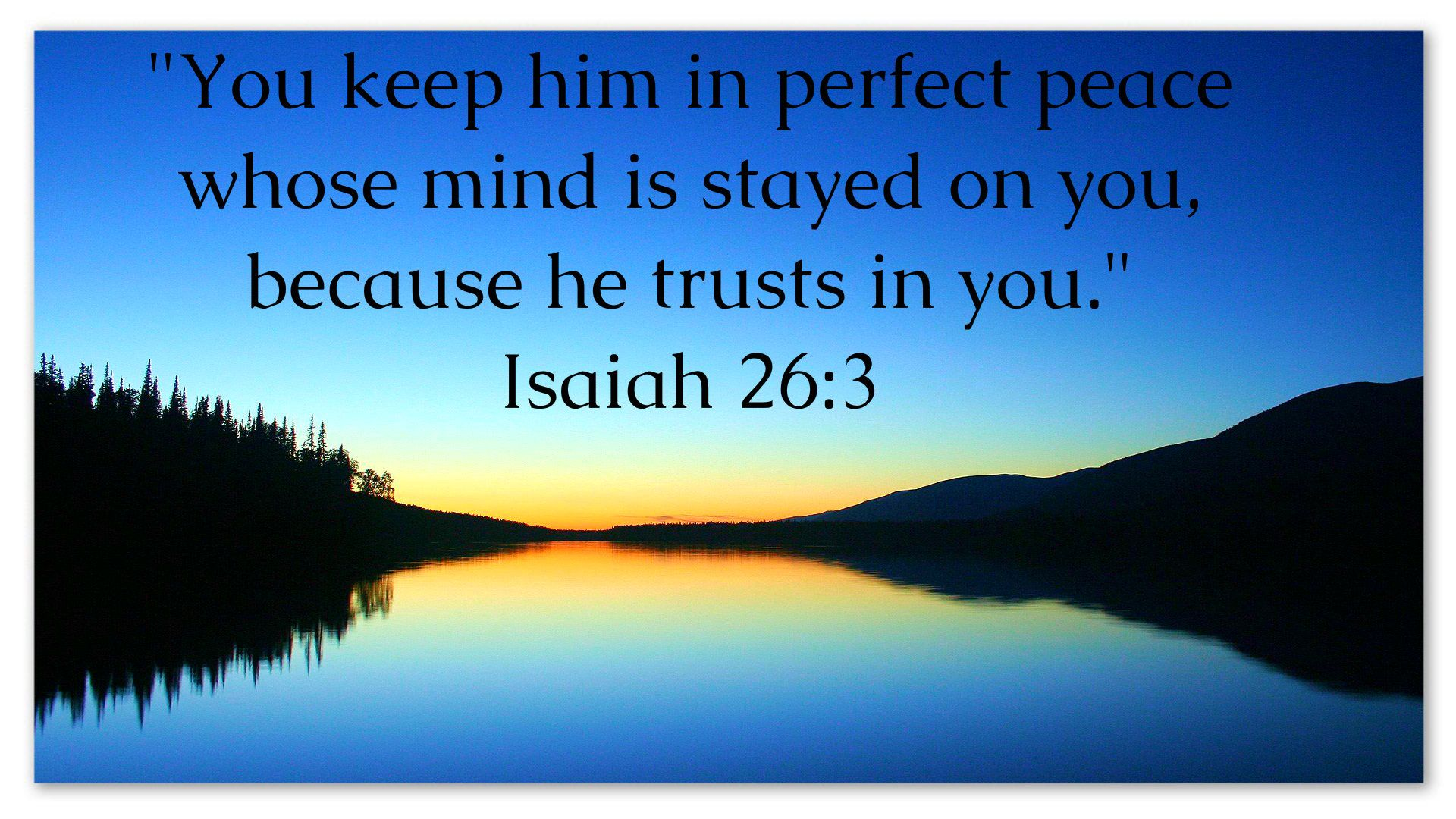
The good news is that true peace from God, “fruit of the Holy Spirit peace,” doesn’t depend on circumstances, health, finances, or anything else. Isaiah 26:3 tells us, “You will keep him in perfect peace, whose mind is stayed on You, because he trusts in You.” (New King James Version) The Message version says, “People with their minds set on you, you keep completely whole, Steady on their feet, because they keep at it and don’t quit. Depend on God and keep at it because in the Lord God you have a sure thing.”

Only God can give the peace of the Holy Spirit, and that’s great news because God isn’t worried about Christmas shopping or bills or health issues or any of the other things that worry us. The Creator of the Universe spoke the stars into existence, and He is all powerful, powerful enough to remove our fears and anxieties.

The prophet Jeremiah had the unenviable task of prophesying to the people of Jerusalem as the Babylonians were building siege mounds and preparing to take the city. False prophets were telling frightened idolaters what they wanted to hear-namely, that God would miraculously deliver them, even though they had abandoned Him. At this point, Jeremiah was in and out of prison and had critics watching him to see how they could destroy him. In the midst of this chaos, God moved one of Jeremiah’s relatives to sell him land as a sign that eventually land would again be bought and sold in Judah. When Jeremiah protested-after all, the Babylonians were literally at the gates-God spoke. “Then the word of the Lord came to Jeremiah, saying,“Behold, I am the Lord, the God of all flesh. Is there anything too hard for Me?” (Jeremiah 32:26-27)   

The prophet Isaiah whose words are quoted at the beginning of this devotional lived in difficult times and eventually was slaughtered by wicked King Manasseh; yet, through Isiah we have some of the most reassuring statements about God’s peace ever written.

We can have peace when we trust “the Lord, the God of all flesh” because that peace comes from God and not from our circumstances. But how do we achieve this peace? Isaiah 26 gives us the answer: “People with their minds set on you, you keep completely whole, Steady on their feet, because they keep at it and don’t quit. Depend on God and keep at it because in the Lord God you have a sure thing.”

Set your mind on God, on His power, His purposes, His goodness, and His holiness. When we keep our focus on God rather than on our problems, we WILL be “steady on our feet because we keep at it and don’t quit.” We can depend on God and keep at it because we KNOW that “in the Lord God we have a sure thing.”

As we end the Thanksgiving season and begin to prepare for Christmas, let us keep our minds focused on God and not on our problems. Find a Bible verse that speaks to you about peace, write it in your phone, put it on post it notes, doing anything you have to so that verse will be with you and ask God to reveal Himself to you through that verse. When you ask for such things, God the Good Father will be happy to teach you.

PRAYER: Father God, thank You for loving us and for caring for us. Lord, many of us are drowning in chaos. We desperately need Your Holy Spirit Peace. Please help us to seek You and Your Will and teach us about Your true Nature, for then we will definitely have lasting peace. In the mighty and precious Name of King Jesus. Amen.
NOVEMBER 28, 2024 HOW CAN WE POSSIBLY BE HOLY? #15 MY WORLD IS FALLING APART! HOW CAN I BE JOYFUL? START THANKING GOD! GRATITUDE BRINGS JOY!

November 28, 2024

Galatians 5:22-23 “But the fruit of the Spirit is love, joy, peace, patience, kindness, goodness, faithfulness, gentleness, and self-control. Against such things there is no law.”

The second fruit of the Holy Spirit is joy, but this is not to be confused with happiness. Biblestudytools.com tells us this:

“The difference between joy and happiness is substantial. We often assume that the fleeting feeling of happiness, giddy laughter, and contentment in the comforts of life is akin to the joy we experience in Jesus. But joy supernaturally sustains our souls in seasons of heartache, injustice, and sorrow. Enduring the valleys of life is nearly impossible without the life-giving fuel of joy in Christ.

There is a big difference between joy and happiness. Happiness is a reaction to something great. Joy is the product of someone great. Let us never forget the difference, nor fail to enjoy both happiness and joy fully on this earth. Jesus died to erase guilt and shame. Every day we come to Him for grace, and He is faithful to give us grace upon grace upon grace. When we are quick to confess and forgive, we can move forward in the freedom of a repentant life in Christ.

Merriam Webster defines happiness as “a state of well-being and contentment; a pleasurable or satisfying experience.” Whereas joy is specifically stated, even in the dictionary, as “the emotion evoked by well-being, success, or good fortune or by the prospect of possessing what one desires; the expression or exhibition of such emotion.” 

The Biblical meaning of joy, in contrast, is not a fleeting feeling with worldly roots. The best personification of Biblical joy is the story of Job. He was stripped of every good thing he had on this earth, but never lost his faith in God. Job knew his experience was unfair, and did not sugarcoat his pain. His conversations with God were frank, yet he never forgot who God was. Job 26:7 says, “He spreads out the northern skies over empty space; he suspends the earth over nothing.”

Joy is rooted in who God is. “The Spirit of God has made me;” Job 33:4 says, “the breath of the Almighty gives me life.” Our Father is fair, compassionate, and all-knowing. His ways are not our ways and His thoughts are not our thoughts. We are wise to pray for our plans to align with His, not just to ask God to bless our intentions. Job possessed the wisdom to know God’s character, and the strong faith to hold onto what he knew to get him through.

That’s the difference between happiness and Biblical joy. Though our lives seem to be falling apart, and we may have every right to fly the victim flag, we instead choose to place our lives in the capable hands of the Father, our Defender. Joy isn’t fleeting, and it doesn’t exit with peachy-keen circumstances. It remains. “The Spirit gives us eyes to see the beauties of Jesus that call joy up out of our hearts,” wrote John Piper. 

The difference in the Biblical definition of joy is the source. Worldly possessions, accomplishments, even the people in our lives, are blessings that make us happy and fuel joyfulness. However, the source of all joy, is Jesus. God’s plan from the beginning, the Word made flesh to dwell among us is rock solid, allowing us to navigate difficult situations in the absence of happiness, while sustaining our joy. 

Happiness is more of a state of mind, while joy is emotionally rooted in our faith in Christ. Jesus has experienced all pain, physically and emotionally. Pastor Rick Warren is quoted as saying “Joy is the settled assurance that God is in control of all the details of my life, the quiet confidence that ultimately everything is going to be alright, and the determined choice to praise God in every situation.” 

Joy allows us perspective to trust God with our daily lives. Happiness is attached to the blessings in our lives. It’s laughter at a funny joke or bliss in accomplishing a goal we’ve worked hard for. We’re happy when our loved ones surprise us, on our wedding day, when our children or grandchildren are born, and when enjoying time with friends or amidst our hobbies and passions. 

There is no bell curve to joy like there is happiness. Eventually, we stop laughing. But joy sustains our reactions and fleeting feelings. “Simply put, Biblical joy is choosing to respond to external circumstances with inner contentment and satisfaction because we know that god will use these experiences to accomplish His work in and through our lives,” writes Mel Walker for Christinaity.com. Joy allows us the perspective to be grateful and happy, but also to survive trying times by reminding us we’re still loved and cared for no matter what direction our daily life goes. “Happiness is external,” explains Sandra L. Brown, M.A., “It’s based on situations, events, people, places, things and thoughts.” 

Trials of many kinds aren’t joyful, themselves. But when we understand who God is, and how He works all things for good, we experience the joy of Christ. Joy trusts in who God is, over our abilities and the complications of this world.

James continued, “because you know that the testing of your faith produces perseverance. Let perseverance finish its work so that you may be mature and complete, not lacking anything” (James 1:3-4). He then goes on to write about wisdom, and asking God for it when we are lacking. Wisdom allows us to wade through trials of many kinds, back to who God is and who we are to Him, and in Christ. 

Joy appears more than 200 times in the English Bible, according to David Mathis of Desiring God. Paul wrote to the Thessalonians, “Be joyful always, pray continually, give thanks in all circumstances; for this is God’s will for you in Christ Jesus” (1 Thessalonians 5:16-18). Paul himself tortured Christians before he became one, and then endured all kinds of torture on account of the Gospel. He spoke from experience when he told them to be joyful always, and then he equipped them with how: pray continually and give thanks in all circumstances. 

How can we have joy even when we are suffering? “Remembering who God is and what He has done for us in the past, refocusing our thoughts to align with His truth, and choosing to be grateful and praise God – even in tough times – is powerful. It ignites the very Spirit of God living in every believer.

Galatians 5:22-23 reads, “But the fruit of the Spirit is love, joy, peace, forbearance, kindness, goodness, faithfulness, gentleness and self-control.” We are not able to activate any of those things in any sustaining circumstances without the very Spirit of God in us. He is the source of our joy, which makes it impossible to suppress it.”

 https://www.biblestudytools.com/bible-study/topical-studies/the-beauty-of-seeking-both-joy-and-happiness-in-christ.html (This is only part of the article. The rest of the article is also well worth reading.)

We can have joy because we trust in God and we know how great God is. We remember who God is, what He has done for us, and we choose to be grateful and praise God. Today is Thanksgiving, and the Pilgrims who celebrated the first Thanksgiving had very little for which to be grateful. But gratitude sustained the Pilgrims, and they were joyful that they were alive and learning to live in this strange new land, even with all its hardships. The Holy Spirit helped the Pilgrims to be grateful, and He can also help us. Let’s pray.

PRAYER: Father God, thank You for loving us and for caring for us. Lord, help us to be grateful for our lives and for Your provision in our circumstances, no matter how difficult they appear to be. Help us to become more grateful each day as we find new things You are doing. In the mighty and precious Name of King Jesus. Amen.

NOVEMBER 27, 2024 HOW CAN WE POSSIBLY BE HOLY? #14 IF I HAVE TO BE LOVING TO BE HOLY, I’M IN TROUBLE!

November 27, 2024

Galatians 5:22-23But the fruit of the Spirit is love, joy, peace, patience, kindness, goodness, faithfulness, gentleness, and self-control. Against such things there is no law.”

Now that we have studied the context in which the fruits of the Holy Spirit are mentioned, it’s time to look at these fruits one by one. The first fruit mentioned is love.

Got Questions.org explains the love referred to this way: “Galatians 5:22-23 is one of the most beloved passages in the Bible. The “fruit of the Spirit” has also been misinterpreted as characteristics that believers should somehow manufacture in their lives. But the key to understanding these qualities is in the name. “Fruit” is the natural result of growth. And “of the Spirit” explains exactly Who causes that growth—it’s not our striving or straining, but the power of the Holy Spirit. No amount of human toil or gritty determination can produce spiritual fruit, but the Spirit’s influence in a yielded heart can work miracles. The fruit of “love” may be the best example. We cannot produce the type of love God desires without the leading and strength of the Holy Spirit.

The English word love has very broad meaning, but the Greek language was very precise. The love which the Holy Spirit manifests in believers is agape. This love is not a feeling, but a choice. It is the choice to be kind, to sacrifice, to consider another’s needs greater than one’s own (Philippians 2:3). Agape is used in all of the “hard” love verses in the New Testament:

“Greater love has no one than this, that one lay down his life for his friends” (John 15:13).

“For this is the message which you have heard from the beginning, that we should love one another” (1 John 3:11).

“Love your enemies, do good to them, and lend to them without expecting to get anything back” (Luke 6:35).

“For this is the love of God, that we keep His commandments; and His commandments are not burdensome” (1 John 5:3).

It is because of love that God carried out His plan to save the world: “For God so loved the world that He gave His only begotten Son, that whoever believes in Him shall not perish, but have eternal life” (John 3:16). It is only by love that we can keep the greatest commandments: “Love the Lord your God” and “love your neighbor as yourself” (Mark 12:30-31).

Love is the greatest gift God can give. First Corinthians 13 says that agape is patient. Agape is kind. Agape never fails. God desires to show His perfect, selfless love to a world that is routinely confused about what true love is. God’s children are the conduits of His love, as they are empowered by the Holy Spirit.
https://www.gotquestions.org/fruit-Holy-Spirit-love.html

1 Corinthians 13: 4-8 describes love this way: “Love suffers long and is kind; love does not envy; love does not parade itself, is not puffed up; does not behave rudely, does not seek its own, is not provoked, thinks no evil; does not rejoice in iniquity, but rejoices in the truth; bears all things, believes all things, hopes all things, endures all things. Love never fails.”

I read the entire chapter of 1 Corinthians 13 every morning, not because I do so well at loving but because I fall so short. My constant prayer as I am reading these verses is “Lord, please help me love because by myself, I can’t do it!”

Look at the qualities of agape love.

Agape love is long suffering and kind. No matter how many times a day your children or your coworkers bother you with questions you’ve already answered, if you have agape love, you will respond patiently and kindly.

Love does not envy. While we might lie to ourselves, insisting that we are actually admiring someone else’s possessions/job/house/spouse/children/talents, etc., we are still envying that person. True love rejoices that someone else is so blessed.

Love does not parade itself and is not puffed up. We have all seen charitable donors who want to make sure that their charity is widely advertised. These days, we don’t have to blow trumpets as we are giving; we can simply go on social media and post about our munificence on Facebook, Instagram, Twitter, TikTok, and every WhatsApp platform to which we belong.

“Love does not behave rudely, does not seek its own, is not provoked, thinks no evil…” In a world where we are encouraged to “have it your way!” and to “look out for Number One!” those who truly love are thinking of others first. We become provoked when we think of ourselves first rather than thinking of others. And we can really become provoked when we think up evil stories about others.

“Love does not rejoice in iniquity, but rejoices in the truth…” Those who truly love refuse to gloat when they hear of someone doing something wrong or when they catch someone doing something wrong. If anything, true lovers grieve when they hear of someone slipping into some sin.

“Love bears all things, believes all things, hopes all things, endures all things. Love never fails.” Lovers persist in loving, no matter how badly people behave. Rather than retaliating, lovers intercede and continue to hope that God will change difficult to love people into His likeness.

“Great!” you say. “But I can’t possibly do this.” No, you’re quite right. None of us can love in this fashion, unless God puts His Holy Spirit in us and we allow the Holy Spirit to work in our hearts. How can this happen? We ask God and God does the necessary work.

PRAYER: Father God, thank You for loving us and for caring for us. Lord, we confess that we are totally incapable of truly loving those around us. We find ourselves repeatedly becoming frustrated, upset, and impatient with difficult people. We lose our tempers easily, and say things that are anything but loving. Lord, we give You permission to change us into Your likeness, for You love unconditionally. Please help us to continue to grow so that we will reflect Your love and not our petty sinful natures. In the mighty and precious Name of King Jesus. Amen.

NOVEMBER 26, 2024 HOW CAN WE POSSIBLY BE HOLY? #13 ARE YOU BEARING ROTTEN FRUIT?

November 26, 2024

Galatians 5: 16-26 Walking by the Spirit (Ezekiel 36:16–38; Romans 8:9–11)

“So I say, walk by the Spirit, and you will not gratify the desires of the flesh. For the flesh craves what is contrary to the Spirit, and the Spirit what is contrary to the flesh. They are opposed to each other, so that you do not do what you want. But if you are led by the Spirit, you are not under the law.

The acts of the flesh are obvious: sexual immorality, impurity, and debauchery; idolatry and sorcery; hatred, discord, jealousy, and rage; rivalries, divisions, factions, and envy; drunkenness, orgies, and the like. I warn you, as I did before, that those who practice such things will not inherit the kingdom of God.

But the fruit of the Spirit is love, joy, peace, patience, kindness, goodness, faithfulness, gentleness, and self-control. Against such things there is no law.

Those who belong to Christ Jesus have crucified the flesh with its passions and desires. Since we live by the Spirit, let us walk in step with the Spirit. Let us not become conceited, provoking and envying one another.”

Paul has done everything he can to convince the Galatians that slavishly following rules and regulations will never achieve holiness. But if those attempts won’t work, what does? What does a holy life really look like? In these eleven verses, Paul gives the answer.

“So I say, walk by the Spirit, and you will not gratify the desires of the flesh. For the flesh craves what is contrary to the Spirit, and the Spirit what is contrary to the flesh. They are opposed to each other, so that you do not do what you want.”  Trying to achieve holiness by following sets of rules amounts to gratifying desires of the flesh, the old nature. Our old nature craves independence from God and continues to struggle to convince us that if we only follow a few more rules, we can achieve holiness all by ourselves with no help from God. If we follow our old nature, we will be certain that Jesus’ death on Calvary was unnecessary. But such thinking is as ridiculous as a tiny ant thinking it can take a bite out of a stately marble column. No amount of struggle will ever cancel our sin debts, because the very act of struggling also constitutes sin.  

When we believe in Jesus Christ, the Holy Spirit enters our hearts and minds and impels us to seek God’s will for our lives rather than our own. “But if you are led by the Spirit, you are not under the law.” The Holy Spirit transforms us so that we become different creatures than we were before we believed in Jesus. 2 Corinthians 5:17 tells us, “Therefore, if anyone is in Christ, he is a new creation; old things have passed away; behold, all things have become new.”

What did we look like before we believed in Christ Jesus? “The acts of the flesh are obvious: sexual immorality, impurity, and debauchery; idolatry and sorcery; hatred, discord, jealousy, and rage; rivalries, divisions, factions, and envy; drunkenness, orgies, and the like. I warn you, as I did before, that those who practice such things will not inherit the kingdom of God.”

You might read this list and think, “Well, I was NEVER as bad as all that!” Really? You never gossiped about anyone or became jealous or resentful or furious? You never indulged in ANY impure thoughts? You never joined a particular faction during an argument, or made statements that led to division rather than to unity in the Body of Christ? Hmm. Do you walk on water on the weekends? Check your thoughts! Even if you haven’t indulged in overt sins, you have still considered many of them. Face it, friends, all of us have sinned and have fallen short of the glory of God, just as Paul says in Romans 3:23. Without the convicting power of the Holy Spirit to transform us, we have no hope of sharing God’s holiness.  

Great! Now we are new creations in Christ Jesus. But what does this actually mean? “But the fruit of the Spirit is love, joy, peace, patience, kindness, goodness, faithfulness, gentleness, and self-control. Against such things there is no law. Those who belong to Christ Jesus have crucified the flesh with its passions and desires. Since we live by the Spirit, let us walk in step with the Spirit. Let us not become conceited, provoking and envying one another.”

“Love, joy, peace, patience, kindness, goodness, faithfulness, gentleness, and self-control” – These are the qualities of a Holy Spirit-led life. These are the qualities that please God. But without God’s help, it is impossible to please Him. Even if we manage to go for a few minutes without thinking something unkind or critical, in the next minute, we will fail because our own efforts will always result in failure.

Hebrews 11:6 tells us, “But without faith it is impossible to please Him, for he who comes to God must believe that He is, and that He is a rewarder of those who diligently seek Him.” When we have faith in God, we may ask God to help us and He will send the Holy Spirit to guide us and empower us to live Godly and holy lives. When we “diligently seek” God, we look to God for direction rather than trusting in our own resources. Does this mean that we must live in constant despair, fearing that we are failing God? No! God is a good Father and good fathers do not torment beloved children. God clearly shows us in His Word what we must do and then sends the Holy Spirit to help us so that we are able to live lives of increasing holiness.

Those who belong to Christ Jesus have crucified the flesh with its passions and desires. Since we live by the Spirit, let us walk in step with the Spirit. Let us not become conceited, provoking and envying one another.” Does a life of holiness become easier as the years go on? Yes and no. Yes, as we grow in grace, we continue to learn more about holiness; however, we remain human and therefore we continue to face temptations. The truth is that as we grow in the knowledge of God and His Word, the temptations become increasingly more subtle. One of the most common temptations is for us to become “conceited (about our knowledge of God,) provoking and envying one another. How can a believer remain humble?

In one of his sermons, C.H. Spurgeon compared growing in the knowledge of God to climbing the mountains in Wales. While standing in the valley, one could only see the first elevation, but once achieving that level, a climber would swiftly realize that there were higher heights yet to be conquered, with succeeding peaks eventually coming into view. The difference between the Welsh mountains and the Kingdom of God is that in the Kingdom of God, there is no end to God’s mercy and grace, to His righteousness and holiness.

Because God’s qualities are endless, we always have more we can learn about God and experience of God. The more we learn about God, the more we realize how little we really know and how far short we fall in comparison to God’s perfection. It’s the difference between paddling in a wading pool and plunging into an ocean.

Today, as we study the fruits of the Holy Spirit, why not pray that God will make each of these abound in your life?PRAYER: Father God, thank You for loving us and for caring for us. Lord, we beg you to send Your Holy Spirit to us so that we will live lives full of love, joy, peace, patience, kindness, goodness, faithfulness, gentleness, and self-control. In the mighty and precious Name of King Jesus. Amen.
NOVEMBER 25, 2024 HOW CAN WE POSSIBLY BE HOLY? #12 WHY BE A SLAVE IF YOU DON’T HAVE TO?

November 25, 2024

Galatians 5:1-15 Freedom in Christ

“It is for freedom that Christ has set us free. Stand firm, then, and do not be encumbered once more by a yoke of slavery.

 Take notice: I, Paul, tell you that if you let yourselves be circumcised, Christ will be of no value to you at all. Again I testify to every man who gets himself circumcised that he is obligated to obey the whole law. You who are trying to be justified by the law have been severed from Christ; you have fallen away from grace.

But by faith we eagerly await through the Spirit the hope of righteousness. For in Christ Jesus neither circumcision nor uncircumcision has any value. All that matters is faith, expressed through love.

You were running so well. Who has obstructed you from obeying the truth? Such persuasion does not come from the One who calls you. A little leaven works through the whole batch of dough. I am confident in the Lord that you will take no other view. The one who is troubling you will bear the judgment, whoever he may be.

Now, brothers, if I am still preaching circumcision, why am I still being persecuted? In that case the offense of the cross has been abolished. As for those who are agitating you, I wish they would proceed to emasculate themselves!

For you, brothers, were called to freedom; but do not use your freedom as an opportunity for the flesh. Rather, serve one another in love. The entire law is fulfilled in a single decree: “Love your neighbor as yourself.” But if you keep on biting and devouring one another, watch out, or you will be consumed by one another.”

Nobody can hurt you like religious people can! When Paul preached to the Galatians, revival broke out, miracles occurred, people repented, and wonderful things began happening. The Galatian made a wonderful start, but now these manipulative teachers have shown up, trying to undermine Paul’s teachings.

Paul is trying to encourage the Galatians to find new freedom in Christ from pagan practices and traditional Jewish practices; meanwhile, false teachers and promoters of Judaism have popped up, demanding that the new believers must follow all the Mosaic Law. These people are even demanding that male believers should undergo circumcision as a sign of their commitment. This controversy has become so heated that people are taking sides, “biting and devouring one another.”

While Paul isn’t certain of the names of these false teachers, he is so furious that he wishes they would castrate themselves rather than leading new believers astray! So much for those who would like to tone down Paul’s statements. When it comes to heresy, Paul doesn’t play nice.

Why is Paul so agitated? Paul wants the new believers to realize that once Jesus has sacrificed his blood for their sins, they have been freed from the need to observe rituals such as circumcision. (The practice of circumcision was not necessarily confined to the Jews; however, it certainly marked Jewish men at a time when young men exercised in the nude at the gymnasium.)  

“For you, brothers, were called to freedom; but do not use your freedom as an opportunity for the flesh. Rather, serve one another in love. The entire law is fulfilled in a single decree: “Love your neighbor as yourself.” But if you keep on biting and devouring one another, watch out, or you will be consumed by one another.” Paul wants the new believers to realize that while Jesus has set them free from observing rituals, that freedom comes at the prices of being responsible. Believers need to behave lovingly toward one another, not criticizing and destroying one another. Paul knows that outsiders are more than willing to persecute Christians in any manner possible, so Christians must come together in love, rather than fragmenting into schisms.

When pursuing holiness, we must be careful to avoid senseless practices that do not help. When I was a small child, we were careful when walking on cement sidewalks to avoid cracks. We chanted, “Step on a crack, and break your mother’s back.” Since none of us wished to harm our mothers, we avoided cracks. Some religious practices make no more sense than that childish practice. But there is another aspect to holiness-love for our neighbors.

It was said of the Christians in ancient Antioch that people were amazed at how much they loved one another. Sadly, there are many churches where brotherly love is in short supply while criticism abounds. How can we possibly approach a holy, righteous, and loving God if we are unwilling to love His children, no matter their appearance? Later in this same chapter of Galatians, Paul will state that love is one of the fruits of the Holy Spirit. Few things will drive the Holy Spirit away faster than hatred and back biting.

“But,” you ask, “how can we love unlovable people?” Good question! Some people are quite lovable while others are not. Personally, I have found this prayer most helpful. “Lord Jesus, I don’t know what to think about ___________. I die to my own imaginations about that person. Please give me Your mind about him/her.” You can also pray this prayer over situations, again confessing that you have no wisdom or insight and begging God to give you His Mind about it. Such prayers are not religious gamesmanship, but practical steps toward holiness. They work. Why not try it now?

PRAYER: Father God, thank You for loving us and for caring for us. Lord, we confess that we are struggling to love ____________ and we have failed. Please give us Your Mind about them and help us to love them as You do. In the mighty and precious Name of King Jesus. Amen.
NOVEMBER 24, 2024 HOW CAN WE POSSIBLY BE HOLY? #11 WHO’S YOUR SPIRITUAL MOTHER? WHY SHOULD IT MATTER?

November 24, 2024

Galatians 4:21-31 Hagar and Sarah (Genesis 21:9–21)

“Tell me, you who want to be under the law, do you not understand what the law says? For it is written that Abraham had two sons, one by the slave woman and the other by the free woman. His son by the slave woman was born according to the flesh, but his son by the free woman was born through the promise.

These things serve as illustrations, for the women represent two covenants. One covenant is from Mount Sinai and bears children into slavery: This is Hagar. Now Hagar stands for Mount Sinai in Arabia and corresponds to the present-day Jerusalem, because she is in slavery with her children. But the Jerusalem above is free, and she is our mother. For it is written:

“Rejoice, O barren woman,

who bears no children;

break forth and cry aloud,

you who have never travailed;

because more are the children of the desolate woman

than of her who has a husband.”

Now you, brothers, like Isaac, are children of promise. At that time, however, the son born by the flesh persecuted the son born by the Spirit. It is the same now.

But what does the Scripture say? “Expel the slave woman and her son, for the slave woman’s son will never share in the inheritance with the free woman’s son.” Therefore, brothers, we are not children of the slave woman, but of the free woman.”

Although slavery still exists in many parts of the world, most of us are unfamiliar with the grueling restrictions slavery brings to a culture. Someone else owns a slave; that means the owner controls everything about the slave-what and when they eat, where and when they sleep, what they wear, where they can go, or even whom they will marry. (For those of you historians, yes, this is a limited and sanitized list of restrictions.) In the American South, slaves who traveled away from the plantations to which they belonged had to wear metal discs around their necks indicating that they had their master’s permission to leave the plantation; otherwise, they were considered run-aways and could be captured and returned for a reward.

In Paul’s day, it was likely that slaves would have to get their master’s permission before doing practically anything. Masters dispatching slaves would have given them some token, perhaps a small scroll sealed with the master’s signet, to indicate that they were on legitimate business for their master. Children born to slaves were automatically considered slaves as well.  

Here Paul is using the example of Hagar and Sarah to illustrate the difference between those following the Mosaic Law and expecting that will make them holy and those who are free in Christ Jesus. God promised Abraham that he would father a son who would succeed him. Sarah was so sure that God couldn’t possibly help her get pregnant in her old age that she gave her slave maid Hagar to Abraham as a concubine so that Hagar would bear a son, Ishmael, for Abraham. But when God finally fulfilled His promise and Sarah gave birth in her old age, Hagar’s son Ishmael mocked and tormented Isaac. Sarah became furious and demanded that Abraham send Hagar and Ishmael away. Genesis 21:9-10 tells us, “But Sarah saw that the son whom Hagar the Egyptian had borne to Abraham was mocking her son, and she said to Abraham, “Expel the slave woman and her son, for the slave woman’s son will never share in the inheritance with my son Isaac!”

Paul is using the story of Hagar/Ishmael and Sarah/Isaac to illustrate the differences between following the Mosaic Laws as a means to holiness and being free in Christ Jesus. Paul asserts that those continuing to observe the Mosaic Law in hopes that they will gain holiness are bound for nothing but frustration, being in spiritual slavery to that law. (How can one know when one has followed the rules enough? There is always something more one can do.) But those who have believed in Christ Jesus are like Isaac, being children of the Promise. The Promise referred to here is the Promise that God would send a Messiah, who would deliver His people Israel. As the Messiah, Jesus is the fulfillment of that Promise, and all who believe in Jesus are sons and daughters of that Promise. Jesus has done what the Law could not do; He has given Himself as the ultimate blood sacrifice for the sins of the world. All who believe in Christ Jesus are new creatures, free from the bondage imposed on them by the rules and regulations of the Mosaic Law.

Reading this, you might think, “Well, that was fine in Paul’s day, but I’m not a slave to anything.” Oh yeah? What do you do first thing in the morning and the last thing at night? Do you pray and thank God for another day, or do you check out Facebook? How many times a day do you access social media of some kind? If you are unhappy, do you respond by going on an ice cream binge, stuffing your mouth with fast food, or turning to alcohol or going on a shopping spree? Do you have other rituals/practices that you follow routinely to make yourself feel better? Some people are addicted to pornography.

You may well be enslaved without realizing it. How important is the opinion of other people? Are you struggling to climb a corporate ladder while your family longs for you to spend more time with them? Or are you a minister or a missionary, giving all your time to your work and none to your family? Slavery situations come in all kinds of guises, many of them socially acceptable. But no matter the appearance, you are still enslaved.

One of the main messages of the entire book of Galatians is freedom in Christ Jesus. Once we have accepted Jesus as Savior and Lord of our lives, we no longer need to turn to rituals or obsessive forms of behavior to satisfy our cravings. We are no longer enslaved, but free in Christ Jesus. “Hah!” you exclaim. “You don’t understand my situation.” No, you’re quite right; I don’t. But Jesus understands; in fact, Jesus understands you better than you understand yourself. Why not take your problems to Jesus and ask Him for solutions. The answers Jesus will give are far better than anything you can do for yourself. Why not let God’s amazing grace break the chains that still bind you?

PRAYER: Father God, thank You for loving us and for caring for us. Lord, we confess that we are slaves to our appetites, our desires, and our fears. Please help us to yield up those things to which we are clinging so that You can free us to live lives of holiness dedicated to You. In the mighty and precious Name of King Jesus. Amen.
NOVEMBER 23, 2024 HOW CAN WE POSSIBLY BE HOLY? #10 INSANITY IS REPEATING THE SAME BEHAVIOR OVER AND OVER AND EXPECTING DIFFERENT RESULTS!

November 23, 2024

Galatians 4: 8-20 “Formerly, when you did not know God, you were slaves to those who by nature are not gods. But now that you know God, or rather are known by God, how is it that you are turning back to those weak and worthless principles? Do you wish to be enslaved by them all over again? You are observing special days and months and seasons and years! I fear for you, that my efforts for you may have been in vain. I beg you, brothers, become like me, for I became like you. You have done me no wrong.

You know that it was because of an illness that I first preached the gospel to you. And although my illness was a trial to you, you did not despise or reject me. Instead, you welcomed me as if I were an angel of God, as if I were Christ Jesus Himself. What then has become of your blessing? For I can testify that, if it were possible, you would have torn out your eyes and given them to me. Have I now become your enemy by telling you the truth?

Those people are zealous for you, but not in a good way. Instead, they want to isolate you from us, so that you may be zealous for them. Nevertheless, it is good to be zealous if it serves a noble purpose—at any time, and not only when I am with you.

My children, for whom I am again in the pains of childbirth until Christ is formed in you, how I wish I could be with you now and change my tone, because I am perplexed about you.”

Paul continues to be frustrated. While traveling through Galatia, he developed some kind of problem, possibly a severe eye infection, that forced him to stop. Finding himself with people willing to listen and learn, Paul taught the Galatians about Jesus and they readily accepted Him. Previously, the Galatians had been following a host of various pagan religious, each of which demanded frequent sacrifices and all other kinds of rituals for “days, and months, and seasons, and years.” It was a positive relief when Paul was able to show the Galatians that they had been deceived and no longer needed to mess with such things.

But now idolatrous teachers have sneaked in, frustrated that their former disciples are no longer willing to slavishly follow their instructions. These people only want power and control over Paul’s converts and are willing to twist Paul’s statements as much as possible, if only they can regain their hold on the new believers. Paul is in so much pain spiritually that he feels as if he is a pregnant lady struggling with labor pains. Paul is several hundred miles away and can only beg God to deliver the Galatians from those who would victimize them.

There’s an old saying that “Insanity is repeating the same behavior over and over and expecting different results.” When Paul preached and taught in Galatia, the Galatians accepted the Gospel of Christ because it was so much superior to the religions they had previously observed. The Holy Spirit moved in the hearts of new believers, baptizing them and undoubtedly working miracles. Nothing like this had ever been seen before in Galatia! But now the Galatians are being tempted to return to rituals that never worked in the first place-truly insane.

If you study the interview in the Garden of Eden between Satan and Eve, you will notice that Satan begins questions by asking, “Did God REALLY…..” These false teachers who are attempting to sway the Galatians away from Christ and back to idols are undoubtedly using the same kind of argument. “Did Paul REALLY tell you_____? Are you REALLY sure of ____? Frankly, it’s a good thing that Paul is at a distance, for if he were physically present in Galatia, he might be tempted to get into a fist fight with these charlatans.

Paul knows that the Galatian converts are making great strides in their quest for holiness but that these false teachers can undo everything. What about us? Are we willing to trust God and His provision and His ways of working things into our lives, or are we tempted to indulge in just a few rituals in hopes of finding shortcuts to holiness?

The reality is that holiness is a lifelong process and that we continue to grow into holiness and holiness continues to grow in us the more we earnestly seek it. But there are no rituals we can follow that will instantly produce complete holiness in our lives. We must trust God and continue to grow in His grace. May we ask God daily to take over our lives, for He is the only One who can make anyone or anything holy.

PRAYER: Father God, thank You for loving us and for caring for us. Lord, sometimes we long for shortcuts so that we can instantly become holy. But You are the One who guides us and who guarantees that if we grow in grace, You will put Your holy nature in us. Thank You for doing this for us. In the mighty and precious Name of King Jesus. Amen.

NOVEMBER 22, 2024 HOW CAN WE POSSIBLY BE HOLY? #9 DO WE DARE CALL GOD “DADDY?”

November 22, 2024

Galatians 4:1-7 Sons and Heirs Through Christ

“Now I say that the heir, as long as he is a child, does not differ at all from a slave, though he is master of all, but is under guardians and stewards until the time appointed by the father. Even so we, when we were children, were in bondage under the elements of the world. But when the fullness of the time had come, God sent forth His Son, born of a woman, born under the law, to redeem those who were under the law, that we might receive the adoption as sons.

And because you are sons, God has sent forth the Spirit of His Son into your hearts, crying out,  “Abba, Father!” Therefore you are no longer a slave but a son, and if a son, then an heir of God through Christ.”

If you have ever been through a brutal estate settlement, you might want to run in the other direction when you hear the term “heir.” There are all kinds of stories about people inheriting things, some of them funny but many of them painful. But when we speak of inheriting along with Jesus Christ, we are not describing struggling over Great Grandma’s jewelry or houses or lands. Here Paul is speaking of an eternal inheritance, an inheritance that allows believers to be adopted as sons-and daughters-into God’s family and to inherit eternal life, all because of what Jesus has done through his sacrificial death at Calvary.

Yesterday I gave this explanation that is worth repeating. Unless we understand the culture in Paul’s day, we might not realize how revolutionary this pronouncement was. Many households had slaves or servants or foster children, none of whom would inherit anything unless the master specifically indicated that in his will. However, if one was adopted, past histories didn’t matter. Once you were fully adopted into a family, you enjoyed all the rights and privileges any child born into that family would enjoy. Even if you had started out as a slave, once you were adopted, your inheritance would be equal to anyone else’s. If your adopted father was a Roman senator, you could even wear a distinctive purple band on your clothing, indicating that you belonged to a high-class family.

Now Paul is assuring the Galatian believers that they have an incredibly precious inheritance, an inheritance of holiness and eternal life. What does inheriting have to do with holiness? Paul is advising the Galatians-and us-that as believers in Christ, we are candidates for holiness, not because we are so good but because God changes our nature to conform with His. This process of sanctification has two parts – God’s and ours. God stands more than willing to change us; we must agree to be changed. The more we agree with God, the more our lives will reflect God’s goodness and God’s glory.

But there’s even more. When we believe in Christ Jesus and become children of God, God sends the Spirit of his Son into our hearts, crying out, “Abba, Father!” In Paul’s day, “Abba” was the equivalent of “Daddy!” This was a term of great affection that only beloved children would use when calling out for their fathers. When God puts His Spirit into us, we too can cry out to Him as our beloved Father who cherishes us.

Sounds great-right? But what if your concept of fatherhood has been perverted? While there are lots of fathers who are loving and caring and who protect their children, there are also many more who are incapable of doing so. Some fathers have been abused by their fathers while others were raised by single mothers and have no idea of how to behave like a father. Some fathers are chronically depressed and unable to care for, nurture, and protect their children.

What can you do if your father was absent, abusive, or failed in some fashion? Ask God to show Himself as your Father. God is fully capable of demonstrating His love, His wisdom, His power, and His ability to protect you. Tell God your problems with the idea of a father and allow him to teach you.

PRAYER: Father God, many of us hate the very term “father” because we have had terrible experiences. Please help us to confess our problems to You and heal our spirits, teaching us what a perfect Father can be. In the mighty and precious Name of King Jesus. Amen.

NOVEMBER 21, 2024 HOW CAN WE POSSIBLY BE HOLY? #8 THE CHANGELESS PROMISE

November 21, 2024

Galatians 3:15-29 The Changeless Promise

“Brethren, I speak in the manner of men: Though it is only a man’s covenant, yet if it is confirmed, no one annuls or adds to it. Now to Abraham and his Seed were the promises made. He does not say, “And to seeds,” as of many, but as of one, “And to your Seed,” who is Christ. And this I say, that the law, which was four hundred and thirty years later, cannot annul the covenant that was confirmed before by God in Christ, that it should make the promise of no effect. For if the inheritance is of the law, it is no longer of promise; but God gave it to Abraham by promise.

Purpose of the Law

What purpose then does the law serve? It was added because of transgressions, till the Seed should come to whom the promise was made; and it was appointed through angels by the hand of a mediator. Now a mediator does not mediate for one only, but God is one.

Is the law then against the promises of God? Certainly not! For if there had been a law given which could have given life, truly righteousness would have been by the law. But the Scripture has confined all under sin, that the promise by faith in Jesus Christ might be given to those who believe. But before faith came, we were kept under guard by the law, kept for the faith which would afterward be revealed. Therefore the law was our tutor to bring us to Christ, that we might be justified by faith. But after faith has come, we are no longer under a tutor.

Sons and Heirs

For you are all sons of God through faith in Christ Jesus. For as many of you as were baptized into Christ have put on Christ. There is neither Jew nor Greek, there is neither slave nor free, there is neither male nor female; for you are all one in Christ Jesus. And if you are Christ’s, then you are Abraham’s seed, and heirs according to the promise.”

Wherever there are people, there are laws governing what they can and cannot do. Even in Paul’s day, there were religious laws and the Roman law that governed all the provinces, including Galatia. It’s a big mistake to assume that the Galatians were unsophisticated illiterates. Many of these people, particularly the upper classes, may have spoken and read  fluent Latin and Greek in addition to any local languages they learned as children. Living under Roman law would give any adult a great deal of information. But in addition to laws, there were also long-standing covenants that were recognized and honored by everyone involved.

Though it is only a man’s covenant, yet if it is confirmed, no one annuls or adds to it. Now to Abraham and his Seed were the promises made. He does not say, “And to seeds,” as of many, but as of one, “And to your Seed,” who is Christ. And this I say, that the law, which was four hundred and thirty years later, cannot annul the covenant that was confirmed before by God in Christ, that it should make the promise of no effect. For if the inheritance is of the law, it is no longer of promise; but God gave it to Abraham by promise.”

But before faith came, we were kept under guard by the law, kept for the faith which would afterward be revealed. Therefore the law was our tutor to bring us to Christ, that we might be justified by faith. But after faith has come, we are no longer under a tutor.”

Here Paul is contrasting laws versus covenants/promises. Before the Mosaic Law was ever given, God had already cut covenant with Abraham, making incredible promises. The Mosaic Law was given to teach people how God wanted them to live; however, the Law did not cancel the covenant agreement God had already made with Abraham.

“For you are all sons of God through faith in Christ Jesus. For as many of you as were baptized into Christ have put on Christ. There is neither Jew nor Greek, there is neither slave nor free, there is neither male nor female; for you are all one in Christ Jesus. And if you are Christ’s, then you are Abraham’s seed, and heirs according to the promise.”

Somebody in Galatia might say, “Yes, but Abraham was a Jew, and I’m not a Jew.” Paul has the answer: God was making the covenant, not only with Abraham, but Christ Jesus, for Christ Jesus was born of the Seed of Abraham. And by extension, all who believe in Christ Jesus become Abraham’s seed. What’s even more wonderful is that once someone believes and is baptized, he joins a new family, a family in which he/she is Abraham’s seed and an heir according to the promises God gave Abraham.

Unless we understand the culture in Paul’s day, we might not realize how revolutionary this pronouncement was. Many households had slaves or servants or foster children; however, if one was adopted, past histories didn’t matter. Once you were fully adopted into a family, you enjoyed all the rights and privileges any child born into that family would enjoy. Your inheritance would be equal to anyone else’s. If your adopted father was a Roman senator, you could even wear a distinctive purple band on your clothing, indicating that you belonged to a high-class family.

What does this have to do with holiness? Paul is advising the Galatians-and us-that as believers in Christ, we are candidates for holiness, not because we are so good but because God changes our nature to conform with His. This process of sanctification has two parts – God’s and ours. God stands more than willing to change us; we must agree to be changed. The more we agree with God, the more our lives will reflect God’s goodness and God’s glory.

PRAYER: Father God, thank You for loving us and for caring for us. Thank You for Your precious promises that assure us of eternal life if we will only believe and allow You to change us into Your image. Please change us and help us to continue to yield ourselves so that all of our natures will reflect You and only You. In the mighty and precious Name of King Jesus. Amen.