Archive for May, 2025

MAY 31, 2025 FOLLOWING JESUS IN A POST-ASCENSION WORLD #37 WHEN YOU’RE ACCUSED, LET GOD DEFEND YOU!

May 31, 2025

Acts 16: 11-15 Lydia Baptized at Philippi

“Therefore, sailing from Troas, we ran a straight course to Samothrace, and the next day came to Neapolis, and from there to Philippi, which is the foremost city of that part of Macedonia, a colony. And we were staying in that city for some days. And on the Sabbath day we went out of the city to the riverside, where prayer was customarily made; and we sat down and spoke to the women who met there. Now a certain woman named Lydia heard us. She was a seller of purple from the city of Thyatira, who worshiped God. The Lord opened her heart to heed the things spoken by Paul. And when she and her household were baptized, she begged us, saying, “If you have judged me to be faithful to the Lord, come to my house and stay.” So she persuaded us.”

Paul and Silas have obeyed the Lord and are now in Macedonia. At first, everything goes swimmingly, for when they speak at a Sabbath prayer meeting, a local businesswoman named Lydia and all her household get converted and baptized. As a wise and wealthy woman, Lydia immediately invites Paul and Silas to come home with her. At this point, Paul and Silas are undoubtedly thrilled, feeling that they have really obeyed the Holy Spirit and that all is well. But Satan is not about to let this significant conversion go unopposed. After all, Lydia is well-known and well-liked, and now she is telling everyone she knows about Jesus. As a seller of purple, Lydia has access to upper class people who might never give Paul and Silas a hearing. No, Satan needs to break up this situation quickly.

Acts 16:16-24 Paul and Silas Imprisoned

“Now it happened, as we went to prayer, that a certain slave girl possessed with a spirit of divination met us, who brought her masters much profit by fortune-telling. This girl followed Paul and us, and cried out, saying, “These men are the servants of the Most High God, who proclaim to us the way of salvation.” And this she did for many days.

But Paul, greatly annoyed, turned and said to the spirit, “I command you in the name of Jesus Christ to come out of her.” And he came out that very hour. But when her masters saw that their hope of profit was gone, they seized Paul and Silas and dragged them into the marketplace to the authorities.

And they brought them to the magistrates, and said, “These men, being Jews, exceedingly trouble our city; and they teach customs which are not lawful for us, being Romans, to receive or observe.” Then the multitude rose up together against them; and the magistrates tore off their clothes and commanded them to be beaten with rods. And when they had laid many stripes on them, they threw them into prison, commanding the jailer to keep them securely. Having received such a charge, he put them into the inner prison and fastened their feet in the stocks.”

Paul and Silas are in for it now! For days, perhaps weeks, a slave girl with a spirit of divination has been following them around, crying, “These men are the servants of the Most High God, who proclaim to us the way of salvation.” While this girl appears to be helping Paul and Silas, the spirits in her are mocking them, and Paul knows this. Finally, Paul casts out the spirit of divination, leaving the girl healed but profitless to her masters. Incensed, these men grab Paul and Silas, dragging them into the marketplace where the authorities are sitting. There these shysters lay false charges against Paul and Silas, claiming that they are Jewish heretics teaching rebellion against Mother Roma. A mob begins screaming imprecations and the magistrates command Paul and Silas to be beaten and to be kept in the innermost parts of the local prison with their feet in stocks so they cannot move.

Well! So far this story certainly sounds like a recipe for disaster. Notice that nobody is specific as to the teachings that encourage rebellion against Rome. If you’re going to accuse someone without proof, it’s always wise to keep your accusations as general as possible, lest reality trip you up. This story has many layers. One possibility is that the local officials are benefiting from the divinations performed by this slave girl. It’s likely the girl’s masters are paying a small percentage to those in charge for the opportunity to roam freely through town conducting business. There’s also an element of racism; the girl’s masters accuse Paul and Silas of being Jewish rabble rousers, encouraging an “us vs. them” mentality. And these fakers are also playing on the fear of the local magistrates that if any disturbance arises, the Romans might appoint someone else in their place, causing them to lose face, money, and power. “No,” the magistrates think. “Better to throw these men in prison and sort things out later after the crowds go away. Besides, a show of law enforcement will always impress the Romans.”

As we learn tomorrow, this dismal situation is not the end of the story. But consider this: Paul and Silas allow themselves to be stripped, beaten, and thrown in jail. There is nothing to indicate that they argue or fight back. Perhaps the Holy Spirit is speaking to Paul and Silas, ordering them to keep quiet and to be patient.

The temptation to justify one’s self is a very strong one, particularly when we KNOW we are innocent. What’s worse is having to remain quiet while our accusers go on at length and then we have no opportunity to answer them. At such times, it is tempting to question God why this is happening and why we are not allowed to answer slanderous accusations. But sometimes there is more to be gained from sitting quietly in a relaxed position, smiling as one horrible lie piles on another. Psalm 75:6-7 tells us, “For exaltation comes neither from the east nor from the west nor from the south. But God is the Judge: He puts down one, and exalts another.” James 4:10 says, “Humble yourselves in the sight of the Lord, and He will lift you up.” May God help us, so that we are willing to trust HIM to justify us, rather than trying to do it ourselves!

PRAYER: Father God, thank You for loving us and for caring for us. Lord, help us to trust You to justify and defend us when we are falsely accused. In the mighty and precious Name of King Jesus. Amen.

MAY 30, 2025 FOLLOWING JESUS IN A POST-ASCENSION WORLD #36 WHEN GOD CHANGES YOUR TRAVEL PLANS, DO YOU OBEY?

May 30, 2025

Acts 16:1-5 Timothy Joins Paul and Silas

“Paul came to Derbe and then to Lystra, where he found a disciple named Timothy, the son of a believing Jewish woman and a Greek father. The brothers in Lystra and Iconium spoke well of him. Paul wanted Timothy to accompany him, so he took him and circumcised him on account of the Jews in that area, for they all knew that his father was a Greek.

As they went from town to town, they delivered the decisions handed down by the apostles and elders in Jerusalem for the people to obey. So the churches were strengthened in the faith and grew daily in numbers.”

Acts 16:6-10 Paul’s Vision of the Macedonian

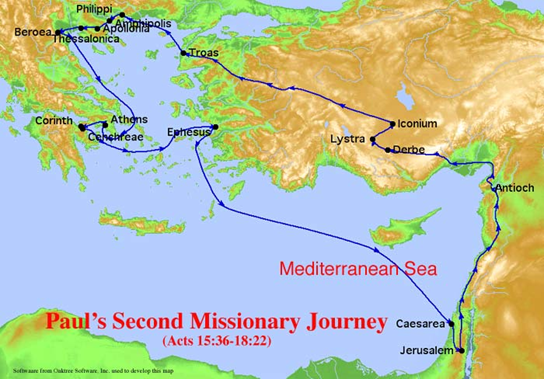
“After the Holy Spirit had prevented them from speaking the word in the province of Asia, a they traveled through the region of Phrygia and Galatia. And when they came to the border of Mysia, they tried to enter Bithynia, but the Spirit of Jesus would not permit them. So they passed by Mysia and went down to Troas.

During the night, Paul had a vision of a man of Macedonia standing and pleading with him, “Come over to Macedonia and help us.” As soon as Paul had seen the vision, we got ready to leave for Macedonia, concluding that God had called us to preach the gospel to them.”

“Paul came to Derbe and then to Lystra, where he found a disciple named Timothy, the son of a believing Jewish woman and a Greek father.” Paul and Silas have returned to Lystra, where Paul was previously stoned and left for dead. But things are different this time. In Lystra, local church elders recommend an outstanding young disciple named Timothy, who will become an important leader in the fledgling church. To avoid undue criticism by the traditional Jews, Paul circumcises Timothy and then the trio travel throughout the area sharing the decisions from church leaders in Jerusalem.

What are the messages Paul and Silas are conveying? Remember that Peter has enunciated these simple tenets for new non-Jewish Christians. “It is my judgment, therefore, that we should not cause trouble for the Gentiles who are turning to God. Instead, we should write and tell them to abstain from food polluted by idols, from sexual immorality, from the meat of strangled animals, and from blood.” (Acts 15:19-20)

For those from non-Jewish backgrounds, this advice is a big relief. Many of the new believers are coming from pagan backgrounds where animals are strangled and worshipers might even be forced to drink blood or paint their bodies with blood as part of the rituals. Then there are some cults favoring fertility rites that encourage flagrant sexual immorality. For those truly seeking a holy God, such practices are nauseating. Rejoicing in the simplicity and purity of this advice, many people believe in Jesus Christ and join the churches. The rapid church growth demonstrates the spiritual hunger of the people.

“After the Holy Spirit had prevented them from speaking the word in the province of Asia, a they traveled through the region of Phrygia and Galatia. And when they came to the border of Mysia, they tried to enter Bithynia, but the Spirit of Jesus would not permit them. So they passed by Mysia and went down to Troas.” What a shock! Even though Jesus has ordered his disciples to “go into all the world,” timing and location remain crucial. While Paul, Silas, and Timothy might not know what’s happening in Bithynia, God knows those who will be receptive. Right now, Bithyinia is not prepared for the Gospel. How do these men know that the Spirit of Jesus is preventing them from entering Bithynia? As these men are traveling, they are praying and asking God for direction. When God says, “No,” these men listen.

Macedonia is a Roman province north of Greece; it includes cities such as Philippi and Thessalonica. Troas is a jumping off point for Macedonia, so by the time Paul has his vision, the group is already poised to depart for Macedonia.

There are several important points in this short passage. Paul and his companions are listening closely to the Holy Spirit, allowing Him to guide them. They are not having meetings in which they consult maps or statistics. When God speaks through a vision, the mission team immediately obeys, rather than questioning God.

Obedience is key when following the Lord. Only God knows what the weather is going to be like for sailing between Troas and Macedonia, the needs of the Macedonians, and the spiritual temperature of places such as Philippi and Thessalonica.

Want success in ministry? Spend time in prayer and obey when God advises you. So many times, we might receive guidance; however, we immediately begin arguing with God. “But God,” we whine, “Why can’t I go where I want to and when I want to.” People who sell real estate know that one of the key facts about any piece of property is location. If a home or a farm is in a desirable location, the seller can ask a far higher price. God knows more about key locations than any real estate expert.

No matter what we think, God is the One who knows hearts and God is the One who knows when people are ready. Several years ago, revival broke out in a church in Brownsville, Florida, a suburb of Pensacola. For years, the Holy Spirit moved in such an amazing way that people flocked to that church from all over the world to see what God was doing. Many who visited the revival returned to their home churches, where mini-revivals also broke out.

May God help us, so that we will listen intently to Him and obey His leading rather than our own preconceived notions. May God also help us to remember that we are ministering for Him and not the other way around!

PRAYER: Father God, thank You for loving us and for caring for us. Lord, help us to have soft teachable hearts and minds willing to accept Your leading. Help us to obey and not to argue. In the mighty and precious Name of King Jesus. Amen.

MAY 29, 2025 FOLLOWING JESUS IN A POST-ASCENSION WORLD #35 GIVING UP ON SOMEONE TOO EARLY!

May 29, 2025

Acts 15:30-35 Continuing Ministry in Syria

“So, when they were sent off, they came to Antioch; and when they had gathered the multitude together, they delivered the letter. When they had read it, they rejoiced over its encouragement. Now Judas and Silas, themselves being prophets also, exhorted and strengthened the brethren with many words. And after they had stayed there for a time, they were sent back with greetings from the brethren to the apostles.

However, it seemed good to Silas to remain there. Paul and Barnabas also remained in Antioch, teaching and preaching the word of the Lord, with many others also.

Acts 15:36-41 Division over John Mark

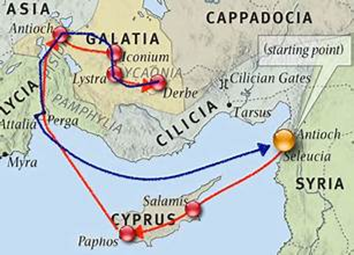
“Then after some days Paul said to Barnabas, “Let us now go back and visit our brethren in every city where we have preached the word of the Lord, and see how they are doing.” Now Barnabas was determined to take with them John called Mark. But Paul insisted that they should not take with them the one who had departed from them in Pamphylia, and had not gone with them to the work. Then the contention became so sharp that they parted from one another. And so Barnabas took Mark and sailed to Cyprus; but Paul chose Silas and departed, being commended by the brethren to the grace of God. And he went through Syria and Cilicia, strengthening the churches.”

It had to happen sooner or later. Paul and Barnabas have been ministering as a team with great results. But now there’s a problem. When Barnabas’ cousin, John Mark, was with them during Paul’s first missionary journey, he left them in Pamphylia, returning to Jerusalem. Was Mark ill? Did he find Paul overbearing? Did God order Mark to return to Jerusalem? We don’t know Mark’s reasons for his departure; we only know that Paul remains offended and incensed. Barnabas has a soft heart for those around him; in fact, Barnabas was the one who introduced Paul to the church leaders in Jerusalem, a fact Paul seems to have conveniently forgotten. While Paul spews forth fiery rhetoric, Barnabas continues to lovingly insist that they include Mark. Finally, relationships become so strained that Paul takes Silas, an elder at Antioch, as a ministry partner while Barnabas and Mark sail for Cyprus, returning to Barnabas’ home area.

Many times, when churches split, the turmoil results in large numbers of people who aren’t attending anywhere. But this split has God’s finger prints all over it. Although we don’t hear much about Barnabas and Mark after the description of this controversy, we can be certain that this team will prove as effective as that of Paul and Silas. Barnabas is one of those men who ministers quietly but lovingly, a combination that’s impossible to ignore. Perhaps this split also is God’s way of allowing Mark to work closely with Barnabas, that “Son of Encouragement.” Without Paul continually trying to dominate every situation, Mark can grow spiritually and as a teacher and preacher. Gardeners can tell you that some plants do better in direct sunlight while others need shade to flourish. Mark may be a gentle soul who will develop far better away from the glaring brightness of Paul.

Not all controversies are bad; sometimes God uses trouble to guide us into or out of particular situations. During our first mission term, we found ourselves in an untenable position. Although we had repeatedly promised our supporters that the new project to which we had been sent would not benefit any private individual, we soon realized that at least two people were trying to get a great deal of money out of our sending agency. The fledgling mission that had sent us was uncertain about the way forward, leaving us at the mercy of greedy men. Although it was extremely painful when the mission agency shortened our term by one year and ordered us to return home, God was actually delivering us from a terrible situation. The struggles we faced helped bring out the problems in that posting and the next missionaries sent there had a far easier time of it than we had. We suspect that the mission agency belatedly realized they had made a major mistake; however, large groups find it nearly impossible to apologize for hurts they have inflicted.

It was less than two years when God opened up other doors and we found ourselves headed to Ghana again. (While interviewing at our next sending agency, we told their leaders, “Here are the mistakes our last mission group made, and if you want to behave like this, we can end this interview right now!”) While the lessons we learned from that first term were quite painful, they were necessary. Once we returned in December 1992, we have never stopped serving the Ghanaian people.

What ever happened to John Mark? Well, we know him as Mark, the author of a Gospel by his name. Eventually, Mark connects with Peter, who gives Mark most of the information contained in that Gospel. Mark’s resilience and persistence in ministry likely reflect the teaching he has received from Barnabas. Perhaps Mark even receives instruction from Barnabas far more readily because he has suffered brow beating from Paul! Only in heaven will we know these things. But this we can be sure of: God does not waste people or their suffering. Suffering always leads to something better, if we will allow it. And for centuries, believers have read Mark’s Gospel and blessed his name. Not bad for a ministry failure?

PRAYER: Father God, thank You for loving us and for caring for us. Lord, we bless Your Name, for You do not waste people. When we fail, You send someone like Barnabas to restore and teach us. Help us to continue to trust You, no matter what. In the mighty and precious Name of King Jesus. Amen.
MAY 28, 2025 FOLLOWING JESUS IN A POST-ASCENSION WORLD #34 WHAT’S MORE IMPORTANT? THE WILL OF GOD OR RITUALS?

May 28, 2025

Acts 15:1-5 Conflict over Circumcision

“And certain men came down from Judea and taught the brethren, “Unless you are circumcised according to the custom of Moses, you cannot be saved.” Therefore, when Paul and Barnabas had no small dissension and dispute with them, they determined that Paul and Barnabas and certain others of them should go up to Jerusalem, to the apostles and elders, about this question.

So, being sent on their way by the church, they passed through Phoenicia and Samaria, describing the conversion of the Gentiles; and they caused great joy to all the brethren. And when they had come to Jerusalem, they were received by the church and the apostles and the elders; and they reported all things that God had done with them. But some of the sect of the Pharisees who believed rose up, saying, “It is necessary to circumcise them, and to command them to keep the law of Moses.”

Acts 15:6-21 The Jerusalem Council

“Now the apostles and elders came together to consider this matter. And when there had been much dispute, Peter rose up and said to them: “Men and brethren, you know that a good while ago God chose among us, that by my mouth the Gentiles should hear the word of the gospel and believe. So God, who knows the heart, acknowledged them by giving them the Holy Spirit, just as He did to us, and made no distinction between us and them, purifying their hearts by faith. Now therefore, why do you test God by putting a yoke on the neck of the disciples which neither our fathers nor we were able to bear? But we believe that through the grace of the Lord Jesus Christ we shall be saved in the same manner as they.”

Then all the multitude kept silent and listened to Barnabas and Paul declaring how many miracles and wonders God had worked through them among the Gentiles. And after they had become silent, James answered, saying, “Men and brethren, listen to me: Simon has declared how God at the first visited the Gentiles to take out of them a people for His name. And with this the words of the prophets agree, just as it is written:

‘After this I will return and will rebuild the tabernacle of David, which has fallen down;
I will rebuild its ruins and I will set it up; so that the rest of mankind may seek the Lord,
even all the Gentiles who are called by My name, says the Lord who does all these things.’

“Known to God from eternity are all His works. Therefore, I judge that we should not trouble those from among the Gentiles who are turning to God, but that we write to them to abstain from things polluted by idols, from sexual immorality, from things strangled, and from blood. For Moses has had throughout many generations those who preach him in every city, being read in the synagogues every Sabbath.”

Acts 15:22-29 The Jerusalem Decree

“Then it pleased the apostles and elders, with the whole church, to send chosen men of their own company to Antioch with Paul and Barnabas, namely, Judas who was also named Barsabas, and Silas, leading men among the brethren.

They wrote this letter by them:

The apostles, the elders, and the brethren,

To the brethren who are of the Gentiles in Antioch, Syria, and Cilicia:

Greetings. Since we have heard that some who went out from us have troubled you with words, unsettling your souls, saying, “You must be circumcised and keep the law”—to whom we gave no such commandment— it seemed good to us, being assembled with one [accord, to send chosen men to you with our beloved Barnabas and Paul, men who have risked their lives for the name of our Lord Jesus Christ. We have therefore sent Judas and Silas, who will also report the same things by word of mouth. For it seemed good to the Holy Spirit, and to us, to lay upon you no greater burden than these necessary things: that you abstain from things offered to idols, from blood, from things strangled, and from sexual immorality. If you keep yourselves from these, you will do well.

Farewell.”

Well, it must happen sooner or later. Since many of the church leaders and many converts have been practicing Jews, ingrained habits are hard to break. “Surely,” these men think, “becoming a Christian can’t be as simple as believing in Jesus, confessing your sins, being baptized, and abstaining from idol worship. Surely, we need more rules, more structure.” Suddenly these men are trying to impose all kinds of rules on new converts from pagan backgrounds who have no knowledge of Jewish laws. You can practically see some of these men rubbing their hands together in glee as they anticipate lording it over Gentile believers while they instruct them in Jewish practices…..only these guys are wrong! Wrong! WRONG!

Church leaders call for a council, and Peter speaks first. After recounting the story of the Roman centurion and his family and friends, Peter says, “Now therefore, why do you test God by putting a yoke on the neck of the disciples which neither our fathers nor we were able to bear? But we believe that through the grace of the Lord Jesus Christ we shall be saved in the same manner as they.”

After a great deal of discussion, James speaks, “Therefore, I judge that we should not trouble those from among the Gentiles who are turning to God, but that we write to them to abstain from things polluted by idols, from sexual immorality, from things strangled, and from blood. For Moses has had throughout many generations those who preach him in every city, being read in the synagogues every Sabbath.” Putting it simply, James points out that all the practices these men are trying to force on new believers have been available for centuries, and if new believers choose to follow those practices, they can easily get information from their local synagogue.

Finally, the council chooses to send Judas and Silas along with Paul and Barnabas to give this message: “For it seemed good to the Holy Spirit, and to us, to lay upon you no greater burden than these necessary things: that you abstain from things offered to idols, from blood, from things strangled, and from sexual immorality.”

How many rituals does someone have to observe to be a true Christian? When we returned from our first mission assignment, we worked for two weeks in a church camp. One week a very conservative group came in, the kind with severe restrictions on female dress. The ladies in the group looked askance at me for my tee shirts and jeans; meanwhile, I was mowing lawns, emptying trash baskets, and doing other janitorial work. There was no point in informing these ladies that I had just completed a two-year mission term in Ghana, for they would never have believed me.

We have friends who have gone to Sturgis, South Dakota to the annual bikers’ convention to witness to their fellow bikers. Naturally, our friends have worn leathers and vests with patches, etc. to fit into the group. Later, Paul will speak of “becoming all things to all men that I might win some.” (1 Corinthians 9:22)

May God help us, so that we refuse to judge but allow God to use anyone He chooses at any time!

PRAYER: Father God, thank You for loving us and for caring for us. Lord, help us to see people with Your eyes and not our own. Help us to remember that Christ died for all those around us and that we have no right to impose rituals that have not come from You. In the mighty and precious Name of King Jesus. Amen.
May 27, 2025 FOLLOWING JESUS IN A POST-ASCENSION WORLD #33 WHEN GOD SENDS YOU, YOU CAN SURVIVE STONING, BUT CAN YOU SURVIVE WITHOUT FELLOWSHIP?

May 27, 2025

Acts 14:19-20 Stoning, Escape to Derbe

“Then Jews from Antioch and Iconium came there; and having persuaded the multitudes, they stoned Paul and dragged him out of the city, supposing him to be dead. However, when the disciples gathered around him, he rose up and went into the city. And the next day he departed with Barnabas to Derbe.

Well, just as Paul and Barnabas are convincing the people of Lystra that they are neither Zeus nor Hermes, Jews from Antioch and Iconium show up. The men of Lystra are already severely disappointed at Paul and Barnabas’ refusal to allow the citizens of Lystra to worship them as Greek gods, so it’s quite easy for these vicious Jewish leaders to convince the mob to stone Paul instead. People are generally fickle and easily swayed. The citizens of Lystra stone Paul and drag him out of the city so he’ll die outside the city gates; however, they must be shocked when Paul rises up and walks back into the city after the disciples gather around Paul and pray for him. How do you get rid of someone who appears to have risen from the dead?

Acts 14:21-28 Strengthening the Converts

And when they had preached the gospel to that city and made many disciples, they returned to Lystra, Iconium, and Antioch, strengthening the souls of the disciples, exhorting them to continue in the faith, and saying, “We must through many tribulations enter the kingdom of God.” So, when they had appointed elders in every church, and prayed with fasting, they commended them to the Lord in whom they had believed. And after they had passed through Pisidia, they came to Pamphylia. Now when they had preached the word in Perga, they went down to Attalia. From there they sailed to Antioch, where they had been commended to the grace of God for the work which they had completed.

Now when they had come and gathered the church together, they reported all that God had done with them, and that He had opened the door of faith to the Gentiles. So, they stayed there a long time with the disciples.”

This passage is a little confusing. As far as we can tell, Paul is stoned in Lystra; yet, this passage mentions returning to Lystra. Perhaps Paul has been stoned in a small village outside Lystra, rather than Lystra itself. The important thing is that even after being violently rejected by the local people, Paul returns and preaches the gospel, making many disciples. After all, Paul and Barnabas have already healed a cripple, and now Paul has survived stoning, evidently without any injuries whatsoever. Rather than discouraging new believers, these persecutions encourage them, for it’s not easy to be a Christian in these times. Ray Van der Laan, in one of his videos, speaks of the pressures on Christian businessmen in pagan cities, for their unbelieving neighbors would try to force them to sacrifice to the gods of the market and commerce. Christians refusing to work on the Sabbath might find themselves without jobs.

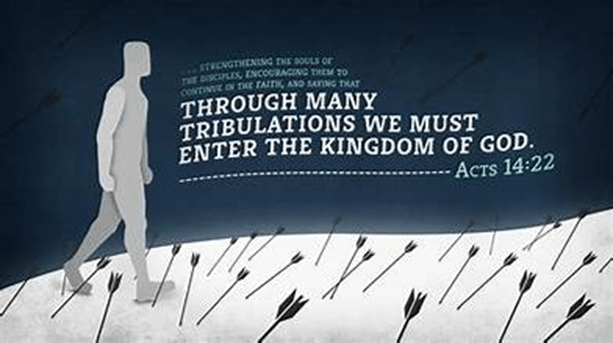
“We must through many tribulations enter the kingdom of God.” Hmm! Try preaching this message today and see how popular it will be with a congregation. Nobody wants to hear that they are likely to suffer; yet, in Northern Nigeria, believers are dying for their faith as Muslim extremists attack worship services. In many parts of the world, believers are suffering and dying. There’s an old Peanuts cartoon in which Lucy proclaims that “I don’t want any downs! I only want ups and ups and ups!” If we are honest, most of us feel the same way. We interpret the petty problems we face daily as profound suffering, refusing to look at the bigger picture of the persecuted church.

These verses mention that Paul and Barnabas fast and pray and then appoint elders in each church. But these men are new believers with only the teaching they have received from Paul and Barnabas to guide them. It is amazing that these men fulfill these functions competently and thoroughly, despite being a lack of experience as Christians. Evidently, God has been preparing these men for these positions all of their lives so that they are able to perform well. Obviously, God has guided Paul and Barnabas in their choice of elders.

After reporting everything to the church at Antioch, Paul and Barnabas stay there a long time. Not only do these men need to report on their missionary efforts, but they themselves need restoration. Here the local church is playing a crucial role in rejuvenating these men for further service, a role many local churches avoid.

Several years ago, we were spending several weeks in one of our “home” locations. We were facing life-shaking challenges-putting my father in a nursing home, dealing with the sudden death of my beloved sister-in-law. It was summer, and some of the fellowship groups at a local church had disbanded; however, the pastor made a special point of boasting about how much the members of his group were enjoying one another. The pastor went so far as to show slides during the worship service of the fun his group had had the previous Sunday during a picnic and swimming party. We quietly went to the pastor, begging to become part of a fellowship group, for we desperately needed restoration. It rapidly became obvious that the pastor did not want to include us in his group for reasons we never understood. Did he think we would take over his group? Who knows? Eventually, leaders of another group heard of our plight and graciously included us. Those precious people are now with Jesus, but we will forever bless their names that they were willing to add us.

Why do I tell this story? Missionaries need restoration just like other believers. We don’t float around on little pink clouds; we have the same life challenges as everyone else. But we must face these challenges while we are also trying to raise money to return to our mission stations and deal with any problems being raised by those back in those stations.

In this passage, Paul and Barnabas return to Antioch after Paul has been stoned and they have been chased across the countryside by furious Jewish leaders. No wonder these men need restoration! It’s likely a relief for Paul and Barnabas to sit quietly while someone else teaches. I end this teaching with a heart-felt plea: If your church is supporting missionaries, ASK what they need in terms of emotional support, rather than guessing!!! You might find that they simply want to sit quietly and listen while someone else teaches.

PRAYER: Father God, thank You for loving us and for caring for us. Lord, help us to hear the heart cries of those around us, particularly those in ministry, and to realize that they need spiritual restoration just as we do. In the mighty and precious Name of King Jesus. Amen.

MAY 26, 2025 FOLLOWING JESUS IN A POST-ASCENSION WORLD #32 WHEN GOD SENDS YOU, DON’T CONFUSE THE MESSENGER WITH THE MESSAGE!

May 26, 2025

Acts 14:1-7 At Iconium

“Now it happened in Iconium that they went together to the synagogue of the Jews, and so spoke that a great multitude both of the Jews and of the Greeks believed. But the unbelieving Jews stirred up the Gentiles and poisoned their minds against the brethren. Therefore, they stayed there a long time, speaking boldly in the Lord, who was bearing witness to the word of His grace, granting signs and wonders to be done by their hands.

But the multitude of the city was divided: part sided with the Jews, and part with the apostles. And when a violent attempt was made by both the Gentiles and Jews, with their rulers, to abuse and stone them, they became aware of it and fled to Lystra and Derbe, cities of Lycaonia, and to the surrounding region. And they were preaching the gospel there.

When you are acting for the Kingdom of God, there will always be opposition. And the more effective your ministry, the stronger the opposition. Here, Paul and Barnabas have been preaching and teaching and many people, both Jews and Greeks, have been streaming into the Kingdom of God. But traditional leaders whose commitment to their own power is greater than their commitment to God’s truth are doing everything they can to fight these men. Finally, Paul and Barnabas find themselves on the road again, fleeing to Lystra and Derbe and the surrounding region, preaching the gospel as they go.

While Paul and Barnabas are probably thinking only of escaping opposition, God has far bigger plans. For as these preachers are fleeing from one place to another, they are teaching people about Jesus wherever they go, lighting fires of hope in people’s hearts. Psalm 37;23 tells us that “The steps of a good man are ordered by the Lord, and He delights in his way.” While Paul and Barnabas might feel they are wandering aimlessly across the countryside, meanwhile, God is moving them into strategically important connections with spiritually hungry people ready to hear the gospel and accept it.

Acts 14:8-18 Idolatry at Lystra

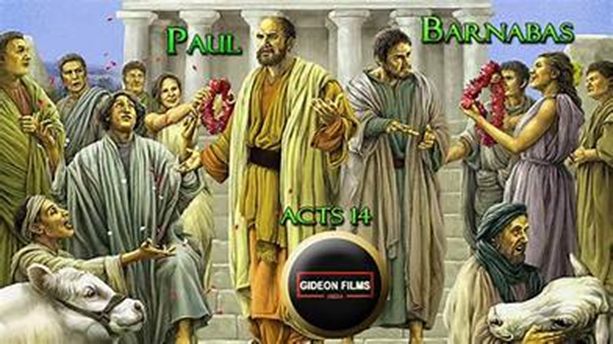
And in Lystra a certain man without strength in his feet was sitting, a cripple from his mother’s womb, who had never walked. This man heard Paul speaking. Paul, observing him intently and seeing that he had faith to be healed, said with a loud voice, “Stand up straight on your feet!” And he leaped and walked. Now when the people saw what Paul had done, they raised their voices, saying in the Lycaonian language, “The gods have come down to us in the likeness of men!” And Barnabas they called Zeus, and Paul, Hermes, because he was the chief speaker. Then the priest of Zeus, whose temple was in front of their city, brought oxen and garlands to the gates, intending to sacrifice with the multitudes.

But when the apostles Barnabas and Paul heard this, they tore their clothes and ran in among the multitude, crying out and saying, “Men, why are you doing these things? We also are men with the same nature as you, and preach to you that you should turn from these useless things to the living God, who made the heaven, the earth, the sea, and all things that are in them, who in bygone generations allowed all nations to walk in their own ways. Nevertheless, He did not leave Himself without witness, in that He did good, gave us rain from heaven and fruitful seasons, filling our hearts with food and gladness.” And with these sayings they could scarcely restrain the multitudes from sacrificing to them.”

The people of Lystra have been worshiping fake Grecian gods, even though the myths describe these beings as far from having any purity or holiness. When Paul and Barnabas speak to a man crippled from birth, he leaps up healed and whole. Local people are so thrilled that they can only conclude that their gods have descended and are favoring them. But now Paul and Barnabas have a new set of problems: the temptation to allow themselves to be worshiped as gods. Quite sensibly, Paul and Barnabas refuse, doing everything they can to convince these people that the God of heaven and earth has done this miracle and that they are only His agents.

The temptation to take glory reserved only for God continues to this day. Here in Ghana, it is quite common for those conducting crusades to spread posters portraying the evangelist and the dates of the crusade as widely as possible, advertising healing and deliverance. But without God, these people are nothing, powerless beings who can only mouth platitudes. The question is this: who is doing the healing and who should receive the glory? While God may work through men and women, He alone deserves the praise and the glory. People do get healed in these crusades; however, the healing comes through their faith in God and not because the evangelist has the power to heal. All power must come from the One True Living God. Paul and Barnabas know that God has healed this man in Lystra and they are doing everything they can to avoid being confused with traditional Greek gods. (Study Greek mythology, and you rapidly realize that the Greek gods are far from holy or pure!)

As God’s ambassadors, we must not take credit when all the glory belongs to God. There is a fictitious story about the donkey that carried Jesus on Palm Sunday feeling proud that all the adulation was for him; meanwhile, the donkey was only a means to an end. Like that donkey, we must allow God to use us but remember that He is the only One worthy of praise.

PRAYER: Father God, thank You for loving us and for caring for us. Lord, help us to continually point people to You, for You are the Source of light and life while we are only messengers. In the mighty and precious Name of King Jesus. Amen.
MAY 25, 2025 FOLLOWING JESUS IN A POST-ASCENSION WORLD #31 YOU CAN HAVE PEACE AND JOY IN THE MIDST OF PERSECUTION!

May 25, 2025

Acts 13:42-52 Blessing and Conflict at Antioch

“So, when the Jews went out of the synagogue, the Gentiles begged that these words might be preached to them the next Sabbath. Now when the congregation had broken up, many of the Jews and devout proselytes followed Paul and Barnabas, who, speaking to them, persuaded them to continue in the grace of God.

On the next Sabbath almost the whole city came together to hear the word of God. But when the Jews saw the multitudes, they were filled with envy; and contradicting and blaspheming, they opposed the things spoken by Paul. Then Paul and Barnabas grew bold and said, “It was necessary that the word of God should be spoken to you first; but since you reject it, and judge yourselves unworthy of everlasting life, behold, we turn to the Gentiles. For so the Lord has commanded us: ‘I have set you as a light to the Gentiles, that you should be for salvation to the ends of the earth.’”

Now when the Gentiles heard this, they were glad and glorified the word of the Lord. And as many as had been appointed to eternal life believed.

And the word of the Lord was being spread throughout all the region. But the Jews stirred up the devout and prominent women and the chief men of the city, raised up persecution against Paul and Barnabas, and expelled them from their region. But they shook off the dust from their feet against them, and came to Iconium. And the disciples were filled with joy and with the Holy Spirit.”

Consider what it must be like to be a Gentile believer attending the synagogue. Those who are truly hungry spiritually will be drawn by the emphasis on holiness, righteousness, and purity so different from the traditional Greek and Roman deities. But no matter how seriously these people pursue God, the Jewish religious leaders never allow them to forget that they are second-class citizens in the kingdom of God. Now this Jewish scholar Saul/Paul arrives and begins teaching about Jesus Christ, whom Paul describes as the Messiah foretold by Jewish prophets for centuries. What’s even more invigorating, Paul tells the Gentile believers that God wants them to be full citizens in His kingdom and that the Gospel is for them as well. This news is electrifying for the Gentile believers who are desperate to learn more; meanwhile, the Jewish leaders are fuming! Paul is a Pharisee and should know better; how can he possibly extend such hope to these Gentiles?

God has been preparing this scene for centuries, moving these Gentile believers into Antioch and creating divine disappointment with religious ceremonies that fail to satisfy the deepest longings of one’s soul. Now Paul and Barnabas bring this new teaching, and the Jews are doing everything they can to blaspheme and confuse the new believers. When Paul first arrives and begins teaching in the synagogue, he probably assumes that he will continue to minister to Jews; after all, he is an accomplished scholar with glittering academic credentials. Only when the Jewish religious leaders explode in anger does Paul face the truth: God is calling him to minister to the Gentiles.

“It was necessary that the word of God should be spoken to you first; but since you reject it, and judge yourselves unworthy of everlasting life, behold, we turn to the Gentiles. For so the Lord has commanded us: ‘I have set you as a light to the Gentiles, that you should be for salvation to the ends of the earth.’”

The leading Jews are so incensed that they stir up public opinion and succeed in ousting Paul and Barnabas from the region. But Paul and Barnabas shake the dust off their feet as a testimony against them and go on to Iconium.

What’s the significance of shaking the dust off one’s feet? Jesus himself advised his disciples to do this if they tried to teach in a place and were rejected.  Matthew 10:14 states: “And if anyone will not welcome you or listen to your words, shake the dust off your feet when you leave that home or town.” Mark 6:11 likewise records Jesus saying: “If anyone will not welcome you or listen to you, when you leave, shake the dust off your feet as a testimony against them.” By shaking the dust of the place off their feet, Paul and Barnabas are calling out to God that these people have rejected His Word. “So what?” you might ask. “What effect will this symbolic act have on these people?” By rejecting God and His teachers, these people are bringing curses on themselves. God never curses anybody; however, people can bring curses on themselves when they reject God, and this is happening here.

“And the disciples were filled with joy and with the Holy Spirit.” Wait a minute, Barnabas and Paul! You’ve just been thrown out of the entire region surrounding Antioch and have had to flee to Iconium. Civic leaders have reviled you and done everything they can to make things miserable for you; yet, you are “filled with joy and with the Holy Spirit?” Yes. The point here is simple: we can be full of joy and the Holy Spirit anytime we are doing the will of God. As long as we are following God’s will for our lives, He will give us His grace and His joy. We do not need to be swayed by outward events as long as we are sure God is with us.

Currently, we are enduring a difficult situation not unlike that of Paul and Barnabas. Despite doing everything we can to remain faithful, vicious critics are spreading lies about us. But God remains on the throne and God is a God of truth and justice. We can remain calm and joyful in the midst of these problems because God is the Giver of joy and the Holy Spirit is always with us as our Comforter. If you find yourself in a similar situation, remember that God is the Judge and God is the One who justifies. You too can have God’s joy and Holy Spirit peace.

PRAYER: Father God, thank You for loving us and for caring for us. Lord, we praise You that You are a God of light and truth and You are the Giver of Joy. Please fill each of us with Your joy and with Your Holy Spirit. In the mighty and precious Name of King Jesus. Amen.
MAY 24, 2025 FOLLOWING JESUS IN A POST-ASCENSION WORLD #30 WANT A SUCCESSFUL MINISTRY? IRRITATE YOUR AUDIENCE SO THAT THEY LEAVE!

May 24, 2025

Acts 13:13- 41 At Antioch in Pisidia 

“Now when Paul and his party set sail from Paphos, they came to Perga in Pamphylia; and John, departing from them, returned to Jerusalem. But when they departed from Perga, they came to Antioch in Pisidia, and went into the synagogue on the Sabbath day and sat down. And after the reading of the Law and the Prophets, the rulers of the synagogue sent to them, saying, “Men and brethren, if you have any word of exhortation for the people, say on.”

Then Paul stood up, and motioning with his hand said, “Men of Israel, and you who fear God, listen: The God of this people Israel chose our fathers, and exalted the people when they dwelt as strangers in the land of Egypt, and with an uplifted arm He brought them out of it. Now for a time of about forty years He put up with their ways in the wilderness. And when He had destroyed seven nations in the land of Canaan, He distributed their land to them by allotment.

“After that He gave them judges for about four hundred and fifty years, until Samuel the prophet. And afterward they asked for a king; so God gave them Saul the son of Kish, a man of the tribe of Benjamin, for forty years. And when He had removed him, He raised up for them David as king, to whom also He gave testimony and said, ‘I have found David the son of Jesse, a man after My own heart, who will do all My will.’ From this man’s seed, according to the promise, God raised up for Israel a Savior—Jesus—after John had first preached, before His coming, the baptism of repentance to all the people of Israel. And as John was finishing his course, he said, ‘Who do you think I am? I am not He. But behold, there comes One after me, the sandals of whose feet I am not worthy to loose.’

“Men and brethren, sons of the family of Abraham, and those among you who fear God, to you the word of this salvation has been sent. For those who dwell in Jerusalem, and their rulers, because they did not know Him, nor even the voices of the Prophets which are read every Sabbath, have fulfilled them in condemning Him. And though they found no cause for death in Him, they asked Pilate that He should be put to death. Now when they had fulfilled all that was written concerning Him, they took Him down from the tree and laid Him in a tomb. But God raised Him from the dead. He was seen for many days by those who came up with Him from Galilee to Jerusalem, who are His witnesses to the people. And we declare to you glad tidings—that promise which was made to the fathers. God has fulfilled this for us their children, in that He has raised up Jesus. As it is also written in the second Psalm:

‘You are My Son, today I have begotten You.’

And that He raised Him from the dead, no more to return to corruption, He has spoken thus:

‘I will give you the sure mercies of David.’

Therefore He also says in another Psalm: ‘You will not allow Your Holy One to see corruption.’

“For David, after he had served his own generation by the will of God, fell asleep, was buried with his fathers, and saw corruption; but He whom God raised up saw no corruption. Therefore let it be known to you, brethren, that through this Man is preached to you the forgiveness of sins; and by Him everyone who believes is justified from all things from which you could not be justified by the law of Moses. Beware therefore, lest what has been spoken in the prophets come upon you: ‘Behold, you despisers, marvel and perish! For I work a work in your days, a work which you will by no means believe, though one were to declare it to you.’”

So far, Saul, who has renamed himself Paul, has remained a faithful and observant Jew, worshiping in the synagogue on the Sabbath. Having returned to Antioch, Paul and his comrades join worship at the local synagogue. For years, Paul has enjoyed an excellent reputation as an outstanding Jewish scholar, having studied under Gamaliel, one of the finest teachers in Jerusalem. So, it’s no surprise that the local Jewish congregation invites Paul to address them after the Scripture readings.

It’s interesting that Paul begins retelling the story of the Jewish people, much in the same fashion as Stephen did on the day of his martyrdom. And Paul arrives at the same place as Stephen: Messiah has come and the Jews have rejected Him, arranging for his crucifixion. But God has raised Messiah from the dead and all who believe in Him will receive forgiveness of sins and eternal life.

“Therefore let it be known to you, brethren, that through this Man is preached to you the forgiveness of sins; and by Him everyone who believes is justified from all things from which you could not be justified by the law of Moses.” This is the culmination of Paul’s sermon, and he is proclaiming it in ringing tones of joy. After long decades of trying to get things right as a “Pharisee of the Pharisees,” Paul knows no greater thrill than the idea that his sins are truly forgiven and that never again must he perform long lists of rituals to try to please God. Paul is hopeful that the leaders of the local synagogue will share his joy and relief; however, to be intellectually honest, he must end with a warning.

“Beware therefore, lest what has been spoken in the prophets come upon you: ‘Behold, you despisers, marvel and perish! For I work a work in your days, a work which you will by no means believe, though one were to declare it to you.’” Perhaps Paul can already see the local Jewish leaders muttering imprecations into their beards, or perhaps Paul is simply issuing this warning for the sake of completeness. Paul is a scholar after all, and as such, he is bound to quote the Scriptures accurately, not tailoring his words to tell his audience what they want to hear. But Paul’s heart must be sad when he sees those local leaders carefully get up and stalk out of the synagogue in a high dudgeon. Obviously, these men anticipated some nice soothing message filled with platitudes that would justify their lifestyles and their cherished beliefs. Now this stranger from Jerusalem has dared to imply that they, the most righteous men in the synagogue, might be counted among the despisers mentioned by the prophets. The nerve of this man!

I once saw a fictitious letter in which Paul was anonymously applying for a position as a preacher. Paul began by listing his outstanding academic achievements but then continued to honestly list all the places where he had been rejected. This application letter was accompanied by an equally fictitious letter from a church board, thanking Paul for his application but stating that the board felt he would not be a good fit for their church because he was too controversial.

This is Paul’s first missionary journey, and the Holy Spirit is about to bless Paul and Barnabas with a major change in their ministry. For now, we simply watch as Jewish religious leaders rise to their feet and stride indignantly out of the synagogue, leaving the gentile worshipers behind.

May God help us, so that we always strive to please Him and not people!

PRAYER: Father God, thank You for loving us and for caring for us. Lord, help us to follow You and seek to please You, listening carefully to the Holy Spirit. In the mighty and precious Name of King Jesus. Amen.

MAY 23, 2025 FOLLOWING JESUS IN A POST-ASCENSION WORLD WHEN THE HOLY SPIRIT GUIDES YOU, HE ALSO DEALS WITH FAKES!

May 23, 2025

Acts 13:1-3 Paul and Barnabas Are Sent to the Gentiles

“Now in the church that was at Antioch there were certain prophets and teachers: Barnabas, Simeon who was called Niger, Lucius of Cyrene, Manaen who had been brought up with Herod the tetrarch, and Saul. As they ministered to the Lord and fasted, the Holy Spirit said, “Now separate to Me Barnabas and Saul for the work to which I have called them.” Then, having fasted and prayed, and laid hands on them, they sent them away.

Saul and Barnabas are in Antioch, praying with prophets and teachers when the Holy Spirit gives them marching orders. Notice what did NOT happen! Even though all the men gathered in Antioch were intelligent, capable, and experienced, they did NOT organize a board meeting and bring up lots of points for discussion. These men did not put the question before the congregation; instead, these men ministered to the Lord and fasted. I suspect that the place was very quiet because it’s impossible to hear the Holy Spirit clearly when there’s lots of background noise. While fasting might cause noise from grumbling stomachs, it’s effective for focusing on God rather than on outside activities. It was in that stillness that the Holy Spirit spoke clearly, designating Saul and Barnabas for a new work.

One of the problems with many “worship” services today is that they are performances with all the adulation going to the worship leader and the band, rather than avenues of praise that will lead people into the throne room of grace. Years ago, we were in a church where the pastor was an anointed worship leader. A holy hush had come over the congregation and the atmosphere was almost pulsating with Holy Spirit energy….And that’s when the other worship leader suddenly chose to do one more peppy worship song, perhaps because she couldn’t tolerate the quiet. I had such a strong sense of the Holy Spirit leaving the building that I hopped out of my seat and ran out of the church, as if somehow I could still meet the Holy Spirit outside. But it was too late. The opportunity had been missed, never to come again.  

Acts 13:4-12 Preaching in Cyprus

“So, being sent out by the Holy Spirit, they went down to Seleucia, and from there they sailed to Cyprus. And when they arrived in Salamis, they preached the word of God in the synagogues of the Jews. They also had John as their assistant.

Now when they had gone through the island to Paphos, they found a certain sorcerer, a false prophet, a Jew whose name was Bar-Jesus, who was with the proconsul, Sergius Paulus, an intelligent man. This man called for Barnabas and Saul and sought to hear the word of God. But Elymas the sorcerer (for so his name is translated) withstood them, seeking to turn the proconsul away from the faith. Then Saul, who also is called Paul, filled with the Holy Spirit, looked intently at him and said, “O full of all deceit and all fraud, you son of the devil, you enemy of all righteousness, will you not cease perverting the straight ways of the Lord? And now, indeed, the hand of the Lord is upon you, and you shall be blind, not seeing the sun for a time.”

And immediately a dark mist fell on him, and he went around seeking someone to lead him by the hand. Then the proconsul believed, when he saw what had been done, being astonished at the teaching of the Lord.”

Accompanied by John Mark, Saul and Barnabas have arrived in a major city in Cyprus and are preaching the Gospel in the Jewish synagogues. At Paphos there’s a Roman proconsul who is spiritually hungry; however, Satan has sent a Jewish sorcerer named Bar-Jesus (Son of Jesus) to try to divert this man from coming to a saving knowledge of Jesus Christ. But the Holy Spirit is not about to be mocked.

Then Saul, who also is called Paul, filled with the Holy Spirit, looked intently at him and said, “O full of all deceit and all fraud, you son of the devil, you enemy of all righteousness, will you not cease perverting the straight ways of the Lord? And now, indeed, the hand of the Lord is upon you, and you shall be blind, not seeing the sun for a time.”

And immediately a dark mist fell on him, and he went around seeking someone to lead him by the hand. Then the proconsul believed, when he saw what had been done, being astonished at the teaching of the Lord.”

We never learn what happens to this sorcerer, although you might think that being struck blind would be enough to convince anybody. But the proconsul recognizes spiritual truth when he hears it and believes in Jesus Christ.

When we are working for the Lord, we must expect opposition. When John Wesley first began the Methodist movement in England, many people in the established churches opposed him violently, driving him out of churches and forcing him to speak outdoors to large groups of people. Wesley endured so much persecution that one day he was riding along the road, wondering if he was doing the Lord’s will, for nobody had attacked him for a few days. Just then, on the other side of the hedge, a man heard Wesley talking to himself and said, “There’s that man Wesley! I’ll show him!” With that, the man picked up a large rock and chucked it over the hedge at Wesley. Wesley’s reaction was quite unique: “Praise God! I’m doing the right thing!”

Perhaps you are enduring persecution right now. You have tried to follow God’s will for your life; however, you find yourself assailed by critics desiring only to destroy your reputation and your work. Hear what Paul says in Romans 8:31-39 “What then shall we say in response to these things? If God is for us, who can be against us? He who did not spare His own Son but gave Him up for us all, how will He not also, along with Him, freely give us all things? Who will bring any charge against God’s elect? It is God who justifies. Who is there to condemn us? For Christ Jesus, who died, and more than that was raised to life, is at the right hand of God—and He is interceding for us.”

“Who shall separate us from the love of Christ? Shall trouble or distress or persecution or famine or nakedness or danger or sword? As it is written:

“For Your sake we face death all day long; we are considered as sheep to be slaughtered.”

No, in all these things we are more than conquerors through Him who loved us. For I am convinced that neither death nor life, neither angels nor principalities, neither the present nor the future, nor any powers, neither height nor depth, nor anything else in all creation, will be able to separate us from the love of God that is in Christ Jesus our Lord.”

PRAYER: Father God, thank You for loving us and for caring for us. Lord, help us to listen for the Holy Spirit and to be guided by Him, no matter who or what opposes us. In the mighty and precious Name of King Jesus. Amen.
MAY 22, 2025 FOLLOWING JESUS IN A POST-ASCENSION WORLD #28 ARE YOU A LEGEND IN YOUR OWN MIND? WATCH OUT!

May 22, 2025

Acts 12:20- 24 Herod’s Violent Death

“Now Herod had been very angry with the people of Tyre and Sidon; but they came to him with one accord, and having made Blastus the king’s personal aide their friend, they asked for peace, because their country was supplied with food by the king’s country.

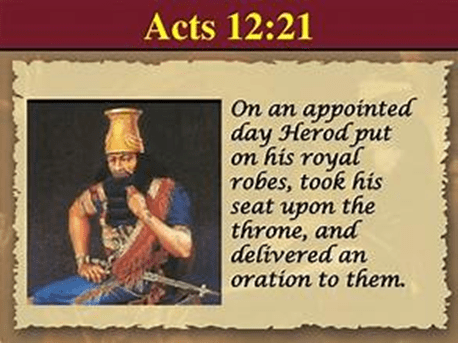
So, on a set day Herod, arrayed in royal apparel, sat on his throne and gave an oration to them. And the people kept shouting, “The voice of a god and not of a man!” Then immediately an angel of the Lord struck him, because he did not give glory to God. And he was eaten by worms and died.

But the word of God grew and multiplied.”

Those who must deal with Herod on a regular basis feel he is a megalomaniac with an ego that won’t quit. Certainly, there is no simple means of dealing with this man, for if you flatter too little, you might lose influence. On the other hand, no amount of effusive flattery appears to be too much for Herod. The more grandiose the praise, the more Herod revels in it.

After Peter has escaped Herod’s jail, despite the four squads of Roman soldiers Herod has sent to guard him, Herod huffs off to his magnificent port of Caesarea on the coast. Caesarea is a true triumph of engineering, for it is a self-cleaning port designed to avoid the silting problem that has plagued so many other ports around the Mediterranean Sea. The kingdom of Tyre is built on a peninsula that juts out into the sea; while Tyre is a major trading city, it depends on Herod’s lands for its food. While Sidon is a coastal city, it too gets its food from further inland.

We don’t know what the citizens of Tyre and Sidon have done to offend Herod; however, they are sensible to the need to make peace with him. After all, no peace with Herod means no food! Through Herod’s personal aid, Blastus, these people invite Herod to visit them. Acting on the theory that no amount of flattery is too much for Herod, these people listen raptly to Herod’s oration and then cry out, “The voice of a god and not of a man!” Herod stands there in the sunlight, preening himself. Surely, this must be one of the finest moments of Herod’s entire career…or is it?

The Bible records that suddenly an angel strikes Herod and that he is eaten by worms and dies.  The ancient Jewish historian Josephus gives this description:  “He put on a garment made wholly of silver, and of a contexture truly wonderful, and came into the theatre early in the morning; at which time the silver of his garment, being illuminated by the fresh reflection of the sun’s rays upon it, shone out after a surprising manner, and was so resplendent as to spread a horror over those that looked intently upon him; and presently his flatterers cried out, one from one place, and another from another (though not for his good), that he was a god…A severe pain also arose in his belly, and began in a most violent manner… when he had been quite worn out by the pain in his belly for five days, he departed this life.” (Antiquities, XIX.8.2)

Did Herod suffer a perforated peptic ulcer or an intestinal perforation from typhoid or some other illness? Whatever has happened must be quite sudden. A perforated peptic ulcer would certainly fit the description, and dying within five days would be a strong possibility with such a perforation. The agony from unrestricted amounts of gastric juice pouring into one’s abdomen cannot be overstated.

Was it necessary for Herod to die in this fashion? NO! Through the years, God gave Herod all kinds of opportunities to repent and to worship Him. But Herod persisted in worshiping himself and paid a horrific price for doing so.

We read this account and think smugly, “Well, I would never do anything like that.” But is that true, or are we “legends in our own minds?” While we might not parade in front of a crowd dressed in silver clothing, how do we handle ourselves in public or on social media? Are we truly worshiping God in everything we do, or do we confine worship to one hour on Sunday morning? And if we confine worship to that small a time period, is it really worship in the first place? Do we acknowledge God as our Redeemer and our Creator, or do we think we are “self-made people?”

Eventually, even righteous Job repented, telling God, “I have heard of You by the hearing of the ear, but now my eye sees You. Therefore, I abhor myself, and repent in dust and ashes.”

When Jesus was speaking to the Samaritan woman at the well, he told her, “God is Spirit, and those who worship Him must worship in spirit and truth.” (John 4:24) May God help us, so that we will worship Him and nobody else and that we will worship in spirit and truth.

PRAYER: Father God, thank You for loving us and for caring for us. Lord, help us to truly worship You and nobody and nothing else. In the mighty and precious Name of King Jesus. Amen.