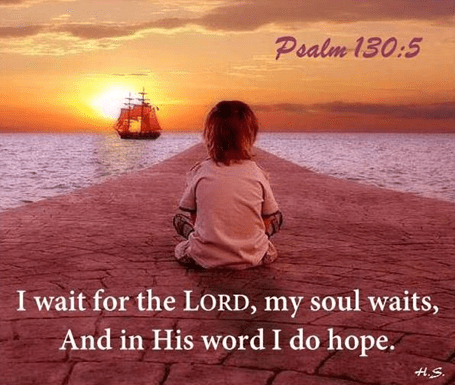
Psalm 130
Out of the depths I have cried to You, O Lord; Lord, hear my voice! Let Your ears be attentive
To the voice of my supplications.
If You, Lord, should mark iniquities, O Lord, who could stand?
But there is forgiveness with You, That You may be feared.
I wait for the Lord, my soul waits, and in His word I do hope.
My soul waits for the Lord more than those who watch for the morning—
Yes, more than those who watch for the morning.
O Israel, hope in the Lord; for with the Lord there is mercy, and with Him is abundant redemption. And He shall redeem Israel from all his iniquities.
We’ve all had those times, periods when our mistakes haunt us and our problems look insurmountable. Fifty years ago, as I was preparing to graduate from medical school, I wrote a piece for the campus newspaper paying tribute to the place and to my fellow medical students. I spoke of “contemplating one’s mediocrity at 2 AM with an overdose handy,” acknowledging the struggles of one of my classmates who had attempted suicide but who had survived. By that time, I too had endured the despair of a failed relationship, a clinical depression, and the temptation to commit suicide. Many medical students face looming anxieties, thinking of leaving the safety of medical school to function as a “real doctor.” Only a few years after I graduated, one surgery resident in a highly-ranked program plunged a knife into his own chest in an act of total hopelessness.
Saint John of the Cross, a sixteenth century Spanish saint, wrote a poem entitled “Dark Night of the Soul.” The poem depicted a time when John was in despair and went out at night seeking Jesus. When John found Jesus, Jesus struck him on the neck with his hand, causing John to leave all his cares and to focus only on Jesus’ love. This eight-stanza poem outlines the soul’s journey from the distractions and entanglements of the world to the perfect peace and harmony of union with God. According to the poet, the “dark night of the soul” is synonymous with traveling the “narrow way” that Jesus spoke of in Matthew 7:13-14. (Gotquestions.org)
How can we survive “dark nights of the soul?” First, we must acknowledge that we have a problem. Twelve step programs are designed to help people addicted to various things to shake off those addictions. Here are the twelve steps of Alcoholics Anonymous with simple explanations as explained on soberspeak.com :
Step 1
We admitted we were powerless over alcohol—that our lives had become unmanageable.
→ This is where you stop fighting. It’s not failure. It’s the beginning of surrender and change.
Step 2
Came to believe that a Power greater than ourselves could restore us to sanity.
→ You don’t need to define that power yet. Just be open to the idea that something stronger than addiction exists, call it a higher power, the group, or even just hope.
Step 3
Made a decision to turn our will and our lives over to the care of God as we understood Him.
→ The third step is about trust, not dogma. A loving God of your understanding is enough.
Step 4
Made a searching and fearless moral inventory of ourselves.
→ Time to dig deep. We look at our character flaws, fears, resentments, and harms.
Step 5
Admitted to God, to ourselves, and to another human being the exact nature of our wrongs.
→ You speak the truth. Shame loses its power when it’s shared out loud.
Step 6
Were entirely ready to have God remove all these defects of character.
→ Readiness is key. You don’t have to fix everything, just be willing.
Step 7
Humbly asked Him to remove our shortcomings.
→ You ask—not demand. This is about humility, not self-hate.
Step 8
Made a list of all persons we had harmed and became willing to make amends to them all.
→ Accountability starts here. It’s also the beginning of healthy relationships.
Step 9
Made direct amends wherever possible, except when to do so would injure them or others.
→ Actions matter more than apologies. But this step is done thoughtfully.
Step 10
Continued to take personal inventory and when we were wrong promptly admitted it.
→ Recovery is a daily practice, not a one-time event. This keeps your personal progress going.
Step 11
Sought through prayer and meditation to improve our conscious contact with God as we understood Him, praying only for knowledge of His will and the power to carry that out.
→ Spiritual growth, done your way. Keep it simple, keep it steady.
Step 12
Having had a spiritual awakening as the result of these steps, we tried to carry this message to A.A. members and to practice these principles in all our affairs.
“But,” you gasp, “I am not addicted to anything!” Oh? Are you sure? Behaviors can be as addictive as anything else. People can be addicted to approval and applause, demanding it from all those around them. Some people are addicted to self-pity, whether or not there are actual grounds for such sentiments. Some people are bullies, confusing noise with achievement and power. No matter the origin of an addiction, the results will eventually be the same: destruction of relationships and despair.
Psalm 130 begins with someone in the depths of despair, but the psalm doesn’t end there. The psalmist realizes his/her plight but also realizes that God is the Source of all hope. I wait for the Lord, my soul waits, and in His word I do hope.
My soul waits for the Lord more than those who watch for the morning—
Yes, more than those who watch for the morning.
O Israel, hope in the Lord; for with the Lord there is mercy, and with Him is abundant redemption. And He shall redeem Israel from all his iniquities.
Psalm 130 offers hope of redemption, a Savior who can lift us out of all the messes we have created for ourselves. There is such a Savior, and His name is Jesus, our Redeemer, and the lover who comes to us in our dark nights of the soul. Turn to him! Run to him! Trust him!
PRAYER: Father God, thank You for loving us and caring for us. Lord, help us to turn all our problems over to You, trusting that You can bring perfect solutions. We praise You that You are our Redeemer, our Savior, and our Friend. In Your mighty and precious Name, King Jesus. Amen.


Leave a Reply