Acts 1:1 In my first book I told you, Theophilus, about everything Jesus began to do and teach 2 until the day he was taken up to heaven after giving his chosen apostles further instructions through the Holy Spirit. 3 During the forty days after he suffered and died, he appeared to the apostles from time to time, and he proved to them in many ways that he was actually alive. And he talked to them about the Kingdom of God.
4 Once when he was eating with them, he commanded them, “Do not leave Jerusalem until the Father sends you the gift he promised, as I told you before. 5 John baptized with water, but in just a few days you will be baptized with the Holy Spirit.”
The Ascension of Jesus
6 So when the apostles were with Jesus, they kept asking him, “Lord, has the time come for you to free Israel and restore our kingdom?”
7 He replied, “The Father alone has the authority to set those dates and times, and they are not for you to know. 8 But you will receive power when the Holy Spirit comes upon you. And you will be my witnesses, telling people about me everywhere—in Jerusalem, throughout Judea, in Samaria, and to the ends of the earth.”
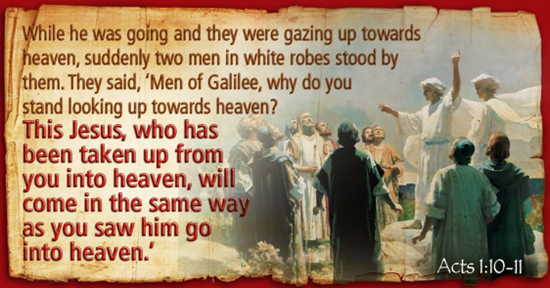
9 After saying this, he was taken up into a cloud while they were watching, and they could no longer see him. 10 As they strained to see him rising into heaven, two white-robed men suddenly stood among them. 11 “Men of Galilee,” they said, “why are you standing here staring into heaven? Jesus has been taken from you into heaven, but someday he will return from heaven in the same way you saw him go!”
The Book of Luke and the Book of Acts were both written by Luke, a physician who was not one of the original apostles but who documented Jesus’ life and that of the apostles scrupulously.
Luke wrote both his gospel and the Book of Acts for a friend named Theophilus, or “Lover of God.” As a fellow physician, I think that in modern times, Luke would have been a great Internal Medicine specialist or even a Neurologist, for he amassed enormous amounts of detail, interviewing as many people as possible before writing.
Many scholars believe that Luke was a physician who lived in the Hellenistic city of Antioch in Ancient Syria,[c] born of a Greek family,[8][9][10] although some scholars and theologians think Luke was a Hellenic Jew.[11][12] While it has been widely accepted that the theology of Luke–Acts points to a gentile Christian writing for a gentile audience, some have concluded that it is more plausible that Luke–Acts is directed to a community made up of both Jewish and gentile Christians since there is stress on the scriptural roots of the gentile mission (see the use of Isaiah 49:6 in Luke–Acts).[13][14]
Whether Luke was a Jew or gentile, or something in between, it is clear from the quality of the Greek language used in Luke–Acts that the author, held in Christian tradition to be Luke, was one of the most highly educated of the authors of the New Testament. The author’s conscious and intentional allusions and references to, and quotations of, ancient Classical and Hellenistic Greek authors, such as Homer, Aesop, Epimenides, Euripides, Plato, Thucydides, and Aratus indicate that he was familiar with actual Greek literary texts. This familiarity most likely derived from his experiences as a youth of the very homogenous Hellenistic educational curriculum (ἐγκύκλιος παιδεία, enkyklios paideia) that had been, and would continue to be, used for centuries throughout the eastern Mediterranean.[15] (https://en.wikipedia.org/wiki/Luke_the_Evangelist)
Although some gospels give the impression that Jesus ascended into heaven almost as soon as he was resurrected, Luke documents a period of forty days, during which Jesus repeatedly appeared to the disciples. It was only at the end of the forty-day period that Jesus ascended. During that time, the disciples besieged Jesus with questions, the main one being “Lord, has the time come for you to free Israel and restore our kingdom?” After all, Jesus had conquered death and the grave, so why not conquer the Romans and bring in the Kingdom of God instantly? The disciples were hoping for quick and easy answers; however, Jesus wasn’t giving out any information. When the disciples persisted, Jesus simply told them that information was privileged and only the Heavenly Father knew the time table. But then Jesus totally changed the subject.
During Jesus’ last night with the disciples in the Upper Room, he breathed on them to receive the Holy Spirit. Now Jesus was promising that the Holy Spirit would soon come, giving them power to witness throughout the world. Frankly, this was not what the disciples wanted. The disciples felt that they had already suffered enough, so why not simply end everything here and now? But God’s ways are higher than ours and His timing is not ours. The next major event found the disciples standing in awe as Jesus ascended into heaven.
May 17, 2026 was Ascension Sunday, a day on which we celebrate Jesus’ ascension. The disciples must have been devastated as they watched Jesus leave them. What would they do now? How could they possibly go on? True, they had Jesus’ teachings, but teachings couldn’t compare with having Jesus present with them physically. And what was this Holy Spirit that Jesus kept talking about? Jesus had tried to tell the disciples about the Holy Spirit the night he was betrayed.
John 16:5 “But now I am going away to the one who sent me, and not one of you is asking where I am going. 6 Instead, you grieve because of what I’ve told you. 7 But in fact, it is best for you that I go away, because if I don’t, the Advocate won’t come. If I do go away, then I will send him to you. 8 And when he comes, he will convict the world of its sin, and of God’s righteousness, and of the coming judgment. 9 The world’s sin is that it refuses to believe in me. 10 Righteousness is available because I go to the Father, and you will see me no more. 11 Judgment will come because the ruler of this world has already been judged.
12 “There is so much more I want to tell you, but you can’t bear it now. 13 When the Spirit of truth comes, he will guide you into all truth. He will not speak on his own but will tell you what he has heard. He will tell you about the future. 14 He will bring me glory by telling you whatever he receives from me. 15 All that belongs to the Father is mine; this is why I said, ‘The Spirit will tell you whatever he receives from me.’
Jesus knew that he needed to return to heaven so that the Holy Spirit could come be with his followers forever. Even in a resurrected body, Jesus would have been severely limited; however, the Holy Spirit would have no physical limitations, existing in eternity.
We can certainly identify with the disciples. We don’t want mysteries; we want God with the skin on, a Being we can touch. And we would really like God to reveal His time table; however, God in His infinite mercy refuses to do that because He knows that we might try to fix things and totally mess things up. Think about Saul on the road to Damascus, bent on capturing as many Christians as possible to drag them back to Jerusalem. If you had asked any of the disciples, they would have warned you against Saul, and even when God ordered Ananias to go pray for Saul, Ananias tried to beg off. We want God to work our way on our terms, not His. And of course, the difference is that our ways don’t work and His ways do.
What should we do while we are waiting for God to reveal Himself to us? Pray. Worship. Praise God for who He is, even though we don’t understand what He is doing or how He is doing it. When we praise God, we open our minds and hearts to His possibilities and He can enlighten us in special ways. Never mind whether or not you can see your way clear. Do the next thing that lies before you, continue to act faithfully, and God will reveal His Will step by step.
There’s this paradox about living a life of faith: the farther we go on with God, the less we can trace Him and the more we must trust Him. That’s because it takes more faith to trust than it does to move when everything is made clear. Do you feel that you are caught in a cloud with no sense of direction? Look at your situation and see whatever small things God is calling you to do. Remember that God doesn’t sneer at small things but uses them. And as you do the small things bit by bit, God will continue to reveal Himself until one day, you will look back and see that God has been leading you safely all these years.
PRAYER: Father God, thank You for loving us and caring for us. Lord, help us to trust where we cannot see and to continue to walk forward, even if we are only taking baby steps. In the mighty and precious Name of King Jesus. Amen.


Leave a Reply