Act 7:1 Then the High Priest asked him, “Are these accusations true?”
2 This was Stephen’s lengthy reply: “The glorious God appeared to our ancestor Abraham in Iraq before he moved to Syria, 3 and told him to leave his native land, to say good-bye to his relatives and to start out for a country that God would direct him to. 4 So he left the land of the Chaldeans and lived in Haran, in Syria, until his father died. Then God brought him here to the land of Israel, 5 but gave him no property of his own, not one little tract of land.
“However, God promised that eventually the whole country would belong to him and his descendants—though as yet he had no children! 6 But God also told him that these descendants of his would leave the land and live in a foreign country and there become slaves for 400 years. 7 ‘But I will punish the nation that enslaves them,’ God told him, ‘and afterwards my people will return to this land of Israel and worship me here.’
8 “God also gave Abraham the ceremony of circumcision at that time, as evidence of the covenant between God and the people of Abraham. And so Isaac, Abraham’s son, was circumcised when he was eight days old. Isaac became the father of Jacob, and Jacob was the father of the twelve patriarchs of the Jewish nation. 9 These men were very jealous of Joseph and sold him to be a slave in Egypt. But God was with him, 10 and delivered him out of all of his anguish, and gave him favor before Pharaoh, king of Egypt. God also gave Joseph unusual wisdom so that Pharaoh appointed him governor over all Egypt, as well as putting him in charge of all the affairs of the palace…
39 “But our fathers rejected Moses and wanted to return to Egypt. 40 They told Aaron, ‘Make idols for us, so that we will have gods to lead us back; for we don’t know what has become of this Moses, who brought us out of Egypt.’ 41 So they made a calf idol and sacrificed to it, and rejoiced in this thing they had made.
42 “Then God turned away from them and gave them up, and let them serve the sun, moon, and stars as their gods! In the book of Amos’ prophecies the Lord God asks, ‘Was it to me you were sacrificing during those forty years in the desert, Israel? 43 No, your real interest was in your heathen gods—Sakkuth, and the star god Kaiway, and in all the images you made. So I will send you into captivity far away beyond Babylon.’
44 “Our ancestors carried along with them a portable Temple, or Tabernacle, through the wilderness. In it they kept the stone tablets with the Ten Commandments written on them. This building was constructed in exact accordance with the plan shown to Moses by the Angel. 45 Years later, when Joshua led the battles against the Gentile nations, this Tabernacle was taken with them into their new territory, and used until the time of King David.
46 “God blessed David greatly, and David asked for the privilege of building a permanent Temple for the God of Jacob. 47 But it was Solomon who actually built it. 48-49 However, God doesn’t live in temples made by human hands. ‘The heaven is my throne,’ says the Lord through his prophets, ‘and earth is my footstool. What kind of home could you build?’ asks the Lord. ‘Would I stay in it? 50 Didn’t I make both heaven and earth?’
The Synagogue of the Freedmen has provided false witnesses; however, they can’t agree and their testimony is faltering. Finally, the High Priest questions Stephen. Stephen responds with a lengthy discourse, summarizing the spiritual history of the Jewish people from Abraham onwards. Unfortunately, Stephen describes the entire history, warts and all, including the exile to Babylon because the Israelites refused to worship God and pursued idols instead. The religious leaders love to pontificate about Abraham, Isaac, and Jacob and to speak knowingly about Moses and his Law. But now Stephen is describing things best left hidden.
51 “You stiff-necked heathen! Must you forever resist the Holy Spirit? But your fathers did, and so do you! 52 Name one prophet your ancestors didn’t persecute! They even killed the ones who predicted the coming of the Righteous One—the Messiah whom you betrayed and murdered. 53 Yes, and you deliberately destroyed God’s laws, though you received them from the hands of angels.”
Here Stephen is referring to the prophet Isaiah as well as other prophets who were stoned, sawed in two, or beaten to death. Those who spoke the most about the coming Messiah also suffered the most. The religious leaders are horrified, for they have been grandly referring to these prophets for years as if they were intimate friends. Now Stephen is unmasking the hypocrisy, and these men refuse to stand for it.
54 The Jewish leaders were stung to fury by Stephen’s accusation and ground their teeth in rage. 55 But Stephen, full of the Holy Spirit, gazed steadily upward into heaven and saw the glory of God and Jesus standing at God’s right hand. 56 And he told them, “Look, I see the heavens opened and Jesus the Messiah standing beside God, at his right hand!”
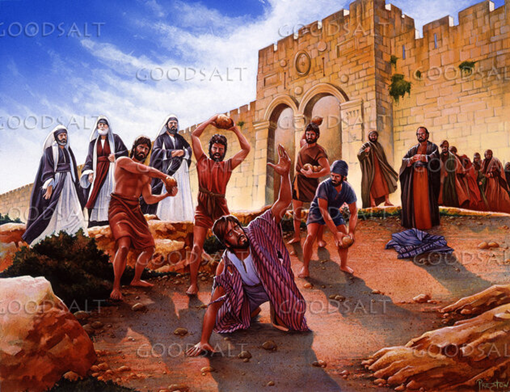
57 Then they mobbed him, putting their hands over their ears, and drowning out his voice with their shouts, 58 and dragged him out of the city to stone him. The official witnesses—the executioners—took off their coats and laid them at the feet of a young man named Paul.
59 And as the murderous stones came hurtling at him, Stephen prayed, “Lord Jesus, receive my spirit.” 60 And he fell to his knees, shouting, “Lord, don’t charge them with this sin!” and with that, he died.
As Stephen is finishing, he receives a vision of Jesus standing at the right hand of God. As soon as Stephen describes that vision, the mob attacks, with the religious leaders stopping their ears while others drag Stephen out of the city to stone him so they won’t desecrate the city. The exact site of the stoning is unknown; however, it took place outside one of the city gates.
This account makes for gruesome reading, and it’s the first time that Saul of Tarsus is mentioned. Saul doesn’t throw any stones; however, he watches the cloaks of those doing the stoning. Perhaps Saul is trying to distance himself from the violence, feeling himself superior. It really doesn’t matter, for Saul is witnessing a true account of Jesus as Messiah at the right hand of God. That vision is going to haunt Saul.
Sometimes we feel that having enjoyed a mountaintop experience, we are entitled to lives of ease and peace. Spoiler alert: there is no such thing as entitlement in the Kingdom of God, apart from the fact that all of us are sinners and therefore entitled to eternal damnation. Only because of the shed blood of Jesus Christ do we receive forgiveness of sins and eternal life. Mountaintop experiences are given so that we will have the strength and courage to go on when we descend into the valleys. It’s easy to forget the lessons of the mountaintop once we are struggling with myriads of problems. How can we maintain focus?
We must remember that if God has called us, then God will guide us and God will protect us until we have completed His work. Hudson Taylor, founder of the China Inland Mission, was fond of saying that “Man is immortal until his work is done.” But we must keep looking to God, not looking inside ourselves. God is the One who calls and who empowers, so God is the One who must direct. May we keep our eyes on God at all times!
PRAYER: Father God, thank You for loving us and caring for us. Lord, help us to trust You at all times, even when things become scary and difficult. In the mighty and precious Name of King Jesus. Amen.


Leave a comment