He (Paul) stayed with the believers in Damascus for a few days 20 and went at once to the synagogue to tell everyone there the Good News about Jesus—that he is indeed the Son of God!
21 All who heard him were amazed. “Isn’t this the same man who persecuted Jesus’ followers so bitterly in Jerusalem?” they asked. “And we understand that he came here to arrest them all and take them in chains to the chief priests.”
22 Paul became more and more fervent in his preaching, and the Damascus Jews couldn’t withstand his proofs that Jesus was indeed the Christ.
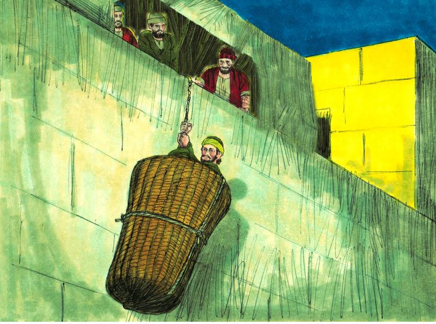
23 After a while the Jewish leaders determined to kill him. 24 But Paul was told about their plans, that they were watching the gates of the city day and night prepared to murder him. 25 So during the night some of his converts let him down in a basket through an opening in the city wall!
Never let it be said that Paul is a shrinking violet! No sooner has Paul regained his vision than he immediately goes to the synagogues in Damascus, testifying about Jesus and presenting irrefutable arguments that Jesus is the Messiah and that he has already lived, died, and has been resurrected. This is NOT the message the Jews in Damascus have been anticipating. What’s worse, many Jews are now believing in Jesus because of Paul’s compelling testimonies. Jewish religious leaders are incensed; if this guy isn’t going to help them, then he needs to be eliminated. Getting wind of these threats, some of Paul’s new converts load him into a large basket and let him down from a window on the city wall at night. Paul was anticipating a triumphal entry into Damascus, but now he’s blindly entered the city with others leading him and leaving ignominiously as a fugitive. Paul’s entry into new life as a Christian has become a trial by fire.
26 Upon arrival in Jerusalem he tried to meet with the believers, but they were all afraid of him. They thought he was faking! 27 Then Barnabas brought him to the apostles and told them how Paul had seen the Lord on the way to Damascus, what the Lord had said to him, and all about his powerful preaching in the name of Jesus. 28 Then they accepted him, and after that he was constantly with the believers 29 and preached boldly in the name of the Lord. But then some Greek-speaking Jews with whom he had argued plotted to murder him. 30 However, when the other believers heard about his danger, they took him to Caesarea and then sent him to his home in Tarsus.
Once Paul reaches Jerusalem, the apostles have no idea what to do with this new colleague. There’s no doubt that Paul is brilliant, able to dissect the most challenging points of Scripture. In later generations, discussions similar to Paul’s will be referred to as apologetics. But Paul’s confrontational tactics infuriate Jewish intellectuals, particularly some Greeks who find Paul quoting Greek philosophers to support the position of Jesus as Messiah. Are these Greeks the same group that caused problems for Stephen? Possible. Remember, as Greek believers, these people must struggle for recognition by the Hebrews. Reporting Paul to the Sanhedrin might gain these people more recognition within Judaism. Concerned about Paul’s safety as well as their own, the fledgling church in Jerusalem sends Paul to Herod’s magnificent port of Caesarea, where he takes a ship back to his home city of Tarsus.
31 Meanwhile, the church had peace throughout Judea, Galilee and Samaria, and grew in strength and numbers. The believers learned how to walk in the fear of the Lord and in the comfort of the Holy Spirit.
Once more, we read simple verses that bear in-depth consideration. Frankly, the early church is not yet prepared to defend itself from all the problems a fiery evangelist like Paul can cause. The church needs peace and time to grow in strength and numbers and to learn how to walk in the fear of the Lord and the comfort of the Holy Spirit. Church leaders must work out requirements for spiritual leadership, communication, and emergency preparedness. Paul also needs time to develop his life of faith.
During the Last Supper, Jesus warns his disciples that they will be persecuted. John 15:19 The world would love you if you belonged to it; but you don’t—for I chose you to come out of the world, and so it hates you. 20 Do you remember what I told you? ‘A slave isn’t greater than his master!’ So since they persecuted me, naturally they will persecute you. And if they had listened to me, they would listen to you! 21 The people of the world will persecute you because you belong to me, for they don’t know God who sent me.
Jesus knows that he will endure suffering and eventual death. But for Jesus’ followers, they need time to develop prayer lives, to learn how to relate to the Holy Spirit, and to walk in the fear of the Lord. These people require time to develop lives of faith so that when persecution come, they would be able to endure and triumph. But what about Paul? How did his faith develop?
https://www.gotquestions.org/Paul-in-Arabia.html
Paul was in Arabia (including Damascus and the surrounding desert) for at least three years immediately after his conversion. Some speculate that Paul spent this time in relative seclusion, perhaps living as a desert hermit and sorting out the implications of his new faith. However, the biblical record emphasizes that he immediately began preaching in the synagogues. Acts 9:22 does not present the picture of a man who is just “figuring it out”: “Saul grew more and more powerful and baffled the Jews living in Damascus by proving that Jesus is the Messiah.” When he left Damascus, with its significant Jewish population, it is reasonable to assume that he did the very thing that Jesus had called him to do—preach the gospel to the Gentiles. This does not eliminate the possibility that he spent solitary time in study of the Scriptures, prayer, and contemplation as he probably did throughout his life. Even in prison near the end of his death, he asks Timothy to bring “my scrolls, especially the parchments” (2 Timothy 4:13). However, the point in Galatians 1 is that Paul already had a vigorous apostolic ministry before meeting with the apostles in Jerusalem, and from Acts 9 this ministry started immediately. For three years he spread the gospel in Damascus and in the surrounding countryside (see the helpful discussion in The Epistle to the Galatians: The New International Greek Text Commentary by F. F. Bruce, Eerdmans, 1982, p. 97).
Although Acts seems to imply that Paul went straight from Damascus to Jerusalem, it’s more likely that he spent three years in what is now Syria, praying and learning about Jesus. Only after this period, did Paul go to Jerusalem.
What can we learn from Paul’s three years in “Arabia” and the experiences of the early Christians? Developing a vibrant faith takes time; spiritual maturity is not something achieved in an instant. How can we develop our faith? I return to the prayer of our late friend, who always prayed, “Lord, help me to love You more each day than I did the day before.” When we trust God to lead us into His Truth and we study His Word, we can trust that God will do exactly that.
PRAYER: Father God, thank You for loving us and caring for us. Lord, help us to learn how to walk in the fear of the Lord and in the comfort of the Holy Spirit. Help us to love You more each day than we did the day before. In the mighty and precious Name of King Jesus. Amen.


Leave a comment