Acts 12: The Death of Herod
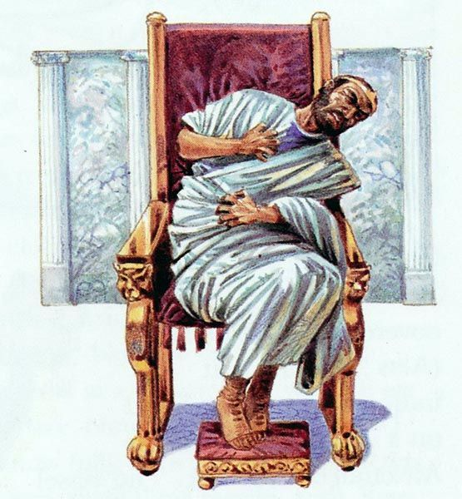
20 Now Herod was in a furious dispute d with the people of Tyre and Sidon, and they convened before him. Having secured the support of Blastus, the king’s chamberlain, they asked for peace, because their region depended on the king’s country for food. 21 On the appointed day, Herod donned his royal robes, sat on his throne, and addressed the people. 22 And they began to shout, “This is the voice of a god, not a man!”
23 Immediately, because Herod did not give glory to God, an angel of the Lord struck him down, and he was eaten by worms and died.
Herod Agrippa I, the grandson of Herod the Great, has been cutting quite a political swath, persecuting Christians and having James slaughtered. After Peter disappears from prison, Herod is so incensed that he huffs off to Caesarea, that magnificent artificial port city on the coast built by his grandfather. But there’s a problem.
Somehow, the people of Tyre and Sidon have gotten crosswise of Herod Agrippa. While Tyre and Sidon are major trading ports, they need the grain produced by Herod’s country, so they can’t afford to be at odds with him. Fearing economic disaster and impending starvation, the citizens of these two cities engage Blastus, the king’s chamberlain, to speak for them. Impressed by his own grandeur, Herod dresses in magnificent robes and haughtily receives the emissaries. When Herod begins his oration, the people cry out, “the voice of a god and not of a man!” As Herod is preening himself, feeling that this is the pinnacle of his royal career, he is suddenly convulsed by severe abdominal pains. Blastus, recognizing the emergency, summons other aids who help support Herod as he tries to make a triumphal exit. But back at the palace, Herod is in deep trouble.
The Jewish/Roman historian Josephus describes Herod’s last days. “He put on a garment made wholly of silver, and of a contexture truly wonderful, and came into the theatre early in the morning; at which time the silver of his garment, being illuminated by the fresh reflection of the sun’s rays upon it, shone out after a surprising manner, and was so resplendent as to spread a horror over those that looked intently upon him; and presently his flatterers cried out, one from one place, and another from another (though not for his good), that he was a god…A severe pain also arose in his belly, and began in a most violent manner… when he had been quite worn out by the pain in his belly for five days, he departed this life.” (Antiquities, XIX.8.2)
As a physician, I have long found this description fascinating. Did Herod suffer an attack of Crohn’s disease or ulcerative colitis, with intestinal spasm and bowel perforations resulting in fistulas carving their ways through the abdominal wall? Did he suffer a typhoid perforation or appendicitis? The possibilities are endless, but the result is that after only five days, Herod dies. The citizens of Tyre and Sidon are probably quite relieved, for surely Herod’s successor won’t be as horrible as Herod. The next Herod is Herod Agrippa II, the King Herod whom Paul tried to convert.
Herod Agrippa I was a horrible man; however, he didn’t have to suffer such an ignominious death. Herod’s problem was that he believed his own publicity. Surrounded by sycophants, bootlickers whose flattery knew no bounds, Herod Agrippa I worshiped only himself. It has been said that “A man wrapped up in himself makes a very small bundle.” Herod was totally and completely self-enamored, and paid for it with his life.
Acts 12:24 But the word of God continued to spread and multiply.
25 When Barnabas and Saul had fulfilled their mission to Jerusalem, they returned, bringing with them John, also called Mark.
Herod dies, and it’s likely that all those around him breathe a sigh of relief. Few things are more difficult than dealing with a ruler whose ego is boundless. Notice something: Herod has James slaughtered. The church goes on. Herod dies, and the word of God continues to spread and multiply. Many times, we are so caught up in current disasters that we forget that the Kingdom of God continues to grow and flourish. Who knows how many people might have witnessed Herod’s demise and taken a warning?
The temptation to found personality cults exists everywhere, and perhaps is nowhere more evident than in the church. Here in Ghana, it’s common for church signs to bear glamorous photos of the pastor and his wife, the unstated implication being that if you attend that church, you too will be wealthy and wear gorgeous clothing. Many church members lavish adulation on pastors that should only go to God. The temptation is also very evident in medicine. There is an apocryphal story that God is in a hospital cafeteria when he begins cutting ahead of everyone else in line. A bystander observes, “Oh, he thinks he’s a doctor.” Sadly, the malpractice crisis in medicine began when too many doctors thought of themselves as God. May God help all of us so that we remember that we are only in advertising and God is in management, and that God will not tolerate any competitors.
PRAYER: Father God, thank You for loving us and caring for us. Lord, help us to worship You and serve You, knowing that You are the One True Living God and that nobody can take Your place. In the mighty and precious Name of King Jesus. Amen.


Leave a Reply