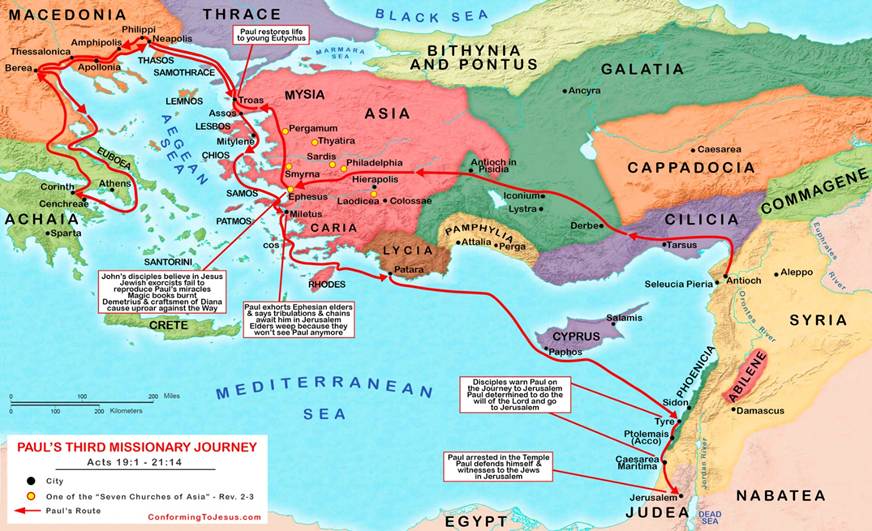
Acts 21 Paul’s Journey to Jerusalem
Acts 21:1 After saying farewell to the Ephesian elders, we sailed straight to the island of Cos. The next day we reached Rhodes and then went to Patara. 2 There we boarded a ship sailing for Phoenicia. 3 We sighted the island of Cyprus, passed it on our left, and landed at the harbor of Tyre, in Syria, where the ship was to unload its cargo.
4 We went ashore, found the local believers, and stayed with them a week. These believers prophesied through the Holy Spirit that Paul should not go on to Jerusalem. 5 When we returned to the ship at the end of the week, the entire congregation, including women and children, left the city and came down to the shore with us. There we knelt, prayed, 6 and said our farewells. Then we went aboard, and they returned home.
As you are studying this map, remember that Paul last stopped at Miletus, where he bad farewell to the Ephesian elders. Paul and his companions board a ship at Patara bound for the port of Tyre, where they continue their journey on land. While in Tyre, many local Christians prophesy, warning Paul not to go on to Jerusalem. Paul has heard several similar prophecies before; however, he will not be deterred. The journey continues down the coast to Caesaria, where four young women, plus another prophet named Agabus also prophesy, warning Paul.
7 The next stop after leaving Tyre was Ptolemais, where we greeted the brothers and sisters and stayed for one day. 8 The next day we went on to Caesarea and stayed at the home of Philip the Evangelist, one of the seven men who had been chosen to distribute food. 9 He had four unmarried daughters who had the gift of prophecy.
10 Several days later a man named Agabus, who also had the gift of prophecy, arrived from Judea. 11 He came over, took Paul’s belt, and bound his own feet and hands with it. Then he said, “The Holy Spirit declares, ‘So shall the owner of this belt be bound by the Jewish leaders in Jerusalem and turned over to the Gentiles.’” 12 When we heard this, we and the local believers all begged Paul not to go on to Jerusalem.
13 But he said, “Why all this weeping? You are breaking my heart! I am ready not only to be jailed at Jerusalem but even to die for the sake of the Lord Jesus.” 14 When it was clear that we couldn’t persuade him, we gave up and said, “The Lord’s will be done.”
Never claim that Paul is a wimp! Despite legitimate prophecies from a number of sources, Paul is absolutely determined to make it to Jerusalem by the Feast of Pentecost. Why is Paul not heeding these prophecies and steering clear of Jerusalem? There are so many other places that would gladly welcome Paul and his ministry. Does Paul have some kind of weird death wish or is he a masochist?

Paul has neither a death wish nor a wish to suffer unnecessarily; however, he feels God wants him to go to Jerusalem, despite the obvious possibility that he will be taken prisoner. In an earlier age, dare devils would load themselves into padded barrels and have friends dump them into the Niagara River just above Niagara Falls. These acts gave rise to the expression “going over Niagara Falls in a barrel.” This phrase refers to a daring act of bravery or recklessness. This act symbolizes a challenge against nature’s power and has become a metaphor for taking extreme risks or facing daunting challenges head-on. The phrase is often used to describe someone undertaking a risky venture, emphasizing the unpredictability and potential danger involved. It reflects a broader theme of human ambition to conquer nature’s formidable obstacles. As Paul turns his face toward Jerusalem, many of his friends must feel that he has taken leave of his senses. If the ancient Christians had known about Niagara Falls, they would certainly have employed that phrase.
Does God ever call people to do reckless or risky things? Absolutely. On January 8, 1956, five American missionaries were martyred by the Auca tribe in Ecuador. These missionaries—Nate Saint, Jim Elliot, Ed McCully, Roger Youderian, and Pete Fleming—were attempting to make peaceful contact with the Waodani (formerly known as Auca), an isolated and violent indigenous group. Their mission aimed to share the Christian gospel with a tribe that had never heard of Jesus Christ. The deaths of these missionaries sparked significant interest and funding for missionary work in the United States, leading to increased evangelization efforts worldwide. Their story has been memorialized in various forms, including the film “End of the Spear,” which highlights their sacrifices and the subsequent outreach to the Waodani. Eventually, the entire tribe became Christians.
Our first missionary assignment was to help open a mission hospital in a Ghanaian village. We were told that a local businessman had built a building he wanted to use for a mission hospital. Nearly a year before we were to leave for Ghana, we met an experienced missionary surgeon and another short-term missionary, both of whom individually warned us that there were lots of problems and that the situation was far more complicated than we had been informed. After speaking with the missionary surgeon, I was in turmoil all night, for I was certain the man was correct and that we were heading into a situation akin to going over Niagara Falls in a barrel. Finally, I fell asleep. The next morning while praying, I received assurance of two things: first, the situation was even worse than we had been led to believe. I knew then that eventually, the mission would blame us for any failures. But God also showed me something else, that while we were going over Niagara Falls in a barrel, God would be in the barrel with us.
Eventually, everything I had anticipated came true. Our mission group blamed us for problems over which we had no control. But God got us to Ghana and allowed us to become semi-fluent in one of the most widely-spoken tribal languages and learn a great deal about the country and the culture. In addition, we made a number of contacts that resulted in our return to Ghana two years later. Had we not endured that first mission term, we could never have accomplished the things we have nor could we have endured the things we have endured.
At some point, you might find yourself feeling as if you are about to go over Niagara Falls in a barrel. The big question is this: Is God in the barrel with you? If God is accompanying you, go ahead. It won’t be easy and you will suffer, but you will endure and God’s purposes will be fulfilled. But if after prayer, you feel that you are only trying to be stubborn, BACK OFF! This isn’t God’s will for you and if you persist, it will be disastrous and you might endanger others unnecessarily.
PRAYER: Father God, thank You for loving us and caring for us. Lord, please help us to wait on You so that we discern Your Will and not our own. We praise You that if You lead us into danger, You will be there with us. In the might and precious Name of King Jesus. Amen.


Leave a Reply