Acts 21:26-40 Paul Is Arrested
26 So Paul went to the Temple the next day with the other men. They had already started the purification ritual, so he publicly announced the date when their vows would end and sacrifices would be offered for each of them.
So far, so good. Paul has gone to the Temple and publicly announces the date on which the vows of the other men will end and that appropriate sacrifices will be made. However, things are about to become nasty, for some of Paul’s Jewish enemies from the province of Asia are about to cause problems. Remember that these Jews from out of town always feel impelled to prove the fervency of their religious practices to the religious authorities, for the religious hierarchy in Jerusalem views those from outlying regions as slightly substandard in comparison to those in Jerusalem. When these men see Paul, they rub their hands in glee, for they are certain that Paul has committed some kind of heresy.
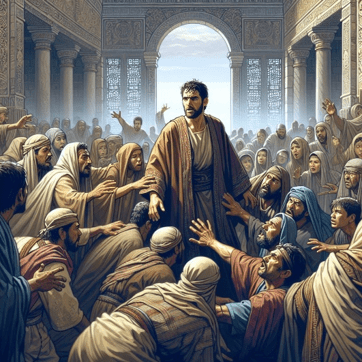
27 The seven days were almost ended when some Jews from the province of Asia saw Paul in the Temple and roused a mob against him. They grabbed him, 28 yelling, “Men of Israel, help us! This is the man who preaches against our people everywhere and tells everybody to disobey the Jewish laws. He speaks against the Temple—and even defiles this holy place by bringing in Gentiles.” 29 (For earlier that day they had seen him in the city with Trophimus, a Gentile from Ephesus, and they assumed Paul had taken him into the Temple.)
Talk about jumping to conclusions! These Jews from Asia are taking a leap akin to jumping across the entire Grand Canyon. Now these men accuse Paul of bringing a Gentile in to the temple. In fact, there is an outer portion of the Temple, the Court of the Gentiles, where Gentile worshipers are allowed; it is only when Gentiles enter the inner court of the temple that they are transgressing. As a Gentile worshiper, Trophimus has the right to enter the court of the Gentiles; however, these men have seen Paul and Trophimus on the street and have assumed that Paul has brought Trophimus into the inner court of the temple, something Paul would never do. In fact, Trophimus has never entered the Temple at all, but that doesn’t matter to these Asian Jews bent on demonstrating their religious fervor and dedication.
30 The whole city was rocked by these accusations, and a great riot followed. Paul was grabbed and dragged out of the Temple, and immediately the gates were closed behind him. 31 As they were trying to kill him, word reached the commander of the Roman regiment that all Jerusalem was in an uproar. 32 He immediately called out his soldiers and officers and ran down among the crowd. When the mob saw the commander and the troops coming, they stopped beating Paul.
33 Then the commander arrested him and ordered him bound with two chains. He asked the crowd who he was and what he had done. 34 Some shouted one thing and some another. Since he couldn’t find out the truth in all the uproar and confusion, he ordered that Paul be taken to the fortress. 35 As Paul reached the stairs, the mob grew so violent the soldiers had to lift him to their shoulders to protect him. 36 And the crowd followed behind, shouting, “Kill him, kill him!”
Remember how worried the mayor of Ephesus was when Demetrius stirred up a mob that rioted? Now these Jews have done the same thing, dragging Paul out of the Temple as a waiting crowd shouts threats. The Roman commander gets wind of the riot and immediately dispatches soldiers to quell the uproar. But the mob comprised largely of hangers-on at the market continues to scream for Paul’s blood. After all, why not? This is the most interesting thing to happen today, and many of these rioters are expert at melting away down side streets at the first real sign of trouble from the Romans. Even if the Asian Jews have not paid anyone so far, some of these loiterers hope that eventually, they will receive something for their trouble. After all, everybody knows those Asian Jews are rolling in money.
Paul Speaks to the Crowd
37 As Paul was about to be taken inside, he said to the commander, “May I have a word with you?”
“Do you know Greek?” the commander asked, surprised. 38 “Aren’t you the Egyptian who led a rebellion some time ago and took 4,000 members of the Assassins out into the desert?”
39 “No,” Paul replied, “I am a Jew and a citizen of Tarsus in Cilicia, which is an important city. Please, let me talk to these people.” 40 The commander agreed, so Paul stood on the stairs and motioned to the people to be quiet. Soon a deep silence enveloped the crowd, and he addressed them in their own language, Aramaic.
While the Roman commander assumes that he has simply arrested a known trouble maker, he is shocked when Paul speaks to him in Greek. It’s likely that Paul could have addressed him just as readily in Latin or in Hebrew as well as Aramaic. As an educated Jew from Tarsus in Cilicia and a seasoned traveler, Paul needs to have several languages at his fingertips. Citizens of small countries or distant provinces must be able to communicate in several languages or be ignored. God has prepared Paul for this moment by allowing him to be born in an outpost of the Roman Empire so that he is a Roman citizen; in addition, Paul’s residency in Tarsus has resulted in his becoming fluent in several languages so that he will be respected when he travels.
Were Paul to have been raised in Jerusalem, he would have learned Hebrew and Aramaic, but he might not ever have studied Latin or Greek. In Athens, Paul has already demonstrated his fluency in the Greek language and now Paul addresses the commander in Greek, assuming that the commander is an educated man who will appreciate the use of this language as a subtle compliment.
Padre Pio, a Catholic saint, is quoted as having said, “With God, there are no coincidences.” As we study Paul’s life, his travels, and his struggles, we realize that God has hand-crafted Paul for the pivotal moments of his life. Little did Paul know, when he was a young man struggling to learn to read and speak Greek, that one day that knowledge would save him from a howling mob in Jerusalem. God’s imagination is unbounded, and His ways are manifold.
Both my husband and I grew up shortly after World War II. Our families were not desperately poor; however, money wasn’t plentiful. I grew up in an old farm house without indoor plumbing; we didn’t have an indoor toilet and bath until I was thirteen years old. I pumped many buckets of water to keep our household running. We only had hot water if we heated it on the stove. “Horrible!” you say. Not really. We coped just as generations had before us. God was preparing me to move to a remote Ghanaian village where there would be neither electricity nor running water and where resources would be severely limited. I learned the benefits of using a gas stove over an electric one, and I participated in 4-H, sewing many of my own garments. When you have coped with problems as a child, you can continue to do so as an adult, and you know such problems might be distasteful but are not harmful or life-threatening. My work on the farm also prepared me for a time when I would be the only doctor at a facility, rounding on patients on a daily basis.
Perhaps you have endured experiences you feel have been trying or shameful. Take heart! God will not allow you to waste those experiences. You will find that God can redeem every difficult thing that has ever happened to you. Trust God and carry on, for He will not waste any part of your story.
PRAYER: Father God, thank You for loving us and caring for us. Lord, help us to trust that You can use every experience, good or bad, that we have ever had and that You will redeem our suffering. In the mighty and precious Name of King Jesus. Amen.


Leave a Reply