The Plan to Kill Paul
12 The next morning a group of Jews got together and bound themselves with an oath not to eat or drink until they had killed Paul. 13 There were more than forty of them in the conspiracy. 14 They went to the leading priests and elders and told them, “We have bound ourselves with an oath to eat nothing until we have killed Paul. 15 So you and the high council should ask the commander to bring Paul back to the council again. Pretend you want to examine his case more fully. We will kill him on the way.”
16 But Paul’s nephew—his sister’s son—heard of their plan and went to the fortress and told Paul. 17 Paul called for one of the Roman officers and said, “Take this young man to the commander. He has something important to tell him.”
18 So the officer did, explaining, “Paul, the prisoner, called me over and asked me to bring this young man to you because he has something to tell you.”
19 The commander took his hand, led him aside, and asked, “What is it you want to tell me?”
20 Paul’s nephew told him, “Some Jews are going to ask you to bring Paul before the high council tomorrow, pretending they want to get some more information. 21 But don’t do it! There are more than forty men hiding along the way ready to ambush him. They have vowed not to eat or drink anything until they have killed him. They are ready now, just waiting for your consent.”
22 “Don’t let anyone know you told me this,” the commander warned the young man.
Well! The high priest and his henchmen are thrilled. More than forty Jewish men come to the religious authorities to tell them that they have sworn an oath neither to eat nor drink until they have slaughtered Paul. All the religious leaders must do is to request Paul be returned to the high council in the morning. These men will take care of Paul, even if they are captured or killed by the Roman soldiers in the process. These men are willing to jeopardize their lives to earn religious credit. But there are few secrets in Jerusalem and news of this plot reaches Paul’s nephew. Remember that Paul is an upper-class Pharisee, so his nephew likely has major social status as well. Who informs Paul’s nephew of the plot? Perhaps someone who has been healed by Peter or Paul. Now Paul’s nephew informs the Roman commander.
For the Roman commander, having a controversial high-value prisoner such as Paul is a terrible responsibility. Paul has already identified himself as a native-born Roman citizen, so the commander has no choice but to protect him. But why keep Paul in Jerusalem? Why not transfer Paul somewhere else where someone else will be responsible for his safety?
Paul Is Sent to Caesarea
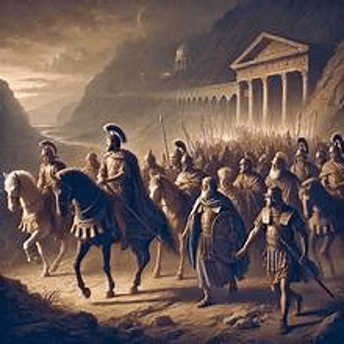
23 Then the commander called two of his officers and ordered, “Get 200 soldiers ready to leave for Caesarea at nine o’clock tonight. Also take 200 spearmen and 70 mounted troops. 24 Provide horses for Paul to ride, and get him safely to Governor Felix.” 25 Then he wrote this letter to the governor:
26 “From Claudius Lysias, to his Excellency, Governor Felix: Greetings!
27 “This man was seized by some Jews, and they were about to kill him when I arrived with the troops. When I learned that he was a Roman citizen, I removed him to safety. 28 Then I took him to their high council to try to learn the basis of the accusations against him. 29 I soon discovered the charge was something regarding their religious law—certainly nothing worthy of imprisonment or death. 30 But when I was informed of a plot to kill him, I immediately sent him on to you. I have told his accusers to bring their charges before you.”
31 So that night, as ordered, the soldiers took Paul as far as Antipatris. 32 They returned to the fortress the next morning, while the mounted troops took him on to Caesarea. 33 When they arrived in Caesarea, they presented Paul and the letter to Governor Felix. 34 He read it and then asked Paul what province he was from. “Cilicia,” Paul answered.
35 “I will hear your case myself when your accusers arrive,” the governor told him. Then the governor ordered him kept in the prison at Herod’s headquarters.
The Roman commander in Jerusalem at the time of Paul was Claudius Lysias. He served as the military tribune in charge of the Roman garrison during Paul’s arrest around 56 C.E. Lysias played a crucial role in rescuing Paul from a mob and later sent him to Caesarea for further protection.
Paul has been transferred to Caesarea, a largely Roman city where there are even more soldiers than in Jerusalem. Now Claudius Lysias is relieved, for Paul is now a problem for Governor Felix. Paul is relieved, for he knows Jesus wants him to reach Rome and dying at the hands of a mob in Jerusalem won’t cut it. The Roman soldiers returning to Jerusalem are relieved because for the time being, they might rest until the next ridiculous Hebrew religious conflict. “Mother Roma! But these people are troublesome!” thinks one soldier as he slogs back to Jerusalem. “How much longer must I be stationed here?”
As we leave Paul, he is in prison in Caesarea. But Caesarea is a major seaport, and Paul knows he must take a ship to reach Rome. Now Paul prays to Jesus and Jesus reassures Paul that Paul now has another and larger audience for the Gospel. Paul rests as he begs Jesus to give him the words appropriate for this new audience.
The famous Kenny Rogers country song tells us “You got to know when to hold ’em know when to fold ’em, know when to walk away, and know when to run.” Paul is no coward, but he does have a strong sense of purpose and knows when it’s time to retreat. As I am writing these words, fellow health workers in DRC are suiting up several times a day to care for Ebola patients. Ebola is a frightening disease, for it can even be spread through contact with the perspiration of a febrile patient. In 2014 one Catholic father lifted a lady suffering with Ebola out of a taxi in front of a hospital. That man eventually paid with his life for his compassion. My fellow health workers remain at their posts, despite watching some of their colleagues die because they firmly believe God has called them to be there. May God help us to know when it’s time to retreat and when we must remain as soldiers of His love.
PRAYER: Father God, thank You for loving us and caring for us. Lord, help us to know when to hold the line and when to retreat. We particularly pray for all those battling Ebola and other communicable diseases. Protect them, strengthen them, encourage them, and uphold them. In the mighty and precious Name of King Jesus. Amen.


Leave a Reply