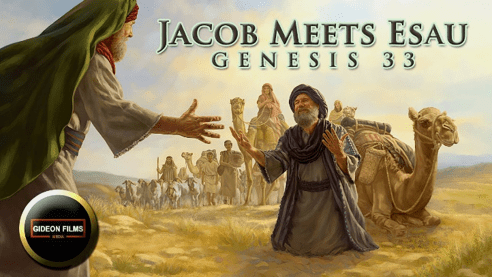
Genesis 33:1Then Jacob looked up and saw Esau coming with his 400 men. So he divided the children among Leah, Rachel, and his two servant wives. 2 He put the servant wives and their children at the front, Leah and her children next, and Rachel and Joseph last. 3 Then Jacob went on ahead. As he approached his brother, he bowed to the ground seven times before him. 4 Then Esau ran to meet him and embraced him, threw his arms around his neck, and kissed him. And they both wept.
5 Then Esau looked at the women and children and asked, “Who are these people with you?”
“These are the children God has graciously given to me, your servant,” Jacob replied. 6 Then the servant wives came forward with their children and bowed before him. 7 Next came Leah with her children, and they bowed before him. Finally, Joseph and Rachel came forward and bowed before him.
8 “And what were all the flocks and herds I met as I came?” Esau asked.
Jacob replied, “They are a gift, my lord, to ensure your friendship.”
9 “My brother, I have plenty,” Esau answered. “Keep what you have for yourself.”
10 But Jacob insisted, “No, if I have found favor with you, please accept this gift from me. And what a relief to see your friendly smile. It is like seeing the face of God! 11 Please take this gift I have brought you, for God has been very gracious to me. I have more than enough.” And because Jacob insisted, Esau finally accepted the gift.
12 “Well,” Esau said, “let’s be going. I will lead the way.”
13 But Jacob replied, “You can see, my lord, that some of the children are very young, and the flocks and herds have their young, too. If they are driven too hard, even for one day, all the animals could die. 14 Please, my lord, go ahead of your servant. We will follow slowly, at a pace that is comfortable for the livestock and the children. I will meet you at Seir.”
15 “All right,” Esau said, “but at least let me assign some of my men to guide and protect you.”
Jacob responded, “That’s not necessary. It’s enough that you’ve received me warmly, my lord!”
16 So Esau turned around and started back to Seir that same day. 17 Jacob, on the other hand, traveled on to Succoth. There he built himself a house and made shelters for his livestock. That is why the place was named Succoth (which means “shelters”).
18 Later, having traveled all the way from Paddan-aram, Jacob arrived safely at the town of Shechem, in the land of Canaan. There he set up camp outside the town. 19 Jacob bought the plot of land where he camped from the family of Hamor, the father of Shechem, for 100 pieces of silver. 20 And there he built an altar and named it El-Elohe-Israel.
It began at birth when Esau came first but Jacob came out grasping Esau’s heel. From the womb, Esau was covered with hair, hence the name “Esau,” or “Hairy.” Esau was a rough, tough outdoors guy who liked nothing better than hunting and exploring the wilderness. The twins’ father Isaac loved Esau, for Esau brought savory game and regaled his father with tales of his exploits. Perhaps Esau was the kind of man Isaac wished he could have been. Jacob, on the other hand, was quieter, more thoughtful, and craftier, remaining at home, learning to cook, and spending large amounts of time with his mother. Esau was the elder of the twins and could comfortably expect to inherit the portion reserved for the oldest son in any family. Esau might well have flaunted his entitlement, for he never did anything quietly.
The pattern was established early and it led to bitter conflict. While Esau could control himself when hunting, once he returned home, he felt entitled to the best the household could offer. After all, hadn’t he just supplied his beloved father with fresh meat? Surely that should earn him the right to relax, while his useless younger sibling waited on him. And so, Esau gave up his birthright, trading it for the delicious stew Jacob was cooking as Esau returned from the hunt.
Rebekah, the twins’ mother, watched all these events as mothers always do. Perhaps Esau made the mistake of disrespecting his mother, as he strutted around the camp, implying that she was weak and insignificant. That disdain would prove Esau’s undoing for when Isaac was preparing to bless Esau, Rebekah helped Jacob deceive Isaac so Jacob got blessed instead. Words spoken under such circumstances could never be taken back, and so Jacob now had both Esau’s birthright and his blessing. Fearing Esau would slaughter Jacob, Rebekah encouraged Isaac to send Jacob back to her people to find a wife.
In Genesis 33, Jacob has returned after decades of working for a cruel father-in-law craftier than Jacob ever thought of being. Terrified that Esau will slaughter the family, Jacob sends flocks and herds ahead of him as a gift and then introduces his family in bowing, kneeling groups. But God has been doing a work in Esau’s heart during these years apart. The two brothers actually make peace and agreeing on a plan.
Esau winds up accepting a very generous gift from Jacob. Genesis 32:13 Jacob stayed where he was for the night. Then he selected these gifts from his possessions to present to his brother, Esau: 14 200 female goats, 20 male goats, 200 ewes, 20 rams, 15 30 female camels with their young, 40 cows, 10 bulls, 20 female donkeys, and 10 male donkeys. 16 He divided these animals into herds and assigned each to different servants. Then he told his servants, “Go ahead of me with the animals, but keep some distance between the herds.”
17 He gave these instructions to the men leading the first group: “When my brother, Esau, meets you, he will ask, ‘Whose servants are you? Where are you going? Who owns these animals?’ 18 You must reply, ‘They belong to your servant Jacob, but they are a gift for his master Esau. Look, he is coming right behind us.’”
Although Esau initially tries to refuse the gift, he eventually accepts it. One wonders if this livestock represents what Esau might have received had he gotten the birthright and the blessing that went to Jacob instead of to him.
Why has Jacob taken these actions? Between the time Jacob plans his gift to Esau and the time the two twins meet, Jacob has an encounter with the Angel of God in which he wrestles with the Angel, and eventually gains a blessing. Jacob is not simply acting out of his own generosity but is also operating under the power of the Holy Spirit.
This story should encourage all of us. Most of us have various amounts of familial dysfunction, and many of us have tried to resolve these problems with varying degrees of success. The story of Jacob and Esau proves that God can give peace to families, even under the worst of circumstances. May God help us so that we will turn our family problems over to Him!
PRAYER: Father God, thank You for loving us and caring for us. Lord, we turn our family problems over to You. Help us to trust You to solve them. In the mighty and precious Name of King Jesus. Amen.


Leave a Reply