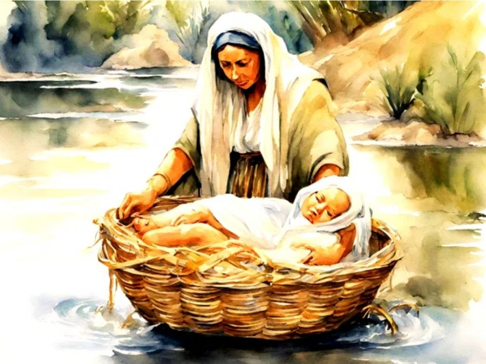
Exodus 2:2 About this time, a man and woman from the tribe of Levi got married. 2 The woman became pregnant and gave birth to a son. She saw that he was a special baby and kept him hidden for three months. 3 But when she could no longer hide him, she got a basket made of papyrus reeds and waterproofed it with tar and pitch. She put the baby in the basket and laid it among the reeds along the bank of the Nile River. 4 The baby’s sister then stood at a distance, watching to see what would happen to him.
When we are thinking about Moses, we always consider the baby floating in the River Nile, but what about Jochebed, Moses’ mother? This is one gutsy lady! Here is a m with a three-month-old baby, a strong lusty boy whose cries are likely to attract unwanted attention from Egyptian authorities. To save this son, Jochebed is so desperate that she makes a basket with papyrus reed, waterproofs it, and places Moses in the basket among the reeds of the river close to the place where Pharaoh’s daughter routinely comes to bathe. Jochebed is taking terrible chances, for the Nile teams with crocodiles that patrol along the edge of the river, seeking any kind of prey. For these fearsome creatures, a baby would simply be an appetizer. And what if an evil person discovers the baby? Jochebed places Moses in the basket and then leaves, charging her daughter Miriam with keeping watch.
What about the faith of Jochebed? While many Hebrews have likely adapted Egyptian styles of worship with amulets and charms, there must be some families who continue to worship the God of Abraham, Isaac, and Jacob. Jochebed and her husband are from the tribe of Levi, the tribe that will eventually become identified with the priesthood, and this is no accident. God is already positioning members of this tribe for their eventual duties as worship leaders in Israel. It is because Jochebed is reverent that she is willing to trust her little son to the River Nile, believing that God will care for him.
5 Soon Pharaoh’s daughter came down to bathe in the river, and her attendants walked along the riverbank. When the princess saw the basket among the reeds, she sent her maid to get it for her. 6 When the princess opened it, she saw the baby. The little boy was crying, and she felt sorry for him. “This must be one of the Hebrew children,” she said.
7 Then the baby’s sister approached the princess. “Should I go and find one of the Hebrew women to nurse the baby for you?” she asked.
8 “Yes, do!” the princess replied. So the girl went and called the baby’s mother.
9 “Take this baby and nurse him for me,” the princess told the baby’s mother. “I will pay you for your help.” So the woman took her baby home and nursed him.
There are few times when Miriam is mentioned in Exodus. The discovery of Moses in the basket is the first time, then Miriam helps lead worship after Pharaoh’s army is wiped out at the Red Sea. Miriam’s final appearance is a sad one; Aaron and she rebel against Moses and Miriam suddenly develops leprosy all over her body. Miriam must repent and Moses must intercede for her before she is healed. But in the beginning, it is Miriam’s quick thinking that causes Pharoah’s daughter to choose Moses’ own mother as a wet nurse. And even better yet, Jochebed gets paid for caring for her own baby. God really has a sense of humor.
10 Later, when the boy was older, his mother brought him back to Pharaoh’s daughter, who adopted him as her own son. The princess named him Moses, [Moses sounds like a Hebrew term that means “to lift out.”] for she explained, “I lifted him out of the water.” God arranges for Moses to be taken into the palace and given a royal upbringing along with a top-notch education. Why does God want Moses to experience life at the palace? Only if Moses understands the culture of Pharoah and his minions can Moses later be fully effective as a representative of the Hebrews. And it’s also likely that Moses learns court Egyptian, the language used when speaking to Pharaoh and other high authorities.
An internet search reveals the following: During the time of Moses, there was a specialized form of the Egyptian language used in the court. This form was known as Late Egyptian, which was the spoken and written language of the time, particularly in administrative and literary contexts. Moses, raised in the Egyptian court, would have been exposed to this language, making him fluent in it alongside his native Archaic Hebrew…Moses’s education in the Egyptian court would have included mastery of this language, enabling him to communicate effectively in a highly literate and bureaucratic environment
God knows that Moses will need to be fluent in Late Egyptian to gain the respect of Pharaoh and his court. Most officials in Moses’ day were multilingual due to the melting pot nature of Egypt. Moses would have become multilingual; however, a fluent command of Late Egyptian would certainly have been a major asset.
In this story, Jochebed trusts God to care for her infant and God gives him back to her, along with payment as his nurse. Later God arranges for Moses to enjoy a superb education and to become multilingual. The situation that originally appeared to spell disaster has now resulted in untold blessings.
God does not play favorites. The same God who protected Moses and who reassured Jochebed can also care for our children and give us peace about them. We can go to God, confident that He will do for us what He has done for so many others.
PRAYER: Father God, thank You for loving us and caring for us. Lord, we beg You to look after our children as You did for the infant Moses. Protect, guide, undertake, and keep them. In the mighty and precious Name of King Jesus. Amen.


Leave a Reply